

So what might an actual strategic asset allocation look like? This depends entirely on who you ask at any given time, but it’s good to have a general idea. Below are three examples for risk profiles Conservative, Balanced and Growth:
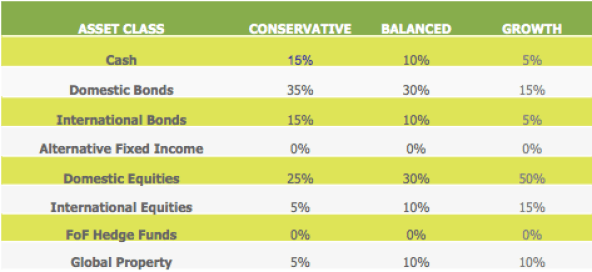
Note how a conservative investor has a heavier weighting to cash and bonds, whereas a growth investor has a heavier weighting to equities. These are by no means set in stone and may vary from year to year, but they are not going to vary from month to month – if you are changing the allocation that often then you are behaving tactically. Professional investors do this as a matter of course: Their strategic weighting to domestic bonds may be 15%, but if they are currently negative on bonds for a particular reason, they may adjust this tactically back to 10% for a period. However, when they rebalance at the end of the year they will rebalance back to the original strategic weighting of 15%.
Here’s what a strategic asset allocation may look like with a “tactical overlay” (T) – a temporary adjustment for tactical reasons:
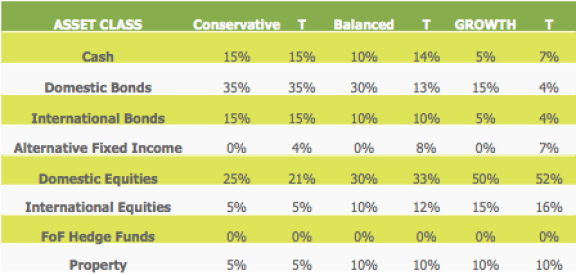
Please note that these are not investment recommendations, they are simply examples to show you what certain asset allocations may look like. If this level of detail is a little overwhelming, don’t worry. We will look at ways to simplify this in future posts.
Discover more from Smart Money Asia
Subscribe to get the latest posts sent to your email.
 Smart Money Asia
One thought on “Strategic Asset Allocations”
Comments are closed.