
Are my investments any good?

opposites-489521_640

How do you know if an investment you have made is doing well or not? How can you tell if it’s worth paying an investment manager rather than just buying an index fund? Is 8% per year a good return?


The simple answer to each of these questions is, it depends what you compare it to. You need to have something meaningful to measure an investment against in order to gauge how it is doing. This is known as benchmarking. Whether you realise it or not, you are probably already familiar with some benchmarks:

  • MSCI Global Index – covers global stocks
  • S&P 500 – covers US stocks
  • FTSE 100 – covers UK stocks
  • Nikkei 225 – covers Japan stocks
  • Citi World Government Bond Index – covers global bonds

So a mutual fund manager running a US Growth Stock fund might be benchmarked to the S&P 500 index. If he is underperforming the index, he is not worth paying fees to. If he is outperforming the index his fund will be popular. If he is getting a wildly different result to the index then he is doing something very strange and likely won’t keep his job for long!

So is 8% a good return? Well it partly depends on what your expectations are. The S&P 500 has returned, on average, 7.1% per year over the last 10 years, so 8% seems like a pretty good return. However, if your goal was to be aggressive and get a 20% return you might still be disappointed. In 2008 the S&P 500 fell by 37%. Even a 1% return that year would be nothing short of exceptional!

So how should the average investor benchmark their investments? I would say the basic minimum benchmark should be inflation in your base currency. Inflation is defined as the rise in the cost of goods and services over time, and is the reason we don’t just lock our money in a safe. Take a look at the table below showing the effect of inflation on $100:
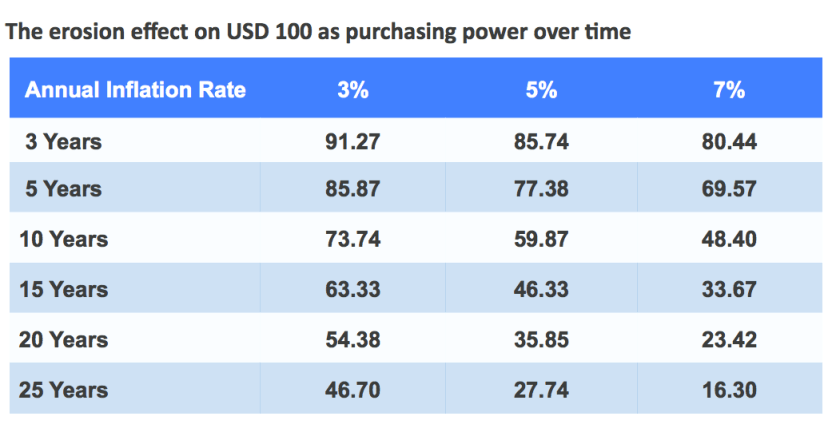
Inflation erosion

We are currently living in a low-inflation environment, particularly if you live in Japan. However, if you look at the historical average, 3% is a good guide. So at 3% inflation, if you put your $100 under the mattress for 20 years you will still have $100, but it will only buy you $54.38 in goods and services. The spending power of your money has almost halved!

One thing I will stress here is that we are talking about inflation in your base currency. If you are living in Japan, but you are planning to retire in Australia, for example, don’t be fooled by the low inflation rate in Japan. Back home the current rate of inflation is 2.1% and rising. Keeping money in your Japanese bank account is not only a currency risk, but you are losing 2.1% per year in spending power!

Investment trade-offs

yin-and-yang-145874_640

There is no such thing as the perfect investment. They all come with advantages and disadvantages, or trade-offs.

One of the simplest explanations of these trade-offs I have heard goes as follows:

Any investment you make needs to balance three factors: low risk, high returns, and liquidity. You can have any two of these but not all three.

If you want high liquidity (easy access to the money) and low risk you are going to have to sacrifice high returns. Your money is going to be in something like a savings account.

If you want high liquidity and high returns you are going to have to take a lot of risk. This could mean an investment in stocks that could go down significantly in the short term.

If you want low risk and high returns, no-one is going to give you that unless they are able to keep your money for a long time. The best performing hedge funds and capital guaranteed products often have lock-ins, preventing investors from withdrawing their money for a fixed period.

Another trade off to consider is capital versus income. Some investments provide capital growth, but little or no income. Income generating investments may have lower prospects for capital growth. Before investing it’s important to understand which is best for you at your current stage in life.

One more trade-off to consider is absolute versus relative return. Absolute return is what an investment returned over a particular period. If a mutual fund returned 10% over the last 12 months is that a good return? Well, it depends on what the rest of the market returned. If the market returned 18%, then 10% is not particularly good. In fact in relative terms it’s a minus 8% return. Active fund managers are benchmarked in this way in order to gauge their performance. We will talk more about benchmarks starting tomorrow.


The Six Asset Classes

athletic-field-1867053_640

Depending on who you ask, you will find that there are varying opinions on the different types of assets out there that you can invest in. In my opinion there are six basic asset classes, plus an extra category we may call “alternatives”.

The main point here is to avoid confusion with investment products. There are thousands of products available, all packaged up with pretty brochures and power point presentations, but the majority of these products are simply investing in one or more of the six basic asset classes.

Let’s start with some simple definitions:

  1. Cash – a means of exchange and a store of value.
  2. Bonds – government or corporate debt.
  3. Equities – stocks and shares representing an ownership interest in a company.
  4. Property – a building or buildings and the land belonging to it or them.
  5. Commodities – raw materials or primary agricultural products that can be bought and sold.
  6. Collectables – items valued and sought after by collectors.

Cash is sometimes confused with currency, but they are not the same thing. If I have ¥10,000 and I step outside my house in Japan and wander into town, I can exchange this for goods and services readily. If I get on an plane and fly to the UK, can I do the same at my destination? The answer, of course, is no. I first need to exchange my Japanese Yen for British Pounds, and this is done at a market determined rate that can fluctuate from minute to minute. The JPY I hold has become a commodity that can be bought and sold.

Bonds are complex instruments, but they have some basic characteristics we can recognise: they have a creditor, who is the bond holder, and a debtor, who is the bond issuer. Bonds have a face value, which represents the amount of principal the bond holder will receive at maturity, and is the amount the issuer pays interest on. They also have a market value, which is what people are willing to pay for them today. They have a maturity date, when that nominal face value amount is typically repaid. They also have a coupon, which is the interest rate the issuer pays to bond holders.

Most people are familiar with the idea of equities or stocks in publicly traded companies. However, it is also possible to own stock in private companies, known as private equity. Private equity is not a separate asset class, however it is less liquid and carries different kinds of risks to investing in listed companies.

For some people property is the simplest asset to understand because it is tangible – you can see it and touch it. Property comes in many different forms: land, buildings, houses, apartments and even collective investments. It’s possible to buy a property fund or Real Estate Investment Trust (REIT) that gives you exposure to the asset class, but with a lower investment amount and potentially higher liquidity. The ability to borrow money to invest in physical property makes it a potentially powerful asset class.

Commodities are exciting due to the high level of price fluctuation, or volatility. This means there are many opportunities to buy low and sell high and make money. It’s also very easy to get it wrong and lose money. Commodities used to be for expert traders only, but these days, with the advent of Exchange Traded Funds (ETFs), it’s simple for anyone to invest in gold, oil or even coffee.

Collectables are about more than just a hobby. An educated investor can make incredible returns  buying and selling artwork, stamps or antiques. However it takes a significant level of knowledge and expertise to make money in collectables and it’s easy for amateurs to get duped. You may want to hang onto that heirloom your grandparents handed down to you though!

As I said, the majority of investment products can be fit neatly into one or a combination of these six categories. However there are “other” investments that may not fit in perfectly. Hedge Funds have long been touted as an asset class all of their own, although I would argue that most hedge funds simply invest in a combination of the above asset classes, albeit it an innovative or original way.

For the average individual investor, concerned with saving and investing for their future, a solid understanding of the six basic asset classes, and the risks and trade-offs associated with them is more than enough to get them started on the path to building wealth.


The Power of Compounding

golf-1938932_640

I’m a keen golfer. How about we bet on a game of golf? Say 10 cents a hole? How about we double that every hole? It wouldn’t be for big money right?

Let’s take a look hole by hole:

  1. $0.10
  2. $0.20
  3. $0.40
  4. $0.80
  5. $1.60
  6. $3.20
  7. $6.40
  8. $12.80
  9. $25.60
  10. $51.20
  11. $102.40
  12. $204.80
  13. $409.60
  14. $819.20
  15. $1,638.40
  16. $3,276.80
  17. $6,553.60
  18. $13,107.20!

Well, as they say…that escalated quickly!


(Credit to Tony Robbins Wealth Mastery for this one)

Retirement Planning – Where to start?

write-593333_640

People save money for many different reasons, but perhaps the most common reason is for retirement. The goal here is to replace income from work with income from investments. It can seem like a daunting task to plan for such a large need, particularly when people these days are far more mobile and may not necessarily know where they will spend their later years.

Here are some simple questions you can start to consider now. Don’t worry if you can’t answer them all yet. Some of them may even have more that one answer:

  • At what age do you anticipate retirement?
  • What country do you plan to make as your base in retirement?
  • Do you want to maintain a similar standard of living in retirement to the one you have now? – simply put do you think you will need the same income, less income, or about the same income as you have now?
  • What value of property would you want in today’s terms?
  • Which assets have you “ear-marked” for retirement planning?
  • Do you think these assets will be adequate?

People tend to underestimate the amount of money they are likely to need to retire securely. Some advisers will say you need a pot of ten times what you earn currently. However, if you are working on current interest rates that is not going to last very long. If you currently earn $100,000 per year, then that’s a million dollar pension pot. Going on historic averages, let’s assume you can earn 5% per year on your capital. That gives you an income of $50,000 per year, or half of what you are earning now. However, the current US base rate is only 1%! A million dollars is only going to earn you $10,000 per year in this environment. The current UK base rate is only 0.25%…

Of course we don’t know where interest rates will be in 20, 30 or 40 years time, but surely it is better to plan conservatively? The number you should really be aiming for is more like 20 times your current income. So a person currently earning $100,000 per year needs $2,000,000. Now two million dollars is a lot of money, but don’t be disheartened. If you start saving and investing early you have the power of compound interest on your side.

If you want to get into more detail on calculating retirement needs, there are a lot of resources available online. Here’s a really simple and easy to use calculator from Vanguard for a start. It’s a US based calculator so it may not be best for everybody. I just like the way you can use the sliders to adjust the variables and see how it affects the end result. If you don’t like it then just google financial calculator and find one that works for you.