


Just under three years ago, I wrote a post titled Bitcoin – It’s About to Get Loud. When I published it on 17 December 2021, Bitcoin had just broken the previous all-time high of $20,000. I knew it wasn’t done yet and the real mania was still to come. This cycle, I’m here a year early to remind you we are going again. It’s time to pump up the volume!
One of the things I love the most about crypto is how few people care about it. It reminds me that this is still a niche asset where asymmetrical returns are possible. If you are a regular person with no interest in crypto, there are only two times when it might appear on your radar: when the price is really high, or when it has crashed. It must seem pretty random, but what if I told you it’s not random at all.

Probably the most important event to understand in Bitcoin is the halving, which occurs approximately every four years. Bitcoin is ‘mined’ by a network of computers performing complex calculations to compete for the next ‘block’. The halving is where the reward for mining a block gets cut in half. This effectively halves the rate at which new Bitcoins are released into circulation.
Already I can feel technically-minded people leaning forward in their seats saying ‘Tell me more’. I can also feel non-technical people’s eyes glazing over as they drift away to a place where nobody ever talks about blockchain technology. I feel you. Luckily, I am just too busy/lazy to launch into a full description of mining, block rewards and hashes. However, if you want to know why the value of Bitcoin will probably go up over the next 1-2 years, you do need to get a basic understanding of this stuff. I like this Bitcoin Halving post on Investopedia because it’s barely a 5-minute read and it’s written by Investopedia and not some laser-eyed Bitcoin evangelist. You should at least read that. Technical people – you can read the Bitcoin Whitepaper.
What is going on these days?
Evangelist’s aside, I follow a lot of crypto traders. I first understood the Bitcoin 4-year cycle from @rektcapital and I still like the charts he posts, such as the one below:
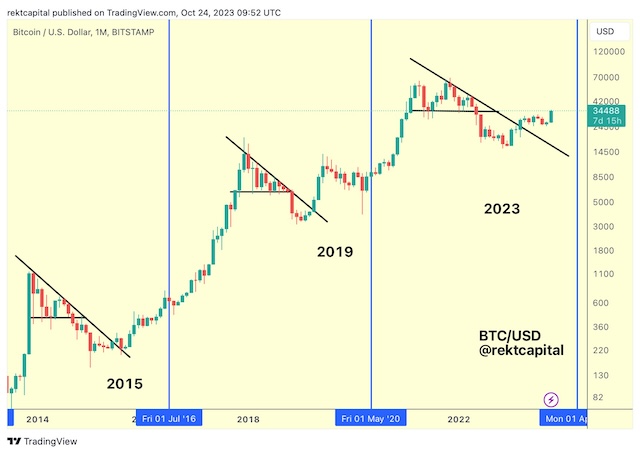
We are currently in year 4 of the cycle, with the halving due in April/May 2024, marking the beginning of the new cycle. You don’t have to be a technical analyst to see that we have broken out of the bear market phase. That doesn’t mean it is up only from here, there will likely be significant retraces before and after the halving. If this cycle at least rhymes with the two that came before, 2024 will still offer nice opportunities to accumulate, and 2025 is when it really gets loud! Remember, the mania phase of previous bull markets came in 2017 and then in 2021. On 11 May 2020, the day of the previous halving, Bitcoin opened at $8,755. At the height of the bull market in November 2021 it peaked at around $68,789. That’s an increase of about 685% in a year and a half. Does that number grab your attention perhaps?
The catalysts for the bear/bull phases of each cycle change over time. The breakout this week was fuelled by one that is long overdue: the prospect for approval of spot Bitcoin ETFs in the United States. Yes, despite many other countries already approving ETFs that hold actual Bitcoin in their portfolio, the Securities and Exchange Commission in America has been dragging its feet on this one. I don’t fully understand the reason for its reluctance but it seems to be political. Elizabeth Warren in particular has it in for crypto and loves to bypass reality in claiming that every bad thing has been funded by this shady new asset class. (and not the US dollar…) The SEC has approved futures-based ETFs that track price changes by buying and selling derivative contracts but has stubbornly rejected all applications for a spot ETF. However, that may be about to change. Grayscale took the SEC to court over its ‘arbitrary and capricious’ rejection of the conversion of the Grayscale Bitcoin Trust to an ETF and won. The D.C. Circuit Court of Appeals closed the book on this case on 23 October and now the SEC has to find another excuse to deny or it has to approve. Also lined up, waiting for approval are names like Blackrock, Invesco and Fidelity. These big players will bring significant demand to an asset with a fixed supply. The funny thing is, the SEC could have approved spot ETFs in the depths of the bear market and no one would have cared. By delaying for this long, the SEC may find itself forced to approve ETFs right as the new bull market begins, unwittingly cranking the volume to 11.
A note on ETFs for Japan residents:
As you may know, the tax treatment of crypto gains in Japan is less than friendly. Gains are reported as miscellaneous income and are taxed at your highest marginal rate, with a maximum of 55% often mentioned in reports. I would note here that your marginal rate depends on how much you earned in the previous year and, depending on your income, you may pay significantly less than 55%. Here is a useful summary of the Japan tax treatment. Another key point is that there is no offset of losses on crypto – ouch!
ETFs, however, are not taxed like crypto, even if they hold it. They are taxed like stocks. That means you pay the flat 20% on gains. Unless you are a Bitcoin purist and want to hold the real thing, a Bitcoin ETF or fund may be the smart play tax-wise, particularly if your plan is to ride the bull market and sell, rather than hold for the longer term. You will need a brokerage account that gives access to overseas ETFs of course.
The macro backdrop
Like it or not, Bitcoin and crypto have become widely traded assets. This makes them susceptible to changes in the macro landscape, just like any other risk asset. It’s no coincidence that the end of the 2021 mania phase of the bull market ended right as inflation picked up and the Federal Reserve and other central banks entered a rate-tightening cycle. As I said, the catalysts may change each cycle, but there is always something behind big moves. So as we approach the end of the Bitcoin 4-year cycle, it’s interesting to note that we are coming to the end of the economic tightening regime. Most likely the US is heading for recession, perhaps early in 2024 – the timing is never easy to call. Risk assets will not fare well. That means stocks, and probably also crypto. If you feel like you should have bought more during the bear market, there will likely be bonus opportunities. Remember March 2020? Right before the halving. Risk assets in freefall. And then the central banks hit the printers. Catalysts…
So what should I do?
I beg you to educate yourself. I wrote a post called Crypto Curious, right in the midst of the 2021 bull market. A lot of it still stands up and there are some good resources in there. Maybe take a look. (Yes I’m well aware that monkey JPEGs went to zero, deservedly so. There will be something else this time around, there always is)
Early-stage bull markets are for dip buyers. If you’re still trying to accumulate, do it on red days. One of the reasons I follow traders is that I don’t really read charts, but these guys will always tell you if we are at support or resistance. You want to bid at support where possible. More on that from Investopedia.
You need to understand the difference between Bitcoin and altcoins. Bitcoin leads the market. If it bleeds, alts bleed more. Altcoins can outperform if you pick the right one, but they come and go. You are taking more risk and if you are new to this you should exercise extreme caution. I own Ethereum and there are a couple of other coins I like – they will crash 95% at the end of the bull market. Only go in with eyes wide open and have a plan for how to hit the exit.
Knowing when to sell is the hardest thing. Everyone fails at this, even skilled traders. The mania phase is intoxicating and it always feels like there is more to come. You have to take profit, you have to do it regularly and avoid getting sucked back in once you’re out. It all sounds easy now but it’s not. The bull market creates more bagholders than millionaires by far.
Follow me on Twitter and I will do my best to guide you through all the noise. Bring a sense of humor!
And so, without further ado…

Disclaimer: This should go without saying, but the information contained in this blog is not investment advice, or an incentive to invest, and should not be considered as such. This is for information only.
 Smart Money Asia