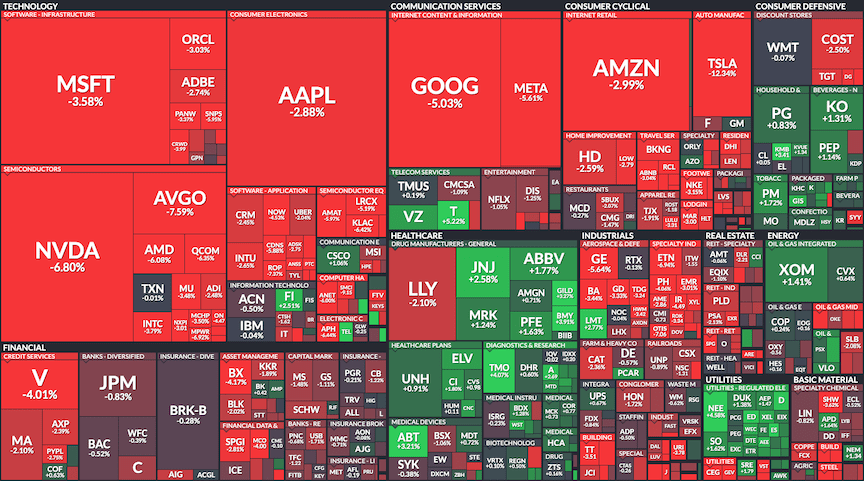
After showing signs of wobbling the last few weeks, US markets slumped on 24 July with big tech shares leading the move down. Tesla Inc (TSLA) fell -12.3% after a Q2 earnings miss while Alphabet Inc (GOOGL) dropped -5% despite beating earnings expectations. That was enough to trigger an avalanche and the NASDAQ ended -3.6% lower and the S&P 500 endured its worst day since 15 December 2022, falling -2.2%.
Correction territory
Japanese shares followed the US market down, with the Nikkei 225 index falling -3.3% today as exporters laboured under a strengthening yen. The benchmark index peaked on 11 July at ¥42,426 and has trended downwards since then. It turns out that I wasn’t imagining things when I asked Are we shaking? at the end of June.
Investors will now be wondering if this is simply a healthy correction after a big run-up or the start of a larger move downwards. It is too early to begin talking about a bear market but we are certainly in correction territory. A correction is defined as a fall of -10% from a recent high and the Nikkei closed today down -10.7% from the 11 July peak.
At 3pm today, USD/JPY was trading at ¥152.7. The current rebound in the yen is being driven by expectations that the Bank of Japan will raise rates at its policy meeting next week. In addition, the US Federal Reserve appears to be moving in the direction of rate cuts starting in September. A sustained sell-off in stocks may well need confirmation of rate cuts in order to stabilise.
Semiconductor stocks fall hard, Lawson delisted
Semiconductor-related stocks are bearing the brunt of the current selloff with Disco Corporation (6146) falling for seven straight days. Disco fell a further -4% today to close at ¥46,850, well off its peak of ¥68,850 set on 11 July.
In other news, convenience store operator Lawson Inc. was delisted from the TSE on 24 July following a successful tender offer from KDDI Corp. KDDI will partner with Lawson’s parent company, Mitsubishi Corp to take the company private.
A stock to watch
Crypto followed the trend in traditional markets with Bitcoin falling to around the $64,200 mark. Ethereum is down around -8% despite the successful launch of the Ethereum ETFs in the US on 23 July.
Meanwhile, Japanese Bitcoin proxy Metaplanet Inc. (3350) has been on a wild ride. The stock has risen more than +1,100% since the company announced its Bitcoin treasury strategy in early April. However, the FOMO really kicked in this week with shares accelerating to ¥300 on 24 July. Metaplanet is back trading around ¥220 today but is still a stock to watch as investors try to front-run the potential decisive break of Bitcoin’s all-time high in the coming months.
It seems likely that traders view Metaplanet as a tax-efficient way to gain exposure to Bitcoin price moves. Crypto in Japan is taxed as miscellaneous income, whereas stocks are taxed as capital gains.
Disclaimer: This should go without saying, but the information contained in this blog is not investment advice, or an incentive to invest, and should not be considered as such. This is for information only.
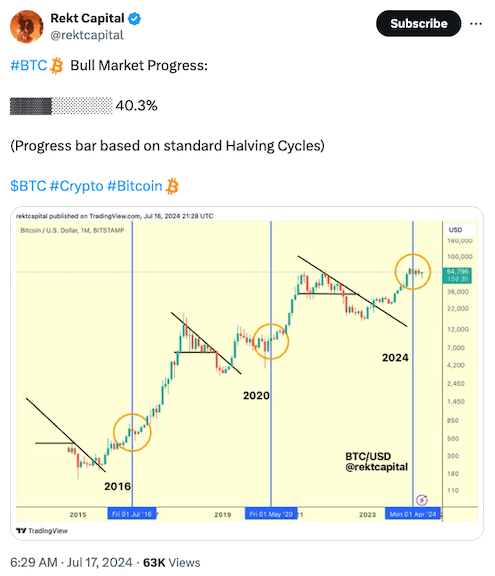
It’s been almost 8 months since my Bitcoin bull market prep post Bitcoin – Pump up the Volume. It feels like it’s time to check in and see how things are going. I don’t know how accurate Rekt Capital’s estimation of progress will turn out to be but it feels about right. When I talk to people about Bitcoin, which I probably do far too much, I’m still stunned to find how little the halving cycle is understood. Nobody is interested in buying in the bear phase, but when the price starts going up and making news, people start asking if they should be getting involved.
For those of us who bought in the bear market, this is supposed to be the fun part. However, the timeline has been strangely depressed. I think a lot of people got sucked into alts and memecoins when they were rallying earlier this year and are stuck there. This is why I tell beginners to focus on Bitcoin. As volatile as it may appear to outsiders, it is actually quite predictable. So, what’s going on at the moment?
ETFs
The spot Bitcoin ETFs that launched in the US in January have been wildly successful. Blackrock’s IBIT took just 137 days to reach $20 billion in assets. The fastest before that took 985 days. The ‘sell the news’ traders did not come out of this well. The five US spot ETFs are at around $56.5 billion in assets. There is nothing complicated here – increased demand for a finite asset is going to have an effect on price and year-to-date the leading crypto asset is up a little over +50%.
What’s more, Blackrock CEO Larry Fink, previously a crypto sceptic, is regularly on TV talking about his belief that Bitcoin is a legitimate financial instrument which has a role in portfolios. Note the repost from Michael Dell:
Larry might be talking his own book, but he has actually grasped another thing that the majority of people are missing: that rather than a get-rich-quick scheme, Bitcoin is actually a defensive asset that can protect against currency debasement and other economic ills.
I’ll say that again: Bitcoin is a defensive asset. Let’s be real here, it’s not going to replace fiat currency as the base layer of the financial system. Governments have far too much invested in the status quo to let it go. And they are going to continue recklessly printing fiat money and inflating their debt. That money is going to go down in value against hard assets over time. Read Harden up your assets for more on that.
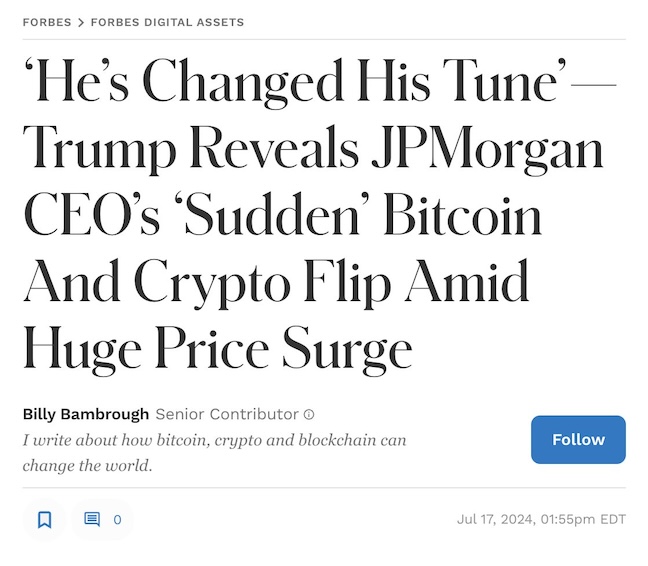
Guess who else seems to have just changed their opinion on Bitcoin?
You think Dimon flipped and doesn’t own any? Dips are for buying in the bull market folks.
Ever the opportunist, Donald Trump has seized on the Democrat’s hostility towards crypto and is speaking at a Bitcoin conference in Nashville later this month. I like the orange coin much more than I like the orange man but a Trump victory in November would likely be a full-bull mania catalyst.
Who are your bets on for Prez these days?
Never mind the parabolics, it’s the banana zone!
Maybe this cycle will be different. Nothing is certain in life. We could be wrong here after all. But if we’re not, the next phase of the bull market is banana-shaped. Raoul Pal is a bit excited:
Ahhhh, liquidity
Summer in Japan officially starts now. It’s going to be a hot one and there will be much call for regular liquid refreshment. And, what comes after summer?
That’s right, rate cuts in the US!
Jerome Powell is now pretty openly signalling that he intends to begin cutting this year, possibly as soon as September. The market believes him too. The biggest investing lesson I learned in the last few years is that liquidity drives markets. Liquidity is coming back and Bitcoin is thirsty. Don’t get me wrong, stocks love liquidity too but Bitcoin slurps it up with the highest intensity of all.
I don’t know if I’m as bullish as Raoul, but I’m not far off.
So, to sum up, we’ve got an asset that has been through three consecutive 4-year bull/bear cycles and is potentially 40% of the way through the current bull phase. We’ve got a bullet-dodging potential US President speaking at a Bitcoin conference. We have the kings of fiat finance changing their tune. And JPow is about to cut rates.
Am I forgetting anything? Oh, yeah. Ethereum ETFs look set to go live next week!
Disclaimer: This should go without saying, but the information contained in this blog is not investment advice, or an incentive to invest, and should not be considered as such. This is for information only.
It’s pretty incredible that the US Federal Reserve has gone through a 27-month hiking cycle and US stock markets are at all-time highs. Unless you’ve been living under a rock during this time, you are probably aware that the main growth driver has been the intense hype surrounding artificial intelligence (AI) and more specifically, generative AI.
What is AI?
The Encyclopedia Britannica defines AI as ‘the ability of a digital computer or a computer-controlled robot to perform tasks commonly associated with intelligent beings’. The US company Nvidia says AI is ‘the capability of a computer program or a machine to think and learn and take actions without being explicitly encoded with commands’.
In March 2023, Bill Gates published a blog post titled ‘The Age of AI has begun’. In it, he says: ‘The development of AI is as fundamental as the creation of the microprocessor, the personal computer, the Internet, and the mobile phone. It will change the way people work, learn, travel, get health care, and communicate with each other. Entire industries will reorient around it. Businesses will distinguish themselves by how well they use it.
Technological revolution or a waste of resources?
I read a couple of interesting threads about AI last week. The first one by David Mattin considers the recent UK election as the last ‘pre-AI’ election we will hold. He sees a world entering a period of deep economic transformation that will change how we live and work and accelerate the process of scientific discovery. Rather depressingly, he expects this transformation to split society into two camps: enthusiasts/accelerationists, who want to lean into this new technology and sceptics/decelerationists, who want to resist the incursion of technology into daily life. This split is not hard to imagine when you look at how divided the Western world has been on almost every issue of late.
The second thread, by Ed Zitron, summarises a recent Goldman Sachs report on generative AI, which brutally dismisses Chat-GPT and its ilk as unreliable and power-hungry. The report concludes that generative AI is unprofitable, unsustainable and fundamentally limited. Moreover, the huge surge in AI-related stocks is a bubble that will soon burst. Original report here.
I don’t think my opinion on the first part is worth much, but I am not really interested in taking sides. There are clearly opportunities for massive positive change and there are also equally glaring risks. In a perfect world, these would be balanced sensibly but that world doesn’t exist. Things are about to get interesting…
As far as generative AI goes, time will tell. I think the most common complaint people have is that they don’t want gen-AI to write stories, produce art and know everything. They want it to do all the boring jobs that we humans don’t want to do and free us up to be more creative.
Investing in AI
From an investment standpoint, I don’t think AI can be ignored. It seems imprudent to dismiss the whole field as a bubble. However, if some parts of the industry are in a bubble, the key question is how long can the bubble continue inflating? As George Soros has pointed out, there is a lot of money to be made by rushing into a bubble. The tricky part is getting out before it bursts.
There are relatively few pure-play AI stocks to invest in. However, many great companies are using AI technology and making investments in AI. I have picked up a few below that I think are worth watching. This is neither an exhaustive list nor a recommendation to invest. Just some ideas to get you started so you can do your own research. (performance is quoted up to 15 July 2024)
Nvidia Corp (NVDA) and Super Micro Computer Inc (SMCI)
If I asked you what the best-performing AI-related stock is over the past 12 months, you could be forgiven for answering Nvidia. However, Nvidia has actually been beaten by a company it is partnered with – Super Micro.
The Motley Fool did a nice write-up on these two companies here: Essentially, they aren’t really competitors, they complement each other. NVDA designs graphics processing units (GPUs) which, among other things, are used for AI model training. SMCI designs servers and it takes Nvidia’s GPUs and other components to make them and sell them to its clients. These are what some people refer to as ‘pick and shovel’ investments in AI.
Of all the big-name tech companies, Microsoft is perhaps the most bullish on AI. The company is accelerating its own AI commitments and has invested some $13 billion in OpenAI in a partnership that dates back to 2019. Microsoft has integrated all of its generative AI assistants into a single AI product named Microsoft Copilot. Copilot offers both free and paid versions and is integrated into a wide range of Microsoft applications providing access to Chat GPT-4 and DALL-E 3.
Investors can keep up with Microsoft’s AI developments here.
Shares are up +21.2% in 2024 so far.
Arm Holdings ADR (ARM)and Softbank Group Corp (9984)
Majority owned by Softbank Group, Arm Holdings was listed on the NASDAQ in September 2023 and has quickly established itself as a major force in AI. The company architects, develops and licenses central processing unit (CPU) products and related technology which semiconductor companies and original equipment manufacturers (OEMs) rely on to develop their products. 99% of smartphones run on Arm-based processors and Arm has shipped 287 billion chips to date.
In Q4 of fiscal 2024, Arm reported its highest-ever revenue of $928 million, up 47% year-on-year. Shares are up +216.5% since listing and +136.3% year-to-date.
Softbank Group has had its ups and downs but is recovering in 2024. Led by the charismatic and controversial Masayoshi Son, Softbank Group has aggressively invested in a broad range of fields including robotics, AI, real estate, e-commerce, telecoms and more. It would be fair to say that the company has backed more than its fair share of losers, but Arm is proving to be one of its better bets.
AI stands at the forefront of Softbank Group’s vision and strategy so investors should expect the heavy investment in AI-related companies to continue. CEO Masayoshi Son says: ‘We are heading for an AI revolution, and we will be the investment company for the AI revolution’.
Softbank Group shares are up +81.1 % so far in 2024.
These are just a few ideas to get you started. There are many more companies involved in AI that are worth considering. Both Amazon and Meta are making huge investments in AI. Arista Networks (ANET) AI networking has driven impressive returns over the past five years. In Japan, NEC Corp is developing a range of AI technologies under the banner of ‘NEC the Wise’. And, of course, the huge boom in semiconductors has largely been driven by demand from AI.
The majority of investors will already have a larger allocation to AI-related stocks than they probably realise. Any S&P 500 or NASDAQ tracker will have significant exposure, so it isn’t always necessary to make an effort to dig out the next big name.
As for timing, returns over the last 3 years have been extraordinary. It remains to be seen if this is a bubble that is soon to burst, but sudden deep corrections can occur at any time. If you are a long-term believer in the AI narrative, there is no rush to pile money into the space in one go. Dollar-cost averaging is a solid strategy, and so is adding on significant dips.
Whether you are allocating passively or building a portfolio of AI satellite holdings, things are going to get interesting and maybe just a little weird.
Disclaimer: This should go without saying, but the information contained in this blog is not investment advice, or an incentive to invest, and should not be considered as such. This is for information only.
The all-time highs keep coming. On Monday 9 July, the Nikkei 225 index made its highest ever close at ¥41,580.17. Semiconductor-related stocks led the way, while other notable movers included Hitachi Ltd (6501) and Fujikura Ltd (5803).
Not to be outdone, the S&P 500 and NASDAQ Composite also closed at record highs on 9 July. Gains were heavily weighted to big tech stocks as the AI narrative continues to drive market sentiment. Fed Chair Jerome Powell stuck to the script during his first day of testimony, reiterating that the Fed’s objective is to cool the economy and progress towards the 2% inflation target without cooling it too much. Market consensus continues to favour a soft landing scenario, with one or two rate cuts expected later this year. CPI data is due on Thursday and if that comes in line with expectations, the positive mood should continue.
Meanwhile, Tesla Inc (TSLA) continued its rebound, closing higher for the 10th consecutive day.
Japan’s real wages fall again, BOJ discussing cuts in bond purchases
Despite the good times in the stock market, much of Japan’s economy still looks relatively weak. Real wages fell by 1.4% in May, marking a record 26th month in decline. Wages are actually rising at the fastest pace in 31 years, but the increases are being offset by inflation, meaning households have less purchasing power.
USD/JPY is trading around ¥161.47 with no end to yen weakness in sight.
This week sees the Bank of Japan meeting with major market players to discuss the tapering of the central bank’s bond purchases. Some market participants are calling on the BOJ to cut bond purchases in half while others favour a more gradual reduction. The final plan is expected to be revealed at the BOJ’s end-of-July meeting.
Semiconductor shares remain strong, Hitachi and Fujikura impress
Chip stocks are once more powering ahead with Advantest Corp (6857) and Tokyo Electron Ltd (8035) gaining +4.1% and +3.8% respectively on 9 July. Chip materials maker Resonac Holdings Corp (4004) announced that it will form a consortium with nine other Japanese and US firms to collaborate on the development of semiconductor technologies for generative AI. Resonac shares surged +8.7% on the news.
Hitachi shares jumped +5.2% on reports that the company is increasingly focused on improving shareholder returns. On 2 July, the electronics giant provided an update on the progress of its buyback of up to 21 million shares at a cost of up to ¥200 billion. The company is targeting a total return ratio of around 50%, including dividends and buybacks – that would be on an expected net profit of 600 billion this fiscal year. Hitachi shares are up +89% year-to-date.
Another big mover was Fujikura Ltd, which jumped +11.4% on 9 July. Fujikura is an electrical equipment manufacturer that develops a range of telecommunication system products, including devices for optical fibres. It appears that Fujikura’s surge was spurred by a 12% move by Corning Inc (GLW) on 8 July after the company revised its sales forecast upward. Fujikura gained a little more today and is now up +228% in 2024.
Japanese stocks rose again today with the Nikkei 225 closing at another record high of ¥41,831.99. Financial stocks were up again on hopes that higher interest rates would bring improved profits. Mitsubishi UFJ Financial Group (8306) has gained over +8% in the past month and almost +50% year-to-date.
Bitcoin also bounced back from its current correction somewhat, moving from around $57,000 to $59,000 despite an increase in market supply from Mt Gox and the German government. Bitcoin ETF flows were positive again and traders eagerly await the SEC decision on Ethereum ETFs.
Disclaimer: This should go without saying, but the information contained in this blog is not investment advice, or an incentive to invest, and should not be considered as such. This is for information only.




 Smart Money Asia