Semiconductors, online banks and Shimamura

As another quarter rolls around, it’s that time again. Yes, the main event this week is, of course, the Nvidia Corp (NVDA) earnings report. Once more, expectations are sky-high and, if the chipmaker fails to meet them, the market mood could sour in a hurry. We find out if the AI bull market narrative remains intact on Wednesday night.

Q1 revenue was a whopping $26 billion with guidance of $28 billion for Q2. Wall Street is expecting even more than that with the average analyst estimate coming in around $28.6 billion. Questions have been asked of this company before – can it deliver again?

US tech stocks are trading warily ahead of the report but the Dow Jones Industrial Average managed to put in another record-high close on 26 August.

In Japan, a Nikkei report says that Resonac Holdings Corp (4004) will make a ¥30 billion investment to improve the performance of power semiconductors used in electric vehicles and other devices. This follows the announcement in early July that Resonac will form a consortium with nine other Japanese and US firms to collaborate on the development of semiconductor technologies for generative AI.

Shares in IOT service developer Future Innovation Group Inc. (4392) went limit up today. The jump follows an announcement that FIG’s subsidiary Realize’s transport robot will be deployed in a semiconductor factory run by Rapidus. Rapidus is working on the domestic production of cutting-edge logic semiconductors.

Online banks are picking up customers

The Nikkei also reported today that online banks have doubled their total number of accounts over the last five years. The six major online banks now boast over 40 million accounts as of the end of March 2024, up 13% from the previous fiscal year. The net banks are taking on traditional banks by linking up with point-based ecosystems and smartphone payments and are also providing systems to external companies.

Rakuten Bank Ltd (5838) and SBI Sumishin Net Bank Ltd (7163) gained +5.2% and +5.3% respectively today on the news.

Selling megabank shares to buy net banks could be an interesting trade. However, investors need to keep in mind that rising interest rates and increased competition could slow the growth of the online banks, particularly those that are reliant on low-interest home loans.

Meanwhile, Paypal’s Solana-based stablecoin, PayPal USD (PYUSD) reached a $1 billion market cap just 383 days after its launch, making it the sixth-largest stablecoin.

In other business

If semiconductors and online banks are too flashy for your risk profile, take note that purveyor of high fashion (ok, I jest), Shimamura Co Ltd (8227) reported a 5.5% increase in same-store sales for August compared to the same month last year. This marks 10 consecutive months in which sales have beaten the previous year’s results. Shimamura’s five-year chart isn’t too shabby and it pays a 2.4% dividend. Money in the bank!

Disclaimer: This should go without saying, but the information contained in this blog is not investment advice, or an incentive to invest, and should not be considered as such. This is for information only.

Lock in

I hope you are enjoying Obon and the summer holiday. After a market crash and a Nankai Trough earthquake warning, things feel a little calmer this week. Hopefully, there won’t be any more ‘big events’ in August other than the local matsuri.

However, September is approaching and it feels like that will be the time to get locked in and focused. So here are a few thoughts as we speed into the last four months of the year!

US markets

There is a slew of economic data coming out of America this week, with the Producer Price Index (PPI) coming in a little softer than expected last night. CPI is tonight and another soft print will heighten expectations of a Fed rate cut in September. Toys will be thrown if Chair Powell does not deliver, but I’m also becoming a little more cautious about the outlook for stocks if he does go ahead and cut. History favours a recession scenario at the end of a hiking cycle. A lot of effort has gone into the soft landing narrative, so we should be on our guard. No reason to make adjustments to long-term investments but things rarely go as smoothly as the crowd expects.

That said, the completion of the US election will remove a lot of uncertainty, regardless of who wins.

Yen / Japan stocks

After starting August with a bang, the Bank of Japan has swiftly backed down from any plan to raise rates again this year. They got as far as 0.25% and the stock market melted down. They didn’t even get to the bond market jitters part of the project. I would love to hear from anyone who can explain how the BOJ will go about a meaningful tightening from here. Imagine what rates at 0.5% would look like. How about 1%?

I just saw a Bloomberg headline that said that PM Kishida is stepping down in favour of a leader who is supportive of the central bank’s efforts to normalise policy. Best of luck to whoever picks up that poison chalice!

Let’s just call BS, shall we? You can’t normalise a ponzi.

Nonetheless, if the Fed does begin to cut, the yen should strengthen. I don’t know how far it will get. 130? 120? 100? It doesn’t matter, because once that cycle is over it is only going the other way. You can save the bond market or the currency and no one is sacrificing the bond market.

I have said it before but I’m nothing if not a broken record: if you are going to spend your future money outside of Japan, you should forget about those alluringly cheap Japanese value stocks and get your money out of yen and into your base currency while you have the opportunity.

If you are here for the long haul, by all means, have at it. In the shorter term, Japanese stocks should do ok and I would even be tempted to look for names that will benefit from a stronger yen. Exporters that did well under the weak yen don’t seem such a great idea going forward.

Getting hard

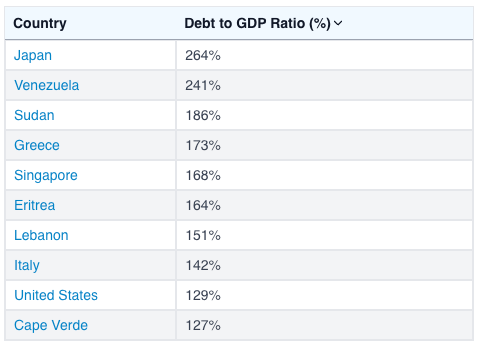
With the US election looming, the cynical among us would be watching out for a liquidity boost to pump up the US stock market. Rather than the Fed, we should probably be looking at the treasury to provide the liquid refreshment. This ‘Bad Gurl Yellen’ piece by Arthur Hayes goes deep into the fountain of liquidity that is about to spring forth. In short, the treasury needs to lower the debt-to-GDP ratio, and it will do so by issuing yet more debt.

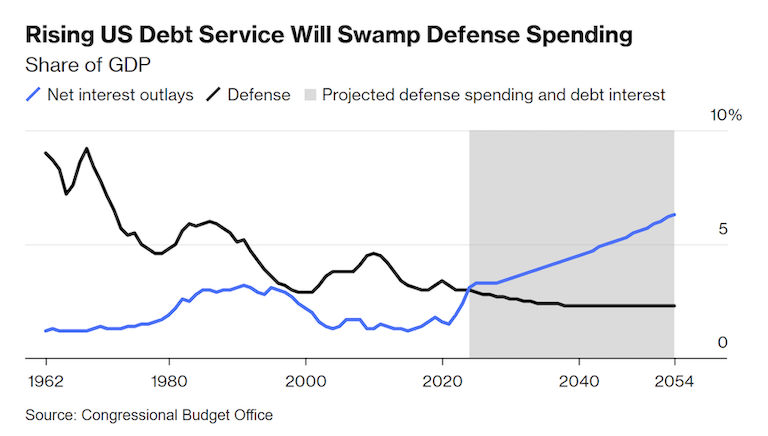
The Congressional Budget Office projects that interest payments on America’s debt will total $892 billion in fiscal 2024 and rise significantly in the next decade.

If you are wondering what that looks like, get a load of this chart:

Tell me you’re gonna print more money without saying you’re gonna print more money…

I wrote about currency debasement and and how to protect yourself in Harden up your assets! If you are looking at stocks to plough your hard-earned money into right now, that’s one way to do it but maybe there is a better option.

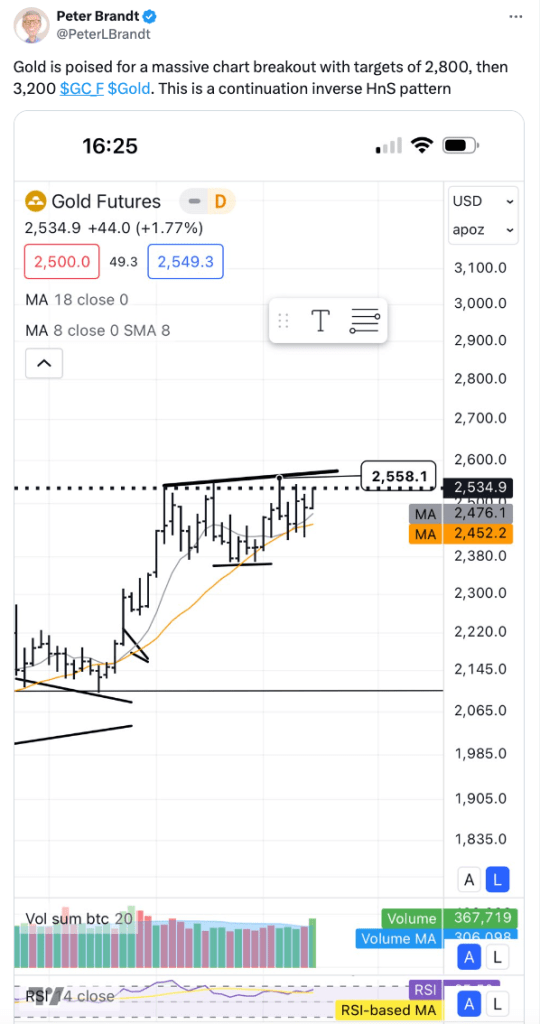
As you can see, some technical traders are getting excited about gold. JP Morgan agrees, arguing that the structural bull market remains intact and forecasting an average price of $2,500 in Q4 and $2,600 in 2025. Geopolitical tensions, rate cut expectations, central bank buying and ETF flows all point to elevated gold prices – report here.

Of course, those are short-term targets and the real point of owning gold is to protect against currency debasement over time. Remember, this is what you’re up against:

Digital gold

Ever the broken record, allow me to point out once more that the boring phase of the Bitcoin bull market is drawing to a close. We probably bounce around for a few more weeks, maybe even a couple of months. The timing is difficult to predict but I expect significantly higher prices by the end of the year. And more to come in 2025. If you are thinking of getting on the train, you don’t have long left…

Despite a reshuffle of the Democratic nominee, pretty much everything I wrote in the Bitcoin bull market update still stands. All aboard!

If you are still trying to get your head around the hardest asset on the planet, the presentations from Michael Saylor’s keynotes are a great resource.

Don’t say I didn’t warn you!

Disclaimer: This should go without saying, but the information contained in this blog is not investment advice, or an incentive to invest, and should not be considered as such. This is for information only.
Hansei-kai

The haters said I couldn’t do it. And they were right. Honestly, great call by the haters.

Stairs up, elevator down.

If you have been diligently investing in stocks these last few years, especially Japanese stocks, you are probably not feeling too great right now. You are probably feeling a little sick in the stomach. And maybe a bit stupid. I’m here to tell you it’s alright to feel bad for a while but don’t beat yourself up too much. Nobody saw a crash like this coming. Hell, the day the BOJ raised rates, the market went up! Don’t listen to the smart-asses who tell you they knew this would happen and traded it perfectly – most of them didn’t even have any skin in the game.

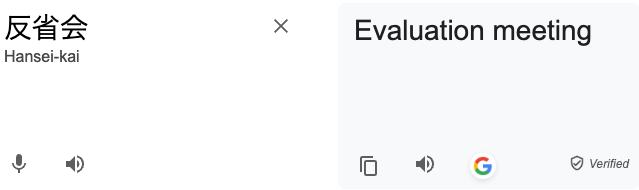
However, if you are going to take a beating in the markets, you better learn something from it. Otherwise, it really was all for nothing. Welcome to the Hansei-kai.

The Google translation is kind of cute. Whenever I hear this word actually used, it’s more like: ‘We screwed up, now we have to examine why and drown our sorrows’. Maybe it’s just the company I keep!

The purpose of this post is not to bore you with another deep-dive analysis of the unwinding of the yen carry trade. You have probably had enough of that already and there are people more qualified to talk about it than me. The idea is to try and learn something from the experience that will be helpful in the future.

There are always signs!

I haven’t lost my shirt in this crash and I hope you haven’t either. However, I was sitting on some rather profitable satellite positions, mostly in Japanese stocks, and I was thinking about selling some of them. I know this because I wrote about it just six weeks ago in Are we shaking?

What’s worse, I had figured out that if anything was going to derail the Japanese equity bull market, it would be the Bank of Japan. I know this because I wrote about it in January: 2024 – Here goes nothing!

The call was coming from inside the house!

Aren’t I the clever one! I had it all figured out and I didn’t sell.

I am a regular viewer of the Nikkei News Next program on BS TV Tokyo. These last few months, I couldn’t shake this nagging impression of hubris as the presenters and guests lauded the performance of the Japanese stock market and talked about the prospects of the BOJ raising rates like it would be just another positive. Don’t get me wrong, it’s a serious news program asking the right questions, but my feeling was that they were a little too caught up in the hype.

And I didn’t sell!

Ok, ok. I said we weren’t going to beat ourselves up. But you get the picture. The signs were there. And of course, they are a hundred times more obvious in hindsight. I’m not even that mad at myself. I never had any intention of touching my core investments and I have dry powder at the ready to allocate once the panic subsides. My point is that if your gut is telling you something, maybe you should listen to it.

Sell euphoria. Sell euphoria. Sell euphoria. I’m not going to get the tattoo but it has been imprinted on my brain.

What happens next?

After the Hansei-kai, it’s time to move forward. It’s still a little early for me to think about how to allocate money. US futures are down bad and it’s probably going to be a long week. I don’t feel the need to dive in immediately and any stocks I buy will be with a minimum 5-year timeframe. I’m a lot better at buying fear than I am at selling euphoria!

So, more on that at a later date. For now, go easy on yourself, learn the lessons and get ready to step up to the next level.

And f**k the BOJ lol!!!

Disclaimer: This should go without saying, but the information contained in this blog is not investment advice, or an incentive to invest, and should not be considered as such. This is for information only.
Buckle up!

It’s the 1st of August. The two big central bank decisions are behind us and summer is in full swing. So what comes next? Where will markets be at the end of this year? Nobody knows the answer to that question but I can almost guarantee you one thing: there is turbulence ahead.

Just like Japanese summer, the volatility already got started in July. However, we seem to have entered a new phase and central banks are the main drivers of the momentum shift.

Having hiked rates to levels unseen in 15 years, there is little doubt that the BOJ has entered a tightening cycle. Governor Ueda did not rule out another hike this year and the yen responded quickly to his comments, rising to 150 against the dollar. Today it is trading at around 149. Weston Nakamura sees 152 as the most important price level in global macro right now and we are already well beyond it.

Japanese stocks reacted positively to yesterday’s decision, pumping across the board. However, the Nikkei 225 index slumped -2.5% today as exporters felt the pinch of a stronger yen.

US tech investors rotate into small caps

In the US, Fed chair Powell left rates unchanged while hinting that he is getting closer to a cut. The market fully expects this to happen in September and there will be visible disappointment in people’s brokerage accounts if it doesn’t. Volatility is already rearing its head. Tech stocks have sold off over the past month amid fears that the AI bubble might be bursting. Nvidia has been trending down from its 6 June high of $140.76 and a -7% dump on 29 July seemed ominous, but last night it pumped +12.7% after AMD’s better-than-expected earnings release. Go figure…

Hats off to strategist Tom Lee for calling the rotation into small caps. IWM has been the main beneficiary of the tech selloff.

The crypto coaster rolls on

Not to be outdone by chipmakers, crypto remains unpredictable over short time frames. At the Bitcoin conference in Nashville last week, none other than Donald Trump showed up to play to the crowd. His list of “promises” included: keeping the Bitcoin the US government has seized as a strategic reserve, (yes, wow!) firing Gary Gensler on day 1, ending the democrat’s war on crypto and making the US a leader in mining.

The air quotes around “promises” don’t need much explanation. Trump has zero interest in crypto and is plainly exploiting the dem’s antagonistic stance toward the industry for votes. But don’t let that distract you from the bigger picture: governments are examining Bitcoin as a strategic hedge against their own money-printing excess. The fact that this conversation is even happening is remarkable. Bitcoin game theory is going to get very interesting in the months and years ahead.

Bitcoin is back in the $64,000 range today, as it appears that the Biden/Harris camp may be selling off the reserve that Trump promised to keep. It’s never boring. See my Bitcoin bull market update for more.

Meanwhile, investors in Japan received a lesson in FOMO from Bitcoin proxy Metaplanet Inc. this week. Shares went on a tear after the company announced its Bitcoin treasury strategy in April and many people piled in late. Now the stock is coming back down to earth with a bang as the excitement wears off. Shares are down over -70% from their 24 July high and the move down doesn’t look done yet. Of course, every man and his dog wanted the stock when it was skyrocketing and nobody is interested now. There’s a clear lesson there. That said, I wouldn’t be surprised if Metaplanet makes another run if/when Bitcoin makes a decisive break above its previous all-time high and enters the parabolic phase of the cycle. Timing is everything in narrative-driven trades.

So, what to do?

I have noticed an uptick in clients trying to position and trade some of these macro moves, particularly the USD/JPY angle. The problem with access to unlimited information, content and opinion is the urge to react to it and do something. So here’s my two cents:

The summer, and perhaps the rest of the year, will see some turbulence. Volatility goes both up and down. Overall, the backdrop keeps me optimistic. Rate cuts in the US are coming – it’s just a question of when. As things currently stand, it would not be a panic cut, which is constructive for risk assets. US stocks, gold and crypto should react accordingly. Regardless of who wins, the US election will remove a lot of uncertainty. If you are broadly diversified, you could do a lot worse than fastening your seatbelt and taking a nap for a while.

If the BOJ is tightening and the Fed is loosening, the yen should continue to strengthen. This is going to put some strain on export-related Japanese stocks and the market as a whole looks more unpredictable than the US. Governor Ueda said he doesn’t think the rate hike will damage the Japanese economy. He’s probably right for now, but let’s see what kind of toll a series of hikes will take. The last time the BOJ tried to hike was 2007/2008 and that move was reversed in a hurry…

If you have been waiting for your chance to escape JPY and get into your base currency, that window is opening. Don’t miss it – long term it does not look good for the yen.

Stay hydrated folks!

Disclaimer: This should go without saying, but the information contained in this blog is not investment advice, or an incentive to invest, and should not be considered as such. This is for information only.