Is Quantum Computing the next megatrend?

Last month, I read a fascinating article about punters in the NFL. What was particularly surprising is how Australians now dominate punting in American football.

I looked up the word ‘punt’ and it has four distinct meanings: a narrow, flat-bottomed boat, to kick a ball upfield, to speculate or gamble and the basic monetary unit of the Republic of Ireland, before the Euro.

You can probably guess which one I’m interested in.

As regular readers will know, I favour a core-satellite approach to asset allocation. The core is a diversified portfolio, mainly denominated in your base currency and matched to your risk profile. Satellite holdings give things an extra spice, or maybe even, an extra kick. If 20% of your investments are in satellites, that 20% may also be broken down into traditional assets, such as commodities, niche stock market sectors – such as biotech, or alternatives. You may even want to take a small portion of the 20% and have a punt on something truly speculative. Imagine if you took a punt on AI a few years back.

The art of the punt is to find a candidate for the next megatrend and allocate a small amount of your wealth to it. If you are wrong, it’s money you can afford to lose. And if you are right, the returns are asymmetrical.

Megatrend: a long-term, large-scale shift that can impact economies, industries, and the way people live. Megatrends can be driven by technological advancements, demographic changes, or global policy shifts. Some examples of megatrends include: the rise of the internet, the ageing population, the shift to renewable energy, rapid urbanization, and technological breakthroughs.

That overview came from Google’s AI, by the way.

Earlier this month, Google caused a stir when it introduced Willow, a state-of-the-art quantum chip. Willow has been in development for 10 years and has reached the stage where it can ‘perform a standard benchmark computation in under five minutes that would take one of today’s fastest supercomputers 10 septillion (that is, 1025) years — a number that vastly exceeds the age of the Universe.’

Does that sound like a megatrend? It sounds like a punt to me! The key thing about technologies like this is that the pace of development is exponential. Nothing happens for years and then massive progress is made in a short period.

A few years back, a friend dragged me to a quantum computing seminar. He was attending to show support to one of the presenters. My friend is a finance pro and I’m a pretty good generalist and I remember clearly how, about a minute and a half into the presentation, we looked at each other like, WTF?????

Needless to say, I will not attempt to explain how QC works. Do your own research, as they say!

Here’s a nice friendly BBC article to get started with.

And, here’s a great thread by Charles Edwards. It helpfully identifies four stocks that punters can buy if they want to get exposure. They are IONQ, RGTI, QUBT and QBTS.

Please note: This is not investment advice. These stocks are a punt! You should not put a large chunk of your net worth into them. Also, they have gone up a lot since the Willow announcement. They will exhibit a ton of volatility and there will probably be better entries in the future. Funnily enough, three of them were down big just last night. I have seen threads detailing how QUBT barely has a business. Three of them might amount to nothing. Maybe all four companies will go bankrupt. However, one of them might develop the ChatGPT of quantum computing.

So, buyer beware. Do as much reading as possible and, if you decide to get involved, only play with money that is truly available for a punt. There is no need to rush into anything and you don’t need to invest a lot to spice up a well-diversified portfolio.

And, unless it’s really your thing, don’t go to any quantum computing seminars!

Top image by benzoix on Freepik

Disclaimer: This should go without saying, but the information contained in this blog is not investment advice, or an incentive to invest, and should not be considered as such. This is for information only.


2024 Final Boss

I don’t mean to think about the Bank of Japan this much.

As we enter December, US markets continue to push to all-time highs and Wells Fargo just got all bulled up and issued a target of $7,007 for the S&P 500 in 2025. Here in Japan, stocks have hardly been in easy mode but are still up around +17% year-to-date. Yesterday, the Nikkei 225 index jumped +1.91% as hopes rose that Japan will be spared the wrath of the incoming US President’s trade controls. These days people seem to love Japan as a destination for investment as much as they do for tourism.

What could go wrong?

The Bank of Japan meets on 18/19 December. For some reason, these dates are marked on my schedule. It must be some kind of PTSD hangover from the July meeting. Remember when they surprised markets with a hike then? I bet you remember the few days that followed. Is Governor Ueda poised to spoil our Santa rally?

Judging by Ueda-san’s recent comments, he aims to avoid any surprises this time around. Earlier this week, he told the Nikkei that rate hikes are ‘nearing’ as economic trends line up with the central bank’s forecasts. The market is interpreting the comments as a signal of a hike with bond yields rising and the yen strengthening against the dollar. In fact, you could say it would be more of a surprise if the BOJ didn’t raise rates this month.

I’m not saying we will see volatility like early August but, once again, Japan’s mainstream financial media seems remarkably calm about the potential impact on markets. With the US in a rate-cutting cycle, tightening in Japan will drive a stronger yen and could lead to another dramatic carry trade unwind. A stronger yen is also not kind to Japanese stocks.

Keep an eye on the Nikkei news for early leaks of the BOJ decision to soften the impact.

What do I care?

Given how quickly markets recovered from the August plunge, it doesn’t seem like there is much to worry about for long-term holdings. However, I once more find myself sitting on some Japanese stocks that have done rather well. And again, I am tempted to take some profits while the going is good. The benefit here is that I could use this money in January to fund my NISA instead of adding more cash. I’m sure I’m not the only one considering this. Imagine how clever we’ll feel if we sell before the meeting, sidestep the crash and buy it all back cheaper in January. (of course, it is never that easy)

Given the possibility of impending central bank shenanigans, the deadline for profit-taking is looming. I’ll give it a few more days and see.

What else is going on?

In other news, Fast Retailing Co. Ltd (9983) shares got a boost as the clothing giant announced a 12.2% rise in domestic same-store sales for November. People must be stocking up on their heat tech!

Donald Trump seems intent on blocking Nippon Steel Corp’s (5401) takeover of U.S. Steel. U.S. Steel released a statement on Tuesday in support of the acquisition. The company is crying for help but foreign takeovers are not a great fit with Trump’s ‘America First’ agenda.

SBI Holdings Inc. (8473) seems to be the beneficiary of the demise of DMM Bitcoin. DMM is giving up the ghost after losing some ¥48.2 billion worth of crypto in a leak back in May. Customer assets will be transferred to SBI VC Trade Co. by around March next year. SBI shares have seen a nice move as a result. One thing about Japanese crypto exchanges – the customers tend to get their money back these days.

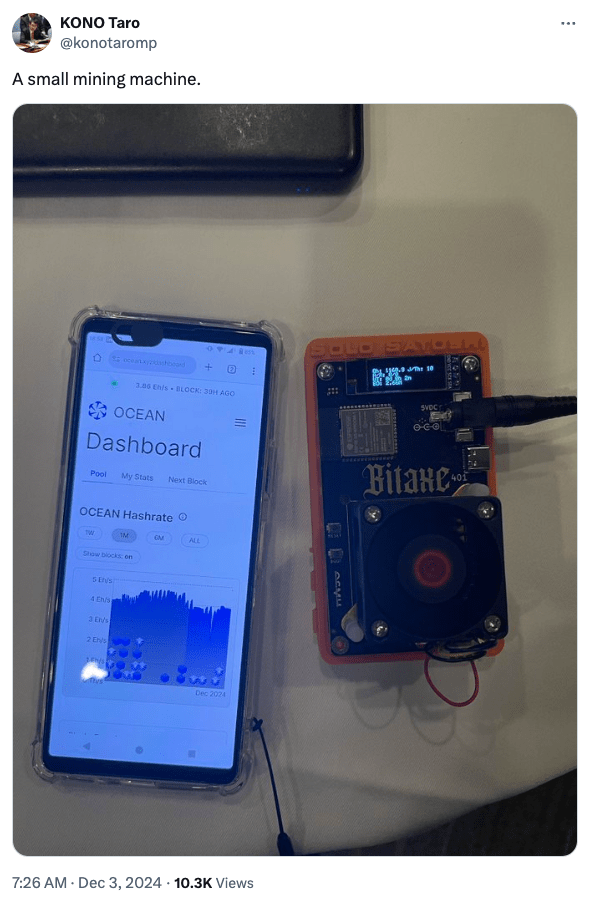
Staying with crypto, I’ve joked before that it’s time to sell when hostesses start trading on their smartphones, so make what you will of this post:

Bull market things…

Finally, Saxo has released its annual Outrageous Predictions list, which is always a fun read. Nvidia surging to double the value of Apple, the end of OPEC and Trump blowing up the dollar feature on this year’s list of unlikely, yet intriguing events.

You never know…

Disclaimer: This should go without saying, but the information contained in this blog is not investment advice, or an incentive to invest, and should not be considered as such. This is for information only.