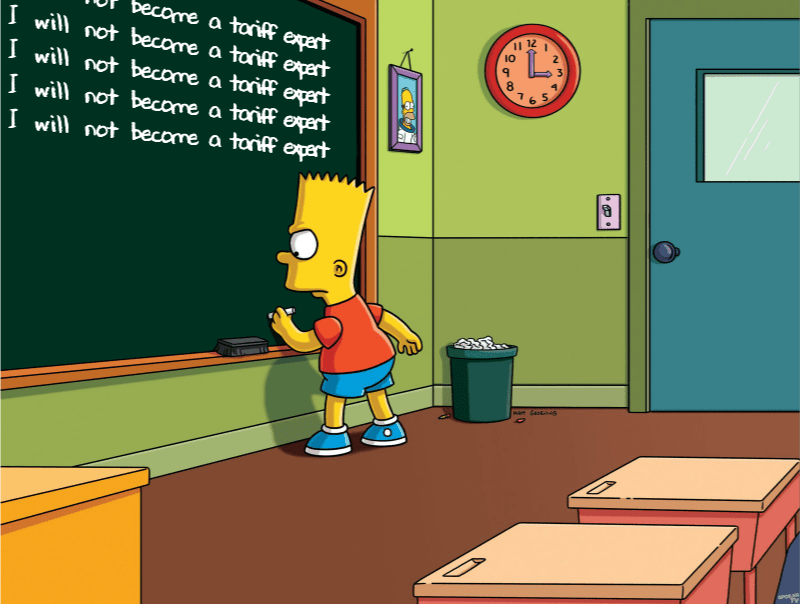

Sell America?

Remember when everyone thought a Trump presidency would be business-friendly?

I admit to belonging to that camp initially. Stocks soared the first time he was elected, when most people expected them to tank. They also ripped between the election and the beginning of his second term, as people bet on a golden age of deregulation. Remember all the tech CEOs at the inauguration?

And then the madness began.

I’m not interested in getting into political commentary, but I will say this: it really couldn’t have been handled much worse. Anyone who has read Chris Voss’s book knows that you don’t start a negotiation with belligerence and threats and expect everyone to come meekly to the table. Anyway, my opinion doesn’t matter. The markets have spoken. So far, Trump 2.0 has been an unmitigated disaster.

Wall Street is openly disussing a “Sell America” trade. The great dealmaker must hate that one. It’s happening, though – look at treasury yields, look at the S&P 500, look at the dollar. And look at gold!
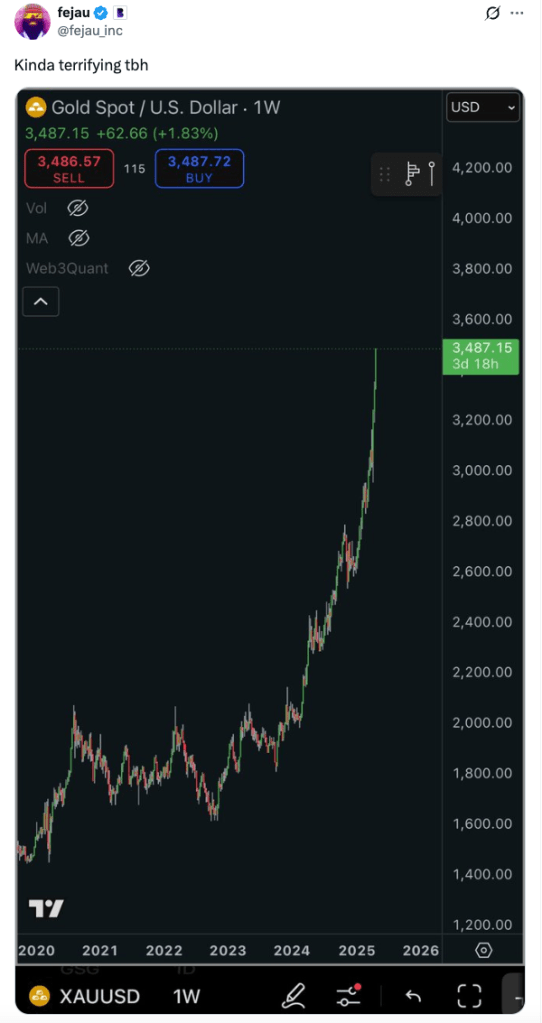
Gold isn’t just a safety trade here. It represents a stampede away from USD-denominated assets. European and emerging market stocks are also seeing inflows, but they come with their own risks as the haphazard tariff ‘negotiations’ blunder ahead.

So what happens now?

Is America really done? Does gold go up forever?

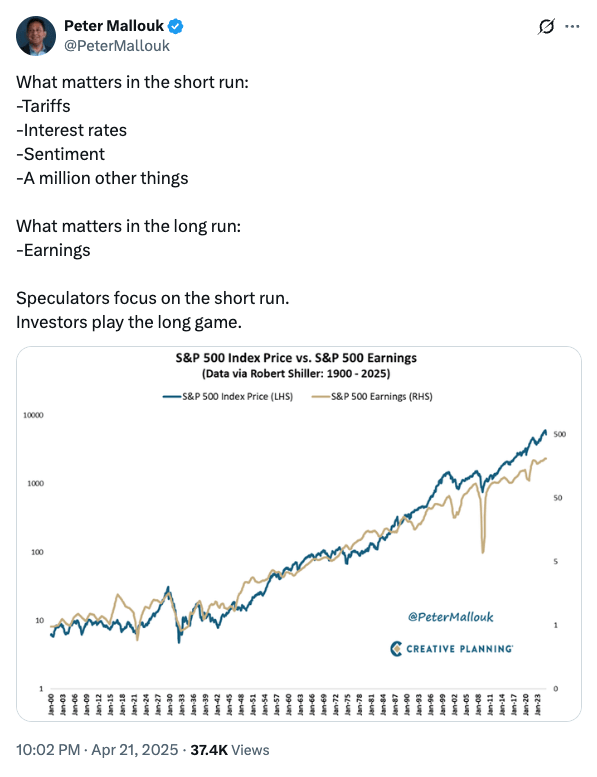
No and no are the short answers. However, the world is clearly changing before our eyes. Here’s an excellent thread summarising Howard Marks’ recent comments on what is happening. Like it or not, globalisation made a lot of things cheaper. As countries become more inward-looking and focus on domestic production, prices will rise. America is still expected to outperform in the long run, but it will need to work harder to attract capital. It is no longer the obvious go-to market, at least while all this chaos is raging.

Can gold still go higher? For sure, but it’s starting to look like Bitcoin does in blow-off top phases. Weekly cycles also suggest it is close to a top. If you’re a long-term diversified investor, continue to hold it. If you’re looking for the next trade, then digital gold is where it’s at.
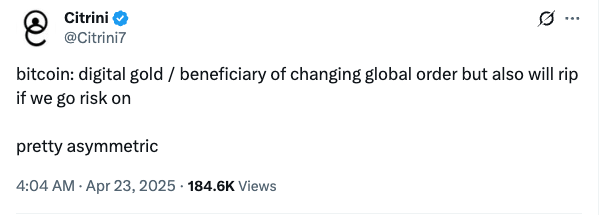

Even the macro guys are starting to agree that Bitcoin looks good right now. This article from @fejau_inc puts it all together nicely and is a must read.

Here’s the conclusion from that piece for easy reference: “And so, for me, a risk-seeking macro trader, Bitcoin feels like the cleanest trade after the trade here. You can’t tariff bitcoin, it doesn’t care about what border it resides in, it provides high beta to a portfolio without the current tail risks associated with US tech, I don’t have to take a view on the European Union getting their shit together, and provides a clean exposure to global liquidity, not just american liquidity.

This market regime is what Bitcoin was built for. Once the degrossing dust settles, it will be the fastest horse out of the gate. Accelerate.”

Meanwhile, the Financial Times reported that Howard Lutnick’s son, Brandon is cooking up a $3 billion Bitcoin acquisition investment vehicle with Cantor Fitzgerald, Softbank Group, Tether and Bitfinex. Reuters summary here.

Is the yen strengthening going to hold?

If you are looking for proof that capital is flowing out of America, it’s right there in the exchange rate, currently around ¥142 to the dollar. It’s quite possible the yen could strengthen further from here, but beware the orange man running his mouth. If Bessent can put the gag on him for a while and they get a few wins on the board in terms of trade deals, then the picture can change very quickly.

Yes, I’m aware that the typical trade deal takes around 18 months to complete. Most likely Trump extracts a few concessions from the major partners, including Japan, and declares some ‘tremendous trade deals’. Then he can move onto pumping the markets back up before the mid-terms.

Long term, I believe the yen is cooked. Nothing has changed there. Short term, we could be at ¥120 just as easily as ¥160 in a month or two. Who knows?

So, sell America or not?

Traders gotta trade, and right now the trade is sell America for anything else you can lay your hands on. For long-term investors, I would view cheaper US asset prices as an opportunity to accumulate. Don’t change your monthly investment allocation too hastily!
Top image by Mediamodifier from Pixabay

Disclaimer: This should go without saying, but the information contained in this blog is not investment advice, or an incentive to invest, and should not be considered as such. This is for information only.

Banking your Bitcoin

This post contains affiliate links.

One of the major obstacles to wider Bitcoin adoption has always been the issue of storing and spending coins. Fortunately, it is getting easier to do both.

I bought my first Bitcoin on Xapo in 2017 and have been storing part of my holdings there ever since. Back then, Xapo served as both a super safe custodian wallet and a trusted platform to buy, sell and store Bitcoin. In the last few years, it has become much more than that. 

There are many ways to manage Bitcoin storage, but here is my strategy:

  1. Do not leave Bitcoin sitting on an exchange
  2. Learn how to self-custody securely
  3. Diversify risk by storing some BTC with a trusted custodian

Bitcoin purists will likely agree wholeheartedly with points 1 and 2 while vociferously objecting to point 3. That’s fine; I get it. However, I live in a wooden house in an earthquake-prone country, and I’m not entirely comfortable having all of my BTC in one place. 

Also, I like to have the option to spend some of my Bitcoin or borrow against it if I want to. That’s not so easy to do with the keys sitting on a hardware device.

Furthermore, I value having a functional USD account. I have plenty of experience with offshore banks, and none have been as easy to use as Xapo Bank.

That’s why I’m still using Xapo Bank today.

Xapo Bank’s history

Xapo was first founded in 2013 and provided a secure cold-storage product using a distributed network of physical bunkers. Yes, you read that correctly! Xapo combined cutting-edge key technology and good old underground physical vaults to protect its clients’ coins. In 2021, Xapo expanded its services, founding Xapo Bank. Headquartered in Gibraltar, the company is licensed as a bank and Virtual Asset Service Provider (VASP) by the Gibraltar Financial Services Commission.

Xapo Bank’s services

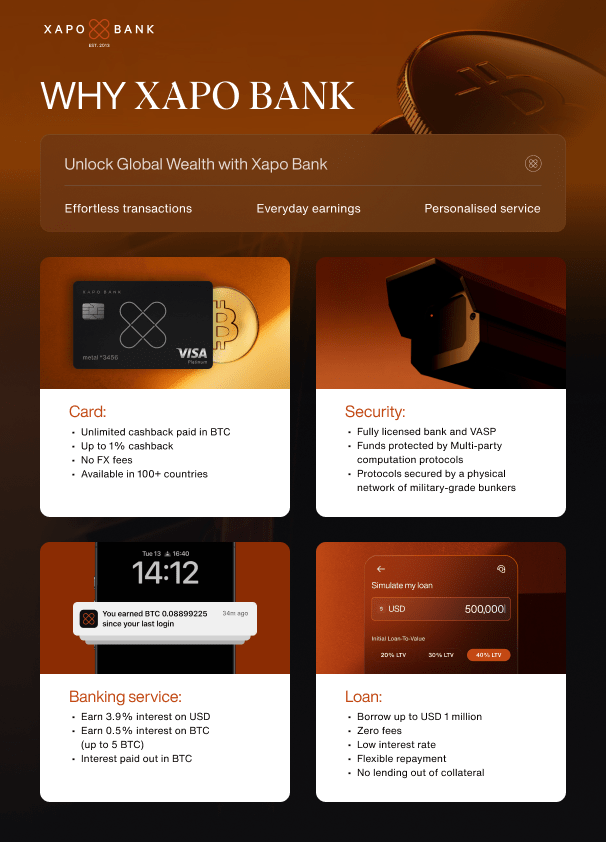
Xapo Bank’s account is entirely app-based and enables Bitcoin customers to hodl, transact, earn, grow and borrow. It also now offers stock and ETF trading.

Users control a main BTC and USD account, which can be used for day-to-day transactions. Then there is the savings account, which pays interest on USD and Bitcoin holdings. And finally, there is the BTC vault for secure cold storage.

The USD savings account currently pays 3.5% annual interest, and the BTC savings account pays 0.5% per year. (rates are subject to change)

Xapo Bank has also just launched a new BTC Credit Fund, offering a simple way for people to grow their Bitcoin by earning up to 4% APY on their holdings.

The Bitcoin trading fees are very competitive, and both Bitcoin and USD can be transferred easily and inexpensively from the app. 

Users can opt for both physical and virtual debit cards, issued by Mastercard and VISA (depending on their country of residence). The cards pay 1.00% cashback, and the really neat thing is you can choose whether to spend your USD balance or your BTC balance. People often complain that you can’t pay for stuff in Bitcoin – well, now you can!

ATM withdrawals are also free up to some thresholds.

Along with BTC, users can also access S&P 500 and NASDAQ stocks and ETFs to grow their balance.

Customers who need cash but don’t want to sell their Bitcoin can borrow against their BTC holdings at an initial loan-to-value of 20%. The cash arrives in under a minute, ready to use through debit cards, bank or crypto transfers. 

Borrowing against Bitcoin may also be a clever way to avoid triggering a taxable event. I have been trying to find confirmation of this for Japan tax residents and have not been able to find anything so far. Selling or spending crypto creates a taxable event. However, it seems likely that borrowing against crypto does not – please note, this is not tax advice, and readers should do their own research before taking action.

One thing is for sure: borrowing against Bitcoin is a smart way to avoid selling at inopportune times, when the market is down, and still benefit from future asset appreciation.

Ok, it sounds amazing, but what does it cost?

Of course, all of these services come at a cost. Membership is USD 1,000 per year.

Some people struggle to come to terms with paying the annual fee. My take on it is that it’s worth it for an easy-to-set-up and use overseas USD account alone. I have used several offshore banks previously, and the transaction fees were significant. Many have a minimum balance requirement with higher costs if you fall below the threshold. 

With debit cards, savings accounts and the BTC vault, Xapo Bank is offering a premium banking service at a manageable cost. I can tell you that the app is very smooth and easy to use, and for a hodler like me, the appreciation of BTC over time easily covers the fees. If BTC trades at over USD 100,000, then 1 BTC in the savings account earning 0.5% annual interest already pays half the cost!

The customer service is top-notch, too. Customers have a dedicated Account Manager, whom they can contact by email or chat on the app. If there is a security issue and a bad actor tries to take control of your account, the account manager will get on a call with you to verify your identity and take action to protect your account.

How to open an account

Opening an account is simple: Click here, and all you need is an ID or passport and a quick selfie. Personal information is verified using your mobile phone.

Referral program: Use this link or referral code XRP-HFF-MR and receive US$42 per month in BTC for 12 months. (To qualify each month, you must have an active paid membership and maintain a minimum of USD 5000 or its BTC equivalent balance in an eligible Xapo Bank account during the cycle)

Any questions?

I am a satisfied customer and have been using Xapo since 2017. Feel free to ask me anything in the replies or via the contact form.

If you have questions for Xapo Bank, check out the FAQs on the website and get in touch with them directly!

If you use the referral link/code to sign up as a member with Xapo Bank, I may receive a small commission, at no additional cost to you.

Top image by Be Ba from Pixabay

Disclaimer: This should go without saying, but the information contained in this blog is not investment advice, or an incentive to invest, and should not be considered as such. This is for information only.

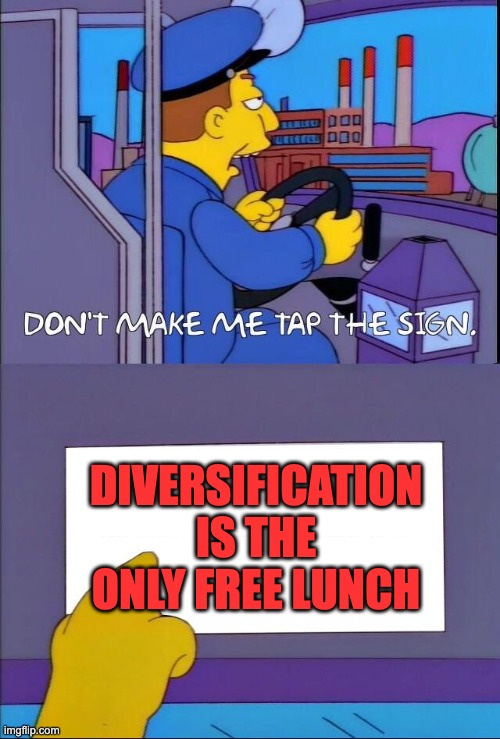
Taps the sign

It’s been a long week. Is it me, or are +/-9% swings on the Nikkei 225 index starting to feel normal? Traders must be loving this – at least the good ones.

I’m not so impressed. Of course, there are buying opportunities, but it gets a bit tiresome when markets swing this wildly based on the pronouncements of one guy who just can’t STFU for 5 minutes.

Orange Swan Event.

Click it, I dare you! And don’t get me started with the Simpsons memes.

Where was I? Tapping the sign, right. The free lunch quote has been attributed to Harry Markowitz, although I have heard Ray Dalio say something similar. It’s a drum I have been banging for years, sometimes with minimal effect.

When the stock market is going up, nobody cares about diversification. Why would I want to own bonds and gold and other stuff when stocks are on a tear? Just buy the index and chill, right? It’s easy to forget that stocks take the stairs up and the elevator down.

Until you get a reminder.

In 2002, psychologist Daniel Kahneman won the Nobel Memorial Prize in Economic Sciences for his work on the psychology of judgement and decision making. Kahneman points out that individuals are more depressed with investment losses than they are satisfied with equivalent returns. In other words, people hate losing money considerably more than they like making money.

Big liquidation events are like waking up after a party. It was fun, but now it’s time to sober up and review your time horizon, risk profile and asset allocation.

Are you diversified enough?

If recent events haven’t troubled you, and you have barely looked at your investments, the answer to this question is probably yes. Carry on!

If things have been a little nervy, then maybe you were over-exposed.

Don’t get me wrong, I’m all for buying stock indices and holding them forever. It’s not a bad strategy, as long as you can stomach the downturns. And as long as you don’t need the money soon. And, it’s not like a diversified portfolio doesn’t go down in times like these either. When panic sets in, people will sell anything they can get their hands on, but pretty soon you will see a flight to safety.

An underappreciated aspect of diversification is the opportunity to tactically rebalance and take advantage of market events. I sold some of a gold ETF this week near all-time highs and bought stocks while everyone was puking them. I didn’t need dry powder. Just a little reallocation.

You can’t do that if you don’t own the gold in the first place. You have to find more cash.

A quick thought experiment

If you are reasonably young and earning good money, then the recent market gyrations are just a blip, but do me a favour: imagine you are 65 years old, about to retire, with a nice fat nest egg invested in the MSCI World Stock index.

And the market dumps 20% in a couple of days. It takes a breather over the weekend and then resumes dumping in earnest. 30% of your retirement pot is gone. Financial media is screaming about recession, trade war, deleveraging or whatever it is this time. Remember in March 2020, when the market crashed and we faced the reality that the entire world was about to shut down? The doomer economists are running victory laps, and the market looks like it is never coming back from this.

How do you feel?

Remember that feeling when you are making future investment decisions, especially as you get closer to spending the money.

Of course, what happened after March 2020 was that central banks slashed interest rates and unleashed a tidal wave of stimulus, and the markets came roaring back before the year was even over. But that type of thing comes at a cost – that’s why your hard-earned cash doesn’t buy as much stuff any more…

Ok, so how do we do this diversification thing?

There are various ways to get yourself a diversified portfolio. How hands-on do you want to be?

For the people who want to put as little effort as possible into it, you can simply buy multi-asset ‘balanced’ mutual funds. I recently came across a collection of Japanese funds that are divided up by age group: “Happy Aging 40”, “Happy Aging 50”, “Happy Aging 60”. The allocations get more conservative the higher the age. These types of funds are available everywhere. Simply dump your money into the fund that fits your time horizon and get back to whatever you’d rather be doing.

In my advisory business, for larger chunks of money, I recommend professionally managed investment portfolios fitted to the client’s base currency and risk profile. Yes, they cost more than an ETF, but they are incredibly well diversified. The asset allocation is reviewed annually, and every quarter the managers implement a ‘tactical overlay’ and buy more of the assets they like and sell some of those they don’t. These guys don’t just buy a broad stock index – they are breaking equity holdings down by style: value, growth, small/large cap, etc. Of course, the entire portfolio is rebalanced annually.

I also recommend a core/satellite approach for even broader diversification. That’s how you slot in the algorithmic trend following strategy that trades stocks, interest rates, currencies, metals and other commodities with very little correlation to any one market. Funnily enough, it likes volatile times like this.

For coaching clients, I take the knowledge I have gained from watching professional money managers and help them develop their own asset allocation using low-cost ETFs. Click the coaching link to find out more.

Keep it simple

Here are a few action points if you want to take on this job yourself:

Separate regular and lump sum money. Regular is the money you invest every month in a pension, savings plan or Tsumitate NISA. If you are relatively young, you can just allocate all of this to stock indices/funds. Let Dollar Cost Averaging do the work for you.

Lump sum money is a chunk of cash you have saved up that you are looking for a better return on. Here, you are going to want more diversification, and you should focus on the currency you are most likely to spend the money in (your base currency). The asset classes you want to look at are: cash, domestic (base currency) bonds, overseas bonds, domestic stocks, overseas stocks, property, and commodities. Hold more stocks if you are young, and more bonds and cash if you plan to spend the money soon. Allocate 70-80% of the lump sum to this broad portfolio, and the remainder can go into satellite holdings to beef up the areas you are most bullish on. For example, if you like Bitcoin, that’s a great satellite holding.

I have written plenty about base currency, asset allocation and core/satellite in the past. Feel free to take a look at earlier posts.

If you are gonna get really serious though, you are going to want to diversify your bonds.

Peace out!

Disclaimer: This should go without saying, but the information contained in this blog is not investment advice, or an incentive to invest, and should not be considered as such. This is for information only.
The Hidden Asset Class Growing in Japanese Soil: Why Investors Are Turning to Bonsai

I like to treat readers to something different from time to time, and today, we have a guest post from Adrien Pichon of Bonsai Collectors. I must admit, I had never thought about bonsai as an investment. However, after talking with Adrien, I realised the trees are collectables, just like artwork or fine wine. (You may remember the six asset classes are cash, bonds, equities, property, commodities and collectables)

So, please read on and enjoy. This is not a sponsored post, and there are no affiliate links. Just a fascinating new asset to learn about.

Most people think of bonsai as delicate little trees, something more at home in a museum or a Zen garden than in an investment portfolio. But what if I told you that some of these trees sell for the price of a luxury car, or more, and that a curated bonsai collection can become a store of value, just like fine art or rare whisky? That’s the world we’re opening up at Bonsai Collectors.

Why Bonsai?

Bonsai are not just decorative plants. In Japan, they are considered living cultural assets. A single tree can be 100, 300, or even 800 years old, meticulously cared for over generations. The craftsmanship, historical value, and scarcity make certain bonsai highly sought after by collectors worldwide, especially as interest in tangible, alternative investments grows.

Prices for museum-grade bonsai can range from $10,000 to over $500,000. And, unlike stocks or crypto, each tree is unique and deeply tied to Japanese tradition and craftsmanship. When properly maintained, they appreciate in value over time, especially as the supply of high-quality, old bonsai continues to shrink.

Making the Market Accessible

Until recently, collecting high-value bonsai was limited to insiders: traditional Japanese gardens, dealers, and a tight-knit community of experts. Foreign investors had limited access not just to the trees, but to the knowledge and care needed to preserve their value.

That’s where Bonsai Collectors comes in.

We’ve built a curated online marketplace where collectors and investors can explore, buy, and preserve authentic bonsai trees grown and maintained in professional gardens in Japan. Each tree is authenticated and tracked with secure ID cards, including its age, artist certificates, and maintenance history.

We work with renowned bonsai artists and export professionals to ensure the trees are properly cared for and legally exportable when needed. Some clients display their bonsai in Japan and enjoy the cultural prestige; others bring them home or include them in exhibitions and events.

Beyond the Tree: Real Asset, Real Care

Owning a bonsai is like owning a living sculpture, but it’s not passive. Maintenance is key to keeping and increasing its value. That’s why all trees on our platform are maintained by licensed Japanese professionals in registered bonsai gardens.

Collectors can also create their own “bonsai collections” through our platform, combining historical trees with expert care and display options. This isn’t a speculative flip; it’s a long-term asset you can watch grow and evolve.

Serious About Preservation and Return

Bonsai Collectors is not just about buying trees. It’s about preserving cultural heritage while opening up a new, stable asset class. We’re targeting a new generation of collectors and investors who care about where their money goes and what it preserves.

Think of it as part art fund, part heritage protection, and part tangible asset. As wealth continues to shift toward alternative and meaningful investments, bonsai is becoming a new way to express values and build value.

Curious to learn more? Visit www.bonsai-collectors.com to explore the marketplace, learn about bonsai investment, and start your own collection.

Disclaimer: This post is for information only. It should not be considered personal financial advice and does not constitute an offer or solicitation to invest in any of Bonsai Collectors’ projects. Investments like these carry specific risks and readers should conduct their own research before proceeding.