Retail therapy

Our family just came back from a weekend break, which was my treat in celebration of our stellar investment returns. Note: don’t tell your significant other how well your portfolio is doing unless you are prepared to spread some of the winning around! We had barely been back home for 5 minutes when the doorbell rang and a new pair of boots was delivered. She bought those herself, so no complaints from me, but you can see how this goes.

Even the stock market is enjoying a little retail therapy.
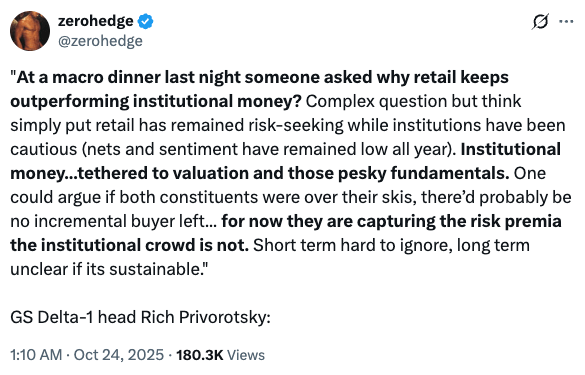
In case you’re not familiar with the term, retail in this case means individual investors: regular people, you and me. One theory is that covid is behind this surge in retail-driven performance. Stuck at home with their stimmy checks, regular investors learned to buy the dip, and it’s been working for them ever since. Stocks, crypto, gold – whatever retail jumps on goes up. Institutional investors look on in bewilderment, stuck with their risk models flashing warnings as the market leaves them in the dust.

It may not be healthy, but these are the cards we’ve been dealt. And with the Fed expected to cut a couple more times this year while simultaneously ending its balance sheet runoff, it’s hard to find a compelling reason to ease off the gas. Trump has even been talking about handing out money from tariff proceeds to the public. Can you imagine?

An interesting tidbit:
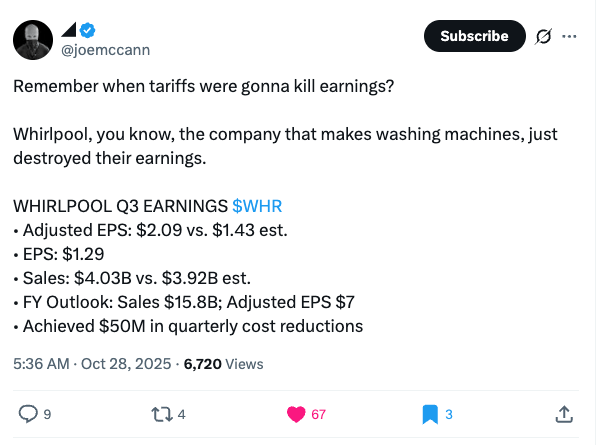
Maybe retail is buying washing machines, too!

Nikkei ¥50,000 party!

It would be rude not to do this! I’m looking at late November, maybe 26th, 27th or 28th. I’m open to suggestions on the venue, but my basic rule is that it must be a cash bar, so we don’t have to worry about whether everyone turns up to cover costs or fiddle around sorting out the bill. What do you say? If you don’t live in Tokyo and have been thinking of taking a trip, well…

Send me a message, email, DM or whatever if you want to come along. Will mostly plan this on X, so keep an eye on this thread.

We’ve been talking about an end-of-year melt-up for a few weeks now. So far, so good. I noticed the Nikkei Asia already started talking down the likelihood of a BOJ rate hike later this week. You can pretty much take that to the bank, right?

Is the Bitcoin 4-year cycle over?

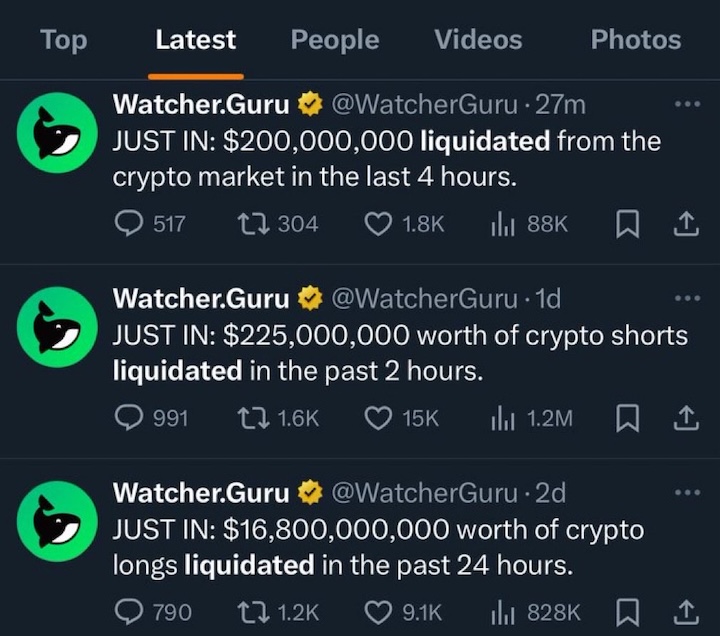
After the most vicious deleveraging event ever just a couple of weeks ago, the crypto market has recovered. Yes, retail bought the dip once more!

There has been a wave of speculation over whether the 4-year cycle is still intact. It’s fascinating, actually, as crypto-natives have been hyper-trained on this narrative. It’s probably the reason Bitcoin is not significantly higher right now. Long-term holders have been unloading, while retail ETF buyers continue to accumulate. Many of the new investors have no idea what the 4-year cycle is and just have a monthly allocation set up for their account.

Price agnostic.

Felix Jauvin makes a pretty good case for the end of the 4-year cycle in this thread.

Felix is awesome, and I love his Forward Guidance Podcast, but time will tell. 2013, 2017 and 2021 were all followed by a nasty bear market. Yes, Bitcoin wasn’t a macro asset like it is now. Yes, you can make a great case that liquidity is rising, and the boomer ETF buyers will keep buying. I really want to believe, you know! But let’s just say I’m ready for anything. Warren Buffett hates crypto, but his quote about finding out who’s been swimming naked when the tide goes out could have been written for the industry. All we need is one good leverage flush to start the dominoes falling, and we all get a chance to buy at $50k again. Don’t think it can’t happen.

At least it will give these guys something to chirp about.

These guys are great! They’ve done zero work, but they will gladly tell you how Bitcoin is too volatile to be investable.

Well, BTC has closed above $100,000 for 172 consecutive days now. If you wanted to sell, you have had plenty of time to do so. If 2026 is a bear market, make sure you ignore these nitwits on their victory lap and back up the truck.

Melt-up before the melt-down, though, right? I’m yet to see real euphoria in crypto this year. Remember the images of people lined up on the street to buy gold a week or so ago? That’s what we’re looking for. We’re not there yet.

It’s a busy week with the Fed meeting, BOJ and Trump on the loose in Asia. I don’t know when the next dip will come, but you can bet that retail will be ready to buy it!

Top image from Pixabay

Disclaimer: This should go without saying, but the information contained in this blog is not investment advice, or an incentive to invest, and should not be considered as such. This is for information only.

Is offshore investing still relevant?

As you may know, I have worked as an independent financial adviser for many years. I first got involved in this business in 2002, and the world has changed drastically since then. Some of the financial products that were popular at that time are almost obsolete now. So, is offshore investing over? Or is it still something worth considering for the right person?

A note here: I have never used this blog to promote offshore products, and that is not my intent here. However, I’m probably as qualified as anyone to discuss this topic, so here we go!

Much has changed

In 2002, if you were an expat in Japan, earning good money and looking for a way to invest, your options were fairly limited. Opening an investment account in Japan was not something many people considered. Along with the obvious language barrier when it came to reading product information, opening an account would involve meeting with a broker from a Japanese securities company and going through their sales process. If you think offshore advisers had a bad reputation, local securities company salesmen were not much better – they were well known for heartily recommending whatever was booming at the time and throwing their clients in at the chuffing top of the market.

Therefore, speaking to a British guy in a suit and cufflinks and investing in the Isle of Man was usually a more palatable option. Of course, these guys operated on commission, and some of them did not have your best interests at heart. Buyer beware! Many people got duped into long-term savings plans they didn’t understand.

To be fair, some of these people partly deserved what they got. All these offshore products had terms and conditions readily available in English. You just had to get a copy and read them! Plenty of people managed to ask questions, read the documents and invest in a product that they actually understood.

These days, investing in Japan could not be simpler. Go online, choose a brokerage, fill in the initial online form (with your name in half-width katakana hahahahahaha!) and then post off copies of your residence card/My Number card. You can have a brokerage account and a tax-free NISA set up in a couple of weeks.

So, is offshore investing dead?

Other advisers may have different mileage, but from my perspective, the demand for offshore products is certainly down significantly. I attribute this to two factors: getting a low-cost brokerage account is very easy, and nobody wants to pay for anything these days.

Not that avoiding high fees on investments is a bad thing. It’s one of the simplest things you can do to improve your returns. However, when offshore advisory is done well, you are not necessarily paying a lot for the product. Lump sum investment products in particular have very flexible fee structures, and a good adviser will be reducing their initial commission and taking an annual management fee for servicing you and providing ongoing advice.

Of course, much depends on your country of origin, how long you plan to spend in Japan and where you will go next. Offshore isn’t a great fit for everyone. (Americans in particular, take note. NISA isn’t necessarily a great fit for you either, and you are likely better off getting US-specific advice and investing in US-based accounts.)

Here’s a simplified view of how I see the steps to allocate money:

  • Make sure you have an emergency cash reserve
  • Fill up anything tax advantaged first – in Japan, that would be NISA, iDeCo
  • Any money over and above that is up for consideration – it could be invested in a taxable Japan brokerage account, an international brokerage account like Interactive Brokers, or offshore.

Again, a lot depends on nationality and personal situation, so no advice here, but some of the benefits of offshore get overlooked in the relentless pursuit of low fees.

I will leave the offshore regular savings plans out of this, as they are somewhat outdated. But many people, including myself, still have plans set up years ago, and that’s fine.

The offshore portfolio bond is for larger lump sum investments. It’s essentially an insurance structure; the individual owns the policy, and the policy owns the assets. It is open architecture so policyholders can access ETFs, mutual funds and individual stocks. For Japan residents, you are not required to report capital gains and dividends within these policies as they occur. You report when you exit the policy and pay a one-time tax payment (一時所得) of around 20% of gains. E.g. You invest $100k and the policy grows to $200k – you cash out the policy and owe approximately $20k.

So you effectively get gross roll-up inside the policy. You can switch investments and take profits as much as you like without triggering a taxable event. For some people, that alone is worth the fees.

If you leave Japan, you just take it with you, and when you cash out, you may end up owing nothing here. Of course, some people may have to factor in the exit tax and the lookback, etc. It depends on amounts and timeframes.

Use of trusts

The other thing you can do with offshore insurance products is put them in a trust. Trusts can be very effective for estate planning, particularly for, but not limited to, British nationals.

In the case of Isle of Man assets, probate will be required on the death of the last policyholder before proceeds can be paid out of the plan. Placing the policy in trust avoids this lengthy and often frustrating process, allowing money to be paid out quickly to the beneficiaries.

Trusts allow the donor to maintain a degree of control over the assets and, in some cases, to have limited access to the capital. A discretionary trust, for example, can instruct the trustees to hold the assets until the beneficiaries reach a certain age before distributing the proceeds to them.

For individuals who are treated as UK long-term residents, a trust is an effective way to shield assets from UK inheritance tax. Trusts are also worth considering for anyone who plans to become a UK long-term resident in the future.

A note here: trusts will not help you to mitigate Japanese inheritance tax. Japanese tax authorities do not recognise foreign trusts and generally look through them and tax the assets. If Japanese inheritance tax is a concern, you should first do your own reading and then discuss with a local tax professional before taking action. Reddit is an incredible resource, but you should not be taking personal tax advice from there.

If you have an offshore policy that you have been holding onto and perhaps do not know what to do with, it could be worth discussing with your adviser as to whether it would be better to put it into a trust. If you have lost contact with your advisor, you are welcome to contact me. I can also assist with general advice on whether it is better to keep the policy or cash it in and invest elsewhere.

In conclusion

Offshore investing is generally less relevant than it used to be. However, it is far from dead. In particular, high-net-worth individuals may find there are significant benefits to investing in a tax-free jurisdiction, and/or taking assets out of their own name.

For simple day-to-day investing for longer-term Japanese residents, NISA and iDeCo are incredibly hard to beat, and local brokerage accounts provide access to a wide range of assets. We are really spoiled these days. If you need help getting things organised, don’t forget that I offer fee-based personal finance coaching!

Top image by Clker-Free-Vector-Images from Pixabay

Disclaimer: This should go without saying, but the information contained in this blog is not investment advice, or an incentive to invest, and should not be considered as such. This is for information only.

Hyperliquidation

Well, that was fun…

I woke up last Saturday morning and, as is my habit, checked on the overnight market movements. I did a double-take and wondered what the hell had happened. Bitcoin, perhaps the nimblest indicator of global risk appetite, had dumped heavily. Several possible scenarios ran through my mind, but I knew it could only mean one thing…

Donald Trump has posted something!

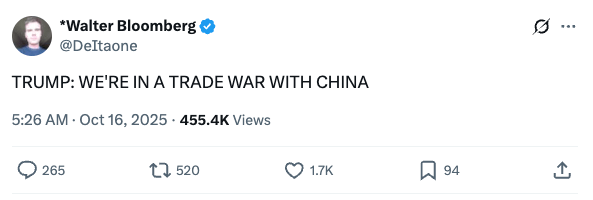
Bingo! After market hours on a Friday, America’s fearless leader had somehow mangled a Chinese announcement on rare earth exports and sent out a post threatening further 100% tariffs on China. After all the TACO earlier this year, I had forgotten about the trade war!

Had stock markets been open, they would not have liked it at all. As they were closed, crypto bore the brunt, and anyone unfortunate enough to be awake got to witness the biggest liquidation cascade of all time. Bitcoin fell to around $104,000 initially before bouncing. Alts were nuked without mercy, with $ATOM token getting as close to zero as you can really get without going negative.

Something in the range of $18.7 billion in positions got liquidated in a matter of minutes, and around $560 billion was wiped from the total crypto market cap. Fun times!

I won’t get into the whole conspiracy theory of what happened. Suffice to say, a very large and very suspicious short position appeared in the market shortly before the fun began. This seems to be the only person who made money that day. It could be a coincidence, of course. I guess we will never know…

Japan is moving to ban insider trading in crypto, by the way. Seems like a good call.

Bitcoin hodlers would be a little concerned to see the price fall so quickly, but most take it in their stride. Leveraged traders, however, some of whom don’t even own Bitcoin, did not make out so well. Many got a lesson in risk management they will never forget.

Of course, by the US open on Monday morning, Trump had already straightened things out, and stocks acted like nothing had ever happened.

It’s always the leverage

Most people should stay away from leverage. Hell, even skilled traders should handle it with care. And yet, Volatility Shares just filed for a total of 27 leveraged 3x and 5x single asset ETFs. If approved, every Robinhooder will be able to go 5x long Nvidia, Palantir, XRP and more. What could possibly go wrong?

Wall of worry

We’re so back! Add to this the growing concern over the AI-driven boom and whether it is, in fact, a bubble, and you have to wonder if the Q4 melt-up might be cancelled.

The AI bubble talk is understandable. OpenAI has around $1.5 trillion in AI build-out plans. This for an unprofitable company with only $13 billion in annual revenue. Both smart money and dumb money alike are positioned for a bullish Q4. Tech stocks sure have a long way to fall if investors lose their nerve.

A week or two ago, the CEO of Goldman Sachs warned that a stock market correction could occur in the next 12-24 months. Thanks for the deep insight, bro! Jamie Dimon is talking about gold possibly going to $5,000 or even $10,000.

Throw in the US government’s shutdown, and you may wonder how stocks can possibly rise further. Surely the Bitcoin bull run is over, too?

While Trump was busy TACOing, Jerome Powell came out on Tuesday and said that “the downside risks to employment appear to have risen.” That appears to imply a further rate cut at the Fed’s end-of-month meeting. More importantly, JPow signalled the end of the Fed’s balance sheet runoff. If quantitative tightening is really over and liquidity flows, the wall of worry could melt rapidly.

I don’t know what’s going to happen, and you certainly shouldn’t be making investment decisions based on my offhand opinions, but if we get a strong earnings season, I still see a bullish Q4 and then trouble on the horizon in 2026. It’s never dull, is it?

Yes, Prime Minister

Organising a Prime Minister seems to be a tough gig these days. France had a guy quit and then get reappointed in the same week! Here in Japan, Sanae Takaichi went from being a done deal to less than Liz Truss in a couple of days. Now the LDP is courting the opposition, and it’s looking like they might find the votes to anoint the country’s first female Prime Minister after all. Who knows?

The market has already tipped its hand if the deal gets done. JP stocks up and yen down. I will unapologetically cheer for our iron lady just because I want my Nikkei ¥50,000 party. The yen is cooked anyway.

A diversified portfolio matched to your base currency and risk profile with satellite holdings in debasement assets.

I sound like a broken record, don’t I? By the way, I found a Japan Physical Palladium ETF (1543). It’s amazing what is available these days. Don’t do anything I wouldn’t do!

Thank you for your attention to this matter.

Disclaimer: This should go without saying, but the information contained in this blog is not investment advice, or an incentive to invest, and should not be considered as such. This is for information only.
Nikkei ¥50,000 party!

You can’t time the market. Except those times when you can. Last week, I wrote a post called Melt Up? Maybe I got lucky, but the meltup began right after and is now in full swing. Gold, Bitcoin and of course, Japanese stocks.

Not that I’m claiming clairvoyance here. I had no idea how the market would react to the LDP leadership vote. Generally, I discount politics as it has far less effect on asset prices than people think. At first, I thought the market reaction was relief that the younger, less experienced guy didn’t get in, but clearly it’s not that. It’s all about the new leader.

I won’t delve into political analysis. I don’t have any edge here. Takaichi’s economic stance is perceived as expansionary, and there seems to be an expectation that she will go full Abenomics on us. That remains to be seen, but here are a few observations:

  • Taro Aso was clearly instrumental in getting Takaichi elected and will be a key figure in the administration. He opposes ‘modern monetary theory’ and argues for fiscal discipline. Watch the yen over the coming months to find out who is really in charge.
  • When Abenomics was implemented, USD/JPY was at 80 and inflation was negative. Now we have the dollar at 152 and 3% inflation. It’s a very different world. You can’t just cut rates to zero and reimplement QE without inflation blazing out of control.
  • The BOJ may not be entirely free from political interference, but it will make its own decisions. It may or may not hike at the next meeting, but it’s not going to go the other way any time soon. No doubt, Chairman Ueda’s job just got a little more complicated, though.

I’ll stop there. Prime Ministers don’t seem to last very long these days, so we should probably give it 6 months or so before expecting a clear indication of where this will land. For now, you can probably give up on any hopes of a stronger yen. And you’d better own stocks and hard assets.

The meltup continues. I joked about having a Nikkei ¥50,000 party on X, but I think we should do it. It may be soon, so get ready!

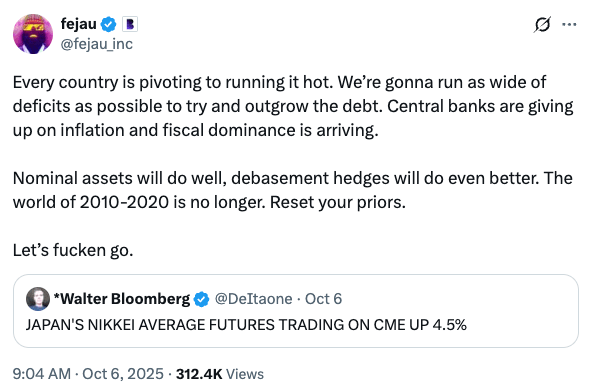
Running it hot

If you are seeing posts and mentions about the ‘debasement trade’, it’s no wonder.

I’ve been harping on about monetary debasement for some time. People seem to be getting the idea. I’m seeing more and more people who don’t own gold capitulating and buying it at all-time highs. They should have owned it earlier, but that doesn’t make them wrong for getting some now.

Reminder: if you run a diversified portfolio, you will already have a 5-10% allocation to gold. You don’t have to play catch-up. People who only own stocks are learning this now.

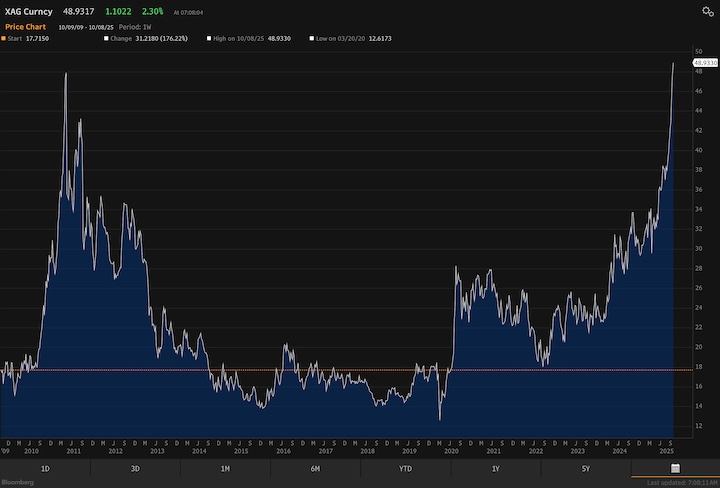
Take a look at this silver chart from Kevin Gordon’s post:

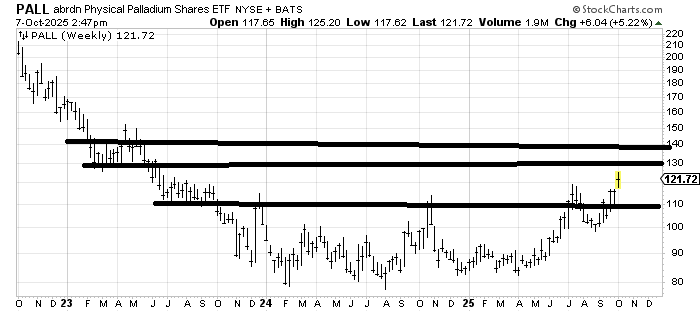
And Helen Meisler posted this palladium chart in response:

Is that going where I think it’s going?

Here’s Paul Tudor Jones again:

Blanket recommendations are generally not a good idea, but if I had to put my current investment thesis in a nutshell, it’s this:

A diversified portfolio matched to your base currency and risk profile with satellite holdings in debasement assets.

Top signals?

A few weeks back, I wrote a post on spending money well. Just this morning, I found a great post from Ben at Retire Japan on the subject in my inbox.

It’s clearly a sign that people’s portfolios are at all-time highs. We should probably be a little careful about getting too greedy, but it’s a wonderful time to consider how to get joy out of the money we have worked for and taken risk to grow.

I ordered the orange iPhone. It’s due to be delivered in early November. I wasn’t planning on becoming a walking top signal, but maybe I’m about to…

See you at the Nikkei ¥50,000 party!

Top image by Mate Holdosi from Pixabay

Disclaimer: This should go without saying, but the information contained in this blog is not investment advice, or an incentive to invest, and should not be considered as such. This is for information only.
Melt up?

It’s a slow week for stocks in Japan, with the market losing ground in part due to the selling of names that went ex-dividend on 29 September, and also out of concern over a possible US government shutdown.

29 September was the cut-off date to receive the next dividend for many Japanese stocks. Prices are often driven up before the ex-dividend date, only to fall after it has passed as investors sell, safe in the knowledge that the next dividend payment will be delivered. It’s really a non-event for long-term holders.

A US government shutdown could lead to a delay in the release of key economic indicators such as jobs data. How can we possibly know when to panic sell our stonks if we don’t know how many jobs were added/lost last month in the USA?

Despite the relative gloom, the focus for Q4 is increasingly on a potential melt-up for markets as liquidity continues to flow. Tech stock valuations are admittedly high compared to the 20-year average. However, compared to the last 5 years, the premium is significantly lower. People looking for the bursting of the AI-driven bubble may have to wait a while longer. This article suggests that Wall Street strategists, including Jim Paulsen, are starting to look at high valuations as a kind of “new normal”:

“There’s something weird going on with valuations from what they used to be — that is, there’s an upward trend in the valuation range,” said Paulsen, who now writes a Substack newsletter called Paulsen Perspectives.

Will gold keep going?

People keep asking me if gold can keep rising. The best answer I have is: unfortunately, yes. Gold ripping to all-time highs, while exciting for goldbugs, is not a good sign overall. There’s a distinct lack of trust in governments and central banks to manage their debt and spending situation.

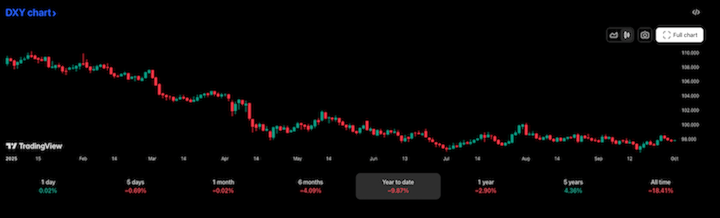
The dollar certainly doesn’t like it:

DXY US Dollar Index

As for the yen? Well, the dollar index is down almost 10% YTD and USD/JPY is still at 148. If you are waiting for a stronger yen, you’d better hope the BOJ gets back to raising rates soon. Your mortgage won’t thank you if they do, though…

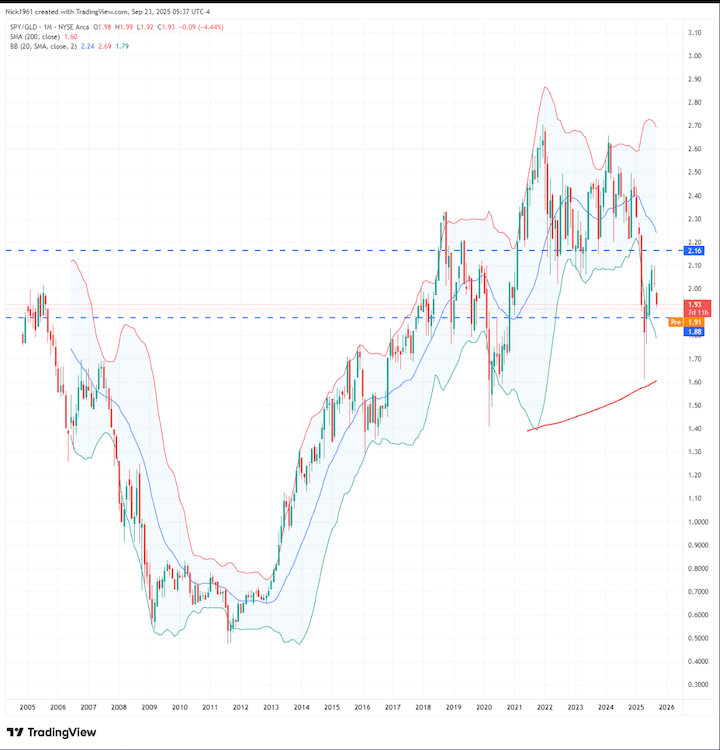
Talking of gold, here’s a chart for people to really hate on!

SPY/GLD

That came from this post by Nick G: “The price of equities is completely unchanged since 2005. All that has changed is the value of the denominator.”

So, priced in gold, the S&P 500 went nowhere since 2005. All “gains” were just the dollar losing value. And that includes dividends, apparently!

No wonder people are hyper-gambling on crypto and tech stocks…

Here’s an interesting (perhaps triggering) opinion piece on financial repression and why you want to own gold, silver and Bitcoin in the face of what’s still to come.

Speaking of which

All eyes are on Bitcoin now as we enter Q4. If stocks remain strong into year-end, what will Bitcoin do? No price predictions from me, but I see a melt-up before a melt-down. This year’s theme has been long-term holders (who bought at rock bottom prices) enthusiastically selling to institutions that are hungry to secure their share of the network. If the OG’s put a pause on selling, look out above.

I’m hearing lots of talk of an extended cycle, a move to a 5-year cycle, and even a supercycle. I heard these same things in October 2021. I’m not saying the theory is wrong, but it was very wrong last time. I’ll believe the 4-year cycle is no longer relevant when I see the evidence. Until then, sign me up for a Q4 meltup followed by a treacherous 2026.

Quantum Leap?

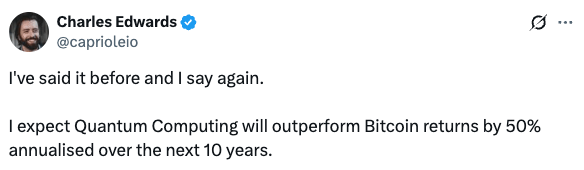
I wrote a post in late 2024 about Quantum Computing. Almost nobody read it. Very few people are discussing QC or even aware of what it is. For me, it’s turning into a no-brainer satellite holding. Incredibly volatile, but with massive potential. Don’t bet the farm, but maybe study up a bit?

Here’s a nice thread by Charles Edwards on the subject. And yes, QC poses a future threat to Bitcoin, which will need to be addressed.

The Quantum stocks have risen significantly over the last couple of years. There will be scary drawdowns for sure, but likely more meltups to come.

Stay cool.

Top image from Freepik

Disclaimer: This should go without saying, but the information contained in this blog is not investment advice, or an incentive to invest, and should not be considered as such. This is for information only.