

Debaser – stocks, metals and Bitcoin in 2026

We’re only halfway through January, and it already feels like we have lived through a year’s worth of crazy news. Maduro has been ousted, Iran is in turmoil, Mexico and Colombia are on alert, the Europeans are mobilising to protect Greenland, and the chair of the Federal Reserve released a video accusing Trump of bringing criminal charges against him because he refused to bend to his will and lower interest rates quickly enough.

And, despite all of this, many markets are near all-time highs. There really has never been a world leader capable of instigating so much chaos, whilst simultaneously making markets stand up and dance for him.

If you are not convinced by now that Trump is going to pump liquidity and juice the stock market as hard as he can this year, I don’t know what to say.

Likewise, Prime Minister Takaichi. With such a strong approval rating, calling a snap election seems like a calculated risk. The market reaction tells you everything you need to know about her economic policies. Yen down, stocks up. She is going for growth, and that means yen debasement and more inflation coming.

Metals are sounding the alarm on all of this. Bitcoin is also finally starting to respond. The debasement trade is far from dead.

Here are a few thoughts on where this could be going:

Stocks

Mag 7 appears to be cooling somewhat, allowing the S&P 493 to catch up a bit. I’m even hearing American commentators discuss emerging markets. This is probably healthy, although the AI trade is by no means over and data centre spending is not slowing down.

Taiwan Semiconductor reported Q4 earnings this week that beat analyst expectations. Trump just announced a trade deal with Taiwan that will boost investment in the US semiconductor industry, and the deal sees the “reciprocal” tariff rate on Taiwanese goods drop from 20% to 15%.

The biggest short-term threat to stocks is the U.S. Supreme Court’s expected ruling on the legality of the Trump tariffs. If the court rules against these duties, expect all kinds of confusion.

Longer term, it’s hard to be bearish with Trump preparing to install the next Fed chair to do his bidding and midterms looming.

I guess the thing that could derail the Japan bull market would be the LDP performing poorly in the upcoming election and Takaichi being forced out as a result. Conversely, expect another yen down/stocks up surge if she wins a clear mandate.

Metals

The metals trade may not be done, but it’s surely in the late innings. People are starting to ask about copper and palladium. A while back, I put some of my old savings plan into a gold mining fund, and when I checked yesterday, the thing has more than tripled. Half of that went right into bonds for the time being.

If you’ve been in metals, well done! I have no idea if it’s over, but it’s not a bad time to trim some exposure.

There was a report on the 10pm news two nights ago about precious metals: Gold and silver jewellery are selling well in Japan. Dentists are losing money on 銀歯 (silver fillings), which are actually made from a mix of silver, palladium and gold. One dentist interviewed said that some people are even trying to sell their fillings! People are walking around with a hedge against yen debasement in their mouths

If you are thinking of getting into silver right now, that’s FOMO.

The metals people on X are starting to sound like the crypto bros in a bull market. There are definite signs of euphoria, which means the reversal will likely be brutal when it comes.

Bitcoin

I’m talking Bitcoin, not crypto, as I can only think of a handful of coins that might do well IF Bitcoin gets back over $100k.

There’s an ongoing debate about whether the four-year cycle is dead. I’m not convinced it is, but at the same time, the liquidity backdrop for Bitcoin looks ridiculously good.

Here’s my best effort at a cheat sheet:

If you own Bitcoin, I’m assuming you are long-term bullish. If not, what the hell are you doing in it? I remain bullish on long time frames.

If you believe the 4-year cycle is alive and well, and 2026 will see the usual brutal bear market, prepare some dry powder. The chance to accumulate cheaply is coming.

If you think we bottomed already, you want to accumulate as much as you can under $100k.

If you’re not sure, DCA is the way. Just buy a little at regular intervals and pay as little attention as possible to short-term price fluctuations.

Fidelity Digital Assets’ 2026 Look Ahead is worth a read if crypto is your thing.

Ray Dalio’s lookback on 2025 is also interesting.

Hopefully, that provides some food for thought. Funnily enough, this post from October 2024 still holds up pretty well: Facing inflation – the four assets you should own.

I don’t see a lot of fiscal responsibility coming out of America and Japan in the near future. Long live the debasement trade!

Disclaimer: This should go without saying, but the information contained in this blog is not investment advice, or an incentive to invest, and should not be considered as such. This is for information only.


Vibe investing – stock analysis with Peter Lynch and ChatGPT

The whole generative AI thing is pretty weird, but I think I’m starting to get it: Some people are using AI to generate torrents of slop. Other people are using it as a tool to learn and get stuff done. I want to be the latter and avoid the former as much as possible.

The thing I initially found LLMs to be useful for was taking a long, information-dense document, perhaps written in Japanese, and getting a nice, concise summary in English. In particular, I used it to read the earnings reports of companies I was interested in investing in. However, here’s the catch: I’m not a stock analyst. So, often, even with a nice summary, I couldn’t decide if a stock I liked was actually a good investment.

I recently got around to reading Peter Lynch’s excellent One Up On Wall Street. It’s a fabulous book, written for retail investors. If I were to really simplify the book’s content, it would be:

1) How to find great investment opportunities simply by looking around you and finding companies you already know offering products you love

2) How to analyse the company’s financial disclosures to figure out if it’s really a good investment

Of course, there is more to the book than that. But these two things alone made it a hugely worthwhile read.

Now, investing in individual stocks is not for everyone. It’s not even necessary. As I write this, the Nikkei 225 index just hit a new all-time high. It’s up almost +50% over the last two years alone. The S&P 500 is up almost as much over the same period. There is nothing wrong with just owning the index and spending your time doing something else. Just don’t make the “something else” generating AI slop posts on LinkedIn or whatever. Please…

Where am I going with this? Oh, yes. After reading the Peter Lynch book, I realised that I could use some of the techniques in there to identify stocks I’m interested in and then use some of the questions Lynch asks to get AI to help me better understand those companies’ earnings reports.

I’ll give you an example, which I may regret. But it’s a stock I actually bought recently using this method.

As I get older, I notice a lot of people around me are wearing spectacles. Some need them permanently, while others, like my wife, can no longer read what’s on their phone without them. Japan’s ageing population problem is well-documented. I guess a lot of these oldies need glasses. Perhaps that’s why there are glasses shops EVERYWHERE!

Like everywhere. Along busy roads, in department stores, in malls. There are tons of eyewear shops.

I often find myself perusing this Trading View list of Japanese stocks. I like how you can use the tabs to sort and view a list of stocks with the most cash or the highest dividend. A few weeks back, I was looking at the list of oversold stocks and I noticed JINS Holdings (3046). And yes, they sell spectacles. I was in one of their shops with my wife just the other day, and it was really busy. Their specs are high quality and low price. And their stock took a beating over the last few months.

So, I decided to see how Peter Lynch works with ChatGPT. I downloaded the latest company earnings report and fed it to the machine. Instead of just asking for a summary and trying to figure it out myself, I asked ChatGPT to provide a summary that focused on answering some Peter Lynch-style questions:

What’s the recent growth in earnings?

What’s the P/E ratio relative to historic levels?

What makes the stock a good buy now?

Are existing stores in profit?

Where’s the expansion coming from?

What’s the debt situation?

How will they finance growth without selling lots of new shares and diluting the earnings?

Are insiders buying?

How does the stock price look versus the earnings over the last 5 years?

What are the dividends, and have they always been paid?

What percentage of shares are owned by institutions?

I won’t post all of the answers I got here. You can try it yourself if you want to. Suffice to say that the information I got was way more useful than a plain summary of the earnings report.

Later, I also asked ChatGPT to search the web and try to identify possible reasons why the stock is down so much recently.

Asking it to give a web-sourced breakdown of the reasons why the stock might be down was deliberate. You’re not supposed to ask LLMs to think. That’s not what they do. In fact, I find that if you do ask them to think, they tend to go out of their way to confirm your bias and tell you whatever it is you want to hear.

So, anyway, long story short, I bought the stock on Xmas Day. It’s down -6.5% since then lol. And it’s down almost -4% today, a day where the Nikkei surged over 3% to another all-time high. (earnings miss haha!)

So, I may be an idiot. But it’s probably a little early to judge.

My point here isn’t so much about whether this approach works in this particular instance. I enjoy picking stocks, but am aware that I am weak when it comes to analysis. Asking good questions is a life skill that can be applied to many disciplines. Peter Lynch is very good at asking questions about company financials. And LLMs can answer those questions in seconds by reading the earnings report, leaving you with valuable time to do something else.

Don’t try this at home. Or do, but don’t blame me if it doesn’t work. The usual disclaimers apply. If you do try it, please let me know how it goes, what you learned and what other questions you came up with.

Let’s revisit JINS later this year and see how it works out. I’ll be trying more of this to get a larger sample size.

Disclaimer: This should go without saying, but the information contained in this blog is not investment advice, or an incentive to invest, and should not be considered as such. This is for information only.

Giddyup! NISA allocations for 2026

Happy New Year, everyone! Welcome to the year of the horse. Markets are off to a strong start and have not shied away from early geopolitical shenanigans. The going appears to be good to firm as we come out of the gate in January, and runners and riders are expecting a fast race.

Ok, enough horsing around. January means many of us have NISA investments to allocate. It’s time to make some decisions.

I just scanned through my 2025 New Year post, Snakes and Elephants, and what do you know? This time last year, USD/JPY was around ¥158. Japanese retail investors were largely ignoring the bull market in local stocks and piling into US companies. And Bitcoin was trading at around $93,000.

Great Scott!

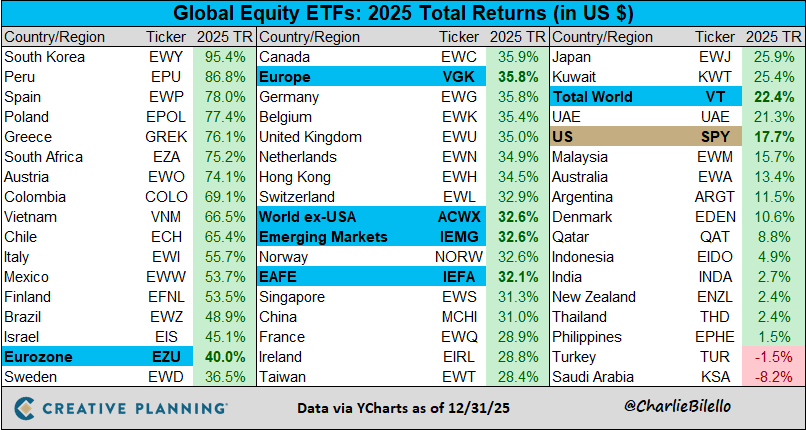
At least stocks are a good bit higher than they were this time last year. You would never guess the whole “Liberation Day” debacle happened unless you were there. If your 2025 NISA allocations are not in profit, something went very wrong…

From @CharlieBilello

The difference with Bitcoin is that last year, it was at $93k on the way up. Now, it’s around the same price on the way back down. At least that’s what I think, although many will disagree. But let’s leave the magic internet money for another post.

What is the outlook for equities in 2026?

The Bloomberg Outlook always provides a nice window into what Wall Street expects in the year ahead. In short, pretty much everyone is optimistic, and the AI boom continues to be the main story. The Fed is expected to continue to loosen monetary policy, and Trump and Bessent are also standing by to man the liquidity pump.

The leaders of Japan’s securities firms are also primed for another big year in domestic stocks, as per this NHK article. However, the Japan Times reports here that Japanese retail investors are still more interested in US stocks. It looks like Japanese stocks remain under-owned.

If, like me, you enjoy a little crypto and spice with your macro commentary, Arthur Hayes’ latest post is a fun read. He sees the Trump admin running the economy hot in 2026, whilst simultaneously trying to contain inflation by holding gas prices down. That Venezuelan oil may have a purpose, huh?

Suffice to say that everyone is sufficiently bulled up that we should be at least a little worried. Risk lurks in the AI bubble, excessive government debt, BOJ policy and the yen carry trade, rising bond yields, geopolitical crises, and who knows where else!

We all love a challenge, don’t we?

My themes for 2026, which I outlined in my previous post, are mostly unchanged

For Japan:

  • Japan’s base interest rate is 0.75%, and inflation is around 3%, so we have a real rate of negative 2.25%
  • The BOJ can maybe squeeze in one more hike to 1%, so real rates could go to negative 2%
  • This is still very accommodative monetary policy and will support asset prices
  • The weak yen will persist
  • Rice isn’t getting any cheaper, and people’s spending power will continue to decline

By the way, I feel like that last point is going to be critical for the Takaichi administration. People are feeling the pinch, and if prices continue to rise, I expect that beautiful approval rate to take a beating. Complaining about bad foreigners will only distract the public for so long…

Some more general themes:

  • Trump’s new Fed pick will likely force lower rates
  • Trump will want to pump the stock market ahead of the midterms
  • However, the AI trade will continue to come under scrutiny
  • The debasement trade is very much still in play – own hard assets
  • Bitcoin bear market – an opportunity to accumulate

I’ll come back to some of these in future posts.

So, what to do with ¥3.6 million?

Of course, I can’t give broad advice here, but I can tell you my own personal plan for NISA this year. Bear in mind that what works for me may not work for you, and we may have different goals and risk profiles. If you need help figuring out what is best for you, remember that I offer a coaching service.

I view NISA as a long-term investment. I want to mess with it as little as possible. If I make a bad pick, sure, I will drop it and reallocate later, but I prefer it to be set and forget.

Therefore, I will stick with last year’s plan of allocating most of Growth NISA to ETFs. I will continue to pick stocks in my taxable account, mainly because I like doing so, not because I really believe I can outperform. (it’s fun to try, and it works sometimes)

While I will allocate some money to global indices, I want to keep a decent chunk in yen. Converting to dollar assets at these exchange rates is painful!

Here are some ETFs I like:

  • 1489 NEXT FUNDS Nikkei 225 High Dividend Yield Stock 50 Index – The S&P 500’s Dividend Yield ended 2025 at 1.15%, its lowest level since 2000. Japan is a dividend paradise, and I love this ETF as a simple way to earn steady dividends without worrying about how a certain company performs over the next decade. For a dividend fund, it has delivered impressive growth these last few years, too.
  • 2644 Global X Japan Semiconductor – this will be volatile, but long-term chip demand is only going up
  • 1624 NEXT FUNDS TOPIX-17 MACHINERY – this is 25% allocated to Mitsubishi Heavy Industries, so a bit concentrated
  • 1627 NEXT FUNDS TOPIX-17 ELECTRIC POWER & GAS – this is a new one for me, and I’m substituting it in for an energy ETF. I’m bullish on power companies.
  • 2559 MAXIS World Equity – good old All Country!
  • 1545 NEXT FUNDS NASDAQ-100 (Unhedged)

The difficult part is timing. Markets are ripping early in the year, and I would love to catch a dip. But who knows when that will come? I will aim to have Growth fully allocated by the 30 March ex-dividend date for Japanese stocks. Maybe Trump can then crash everything in April again for a bit more déjà vu…

Tsumitate, I will keep the same at 40% JPX 400, 30% All Country, 30% NASDAQ. Average in and chill.

How about you? Do you have a plan in place, or are you still mulling the options? I would love to hear what other people are doing.

Wishing everyone all the best for 2026. Let’s make it a great year!

Top image by Freepik

Disclaimer: This should go without saying, but the information contained in this blog is not investment advice, or an incentive to invest, and should not be considered as such. This is for information only.