

The AI scare trade

AI has been the relentless driver of markets for several years now. Over the last few weeks, however, the tone has changed, and investors are dumping stocks in companies that may be at risk from AI tools. “Shoot first and ask questions later” is how analysts describe the action.

What is happening?

The AI scare trade is the rapid repricing of companies based on the perceived risk that generative AI will destroy their business model.

The narrative has shifted noticeably from AI as a productivity driver to AI as ruthless disruptor of whole swathes of the corporate landscape. First, it was software companies, then payments. Now, consulting and even cybersecurity are apparently on the brink of obsolescence.

Much of this is clearly overdone. And some of it probably isn’t. The job now seems to be to identify which services are genuinely under threat and which are merely suffering collateral damage. IBM shares plunged -13% on 24 February after Anthropic said its Claude Code tool could modernise Cobol, an old programming language running on IBM machines. So, is IBM done now?

IGV (the iShares software ETF) is down almost -20% in the last month. In Japan, Sansan Inc (4443) is down -36% over the same period. Are these stocks falling because earnings will collapse? Or because multiples are contracting due to uncertainty?

Regardless of your level of buy-in to the AI story, humans are writing some interesting pieces. Matt Shumer’s “Something Big is Happening” caused quite a stir. Citrini’s “2028 Global Intelligence Crisis” scenario actually moved the market!

I think it’s important to read this stuff because, whether it’s big or not, something is definitely happening.
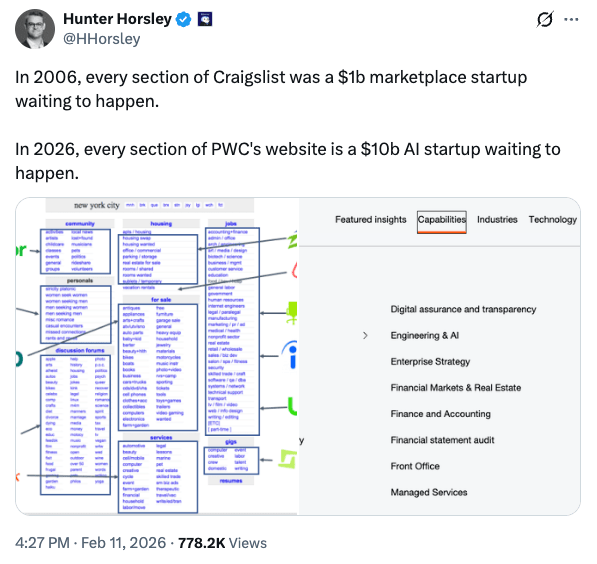
The Citrini article in particular struck a nerve. It was deliberately positioned as a possible scenario, rather than a prediction. The people writing it off as doomerism are probably more afraid than they will admit. What makes the AI scare trade different from past sector rotations is that many investors feel personally exposed. When the technology threatens your own profession, the fear feels more real.

And the market hates the uncertainty.

How to position

So how should we, as investors, navigate these uncharted waters? Shooting first and asking questions later is probably not a smart approach. I don’t necessarily have the answers, but here are a few thoughts:

If you are in the accumulation phase and mostly averaging into index funds and passive ETFs, there is no need to make any big changes. The indices themselves do a good job of allocating more cash to the winners than the losers. A few software companies may drop out of the S&P 500 over time, but they will be replaced by growing companies.

For more active investors, particularly those who like to pick stocks, it’s a good idea to separate out the genuine risks and opportunities:

  1. Direct displacement risk – code generation, content creation (ouch!), basic legal/admin work
  2. Margin compression risk – services that become cheaper, but not obsolete
  3. AI beneficiaries – infrastructure, energy, chips, data centres, automation

It’s productive to focus on number 3, I think. If AI makes software 10x cheaper, demand for compute, electricity and physical infrastructure likely rises rather than falls.

In the chaos of the last few weeks, I heard about logistics stocks selling off. These are exactly the kind of companies that are likely to incorporate AI and deploy it to streamline processes and boost efficiency.

I saw a client last week whose company does commissioning for data centres. They are the guys who go in and check that everything works before the operation begins. They are jammed with work and can barely keep up.

Where is the power going to come from to run these places? What infrastructure needs to be built? Who makes the wiring, and where do the raw materials come from?

What stocks have been oversold, but clearly are not going away? Meta, Microsoft and Amazon have all weakened on concerns about their massive AI capex. Is the concern justified, or is this just another buy-the-dip opportunity? It’s not the first time these companies’ heavy investment has been called into question, but look at their long-term performance.
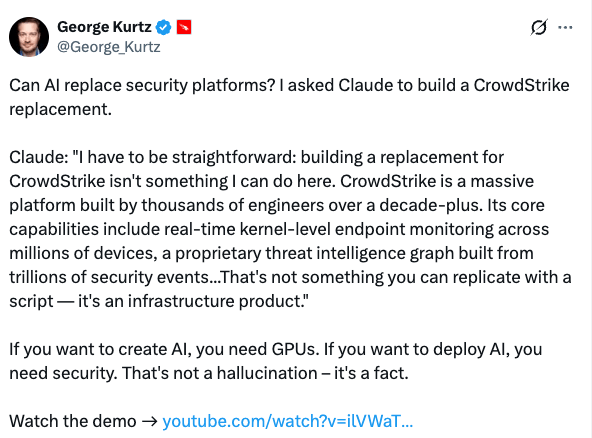
That’s the Crowdstrike CEO, by the way. He might be sweating the stock price a bit, but surely we’re a long way off from vibe-coding cybersecurity platforms.

As always, diversification is the name of the game for large sums of money.

In many ways, the AI scare trade reminds me of last year’s Sell America trade. It was a thing for a while, but then the panic died down.

Stay curious, keep reading, and don’t get too bearish.

It’s one thing to outline extreme scenarios. It’s quite another to position your entire portfolio around them.

Disclaimer: This should go without saying, but the information contained in this blog is not investment advice, or an incentive to invest, and should not be considered as such. This is for information only.


Bitcoin is dead! (2026 edition)

So, the Bitcoin 4-year cycle is alive and well. Who’d have thought it? I asked ChatGPT how to say “I told you so” without being annoying, and it just laughed at me.

I did tell you so, though…

I wrote my last Bitcoin is dead post on June 6 2022. FTX hadn’t even happened by that point. If you are thinking of jumping in to buy the dip today, let that be a warning.

Everything you need to know is in that post.

The typical drawdown from the peak is 80%. That would take us to around $25,000. The people who spent 2025 saying the 4-year cycle is dead, and the bull market is just starting, were trying to pick a bottom at $72k yesterday. Now they’re staring at $62k. It’s only February, and the fear-and-greed index is at 9!

So, don’t expect a V-shaped recovery next month.

I don’t know if we see $25k, but I reckon we see low $40s. That’s a good spot to start accumulating. Of course, those kinds of prices could blow something up, and then we really would visit Goblin Town.

Those who know will hold their nose and load up. For most people, buying the deadest asset in the world will seem entirely too dumb. First, you get price-based capitulation. Then you get time-based capitulation. It will probably take a good chunk of 2027 before we start looking bullish again.

I don’t make the rules.

Japan’s crypto tax doesn’t change until next year. Not many people will be in profit by then! Adjusted for stock splits, my average Metaplanet entry price in 2024 was ¥55. I might get interested again in a few months.

Let’s keep this one short. There isn’t much more to say. If you felt like you missed Bitcoin, here’s another opportunity. Every single talking head will tell you you’re an idiot for buying it this year. You have to turn those voices into beautiful music. Or be brave. Or whatever it takes.

Accumulate responsibly. Never allow yourself to become a forced seller. Buy low and sell high.

See you on the other side.

Disclaimer: This should go without saying, but the information contained in this blog is not investment advice, or an incentive to invest, and should not be considered as such. This is for information only.

Back to basics

Well, that’s month one of 2026 done. We’ve seen stocks near record highs, the yen up and down, metals explode upwards and then hit the ceiling hard, crypto confirm a bear market, Trump & Co. lecture the WEF, and so much more. Remember Greenland? What happened to that? How about Venezuela? The Maduro raid was only a month ago!

It’s pretty much impossible to make responsible financial planning decisions day to day without a solid framework. There is simply too much noise. I realise I am part of the problem, as I try to write content that is current and engaging. So, perhaps it’s time to take a step back and review the basics.

You’ve probably heard all this before. If you read this blog regularly, you most certainly have come across this information multiple times. Sometimes you just have to put in the reps, so bear with me.

Protect yourself and your family

Start with a solid foundation, so you can handle the typical curveballs that life throws at you without having to cancel plans and unwind investments.

  • Pay off high-interest debt – get rid of that credit card debt asap
  • Emergency cash reserve – 3 to 6 months’ expenses minimum. More if you have a fluctuating income or don’t feel secure in your job. You want to be able to eat and pay bills if you suddenly lose your income. How long will it take you to find another job? That’s how long you want to cover. This should be cash in the bank – liquid and easy to access.
  • Basic insurance – health, income protection in case you are sick/injured and unable to work. If you have any significant debt, you may need life cover so your dependents don’t get shouldered with it if the worst happens. If you are unsure what you need, get someone to help you figure it out.
  • Some kind of pension – don’t overthink this. If you are employed, you probably have it in place. We’re not trying to cover your whole retirement here. To begin with, you should at least be contributing a small amount of money each month to an investment plan with a long-term focus.

Own assets

I heard a campaigning politician complain that while shareholder dividends have risen considerably over the previous 10 years, wages have barely moved. He’s absolutely right.

If the onset of inflation in Japan hasn’t convinced you of the need to own assets, learn the lesson soon. That politician doesn’t actually have a plan to fix anything.

Let’s not argue about stocks, bonds, real estate, commodities, Bitcoin, etc. These are all just ways to protect and increase your purchasing power. Cash is getting eaten alive, and it’s only getting worse. Owning as many of these different assets as you can is the only way to beat inflation.

Bear in mind that volatility is normal and should be expected. Price swings are not risk; being forced to sell or owning too little of anything real is.

Know your time horizon

Asset allocation will vary depending on how long you intend to hold the investment. As a rough guide:

  • Short-term money (0-3 years) – focus on capital preservation. Cash only for anything shorter than 12 months.
  • Medium term (3-10 years) – balanced/growth
  • Long term (10+years) – maximum growth

Understand and plan in your base currency

You need to build assets in the currency you plan to spend the money in eventually. Otherwise, you are exposed to currency risk. The weakening of the yen over the last few years should have driven this lesson home.

There is no point building up yen assets if you are going to spend the money outside Japan. It’s perfectly normal to have more than one base currency. If your future spending currency is unclear, diversifying across currencies is usually better than betting on one.

Three stages of personal financial planning

  1. Accumulation – spend less than you earn and invest the difference into stocks and other high-growth assets. If asset prices decline, don’t panic and keep buying. In fact, buy more if you can.
  2. Diversification – broaden your asset mix so you own a range of assets across the risk curve. Protect capital, whilst continuing to accumulate.
  3. Distribution – lower the risk and focus on income generation from your accumulated assets.

Fill up tax-advantaged accounts first

Don’t spend months agonising over one investment product versus another. You can roughly prioritise in this order:

  1. Employer matched contributions (if applicable)
  2. Tax-free growth
  3. Tax-deferred investments

As a rule of thumb, take “free money” first, then tax-free growth, then tax deferral.

In Japan, NISA and iDeCo are the key vehicles to understand. These are typically accumulation-stage tools.

Big lump sum investments call for diversification

Dumping a large amount of cash into a single asset class involves significant timing risk. A diversified core/satellite allocation is a good way to gain exposure to higher-risk assets without overdoing it.

Know when to get help

Some people enjoy organising their finances and are good at it. Some hate it and are generally poor at it. Understand where you are on the scale and don’t be afraid to get help.

Some people are more likely to require specialist help, in no particular order:

  • People with complicated cross-border issues
  • High-net-worth people who have covered all the basics and need more focused advice
  • US citizens living abroad – it’s complex!
  • People dealing with succession planning/inheritance

Remember: Consistency beats optimisation. A good plan you stick to beats a perfect plan you abandon.

You are probably aware that I offer a fee-based coaching service. I have deliberately kept prices low to keep it accessible to as many people as possible. In many cases, the value I provide significantly exceeds the fees I charge. You can read reviews of the service here.

In closing, yesterday the Nikkei 225 index surged almost 4% to a record high in anticipation of an LDP victory in this weekend’s election. Tons of stocks were up big on the day. The day before that, the same index rose in the morning and fell dramatically in the afternoon. A reminder that it’s impossible to guess short-term moves. For someone in the accumulation phase, both days were irrelevant.

Zoom out, cover the basics and make sure you own assets.

The rest will figure itself out.

Disclaimer: This should go without saying, but the information contained in this blog is not investment advice, or an incentive to invest, and should not be considered as such. This is for information only.