Yes, on 20 January, Donald J. Trump will be sworn in as the 47th President of the United States of America. The orange man is expected to unleash a flurry of executive orders on day one. We’re talking about deportations, tariffs, and maybe, just maybe, some crypto-related announcements.
If you were holding out for an executive order to create a strategic Bitcoin reserve, I don’t quite know what to tell you. In classic Trump style, the first crypto president has spectacularly missed the point and befuddled the market with a ‘winning’ combination of grift and incompetence.
Where to begin? Over the weekend, whilst holding a black tie pre-inauguration crypto ball, the Trump team decided to launch a $TRUMP meme coin. Traders and degens scrambled to verify if it was official and when they did, the new coin went from zero to around $14 billion market cap in 7 hours.
People got rich. One of those people being the man himself, whose team owns 80%+ of the supply. The potential for a rug pull did not deter traders and the coin looked poised to continue its rise. And then, a truly crazy thing happened.
They released another meme coin.
Early this morning, news began circling of the launch of $MELANIA. Before long, Trump himself reposted the announcement. I bet you can’t guess what happened?
Yes, the minute the market realised the Melania coin was real, they dumped the Trump coin in droves to hop on the next train, sending $TRUMP crashing from around $72 back to $40. They also managed to overload the Solana blockchain to the point where it could no longer cope and chaos ensued as people struggled to get their money out of one ridiculous shitcoin and into the other.
I learned a new term today: grift dilution. That’s where you release a second grift, right on the heels of the first one, and it diminishes the impact of the first grift without creating any more profit via the new one.
Talk about snatching ‘it’s so over’ from the jaws of ‘we’re so back’…
The initial Trump coin had already sucked the liquidity out of all altcoins except Solana. The Melania coin managed to knock over Solana and even caused Bitcoin to dump about 6% in one candle.
Magnificent! And tomorrow the real chaos begins!
To add insult to injury, Trump’s World Liberty Financial purchased around $48 million of Ethereum (for whatever stunt they are planning to pull next, no doubt) and the price of ETH, wait for it…, did not move at all!
Cursed that coin is.
I know what you’re thinking: isn’t releasing meme coins with massive rug potential right before taking the highest office in the land kind of, well you know…criminal? But never fear, because the new administration is replacing all the top dogs at the SEC with their own people.
Not that anyone in crypto is sad to see Gary Gensler head out of the door. But somehow I can’t imagine that David Sacks, the new crypto czar, would have been prepared for this level of insanity. Who knows, though?
I write this with full knowledge that people outside crypto probably don’t even know any of this happened and are just going about their Monday. Metaplanet (3350) just made another all-time high today as investors pile in hoping that Trump will announce something monumental related to Bitcoin overnight. While he may do so, he could of course just launch a $BARRON meme coin instead.
It’s going to be a weird four years…
As I edit this hasty missive, I see that $TRUMP is back at around $58 a coin, which is approximately $11.6 billion market cap. $MELANIA is at $1.7 billion. So maybe it is a successful grift after all? The mind boggles.
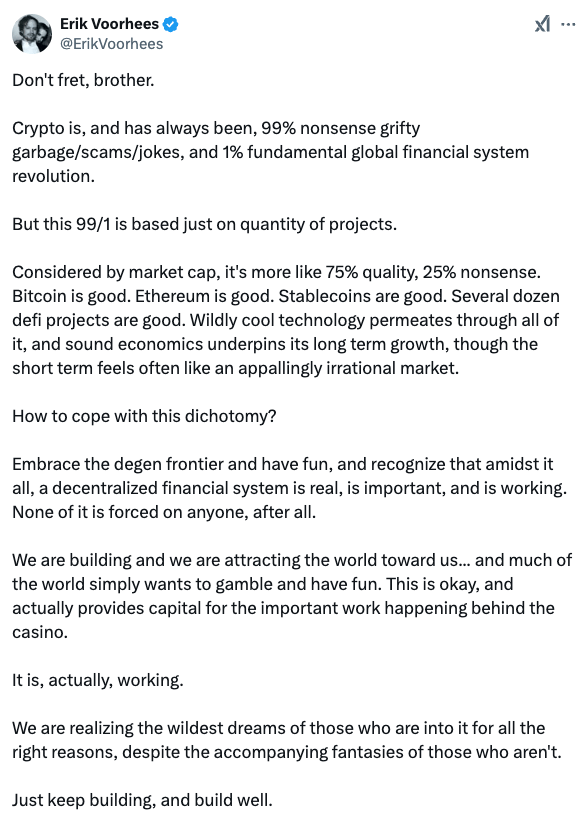
Before we all get too down on crypto, OG Eric Voorhees actually explained things rather well in this post:
Amen to that. Take care out there, folks!
Disclaimer: This should go without saying, but the information contained in this blog is not investment advice, or an incentive to invest, and should not be considered as such. This is for information only.
Happy New Year, everyone! Welcome to the year of the snake. Just as we get back in the swing of things, a three-day holiday lies ahead. I watched the news last night and was reliably informed for 20 continuous minutes that it is snowing in the places where it always snows at this time of year. It’s nice when things go to plan, huh?
If you enjoy winter sports, it looks like a great season for it!
It would be nice if the investment climate was equally predictable, but alas, it’s complicated. In many ways, 2024 was smoother than expected. Global stocks gained around 19%, led by the Magnificent Seven and the hype around the AI trade. Japanese stocks kept pace well, although gains were concentrated in the first half of the year and things got a little scary for a minute there in August!
I had a look back and over the year I wrote 26 posts, covering the usual financial planning and asset allocation stuff along with macro views, currency, stocks to watch, crypto, AI, quantum computing and more. I hope it kept you entertained and maybe provided some actionable ideas. I plan more of the same in 2025, with the focus remaining on action. There’s already far too much information out there and the key for me is uncovering what we can actually do with it.
January is prime NISA allocation season and I’m sure many of you are already getting your accounts organised. If you are a ‘keep it simple’ type and have already completed this task, I salute you! Just like the gym, most of the battle is simply showing up and getting stuff done.
If you haven’t started yet, here are some things to consider:
Consensus views
So what is the forecast for 2025? The Bloomberg Outlook is always an interesting read. In short, the ‘experts’ are calling for more of the same: a strong US economy, a continued AI-led boom, albeit with a slightly tempered outlook on stocks.
Smart consensus sees US interest rates continuing lower, a weaker dollar, gold higher, and oil lower, with a mild stock market correction likely, but no bear market. Simple enough!
The potential spanner in the works is inflation reigniting as you know who takes office in the US. For what it’s worth, I think a lot of Trump’s tariff talk is bluffing/negotiating but we will know more in a few weeks. All bets are off if he invades Greenland lol! The inflation risk is a more pressing concern. You may have noticed how slightly stronger PMI data sent rate-cut expectations plummeting earlier this week. The market is near all-time highs, yet ultra-sensitive to the rates higher-for-longer narrative.
Liquidity drives markets. How high will risk assets go? Well, that probably depends on the money supply more than anything else.
Bubble watch
Getting away from the consensus views, this morning I found legendary investor Howard Marks writing about bubbles – his memo here is worth a read.
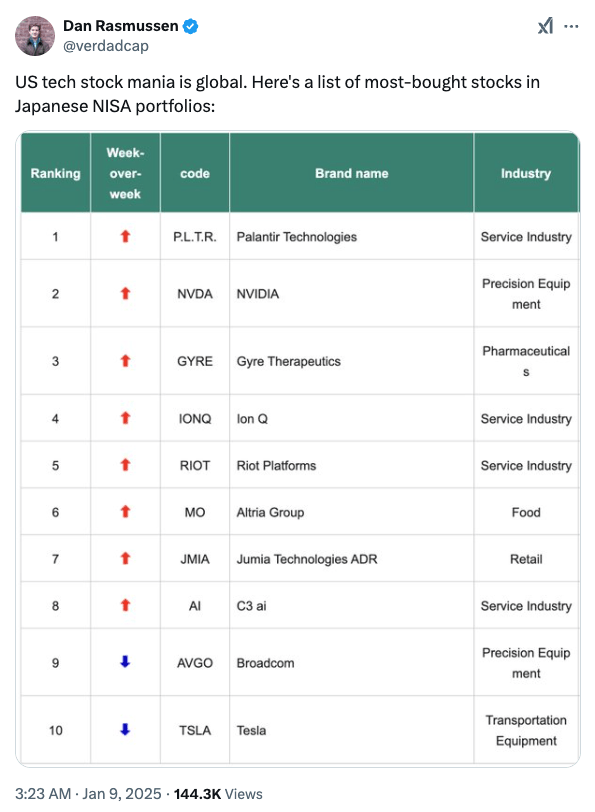
If you want to skip to the Tldr and know where the potential bubble could be, get a load of this:
So much for Mr & Mrs Watanabe being conservative. In my experience, the average ‘balanced’ Japanese investor has half of their money in the bank and the other half in whatever went up the most last year. And they are buying this with a weak yen???
So, how about Japanese stocks?
Global asset allocators that I pay attention to are still overweight Japan. And why not with USD/JPY at ¥158! There are many positives here in the land of snow in winter, with companies expected to post record profits for the 5th year straight. On average, wages increased +5.1% in 2024 and are expected to rise again this year, which is good news for consumer spending. The question is whether the hikes will keep pace with inflation. Remember, real wages have been down only over the last three years…
Still, there are several good reasons to own Japanese stocks: the TSE has successfully pushed companies to enhance returns for investors, resulting in a marked increase in dividends and buybacks. Companies also continue to unwind cross shareholdings.
Of course, the elephant in the room is the Bank of Japan. Having skipped a December rate hike, the BOJ is poised to continue its efforts to ‘normalise’ in 2025. In true Galapagos fashion, Japan boasts the only developed-world central bank trying to tighten policy this year. If you’re looking for a potential wrecking ball, look no further. A sharp upward move in the yen would severely curtail exporters’ profit. Not to mention the whole carry trade unwind thing. (oh, another elephant!)
On the other hand, banks will benefit from rising interest rates due to improved margins on their loan business. Homeowners won’t enjoy that one so much.
With demand for electric vehicles and smartphones flattening, the semiconductor sector will rely heavily on AI growth. A lot is riding on the rise of the machines.
All in all, though, the outlook is constructive for Japanese equities.
Time for some action!
Ok, I promised some action points. Obviously, I can’t give broad advice here, but this is how I am organising NISA this year:
Tsumitate is set and forget. I’m at 40% JPX 400, 30% All Country, 30% NASDAQ
Growth – I allocated about a third this week and plan to allocate the rest in the next week or two
I am leaning toward a much broader ETF allocation this year rather than trying to pick stocks. The last two years have been too easy – you could just throw darts and the stocks you hit would go up. I’m not convinced it will be so simple this year
At ¥158 to the dollar, I will keep a sizeable allocation to Japanese stocks. 1489 High Dividend is a favourite of mine and I also like the 1624 Machinery ETF
Can we forget about Bitcoin now?
Bitcoin has crashed to $93,000. These are desperate times!
If you are new to crypto, allow me to remind you that -30% dips are normal in a bull market. We had a -50% dump right in the middle of 2021. You get used to it, kind of…
If anything, the drawdowns have been mild so far. Unless you own Alts – those dips sting!
If you own crypto, I can’t stress this enough: the best thing you can do is go to sleep for about 3 months. Block out the noise.
I think we are all aware that 90% of what the orange man says is hot air, so if you are relying on the President-elect to send your bags higher, you may be disappointed. However, make no mistake, the new administration in the US is massively crypto-friendly compared to that of the outgoing dinosaur dude. It will be a factor.
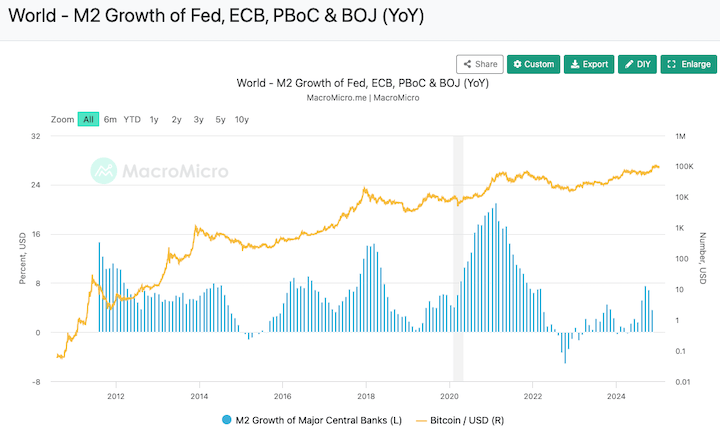
The best indicator is right here – keep an eye on it: (chart from MacroMicro)
Money supply has just taken a dip of its own, hence the market reaction. However, it won’t stay down for long. Unless inflation really runs wild, conditions will loosen.
You may think I am nuts. A year ago I wrote The Investment Case for Bitcoin with the price at just under $40,000. Some guy on Facebook called me a scammer and proceeded to spout a bunch of talking points I recognised from mainstream media circa 2017. These people are everywhere and they are brimming with confidence. I wonder if he has any other assets he thinks we should avoid?
Currently, sentiment is remarkably bad for $93k. ‘Crypto influencers’ are stressing over every dip. When we reach the top, these same people will tell you that dips are mathematically impossible and we are going up forever. Welcome to magic internet money musical chairs!
Long term, it’s going way higher than you think against Fiat. Don’t sweat it if you fail to execute a perfect dismount from the bull. Just don’t FOMO in money you can’t afford to sit on for a few more years.
If you haven’t subscribed, feel free to do so to get my posts by email. If you need help, please check out the coaching link, and follow me on X for jokes and details of Tokyo meetups.
I wish you all the best for the year ahead. Let’s make it a sensational one!
Disclaimer: This should go without saying, but the information contained in this blog is not investment advice, or an incentive to invest, and should not be considered as such. This is for information only.
I don’t mean to think about the Bank of Japan this much.
As we enter December, US markets continue to push to all-time highs and Wells Fargo just got all bulled up and issued a target of $7,007 for the S&P 500 in 2025. Here in Japan, stocks have hardly been in easy mode but are still up around +17% year-to-date. Yesterday, the Nikkei 225 index jumped +1.91% as hopes rose that Japan will be spared the wrath of the incoming US President’s trade controls. These days people seem to love Japan as a destination for investment as much as they do for tourism.
What could go wrong?
The Bank of Japan meets on 18/19 December. For some reason, these dates are marked on my schedule. It must be some kind of PTSD hangover from the July meeting. Remember when they surprised markets with a hike then? I bet you remember the few days that followed. Is Governor Ueda poised to spoil our Santa rally?
Judging by Ueda-san’s recent comments, he aims to avoid any surprises this time around. Earlier this week, he told the Nikkei that rate hikes are ‘nearing’ as economic trends line up with the central bank’s forecasts. The market is interpreting the comments as a signal of a hike with bond yields rising and the yen strengthening against the dollar. In fact, you could say it would be more of a surprise if the BOJ didn’t raise rates this month.
I’m not saying we will see volatility like early August but, once again, Japan’s mainstream financial media seems remarkably calm about the potential impact on markets. With the US in a rate-cutting cycle, tightening in Japan will drive a stronger yen and could lead to another dramatic carry trade unwind. A stronger yen is also not kind to Japanese stocks.
Keep an eye on the Nikkei news for early leaks of the BOJ decision to soften the impact.
What do I care?
Given how quickly markets recovered from the August plunge, it doesn’t seem like there is much to worry about for long-term holdings. However, I once more find myself sitting on some Japanese stocks that have done rather well. And again, I am tempted to take some profits while the going is good. The benefit here is that I could use this money in January to fund my NISA instead of adding more cash. I’m sure I’m not the only one considering this. Imagine how clever we’ll feel if we sell before the meeting, sidestep the crash and buy it all back cheaper in January. (of course, it is never that easy)
Given the possibility of impending central bank shenanigans, the deadline for profit-taking is looming. I’ll give it a few more days and see.
What else is going on?
In other news, Fast Retailing Co. Ltd (9983) shares got a boost as the clothing giant announced a 12.2% rise in domestic same-store sales for November. People must be stocking up on their heat tech!
Donald Trump seems intent on blocking Nippon Steel Corp’s (5401) takeover of U.S. Steel. U.S. Steel released a statement on Tuesday in support of the acquisition. The company is crying for help but foreign takeovers are not a great fit with Trump’s ‘America First’ agenda.
SBI Holdings Inc. (8473) seems to be the beneficiary of the demise of DMM Bitcoin. DMM is giving up the ghost after losing some ¥48.2 billion worth of crypto in a leak back in May. Customer assets will be transferred to SBI VC Trade Co. by around March next year. SBI shares have seen a nice move as a result. One thing about Japanese crypto exchanges – the customers tend to get their money back these days.
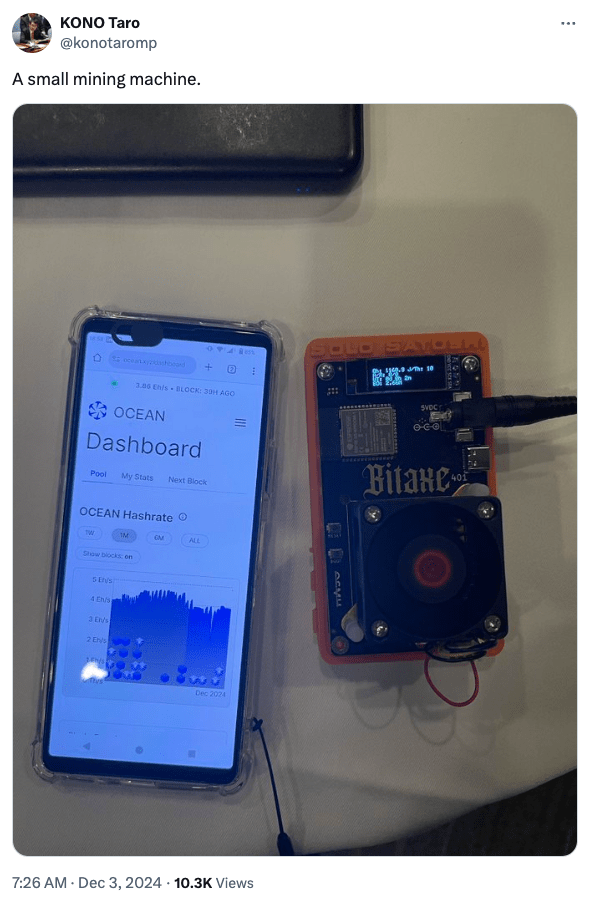
Staying with crypto, I’ve joked before that it’s time to sell when hostesses start trading on their smartphones, so make what you will of this post:
Bull market things…
Finally, Saxo has released its annual Outrageous Predictions list, which is always a fun read. Nvidia surging to double the value of Apple, the end of OPEC and Trump blowing up the dollar feature on this year’s list of unlikely, yet intriguing events.
You never know…
Disclaimer: This should go without saying, but the information contained in this blog is not investment advice, or an incentive to invest, and should not be considered as such. This is for information only.
As I sit here on a calm November afternoon, Bitcoin is trading right around the $90,000 mark. In yen, we are getting close to ¥14 million per BTC. Quite a number, huh? The Bitcoin market cap just overtook silver. Yes, silver. And the total crypto market cap briefly touched an all-time high of $3.01 trillion today.
The mainstream media have picked up on the feverish price action since the US election. Being mainstream media, they are making the mistake of reporting on it as a ‘Trump trade’. I have seen this on the BBC, the evening Nikkei news and elsewhere.
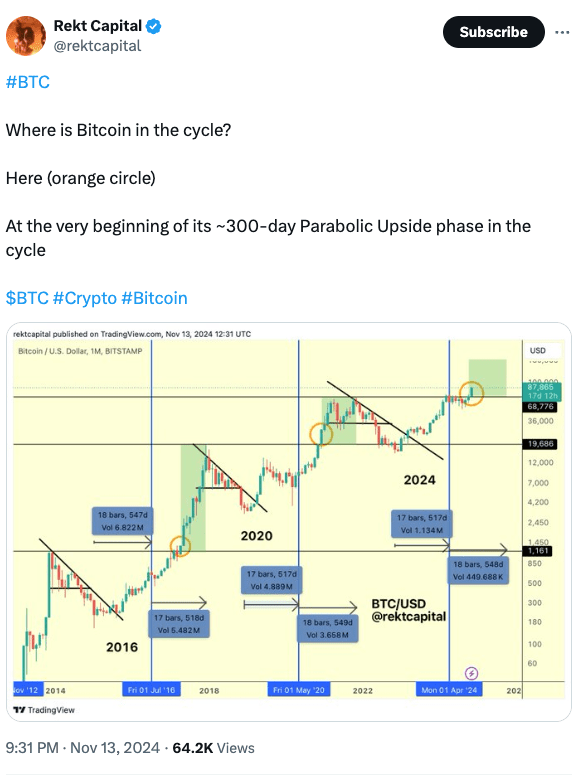
Here’s the first thing to note: the bull market was already in motion and primed to enter the parabolic phase. Trump was just a catalyst. It was going to happen anyway. Something else would have kicked it off if it hadn’t been Trump’s victory. If you think this is about Trump, you have missed the point.
That said, the incoming US administration is going to be far more crypto-friendly than the current one, which is something I covered in my previous post, Full Send.
I discussed bull market catalysts back in my October 2023 post: Bitcoin, Pump up the Volume! I was wrong about the US entering recession (so far), but that wouldn’t have stopped the bull market either.
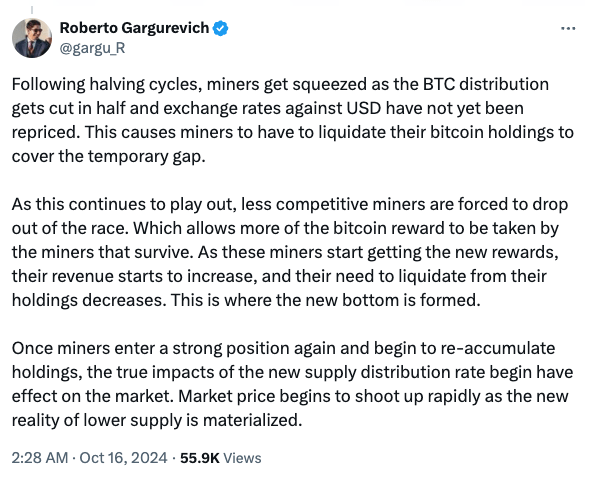
Here is an excellent explanation of how the halving, which took place in April this year, squeezes miners and eventually leads to a surge in price:
The key takeaway: the bull market mania phase was going to happen regardless. Trump was a catalyst. Central banks entering a rate-cutting cycle was a catalyst. They lit the fuse, and now we get to watch the fireworks.
So, when do I sell?
Take it easy now. The decisive break of the 2021 cycle top was only a week ago!
We need to be careful who we listen to when things go parabolic. One week in and crypto ‘analysts’ are already calling the top.
It’s been interesting to note that over the past week, during Asia daytime, price has tended to dip. People are taking profit at these levels. Some of these people probably bought the 2021 top, of course. Then overnight, when Blackrock and the other ETFs start buying, price moves up again. ETF inflows for the first 3 days of this week totalled $2.4 billion. Retail FOMO is only just getting started.
Some have lamented how people are now going to pile in and end up buying high and getting stuck holding the bag. Yes, that’s what is going to happen. It happens everywhere when the price of an asset shoots up. It’s not limited to crypto. Your job is not to join the legions of people who make this mistake.
Study this tweet. Ponder it. There’s a whole chapter of George Soros’ best-selling book in those 6 words. (look up reflexivity from ‘The Alchemy of Finance’)
An asset may start to rise due to fundamentals, an economic or political event, a drag on supply, or whatever. Once it starts going up, people notice and react to the price, pushing it higher. This can get extreme during bull markets and bubbles.
Things are about to get silly. Focus.
Professional traders and investors are generally very good at buying low. Research shows that they are mostly pretty average when it comes to selling high. It’s actually really difficult. Sell too early and you regret leaving money on the table. Wait too long and you get fixated on the all-time high and start willing it back up there when you should be hitting the exit.
It’s hard. Don’t let anyone tell you otherwise.
You are not going to sell the top
Accept this. It’s not going to happen.
So, what to do?
Have a plan
Are you even going to sell? Bitcoin is going way higher over the next 10 years. It’s perfectly acceptable to hodl and ignore all the noise. You don’t have to complicate matters. If that’s your plan, it’s a good one. Please enjoy doing something else!
Many intend to sell during the bull run so they can accumulate more in the inevitable bear market that follows. That requires a plan of action. I can’t tell you exactly what that plan should look like. It’s an individual thing. But have a plan.
Some people need to build a spreadsheet. Some just need a few calendar reminders. Here are some general pointers:
Avoid round numbers – everyone wants to sell $100k. Yep, they did in 2021 too. The market does not owe you a particular number. Your favourite analyst says we are going to $125k – giddyup!!! This is how people screw up. Waiting for a number that never comes. Your favourite influencer says the bull market will run until February 2026 – red flag!!! Don’t get sucked into this kind of thinking. Nobody knows anything.
I would be much more willing to bet that BTC reaches $1 million sometime in the future than I would to bet on it reaching any particular number in the next 10 months.
Average out – the chances are you didn’t buy all of your Bitcoin at the stone-cold bottom of $16k. More likely, you bought little by little during the bear market and the early bull market. Dollar-cost averaging is a great way to buy a volatile asset. It’s also a great way to sell a volatile asset. Exiting a little at a time over the coming months means you will get out at an average price, which is a lot better than round-tripping the whole bag back to the bottom. You might even sell the top on one of those orders!
Alts go first – I stressed this in my previous post: Bitcoin and crypto are not the same thing. Any non-Bitcoin crypto asset needs to be aggressively sold when things get crazy. That means ETH, SOL, SUI, dogs, cats, squirrels. Whatever crazy coin you got yourself into that is destined for the moon. It’s going to crash 90%. And then it’s going to get cut in half again. Most meme coins are going to zero. (don’t worry, Doge will survive!)
Sell catalysts
The 2021 bull market peaked at $69k in November of that year. At that time, crypto influencers were loudly calling for a push to $100k by around February 2022. Euphoria reigned. Meanwhile, Jerome Powell and his pals at the Fed were just getting to grips with the fact that inflation was not going to be transitory like they thought. Bitcoin rolled over as it became apparent we were about to enter a rate hike cycle. Maybe we would have got $100k without it, maybe we wouldn’t. I wish I could say I correctly identified this glaring top signal, but I didn’t. I know one or two traders who did, but we are talking about a very small minority.
Just like there are catalysts that ignite a bull market, there are events and conditions that usher in the bear. Whilst averaging out, look for the signs. Averaging out may well require selling on both sides of the cycle top.
The number one thing to look out for is euphoria. When everyone thinks we are going up forever, take cover.
Don’t forget the tax man – assuming you did a great job and averaged out, you should end up with some handsome profits. But don’t rush out and buy the lambo just yet. Remember, you are going to have to declare your winnings and pay the man. Many a successful trader has fallen into this trap and ended up in debt.
Reinvest – make sure you reinvest profits for the future. You don’t have to lump it all back into crypto. Splitting part of the gains into a well-diversified portfolio is a smart move. Past bear markets have seen Bitcoin drop by around 80% from its peak. Start getting greedy again when we get to those levels.
Enjoy the ride – bull markets are fun! Laugh at the memes, smile at the gains, take profits and just beware of euphoria.
Disclaimer: This should go without saying, but the information contained in this blog is not investment advice, or an incentive to invest, and should not be considered as such. This is for information only.
The American people have spoken, and it’s about goddamn time! We may argue about politics but I think there’s one thing we can all agree on: there is no need for a presidential election campaign to take all year. Can’t you just get it over with in a month or so?
You have likely already had your fill of election hot takes, so I will spare you mine. I will, however, use this post to explore what the result could mean for our investments over the weeks and months to come.
Risk on, for now at least…
The initial market reaction to Trump’s win was well-expected. Stocks pumped, and Bitcoin surged to a record high. Add to that above-trend GDP growth and gold around all-time highs and you have an intriguing risk cocktail in the mix.
And then, last night, Jerome Powell delivered another rate cut. The Santa rally is well and truly in play.
Financial conditions in the US are easing considerably with a strong economy and inflation not fully defeated. What could go wrong? Many, myself included, think that the Fed is cutting too soon.
It’s one thing to disagree with the man’s strategy. However, don’t go asking him any stupid questions!
I’ll take that as a ‘no’.
On the subject of inflation, Powell also wasn’t afraid to say the quiet part out loud:
For those who think pre-pandemic price level is coming back Fed’s Powell notes “the price level doesn’t come back down…It takes some years of real wage gains for people to feel better.” Underscores disconnect from how public experiences inflation vs. economists view.
Take a moment on that one. Prices don’t come back down. Wages have to catch up. If you live and work in Japan, how are those wage hikes coming along? Data released on 7 November showed that Japan’s inflation-adjusted wages fell for the second month running in September. (you may remember that before that they fell every month for more than two years)
In case you missed it, I covered the four must-own assets for inflationary times in my previous post. All roads lead to inflation. Plan accordingly.
Stocks look likely to remain strong into year-end. If you are wondering what can go wrong after that, the bond market is the place to look. America just came out of the longest period of yield curve inversion in history. (short-term interest rates being higher than long-term rates) Without getting too deep into the weeds here, an inverted yield curve frequently precedes a recession. The consensus, however, seems to be that this time it’s different and the US economy is heading for a soft landing. Time will tell.
If you want to challenge yourself to understand the relationship between bond yields and the Fed, have a crack at this X thread. I’ve read it twice now and I think I still need another go…
How high is Bitcoin going?
Forgive me, I know I have been banging on about Bitcoin for a long time, even longer than the US election! My take is that the 4-year halving cycle is the best predictor of price movement – until it’s not. If that cycle breaks, I will change my view but as of now, it is playing out exactly as expected.
However, the Republican election sweep just added rocket fuel to the fire. In no particular order, here is the crypto bull case for the next 10-12 months and beyond:
The Democrats’ war on crypto is over
SEC head Gensler is on the way out – see ya buddy!
A significant number of incoming senators are pro-crypto/crypto-curious
Senator Cynthia Lummis has submitted a bill proposing a strategic bitcoin reserve. The proposal is for the US to buy 1 million BTC over the next 5 years. That’s 548 BTC a day. Currently, only 450 are mined every day.
Detroit, Michigan just became the largest American city to accept crypto as payment for taxes
Global easing cycle underway
Retail didn’t even get interested yet
Solana ETF possibly in the works
The parabolic phase of the bull cycle is upon us. I am not making any predictions as to how high it will go. Nobody knows. But the higher it goes, the harder it will fall at the end. That’s how the 4-year cycle runs. Here’s Mark Yusko with his take:
📺 The Bitcoin Bull Run Cycle Explained by Mark Yusko! 👀
Mark Yusko of Morgan Creek Capital Management breaks down what will happen next for Bitcoin as the bull market cycle continues into 2025.
— Tony Edward (Thinking Crypto Podcast) (@ThinkingCrypto1) November 6, 2024
If you own Bitcoin, you need to decide if your strategy is to hodl for the long term or sell during the bull run so you can increase your holdings in the inevitable bear market that follows. Option two sounds great, but it’s harder than you think. Expect more on that in a later post. In my humble opinion, any other flavour of crypto needs to be sold in the bull market. Those Metaplanet shares too. It will all get crushed when the music stops. But for now, enjoy the ride!
Disclaimer: This should go without saying, but the information contained in this blog is not investment advice, or an incentive to invest, and should not be considered as such. This is for information only.
Happy Friday! I thought I would provide a quick round-up of what is going on in markets. In case you missed it, here’s the most important five minutes of financial commentary I saw this week:
If you don’t know who PTJ is, here is his Wikipedia page. The Tldr is legendary trader and billionaire hedge fund manager.
The message here couldn’t be clearer: ‘All roads lead to inflation.’ Note the mention of Japan around the 4-minute mark. The playbook for how nations get themselves out of debt trouble is to inflate their way out. This is happening. Think what that means for your spending power. Think what it means for the yen…
So what assets does a guy like this own to face down the inflation threat? Bitcoin, gold, commodities and tech stocks. Hard assets and tech stocks. Simple.
I have had numerous conversations this past few weeks along the lines of ‘I want to own gold, but I feel like I’m too late.’ Yes, this is why I preach having the core of your assets in a diversified portfolio instead of just lumping it all into a global stock ETF. If you owned a diversified portfolio, you would have 3-5% in gold, and that part of your portfolio would be up +30% this year already. You wouldn’t have to scramble to buy some now.
This is an excerpt from a post I wrote in March 2023:
‘But global stocks have outperformed a diversified allocation over the last 12 months.’ – yes, there will be times when they will do that and there will be times when they won’t…
Here’s the simplest way I can put it: if you are young and in the process of accumulating wealth, then maybe a 100% stock allocation is ok. If you have already built up a nice nest egg, you need to think seriously about how to keep it. Spread the risk and sleep well at night.
When it comes to the satellite holdings, it’s pretty clear what needs to be beefed up right now: bitcoin, gold, commodities and tech stocks. You might already have commodities in your diversified portfolio, but with inflation looming, it’s time to get some more. Note that PTJ mentions how commodities are still under-owned.
Bitcoin is coiled
The Bitcoin four-year cycle is playing out exactly as expected and we are about to enter the fun phase.
If you are waiting around for a Japan Bitcoin ETF, I wouldn’t hold your breath – see this Financial Times article.
Meanwhile, Microsoft placed an ‘assessment on investing in Bitcoin’ on the voting ballot for its 10 December annual shareholder meeting. The Microsoft board recommends voting against the proposal, deeming it ‘unnecessary’ as the firm’s management ‘already carefully considers this topic’. This is a conversation that will take place in boardrooms of more and more major companies. Note here that Tesla still owns 9,720 BTC.
Gold breakout is happening now – are you really late?
Chart of the Week – Gold
Gold is starting to come on the radar for more and more people (after rallying some 60% off the October 2022 low), with financial pundits, hedge fund billionaires, and even mainstream media starting to talk louder about the shiny metal.
Tesla was the first Magnificent 7 company to report earnings this season and it got things off to a good start. The EV manufacturer’s stock just had its best day in the market in over a decade after reporting better-than-expected results. I understand why some people don’t like the CEO, but betting against his companies is a risky business. A +22% gain in a day is going to hurt some short sellers. More on upcoming Mag 7 earnings here.
That’s all I have for today. Wishing everyone a great weekend!
In summary, all roads lead to inflation. A core diversified portfolio and satellite holdings in bitcoin, gold, commodities and tech stocks is the best way to face down the threat to your purchasing power.
Disclaimer: This should go without saying, but the information contained in this blog is not investment advice, or an incentive to invest, and should not be considered as such. This is for information only.
So, here we are. Overnight, the Federal Reserve announced a rate cut of 50bps, the first cut in four years. Projections imply a further 50bps later this year and another 100 bps in 2025. Welcome to the rate cut cycle.
US markets reacted cautiously, with stocks rising ahead of the announcement only to give back those gains and close down slightly. 50bps is considered a big initial cut, so it will be interesting to see how markets behave over the next few days as they digest the news.
Surprisingly, the yen fell against the dollar to the upper ¥143 range and Japanese stocks were up strongly this morning. Again, time will tell if the initial reaction is the correct one.
The macro gurus will no doubt be fighting it out as to whether the US economy is coming in for the much-vaunted soft landing or heading for recession. Jerome Powell sounded upbeat on America’s economic prospects and made clear that he views the larger cut as a move to prevent the Fed from falling behind.
We will find out in due course.
Sometimes the most obvious take is the correct one: rate cuts are generally bullish for risk assets over time, although we may need to ride out some volatility in the short term. The doomers will keep dooming but optimists make more money in the long run:
“Bulls make more than bears, so if anything being an optimist about life and about things in general is a great attribute as an investor. You just can’t be starry-eyed and naive.” — Stanley Druckenmiller
Deja vu
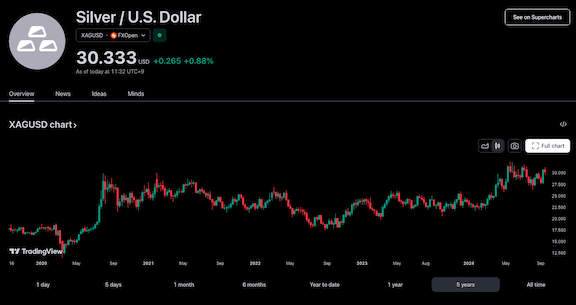
Three assets that are a hot topic in this new environment are gold, silver and bitcoin. It’s funny because I remember these three getting a lot of attention four years ago. Granted, the post-Covid crash environment in 2020 was very different from today – for a start, the Fed funds rate was already at zero in September 2020. However, it’s interesting how things move in cycles. Gold is around all-time highs now and silver enthusiasts are clamouring for a breakout. It has a strong 2020 feel to me, so I thought I would take a look back and see what happened four years ago.
Observe the five-year charts:
As you can see, both gold and silver reacted quickly to the stimulus injection that followed the March 2020 Covid shock. Liquidity is generally good for hard assets. Bitcoin took longer to catch alight but when it did, the fireworks were spectacular as it took out the previous all-time high of $20k and then marched right on to $60k and then $69k in 2021. That move started at $6k at the end of March 2020 and BTC was still only $11k on 19 September 2020.
I like all three of these assets in the current environment, but I like one much more than the others.
Game time soon, anon.
Disclaimer: This should go without saying, but the information contained in this blog is not investment advice, or an incentive to invest, and should not be considered as such. This is for information only.
As another quarter rolls around, it’s that time again. Yes, the main event this week is, of course, the Nvidia Corp (NVDA) earnings report. Once more, expectations are sky-high and, if the chipmaker fails to meet them, the market mood could sour in a hurry. We find out if the AI bull market narrative remains intact on Wednesday night.
Q1 revenue was a whopping $26 billion with guidance of $28 billion for Q2. Wall Street is expecting even more than that with the average analyst estimate coming in around $28.6 billion. Questions have been asked of this company before – can it deliver again?
US tech stocks are trading warily ahead of the report but the Dow Jones Industrial Average managed to put in another record-high close on 26 August.
In Japan, a Nikkei report says that Resonac Holdings Corp (4004) will make a ¥30 billion investment to improve the performance of power semiconductors used in electric vehicles and other devices. This follows the announcement in early July that Resonac will form a consortium with nine other Japanese and US firms to collaborate on the development of semiconductor technologies for generative AI.
Shares in IOT service developer Future Innovation Group Inc. (4392) went limit up today. The jump follows an announcement that FIG’s subsidiary Realize’s transport robot will be deployed in a semiconductor factory run by Rapidus. Rapidus is working on the domestic production of cutting-edge logic semiconductors.
Online banks are picking up customers
The Nikkei also reported today that online banks have doubled their total number of accounts over the last five years. The six major online banks now boast over 40 million accounts as of the end of March 2024, up 13% from the previous fiscal year. The net banks are taking on traditional banks by linking up with point-based ecosystems and smartphone payments and are also providing systems to external companies.
Rakuten Bank Ltd (5838) and SBI Sumishin Net Bank Ltd (7163) gained +5.2% and +5.3% respectively today on the news.
Selling megabank shares to buy net banks could be an interesting trade. However, investors need to keep in mind that rising interest rates and increased competition could slow the growth of the online banks, particularly those that are reliant on low-interest home loans.
Meanwhile, Paypal’s Solana-based stablecoin, PayPal USD (PYUSD) reached a $1 billion market cap just 383 days after its launch, making it the sixth-largest stablecoin.
In other business
If semiconductors and online banks are too flashy for your risk profile, take note that purveyor of high fashion (ok, I jest), Shimamura Co Ltd (8227) reported a 5.5% increase in same-store sales for August compared to the same month last year. This marks 10 consecutive months in which sales have beaten the previous year’s results. Shimamura’s five-year chart isn’t too shabby and it pays a 2.4% dividend. Money in the bank!
Disclaimer: This should go without saying, but the information contained in this blog is not investment advice, or an incentive to invest, and should not be considered as such. This is for information only.
I hope you are enjoying Obon and the summer holiday. After a market crash and a Nankai Trough earthquake warning, things feel a little calmer this week. Hopefully, there won’t be any more ‘big events’ in August other than the local matsuri.
However, September is approaching and it feels like that will be the time to get locked in and focused. So here are a few thoughts as we speed into the last four months of the year!
US markets
There is a slew of economic data coming out of America this week, with the Producer Price Index (PPI) coming in a little softer than expected last night. CPI is tonight and another soft print will heighten expectations of a Fed rate cut in September. Toys will be thrown if Chair Powell does not deliver, but I’m also becoming a little more cautious about the outlook for stocks if he does go ahead and cut. History favours a recession scenario at the end of a hiking cycle. A lot of effort has gone into the soft landing narrative, so we should be on our guard. No reason to make adjustments to long-term investments but things rarely go as smoothly as the crowd expects.
That said, the completion of the US election will remove a lot of uncertainty, regardless of who wins.
Yen / Japan stocks
After starting August with a bang, the Bank of Japan has swiftly backed down from any plan to raise rates again this year. They got as far as 0.25% and the stock market melted down. They didn’t even get to the bond market jitters part of the project. I would love to hear from anyone who can explain how the BOJ will go about a meaningful tightening from here. Imagine what rates at 0.5% would look like. How about 1%?
I just saw a Bloomberg headline that said that PM Kishida is stepping down in favour of a leader who is supportive of the central bank’s efforts to normalise policy. Best of luck to whoever picks up that poison chalice!
Let’s just call BS, shall we? You can’t normalise a ponzi.
Nonetheless, if the Fed does begin to cut, the yen should strengthen. I don’t know how far it will get. 130? 120? 100? It doesn’t matter, because once that cycle is over it is only going the other way. You can save the bond market or the currency and no one is sacrificing the bond market.
I have said it before but I’m nothing if not a broken record: if you are going to spend your future money outside of Japan, you should forget about those alluringly cheap Japanese value stocks and get your money out of yen and into your base currency while you have the opportunity.
If you are here for the long haul, by all means, have at it. In the shorter term, Japanese stocks should do ok and I would even be tempted to look for names that will benefit from a stronger yen. Exporters that did well under the weak yen don’t seem such a great idea going forward.
Getting hard
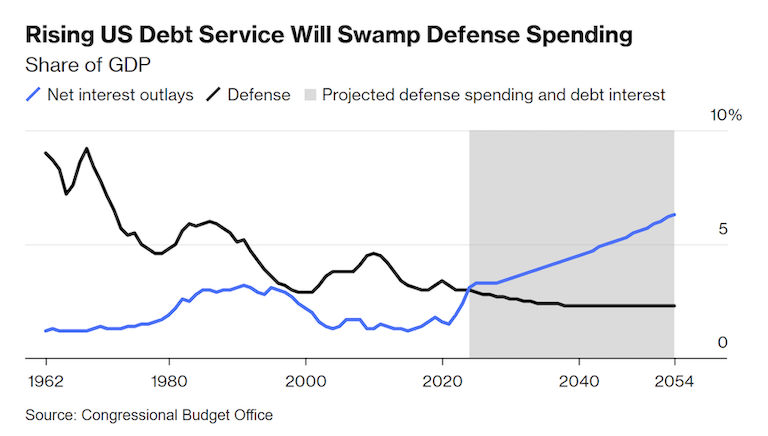
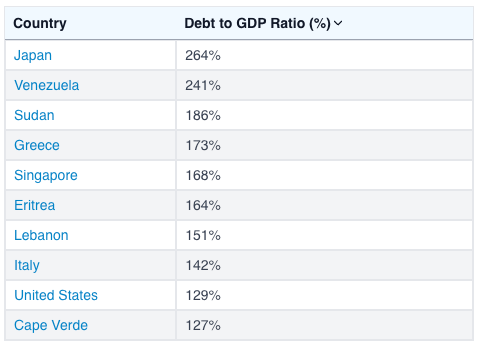
With the US election looming, the cynical among us would be watching out for a liquidity boost to pump up the US stock market. Rather than the Fed, we should probably be looking at the treasury to provide the liquid refreshment. This ‘Bad Gurl Yellen’ piece by Arthur Hayes goes deep into the fountain of liquidity that is about to spring forth. In short, the treasury needs to lower the debt-to-GDP ratio, and it will do so by issuing yet more debt.
The Congressional Budget Office projects that interest payments on America’s debt will total $892 billion in fiscal 2024 and rise significantly in the next decade.
If you are wondering what that looks like, get a load of this chart:
Tell me you’re gonna print more money without saying you’re gonna print more money…
I wrote about currency debasement and and how to protect yourself in Harden up your assets! If you are looking at stocks to plough your hard-earned money into right now, that’s one way to do it but maybe there is a better option.
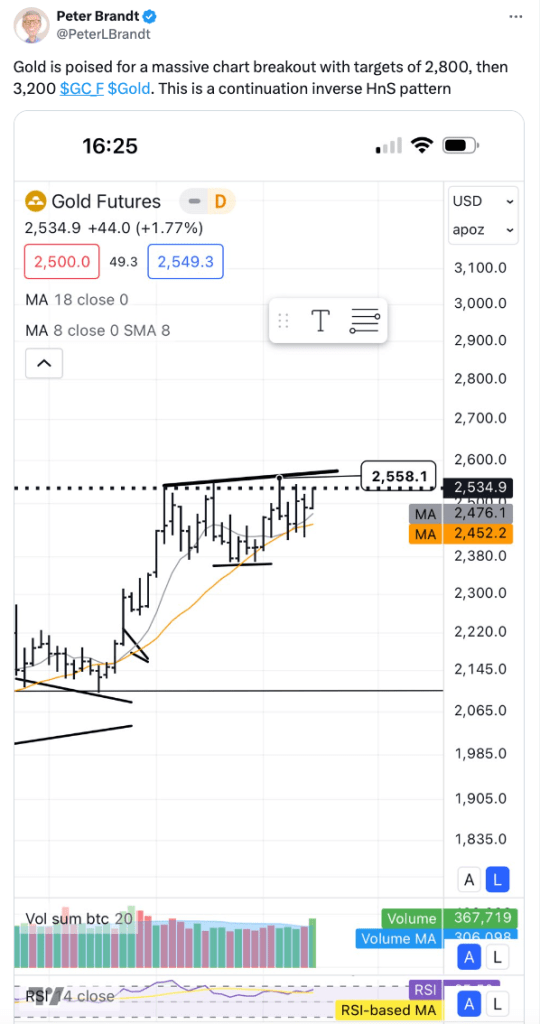
As you can see, some technical traders are getting excited about gold. JP Morgan agrees, arguing that the structural bull market remains intact and forecasting an average price of $2,500 in Q4 and $2,600 in 2025. Geopolitical tensions, rate cut expectations, central bank buying and ETF flows all point to elevated gold prices – report here.
Of course, those are short-term targets and the real point of owning gold is to protect against currency debasement over time. Remember, this is what you’re up against:
Digital gold
Ever the broken record, allow me to point out once more that the boring phase of the Bitcoin bull market is drawing to a close. We probably bounce around for a few more weeks, maybe even a couple of months. The timing is difficult to predict but I expect significantly higher prices by the end of the year. And more to come in 2025. If you are thinking of getting on the train, you don’t have long left…
Despite a reshuffle of the Democratic nominee, pretty much everything I wrote in the Bitcoin bull market update still stands. All aboard!
If you are still trying to get your head around the hardest asset on the planet, the presentations from Michael Saylor’s keynotes are a great resource.
Don’t say I didn’t warn you!
Disclaimer: This should go without saying, but the information contained in this blog is not investment advice, or an incentive to invest, and should not be considered as such. This is for information only.
It’s the 1st of August. The two big central bank decisions are behind us and summer is in full swing. So what comes next? Where will markets be at the end of this year? Nobody knows the answer to that question but I can almost guarantee you one thing: there is turbulence ahead.
Just like Japanese summer, the volatility already got started in July. However, we seem to have entered a new phase and central banks are the main drivers of the momentum shift.
Having hiked rates to levels unseen in 15 years, there is little doubt that the BOJ has entered a tightening cycle. Governor Ueda did not rule out another hike this year and the yen responded quickly to his comments, rising to 150 against the dollar. Today it is trading at around 149. Weston Nakamura sees 152 as the most important price level in global macro right now and we are already well beyond it.
Japanese stocks reacted positively to yesterday’s decision, pumping across the board. However, the Nikkei 225 index slumped -2.5% today as exporters felt the pinch of a stronger yen.
US tech investors rotate into small caps
In the US, Fed chair Powell left rates unchanged while hinting that he is getting closer to a cut. The market fully expects this to happen in September and there will be visible disappointment in people’s brokerage accounts if it doesn’t. Volatility is already rearing its head. Tech stocks have sold off over the past month amid fears that the AI bubble might be bursting. Nvidia has been trending down from its 6 June high of $140.76 and a -7% dump on 29 July seemed ominous, but last night it pumped +12.7% after AMD’s better-than-expected earnings release. Go figure…
Hats off to strategist Tom Lee for calling the rotation into small caps. IWM has been the main beneficiary of the tech selloff.
The crypto coaster rolls on
Not to be outdone by chipmakers, crypto remains unpredictable over short time frames. At the Bitcoin conference in Nashville last week, none other than Donald Trump showed up to play to the crowd. His list of “promises” included: keeping the Bitcoin the US government has seized as a strategic reserve, (yes, wow!) firing Gary Gensler on day 1, ending the democrat’s war on crypto and making the US a leader in mining.
The air quotes around “promises” don’t need much explanation. Trump has zero interest in crypto and is plainly exploiting the dem’s antagonistic stance toward the industry for votes. But don’t let that distract you from the bigger picture: governments are examining Bitcoin as a strategic hedge against their own money-printing excess. The fact that this conversation is even happening is remarkable. Bitcoin game theory is going to get very interesting in the months and years ahead.
Trump to the Bitcoin Bros: “Have a good time with your Bitcoin and your Crypto and everything else you’re playing with.”pic.twitter.com/9Mf1zr1mGX
Bitcoin is back in the $64,000 range today, as it appears that the Biden/Harris camp may be selling off the reserve that Trump promised to keep. It’s never boring. See my Bitcoin bull market update for more.
Meanwhile, investors in Japan received a lesson in FOMO from Bitcoin proxy Metaplanet Inc. this week. Shares went on a tear after the company announced its Bitcoin treasury strategy in April and many people piled in late. Now the stock is coming back down to earth with a bang as the excitement wears off. Shares are down over -70% from their 24 July high and the move down doesn’t look done yet. Of course, every man and his dog wanted the stock when it was skyrocketing and nobody is interested now. There’s a clear lesson there. That said, I wouldn’t be surprised if Metaplanet makes another run if/when Bitcoin makes a decisive break above its previous all-time high and enters the parabolic phase of the cycle. Timing is everything in narrative-driven trades.
So, what to do?
I have noticed an uptick in clients trying to position and trade some of these macro moves, particularly the USD/JPY angle. The problem with access to unlimited information, content and opinion is the urge to react to it and do something. So here’s my two cents:
The summer, and perhaps the rest of the year, will see some turbulence. Volatility goes both up and down. Overall, the backdrop keeps me optimistic. Rate cuts in the US are coming – it’s just a question of when. As things currently stand, it would not be a panic cut, which is constructive for risk assets. US stocks, gold and crypto should react accordingly. Regardless of who wins, the US election will remove a lot of uncertainty. If you are broadly diversified, you could do a lot worse than fastening your seatbelt and taking a nap for a while.
If the BOJ is tightening and the Fed is loosening, the yen should continue to strengthen. This is going to put some strain on export-related Japanese stocks and the market as a whole looks more unpredictable than the US. Governor Ueda said he doesn’t think the rate hike will damage the Japanese economy. He’s probably right for now, but let’s see what kind of toll a series of hikes will take. The last time the BOJ tried to hike was 2007/2008 and that move was reversed in a hurry…
If you have been waiting for your chance to escape JPY and get into your base currency, that window is opening. Don’t miss it – long term it does not look good for the yen.
Stay hydrated folks!
Disclaimer: This should go without saying, but the information contained in this blog is not investment advice, or an incentive to invest, and should not be considered as such. This is for information only.

















 Smart Money Asia