
USD/JPY: ¥160 and beyond!

I came back from the gym this morning and found my wife at her desk.

“Wow, my stocks are up again!”

This is good news.

“But why are they going up so much? News on the economy doesn’t seem so great.”

I begin an explanation of how low interest rates have finally reignited inflation in Japan and fueled a boom in stocks. And despite the recent rate hike by the Bank of Japan, real rates remain negative, which means the price of things, including assets, will continue to rise.

Her eyes quickly glaze over, and she goes back to work. I put some coffee on. Then I begin writing this, in case someone is actually interested!

USD/JPY is at ¥157. GBP/JPY is ¥210!!!

Last week’s BOJ rate hike was viewed mainly as an effort to prop up the currency. But it seems unlikely to halt the slide back to ¥160. Could we go further than that next year?

Here’s a quick reminder about the bind the central bank finds itself in, from my January 2023 post How screwed is the yen?:

The BOJ is caught in a spiral of rising bond yields and a falling yen. And between the bond market and the yen, it can only save one. The programs you would have to enact to save the yen are the exact opposite of the programs you would have to enact to save the bonds. To save the currency, you have to raise rates. To save the bond market, you need to keep rates low.

Last week’s rate hike was a band-aid. Many were hoping for at least a short-term bounce in the yen, but it didn’t come. The BOJ can’t manage an aggressive hiking cycle without destroying the bond market and taking down the banks, pension funds and insurance companies that own the bonds.

Nobody wants to say it, but further devaluation of the yen is the only option. And the new Takaichi administration is implementing policies that will only accelerate the decline. (Japan Diet enacts 18 trillion yen extra budget for PM’s expansionary stimulus)

¥160 and beyond is firmly on the table.

This is all very depressing, I know. However, I imagine many of us will be looking to allocate money to NISA, etc, next year and need to begin thinking what to do with it. I haven’t made any decisions myself yet, but I’m beginning to put together a list of themes that will influence these decisions:

Themes for 2026

  • Japan’s base interest rate is 0.75%, inflation is around 3%, so we have a real rate of negative 2.25%
  • The BOJ can maybe squeeze in one more hike to 1%, so real rates could go to negative 2%
  • This is still very accommodative monetary policy and will support asset prices
  • The weak yen will persist and perhaps go beyond 160
  • Rice isn’t getting any cheaper, and people’s spending power will continue to decline

To be clear, I’m not in the doomer “Japan has reached the end of the road” camp. Japan is the world heavyweight champion of muddling through with extraordinary monetary policy. There’s still a lot of road to kick this can down. However, those who do not own financial assets will struggle. It’s not going to be pretty.

Outside Japan, things could get pretty spicy, too.

Better have a plan to not get knocked out!

A few additional themes:

  • Trump’s new Fed pick will likely force lower rates
  • Trump will want to pump the stock market ahead of the midterms
  • However, the AI trade will continue to come under scrutiny
  • The debasement trade is very much still in play – own hard assets
  • Bitcoin bear market – an opportunity to accumulate

I will think on this some more and come back with a plan for 2026 in the next few weeks. Let’s see if the yen breaches the ¥160 mark before the year’s end.

Thanks for reading. Wishing you all a wonderful Christmas!

Disclaimer: This should go without saying, but the information contained in this blog is not investment advice, or an incentive to invest, and should not be considered as such. This is for information only.


Financial repression playbook

One down, one to go. With the FOMC resulting in a dovish cut, we now await the BOJ meeting next week. So, how are things shaping up for the end of the year and 2026?

The Fed delivered the expected 0.25% rate cut. It was accompanied by cautious commentary on next year, without really turning hawkish. Pretty much a goldilocks result for markets. Stocks rallied into the close, while Bitcoin pumped to $94k before quickly retracing. The Fed’s dot plot and 2026 outlook seem wildly irrelevant given where things are going after Powell’s term ends.

Does anybody need that stated more clearly? The next Fed chair will be appointed by Trump and will do his bidding. Their primary function will be to cut interest rates. End of story.

Leaping into the future, it will be fascinating to see if a post-Trump Democrat administration will work to reinstate the Fed’s “independence”. I bet you they won’t…

Anyway, I digress. The US is moving toward financial repression in 2026. Inflation allowed to run hot, and interest rates forced lower = Negative real rates. Negative real rates are a stealth tax on savers. It’s how the government reduces the debt burden.

It’s not good. But it’s what is going to happen.

Americans who own assets will be fine. Those who don’t will struggle.

Lots of liquidity, equities up, hard assets up, and a weaker dollar.

So, Bitcoin to the moon, right?

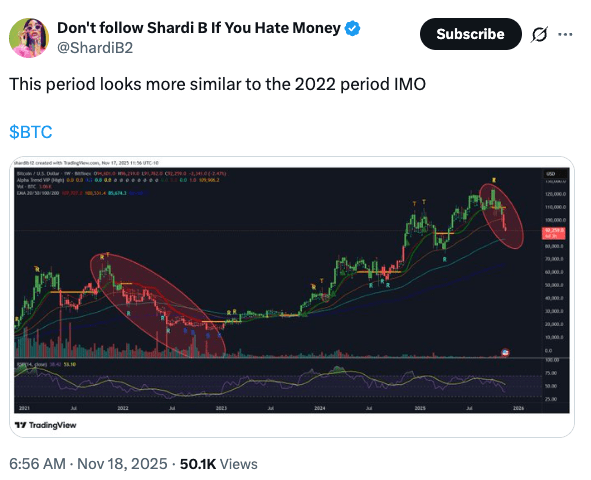
Hmmm, given what I wrote above, we are looking at the perfect environment for Bitcoin. The macro gurus, who are relatively new to Bitcoin, are declaring the 4-year cycle dead and preparing for new all-time highs in 2026. Except that’s not what usually happens. October marked a picture-perfect 4-year cycle top. It doesn’t get any clearer. The bottom should be around Oct/Nov next year.

I’m long BTC and happy to be proven wrong, but I think there is pain to come. I think we will see $40-50k, and buying Bitcoin when stocks are pumping will seem like the dumbest thing a person could ever do with their money. Sentiment needs to be broken before we run again.

And yes, I will buy at those levels. Until then, there isn’t much point in thinking too hard about it.

As for stocks…

The midterm general election is in November. Sometimes the most obvious outcome is the correct one.

Is the BOJ going to spoil the party?

The BOJ is signalling a hike. It’s been reported in the Nikkei. It’s pretty much baked in and would be more of a surprise if it didn’t happen. I don’t think it’s going to shock markets. It might strengthen the yen a little, but it probably won’t be earth-shattering. See my post on the Yen Carry Trade from last week.

Japan, of course, is already at negative real rates. That should support the Japan equity bull market. It only sucks if you don’t own stocks…

I have the flu. That’s as much brain power as I have this morning. Time for a lie down.

Disclaimer: This should go without saying, but the information contained in this blog is not investment advice, or an incentive to invest, and should not be considered as such. This is for information only.
The yen carry trade explained

It looks like the Bank of Japan (BOJ) is finally ready to raise rates again this month. So, right on cue, out come the doomers to ring the alarm on how the unwinding of the yen carry trade is going to blow up global financial markets.

Should we be worried? How could a potential unwind of this trade affect investors in Japan?

What is the yen carry trade?

The core idea behind this trade is to borrow money in a low-interest currency (JPY) and invest it in higher-yielding assets elsewhere.

For example, a fund could borrow yen at less than 1% interest, invest in US Treasuries earning 3.5%, and pocket the difference. This works perfectly until exchange rates make a big move. Then things can get interesting.

A conservative estimate puts the size of the carry trade at around $1 trillion, based on Japanese banks’ foreign lending. Some estimates use the notional value of FX swaps and forwards using the yen to reach a figure closer to $14 trillion.

Of course, hedge funds are not necessarily just buying conservative US government bonds on this trade. A mountain of cheap yen is converted to dollars and other currencies and flows into all kinds of assets. A deep dive would likely reveal that a large portion of this trade has gone right into the red-hot Magnificent 7 stocks.

Why Japan?

The carry trade can take place using any currency with a low interest rate. Japan has been the primary go-to market due to its unique characteristics:

  • The lost decades following the bursting of the bubble in the early 90s
  • Deflation and slow growth
  • The BOJ’s long-term low/negative interest rate policy
  • Hence, the yen became the world’s cheapest funding currency

How the carry trade makes (and loses) money

This trade works based on the interest rate differential – the carry. With a stable or weakening yen, it will remain profitable. In this type of environment, it’s hard to miss.

Problems occur if the yen strengthens. If an institution borrowed yen at ¥150 to the dollar but later the yen strengthens to ¥130, it suddenly requires more dollars to repay the same yen loan.

The unwind then happens as follows:

  • Sell the dollar asset (treasuries/stocks, etc.)
  • Convert to yen
  • Repay the yen loan

This unwind puts downward pressure on the asset being sold, which could be US treasuries or global stocks. And the flood of capital back into JPY accelerates the yen’s strengthening. A relatively small move in exchange rates can snowball into something much larger.

Famous unwind events include the 1998 Asian financial crisis and the 2008 global financial crisis. In 2024, we saw a mini unwind as the BOJ shifted policy.

Why does it matter to everyday investors, especially in Japan?

With the US central bank cutting rates and the BOJ looking to raise rates, there is a real possibility that the yen will strengthen in the short term. Most Japan residents will be relieved as foreign goods and overseas trips will become more affordable.

However, the unwind can suck out global liquidity and do some real short-term damage to our investments. Not many risk assets fare well in this kind of event, so be prepared for international stocks, Japanese stocks, high-yield bonds and crypto to take a beating. Japanese exporters, such as Toyota, are particularly sensitive as a stronger yen erodes their overseas profits.

So, are the doomers right this time?

Beware of people claiming that the yen will suddenly surge and stocks will crash overnight. The reality is:

  • Yen carry trade unwinds tend to happen in bursts, and not always in a straight line
  • Central banks will often intervene, verbally or via policy tools.
  • Markets tend to pre-position before the worst moves happen

You can already see this pre-positioning happening. The yen has strengthened over the last few days after the BOJ hinted at action at its next meeting. Note how BOJ governor Ueda is trying to communicate his thoughts in advance and avoid a “shock rate hike” a la August 2024.

People writing epic threads on X tend to overstate the timeline risks. Sharp moves can indeed happen. However, it doesn’t necessarily guarantee an imminent crash.

Should we be worried?

Concern about the carry trade unwind is most rational if you have:

  • Investments heavily exposed to foreign currencies
  • A portfolio dominated by global stocks
  • Income linked to export-driven Japanese companies

There is less to worry about if you have:

  • Mostly yen-denominated assets
  • A long time horizon
  • No plans to move money internationally soon

Concerns about a carry trade unwind are certainly not irrational. However, the real risk lies less in timing the event and more in understanding how currency moves can affect your portfolio and positioning accordingly.

So it really comes down to portfolio structure. Trying to predict macro events is insanely hard…

Ok, then how do I hedge against this?

Of course, some assets will benefit from a carry trade unwind:

  • The yen, of course, is the obvious winner – that trip abroad could get a lot cheaper next year!
  • Gold is historically a beneficiary of unwinds as investors deleverage and seek out safe havens. If the yen is rising, the dollar is usually falling, which is generally good for gold.
  • Long-duration government bonds generally do well as the world goes risk-off and money flows into the safest assets. Bond prices go up as yields go down.

In conclusion, don’t let the doomers scare you out of long-term investments, but be prepared for some volatility. Keep an eye on central bank rate decisions, the corresponding US-Japan interest rate gap, USD/JPY exchange rate and global risk sentiment.

Personally, I am long-term bearish on the yen, but in the short term, anything can happen.

It’s always good to keep some dry powder to pick up risk assets while investors run scared.

And make sure your passport is still valid for that overseas trip you’ve been planning!

Top image from Freepik

Disclaimer: This should go without saying, but the information contained in this blog is not investment advice, or an incentive to invest, and should not be considered as such. This is for information only.

Bear with me

Markets are not looking so hot right now. I really hate to be bearish, but it’s becoming unavoidable.

Last week, Bitcoin made its first daily close below $100,000 in 188 days. Then yesterday it closed below the 50-day moving average on the weekly chart. This is always bad news for bulls. Some of the people who were telling us the 4-year cycle is over are still holding out for a reversal, but they are probably grasping at straws.

We are so done. Thank you for playing.

I know it’s unlike me to be so negative, but when a situation changes, it’s important to confront reality quickly. Crypto is heading into a bear market, and it’s right on schedule.

Initially, Bitcoin is acting as the pressure release valve as investors lose faith in an overheated risk environment. You will note how, over the last week or so, Bitcoin is lower when you wake up. Asia propped up the price in the daytime, and then America sold hard while we slept. Now Asia is selling, too.

Worse still, BTC tends to lead equities, and in my humble opinion, BTC is heading lower.

Stocks are already wobbling. In particular, the AI trade is coming under increased scrutiny. Nvidia earnings are due on Wednesday. I don’t think there are numbers big enough to satisfy the masses this time, although the numbers will likely be impressive regardless.

I talked about Michael Burry in my last post: In this economy?

Burry put on his Nvidia/Palantir short and then closed his fund. Now he doesn’t have to worry about investors trying to pull their money when the market moves against him. People are debating whether he is actually any good at calling this stuff, which is a valid question. It’s such an obvious trade that you wonder if it can really be that simple, especially with Trump there to pump the markets every time they stumble.

But it doesn’t look great to me. In the short term, at least, I’m siding with the bears.

Time preference is key

It’s ok to be bearish, but the big question is: over what timeframe?

BTC is a good starting point for this discussion, as it is highly sensitive to both global liquidity and overall risk sentiment.

When Bitcoin topped in November 2021, it was just as the Federal Reserve pivoted to begin a brutal tightening regime. Interestingly enough, in November 2025, the Fed is going in the opposite direction. In fact, the market was pricing in a further rate cut in December until the US government shutdown delayed the data and muddied the waters. Uncertainty around rates is a huge factor in sparking the sudden loss of appetite for risk.

The liquidity picture for 2026 actually looks pretty rosy. Trump is effectively going to gain control over the Fed, and he has the midterm elections to pump the market for. On the flip side of that lies a slowing US economy.

Bitcoin’s level of institutional adoption was meagre in 2021/2022. In fact, it turned out the industry was on the brink of collapse. And collapse it did: Terra/Luna, Celsius, Blockfi, 3AC, and, of course, FTX all fell during the bear market.

The picture is very different now. US Bitcoin ETFs have almost $120 billion in assets under management. $72 billion of that is in BlackRock’s IBIT alone. What’s more, the Trump administration is pro-crypto. This is not an industry on the brink of collapse any more. It’s just going to need to take a breather for a while.

Plan for the worst

The typical bear market drawdown from the peak for Bitcoin is 80%. So, worst case, we are going back to $25,000. Ouch! Not pleasant at all, but I would not bet against this outcome.

If ETFs and institutional adoption, plus a favourable liquidity cycle count for anything, which I think they do, we may not go that low. Personally, I’m not really interested in bidding $90k. I’ll get interested at lower levels. $50k seems a bit more like it. (this is my finger in the air, best guess if you are wondering how I got this number)

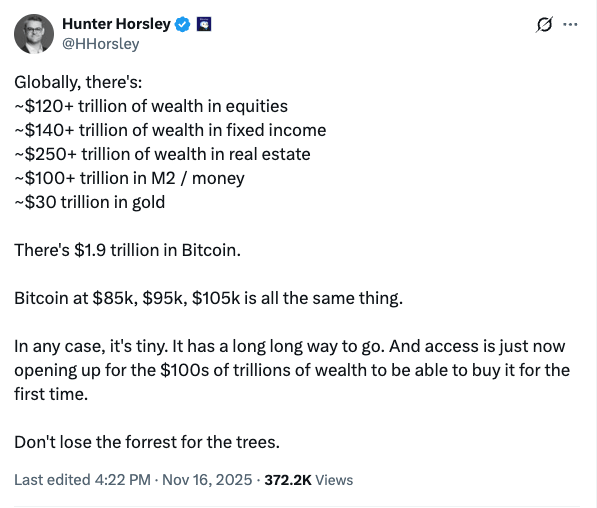
Here’s a little perspective:

What about stocks?

Nvidia’s P/E ratio is around 53. Investors are willing to pay that amount for each dollar of the company’s earnings. I probably don’t need to tell you that future earnings expectations are a little on the high side. The Magnificent 7’s average P/E ratio is around 28 to 35. Those expectations may well be due for a sharp adjustment.

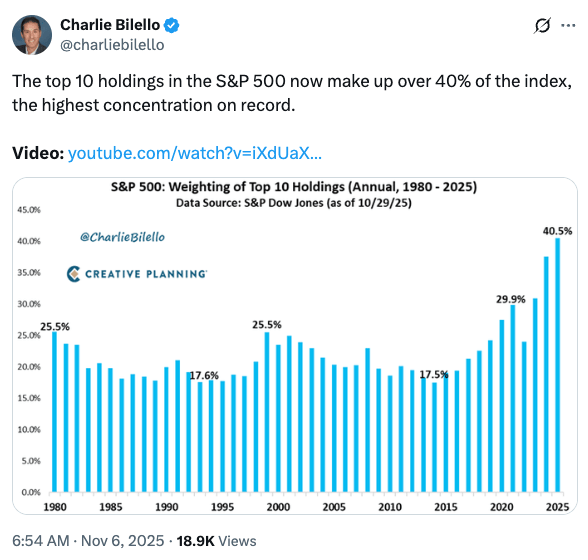
The other 493 stocks in the S&P 500 are not looking so bad, although they could get dragged down somewhat in a Mag 7 correction.

Global stocks, Japan included, are unlikely to emerge unscathed, but we could well be looking at an interesting buying opportunity.

Personally, I kind of like the idea of reducing US exposure (particularly Mag 7) and increasing Japan. The only problem is then you get trapped in yen. Finance Minister Katayama is making the usual concerned noises about exchange rates, while taking absolutely no action to counter the yen’s decline. Real interest rates in Japan remain negative, and as long as they persist, the currency will continue to struggle.

Negative real rates are a boon for stocks, though. If rates somehow ever turn positive, it’s time to rethink.

All in all, it comes down to where you are in the financial planning process. I covered this in the Burry post, but here it is again in simpler form.

I see three key stages in the personal finance journey:

  1. Accumulation – spend less than you earn and invest the difference into stocks and other high-growth assets. If asset prices decline, don’t panic and keep buying. In fact, buy more if you can.
  2. Diversification – a mix of protecting capital, whilst continuing to accumulate. The key to knowing when to diversify comes down to three factors:

a) The data tells you – you hit your number and simply don’t need as much risk any more

b) You become conscious of the amount of money you have at risk and start thinking about what to do

c) Asset prices are considerably higher than the average price you paid when accumulating. Despite the wobbles, we are still in this zone for anyone who has been accumulating for a while. It may not last much longer, however…

3. Distribution – you begin living off the income generated from your accumulated assets, or simply spending the money

If you are in stage 1 or 3 and are properly allocated, a stock market correction should not bother you too much. If you are at stage 2 but have not diversified yet, the current window of opportunity may be about to close for a while. Don’t panic, but perhaps give it some thought.

Personally, I have been selling stocks that have done well over the short term, particularly tech/semi/AI-related stuff. A few Japanese tech stocks I owned got a big boost when PM Takaichi was elected and are probably due for a reality check.

In other business

My next casual meetup, billed as the Nikkei ¥50,000 party, is on 26 November from 7pm at Hobgoblin Roppongi. Everyone is welcome. You don’t have to talk about investing, and you don’t have to drink unless you want to. Some of us may need to!

Before you ask, yes, the event will go ahead even if the Nikkei is below ¥50,000. That is an achievement unlocked, and I’m sure we’ll be back above that level in due course.

Don’t get too bearish!

Disclaimer: This should go without saying, but the information contained in this blog is not investment advice, or an incentive to invest, and should not be considered as such. This is for information only.

In this economy?

It’s been another interesting week. ‘Big Short’ legend Michael Burry returned to X to call out the AI bubble, posting charts that question whether the ongoing mega AI capex boom really matches demand. Burry pops up every now and then to predict disaster, and his hit rate post-2008 is not all that spectacular. However, he followed up by filing his investment firm’s 13F 11 days early, showing that he is short 1 million Nvidia shares and 5 million Palantir shares.

Money where his mouth is.

The market took notice and US tech stocks tumbled on 4 November. Japanese stocks followed suit, with Softbank Group dumping almost -17% over 2 days. This comes at a time when the US government shutdown is blocking the liquidity faucet and tightening things up considerably.

Crypto didn’t like it either, but hey…

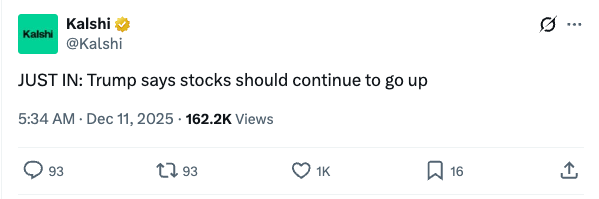
Predictably, President Trump issued some positive comments about stocks and Bitcoin overnight, and the situation calmed down. Every time I think this market is ready to begin its descent into hell, I’m reminded that the guy in charge of America has a vested interest in keeping it above ground…

Clearly, Burry is hitting a nerve with AI bubble enjoyers. Here’s a great thread from Marko Bjegovic covering why he is probably correct.

The ‘K-shaped’ economy

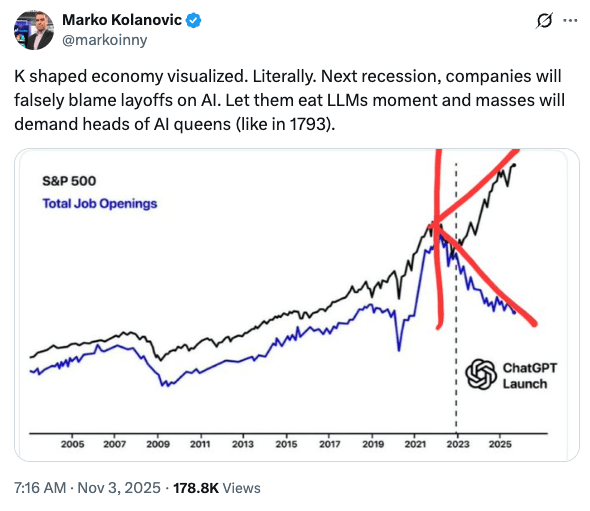
You are probably hearing this term lately. The K-shape represents the latest expression of wealth inequality. Essentially, high earners and large corporations are getting richer as asset prices rise, while low-income households and small businesses, the lower leg of the K, are struggling to get by.

High-end products are selling, while companies like Chipotle are finding their customers poorer and less inclined to visit.

Here’s another way of looking at the K-shape, from a different Marko:

Speaking of liquidity and the AI bubble, Ray Dalio just posted about how the Fed is stimulating at an odd time. I’m not sure the Fed is really beginning QE, as he says, but it is certainly ending QT, cutting rates and taking an expansionary stance. This is something it would generally do when the economy is in trouble. Instead, the backdrop for the Fed’s easing is high asset valuations, a relatively strong economy, inflation above target and abundant credit. Not to mention a bubble in AI-related stocks – the elephant in the room, so to speak.

The Trump administration is taking a bold and probably reckless bet on growth, and particularly AI growth. What could go wrong???

Time to take profit?

We’ve been talking about a melt-up before a melt-down, but that’s by no means guaranteed, and we’ve already melted up a lot.

Stock investors, belonging to the top leg of the K, have done very well, but are now faced with a choice: remain invested and ride through the bubble or protect capital. As Michael Burry experienced in 2008, bubbles can keep inflating and punishing shorts for a long time before they finally pop. Younger investors can probably handle the drawdown, provided they are disciplined enough not to sell the bust. We all know the drill when panic hits: as the last desperate few capitulate, central banks will cut rates, stimulate, and markets will surge back over the next 12-18 months.

People who are getting closer to spending their investment money should probably think more carefully. There may not be a better opportunity to take risk off the table and diversify for some time. Nobody ever went broke taking profit, especially around all-time highs.

For people in between, US treasuries are holding up as a safe haven as well as anything else at this time. Spreading some of the risk also serves an often overlooked purpose: offering the opportunity to rebalance and buy the bottom in stocks if we do suffer a crash. I stand by my belief that anyone with a meaningful amount of money should be well diversified at a time like this.

The stock market is not the economy

Here in Japan, we are enjoying the Nikkei holding above the ¥50,000 mark. That doesn’t mean we escaped the K-shaped economy. In a rare quiet moment the other evening, I was thinking about Japan’s economy and why interest rates don’t seem to go up much. Aside from the rich asset holders, many people are struggling. Wages still lag inflation. 5kg of rice is almost ¥5,000. The lower/middle classes do not have a lot of money to spend.

Fewer people spending money is bad for the economy. The general expectation seems to be that interest rates will rise gradually. They certainly won’t rise quickly. Higher rates would mean higher interest payments on government debt. PM Takaichi is focused on growth, not inflation.

Should we really expect a meaningful rise in interest rates? I simply can’t see it.

If rates can’t rise, then the yen remains weak, prices increase, stocks and Tokyo property appreciate, and low-income families continue to struggle.

If all this is true, then what’s the trade?

Own dollars, own financial assets, own hard assets, and be kind…

Disclaimer: This should go without saying, but the information contained in this blog is not investment advice, or an incentive to invest, and should not be considered as such. This is for information only.
Is offshore investing still relevant?

As you may know, I have worked as an independent financial adviser for many years. I first got involved in this business in 2002, and the world has changed drastically since then. Some of the financial products that were popular at that time are almost obsolete now. So, is offshore investing over? Or is it still something worth considering for the right person?

A note here: I have never used this blog to promote offshore products, and that is not my intent here. However, I’m probably as qualified as anyone to discuss this topic, so here we go!

Much has changed

In 2002, if you were an expat in Japan, earning good money and looking for a way to invest, your options were fairly limited. Opening an investment account in Japan was not something many people considered. Along with the obvious language barrier when it came to reading product information, opening an account would involve meeting with a broker from a Japanese securities company and going through their sales process. If you think offshore advisers had a bad reputation, local securities company salesmen were not much better – they were well known for heartily recommending whatever was booming at the time and throwing their clients in at the chuffing top of the market.

Therefore, speaking to a British guy in a suit and cufflinks and investing in the Isle of Man was usually a more palatable option. Of course, these guys operated on commission, and some of them did not have your best interests at heart. Buyer beware! Many people got duped into long-term savings plans they didn’t understand.

To be fair, some of these people partly deserved what they got. All these offshore products had terms and conditions readily available in English. You just had to get a copy and read them! Plenty of people managed to ask questions, read the documents and invest in a product that they actually understood.

These days, investing in Japan could not be simpler. Go online, choose a brokerage, fill in the initial online form (with your name in half-width katakana hahahahahaha!) and then post off copies of your residence card/My Number card. You can have a brokerage account and a tax-free NISA set up in a couple of weeks.

So, is offshore investing dead?

Other advisers may have different mileage, but from my perspective, the demand for offshore products is certainly down significantly. I attribute this to two factors: getting a low-cost brokerage account is very easy, and nobody wants to pay for anything these days.

Not that avoiding high fees on investments is a bad thing. It’s one of the simplest things you can do to improve your returns. However, when offshore advisory is done well, you are not necessarily paying a lot for the product. Lump sum investment products in particular have very flexible fee structures, and a good adviser will be reducing their initial commission and taking an annual management fee for servicing you and providing ongoing advice.

Of course, much depends on your country of origin, how long you plan to spend in Japan and where you will go next. Offshore isn’t a great fit for everyone. (Americans in particular, take note. NISA isn’t necessarily a great fit for you either, and you are likely better off getting US-specific advice and investing in US-based accounts.)

Here’s a simplified view of how I see the steps to allocate money:

  • Make sure you have an emergency cash reserve
  • Fill up anything tax advantaged first – in Japan, that would be NISA, iDeCo
  • Any money over and above that is up for consideration – it could be invested in a taxable Japan brokerage account, an international brokerage account like Interactive Brokers, or offshore.

Again, a lot depends on nationality and personal situation, so no advice here, but some of the benefits of offshore get overlooked in the relentless pursuit of low fees.

I will leave the offshore regular savings plans out of this, as they are somewhat outdated. But many people, including myself, still have plans set up years ago, and that’s fine.

The offshore portfolio bond is for larger lump sum investments. It’s essentially an insurance structure; the individual owns the policy, and the policy owns the assets. It is open architecture so policyholders can access ETFs, mutual funds and individual stocks. For Japan residents, you are not required to report capital gains and dividends within these policies as they occur. You report when you exit the policy and pay a one-time tax payment (一時所得) of around 20% of gains. E.g. You invest $100k and the policy grows to $200k – you cash out the policy and owe approximately $20k.

So you effectively get gross roll-up inside the policy. You can switch investments and take profits as much as you like without triggering a taxable event. For some people, that alone is worth the fees.

If you leave Japan, you just take it with you, and when you cash out, you may end up owing nothing here. Of course, some people may have to factor in the exit tax and the lookback, etc. It depends on amounts and timeframes.

Use of trusts

The other thing you can do with offshore insurance products is put them in a trust. Trusts can be very effective for estate planning, particularly for, but not limited to, British nationals.

In the case of Isle of Man assets, probate will be required on the death of the last policyholder before proceeds can be paid out of the plan. Placing the policy in trust avoids this lengthy and often frustrating process, allowing money to be paid out quickly to the beneficiaries.

Trusts allow the donor to maintain a degree of control over the assets and, in some cases, to have limited access to the capital. A discretionary trust, for example, can instruct the trustees to hold the assets until the beneficiaries reach a certain age before distributing the proceeds to them.

For individuals who are treated as UK long-term residents, a trust is an effective way to shield assets from UK inheritance tax. Trusts are also worth considering for anyone who plans to become a UK long-term resident in the future.

A note here: trusts will not help you to mitigate Japanese inheritance tax. Japanese tax authorities do not recognise foreign trusts and generally look through them and tax the assets. If Japanese inheritance tax is a concern, you should first do your own reading and then discuss with a local tax professional before taking action. Reddit is an incredible resource, but you should not be taking personal tax advice from there.

If you have an offshore policy that you have been holding onto and perhaps do not know what to do with, it could be worth discussing with your adviser as to whether it would be better to put it into a trust. If you have lost contact with your advisor, you are welcome to contact me. I can also assist with general advice on whether it is better to keep the policy or cash it in and invest elsewhere.

In conclusion

Offshore investing is generally less relevant than it used to be. However, it is far from dead. In particular, high-net-worth individuals may find there are significant benefits to investing in a tax-free jurisdiction, and/or taking assets out of their own name.

For simple day-to-day investing for longer-term Japanese residents, NISA and iDeCo are incredibly hard to beat, and local brokerage accounts provide access to a wide range of assets. We are really spoiled these days. If you need help getting things organised, don’t forget that I offer fee-based personal finance coaching!

Top image by Clker-Free-Vector-Images from Pixabay

Disclaimer: This should go without saying, but the information contained in this blog is not investment advice, or an incentive to invest, and should not be considered as such. This is for information only.
Japan’s bull market – room to run?

As I type, the Nikkei 225 index is over ¥44,000 after closing on 10 September at a fresh all-time high. Do you think this market looks tired?

It’s a great feeling as I know that many readers are invested in Japanese companies, whether by picking stocks or simply buying the index.

For those who feel they don’t have enough exposure, where do the opportunities lie? Is it a little late, or does this bull have longer to run?

Why own Japanese stocks?

There are many reasons to own Japanese stocks. Not least, the fact that the Tokyo Stock Exchange’s campaign to pressure/shame companies trading below book value to improve their P/B ratio is paying dividends – literally! Corporate governance has improved significantly and share buybacks have been another major market catalyst.

Personally, I have been accumulating Japanese stocks for the last few years for three main reasons:

  • As a long-term Japan resident, I have a future base currency need in JPY
  • With the yen so weak, I have been less inclined to convert JPY to buy overseas stocks
  • With inflation at around 3%, plus the effects of currency debasement, stocks that pay solid dividends are a massive improvement on cash in the bank

Money is flowing into Japan from overseas due to the powerful combination of the weak yen and a booming stock market. Japan is hot right now!

As ever, the long-term economic situation here is cause for concern. High debt, rising long-term yields, and poor demographics. The problems are well-known. Investing in Japan from overseas still carries that ‘picking up dimes in front of a bulldozer’ kind of vibe. The big boys like Warren Buffett, of course, are borrowing cheaply in yen and collecting dividends above their borrowing cost. They can stomach some volatility. However, for an individual planning to spend their money outside Japan, the currency risk is a genuine concern.

Of all the things that might derail this bull market, the Prime Minister quitting doesn’t seem to be an issue! That’s good to know, given the revolving door nature of that role.

Buy the index or pick stocks?

For most people, buying the Nikkei 225 index is the best advice. I also like the JPX Nikkei 400 index for more investor-focused companies. You may remember that 1489 High Dividend is a favourite of mine, and I also like the 1624 Machinery ETF.

Along with these ETFs, I like to pick a few stocks. Owning the index is great, but you are missing out on a lot of golden opportunities and can get dragged down by large caps struggling with global issues, such as US tariffs. Smaller-cap value stocks are outperforming the indices and generally come with a lower volatility profile.

I’m no securities analyst, and I’m well aware of the fact that we are in a bull market. You could pretty much throw darts at the Nikkei Shinbun and make money over the last 3 years. That won’t last forever. Keep that in mind if you are just getting into this market.

I maintain a Japan Stocks list on X. There are some excellent accounts in there doing valuable work. Try to use it as a source of ideas for research rather than just aping into whatever they write up. (although we’ve all done that!)

I love this Trading View list of cash-rich stocks – that’s been a great hunting ground for me. I also like this list from Simply Wall Street: Japanese net-cash stocks with a growth track record.

A little googling turned up a couple of Japan market outlooks that are worth a read, one from a Japanese asset manager and the other from an overseas manager:

Sumitomo Mitsui DS Asset Management

JP Morgan Asset Management (from May 2025)

The Federal Reserve and Bank of Japan both meet next week, with the Fed expected to cut rates and the BOJ, well… who knows what the BOJ will do, but there’s a chance they could hike. That could affect USD/JPY, although I’m in the camp that longer-term rates will be the drivers of currency moves over time. A sudden stock market correction is always a possibility, and those dips offer buying opportunities.

In summary:

  • Japanese stocks are hot; be aware that we are pushing all-time highs
  • Dividends alone are a good reason to own Japanese stocks
  • Think about your base currency before making decisions
  • A combination of index funds and individual stocks is a good approach, but if you are not sure, stick to the index
  • US stocks will start to look more attractive from a Japanese resident’s perspective if the yen strengthens over the next few months
  • Keeping a little dry powder to buy dips is always a good strategy
  • Don’t worry too much about politics!

Disclaimer: This should go without saying, but the information contained in this blog is not investment advice, or an incentive to invest, and should not be considered as such. This is for information only.
Top retirement destinations

Here we are again. Every August, I lose a little more of my will to live in Japan. Summer is getting longer and hotter every year. It’s on a one-way track, too. I doubt it will reverse and cool down in my lifetime.

Of course, I live in the Kanto region, so I get what I deserve. We recently took a trip to Tochigi, near Nikko, and it was noticeably cooler surrounded by the forest there. If you are comfortable living away from the baking concrete jungle, Japan has plenty of great options. However, I’ve seen reports of 40-degree temperatures in parts of Hokkaido this year. Retirement somewhere else is sounding pretty good to me right now. Or at least summer somewhere else!

You have probably seen a host of ‘Best places to retire’ rankings already. They are often contentious, as everyone has their personal preference. I just took a look at International Living’s Best Places to Retire in 2025: The Annual Global Retirement Index. Whether you agree with the conclusions drawn there or not, it’s an interesting read. I get the feeling that many of the contributors on the article are American by the way they are gushing about countries that have decent, affordable healthcare!

In Asia, Thailand and Malaysia make the top 10. I wonder about how affordable Bangkok really is these days, but I think it’s easy to dial your lifestyle up or down depending on your budget. Thailand gets my vote simply for the food, which I boldly proclaim to be the second-best in Asia behind Japan. In pure value-for-money terms, the Philippines must rank pretty high, but if you are trying to escape the heat, I’m not sure it’s the right direction to be heading!

The usual suspects dominate Europe. Italy and Greece would be hard to beat for weather, culture and food. Portugal seems to rank highest these days, but at 2,500 – 3,000 a month for a couple to live comfortably, it isn’t exactly cheap.

I imagine somewhere like Croatia could give these countries a run for their money.

So, Panama?

I’ve noticed that Panama comes top of a few of these surveys. Proximity to America is possibly driving this. It’s certainly not the first place I would think of relocating to. Other than the canal and hats, I don’t know much about it. (Apparently, Panama hats are of Ecuadorian origin)

A little internet research suggests that the Central American republic has a stable economy, which is heavily reliant on the service sector. It is an international banking centre, and the world-famous canal makes it a logistics hub. It’s also popular with tourists.

No tax on foreign-earned income is nice. You can qualify for a pensioner visa if you have a pension of over $1,000. If you don’t have a pension, a $200,000 investment in real estate qualifies. You can also simply park the $200k in a three-year fixed-term deposit if you don’t want to buy a place.

“Imagine renting a modern, furnished condo for just over $1,000 a month in a world capital with great weather, New York-style nightlife, and every imaginable convenience. Central America’s only metro line, cheap Ubers, excellent shopping, and a vibrant dining scene await. Or imagine living in a coveted beach town where a golf membership costs $350 a month—that’s what my neighbors pay in Coronado, where I live.”

Well, that doesn’t sound so bad, although it is a little far from Japan!

Of course, it’s probably not necessary to fully relocate somewhere else. My sister just sent photos of her family holiday in a Welsh seaside resort: beach all day, cool at night and light until 9 or 10pm. It’s easy to forget how nice parts of the UK are in summer. And winter in my part of Japan is very mild these days, mostly sunny with very little rain. So a combination of the two would be a pretty good life.

It’s all very well saving and investing for the future, but what does your ideal retirement actually look like? I would love to hear from you – it might give me some new ideas!

Wales isn’t so bad – Image by InspiredImages from Pixabay

Top image by salocin1 from Pixabay

Disclaimer: This should go without saying, but the information contained in this blog is not investment advice, or an incentive to invest, and should not be considered as such. This is for information only.
Dumb money

I am reading “When Genius Failed: The Rise and Fall of Long-Term Capital Management”. It’s the remarkable story of a ’90s hedge fund comprising a group of big-brained academics, including Nobel Prize winners, who were so convinced that their models were infallible that they built a gigantic book of highly leveraged derivative trades. Even if you’re not familiar with the story, you can imagine how that ended.

The smart money doesn’t always win.

One of my favourite books is Jon Krakauer’s “Into Thin Air”. LTCM is like the hedge fund version of that cautionary tale. Hubris and leverage are a dangerous combination. The academics somehow convinced themselves that they had modelled out every outcome, and even if things went bad, there would always be enough liquidity to get out of their positions. Of course, ‘one in a million’ events happen more frequently than we expect, and when they do, nobody is around to buy what you desparately need to sell.

At least we learn our lessons, right? Well, LTCM blew up in 1998, and it was only 10 years later that Bear Stearns, which was closely linked to the fund, faced its own meltdown.

There’s a lot to be said for keeping things simple. Viva le dumb money!

Wait, isn’t this site supposed to be SMART Money Asia?

This is easily the greatest meme ever created. It applies to so many areas of life, and none more than investing. The LTCM guys were just too far out on the right of the curve that they no longer lived in reality.

Generally, the smart money and the dumb money follow the same strategy. They buy risk assets and sit on them. In my previous post, Liquid Refreshment, I covered how tech stocks and Bitcoin are the two things that outperform currency debasement. And what do the Robinhood degenerate gamblers do? They buy Mag 7 and IBIT and print money. When these assets dip, they buy more! What are the older, wiser retirement accounts buying? NASDAQ and IBIT, by the looks of it!

Wait, is the diversified portfolio guy telling us to just buy tech stocks and Bitcoin?

I have always said, if it’s a meaningful amount of money, you should have a core diversified portfolio weighted toward your base currency for about 80% of your wealth. You can allocate 20% or so to satellite holdings to take advantage of opportunities for higher returns. This is where you can go hard on tech stocks, gold, commodities and Bitcoin/crypto as you wish.

Overthinking and mid-curving are the killers. See my post, It’s going up forever, Laura, on why dumb money wins in the end.

I see that USD/JPY is back at ¥150. Let’s do the meme:

Simple!

Of course, mid-curve guy is right. Short-term, barring any crazy events (which happen a lot!), the yen should strengthen against the dollar. However, if you are doing long-term planning and trying to figure out how currency could affect you, it’s pretty clear that the country with the worst debt/demographics profile is going to lose against the country with the global reserve currency.

Plan accordingly.

Trump wants rates lower, and Powell won’t play ball. So, Trump and Bessent will find ways to work around Powell and add liquidity regardless. This is bullish for stocks. If there is some kind of panic and a dip in stocks in the meantime, they will turn on the fire hose. Back up the truck and buy the dip!

The TSE apply pressure to listed companies to improve their governanace and return capital to shareholders – it’s a great time to own Japanese stocks if you have a JPY base currency need! (not so great if you don’t, see above)

Every four years, Bitcoin goes down around 80%. Then it spends about a year floundering around and recovering slightly, and the next two years in a powerful bull market. If it goes down 80% next year, you swing like Happy Gilmore!

See how it works? Dumb money stays winning!

Have a great weekend.

Disclaimer: This should go without saying, but the information contained in this blog is not investment advice, or an incentive to invest, and should not be considered as such. This is for information only.

Liquid refreshment

The hot summer months usually mark a quiet period for markets, but there are no signs of a lull so far this year.

While the upper house election last weekend likely had a limited impact on stocks, the trade deal announced shortly after certainly got things moving. The Nikkei 225 index surged over 3% on 23 July and is creeping up on ¥42,000 as I type today.

Shigeru Ishiba may have lost his ‘mandate from heaven’, but the Japanese auto industry is saved!

Perception really is a funny thing. Automaker stocks surged yesterday as investors cheered a 10% ‘reduction’ in US import tariffs from the 25% touted by Trump. However, before Trump took office, the tariff on cars was 2.5%. So there has actually been a 12.5% increase. Trump’s big stick negotiation tactics may be crude, but they appear to be working.

By the way, Weston Nakamura isn’t buying the coincidental timing of the trade deal announcement.

Probably the biggest pressure release for markets will be the end of tariff uncertainty. If Trump can secure a similar deal with the EU, then we are likely through the worst of it.

He’ll still have to come up with a pretty big distraction from the Epstein files, though, so we should stay on our toes.

Anyway, moving swiftly on

I find a lot of people struggle to understand the concept of currency debasement. If this is you, I highly recommend this episode of Forward Guidance with Raoul Pal and Julien Bittel:

You only actually need to listen to the first 10 minutes to get the picture, although it’s all good stuff.

A quick summary:

  • Governments restructured their debts after the ‘debt jubilee’ that followed the 2008 financial crisis, forming an almost perfect 4-year liquidity cycle
  • We’re in the 4th year of that cycle now, where the larger part of the debt is due
  • The liquidity that gets added never really gets taken back and is rising at a rate of around 8% per year
  • That is about the rate of debasement of fiat currency
  • If you divide an asset by the rate of global liquidity, you find out it’s true performance vs debasment
  • The S&P 500 is basically flat, same with other countries’ indexes
  • Gold is also flat, as it should be
  • The only assets that outperform debasement are tech stocks and crypto

Governments are now just servicing their debt. i.e. paying interest and not repaying the principal. GDP is falling due to the declining birth rate and shrinking labour force. And so, governments are debasing currency to pay for the debt.

Until political parties appear that are willing to tackle this problem, elections and politics are pretty much meaningless when it comes to investing. And, of course, no party wants to deal with the giant elephant in the room as it will mean years, likely decades of pain. That’s the reality. If you don’t want your spending power to get eroded over time, you need to be invested appropriately.

Now, should you only own tech stocks and crypto? Clearly not. But, in my humble opinion, you would be crazy not to have an allocation to them.

Incidentally, the Bitcoin 4-year cycle dovetails remarkably neatly with the 4-year liquidity cycle. I have come to realise that this is also not a coincidence. In fact, BTC lags global M2 money supply by around 90 days. Here is Julien Bittel’s chart of projected M2 from back in May:

Are you surprised that BTC is now near $120k? You shouldn’t be!

Now imagine if the Fed cuts rates in the next few months…

As long as that M2 line keeps going up, expect risk assets to follow. If you see it turn down later this year, that’s the purest signal possible that the Bitcoin bull market is nearing its end.

Inject that chart directly into my veins!

If you want to get deep into the weeds on liquidity, Arthur Hayes writes some entertaining posts. His latest is here. Be warned, Arthur is a liquidity/crypto uberbull.

Meanwhile, here in Japan, stocks are in celebration mode. I don’t see any reason to fade the mood, although my bullishness is always tempered by the fact that I’m living right here next to the canary in the debt/demographics coalmine.

You can only worry so much, though. Stay cool, and if the world ends, it will probably be a great time to buy stocks!

Top image by Jonas KIM from Pixabay

Disclaimer: This should go without saying, but the information contained in this blog is not investment advice, or an incentive to invest, and should not be considered as such. This is for information only.