
Taps the sign

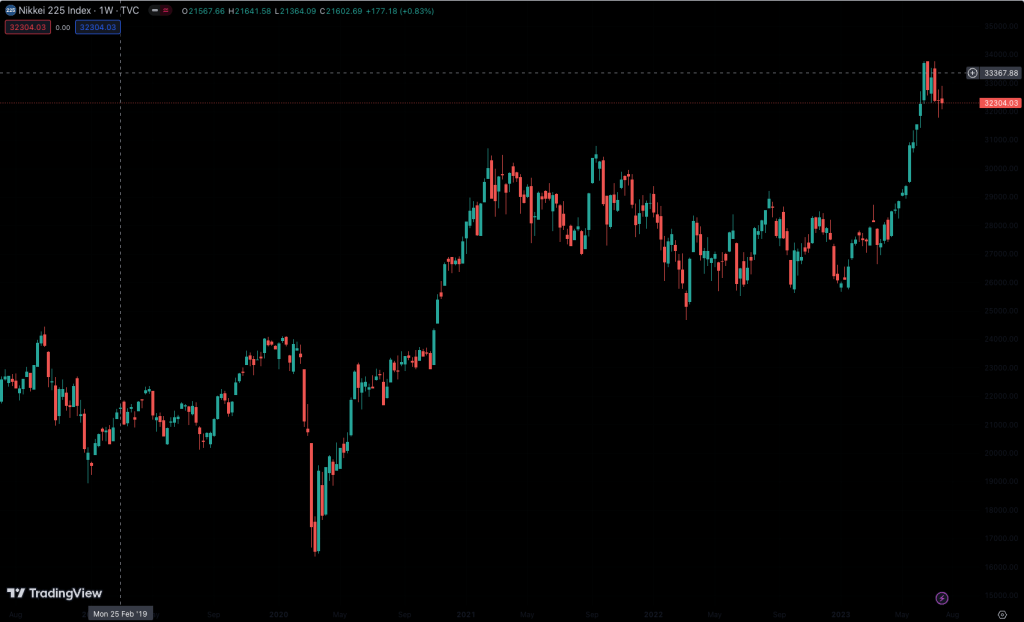
It’s been a long week. Is it me, or are +/-9% swings on the Nikkei 225 index starting to feel normal? Traders must be loving this – at least the good ones.

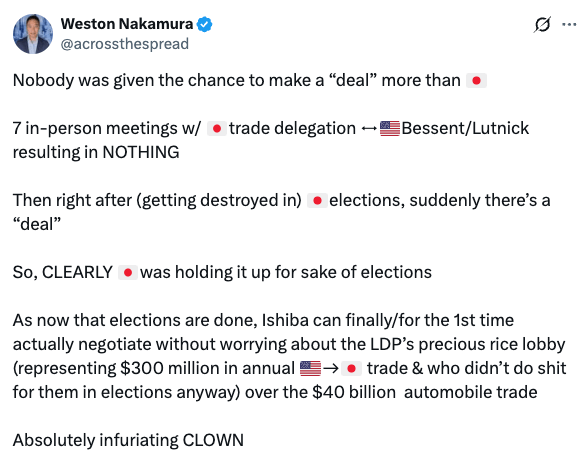
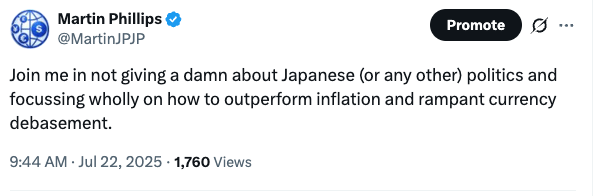
I’m not so impressed. Of course, there are buying opportunities, but it gets a bit tiresome when markets swing this wildly based on the pronouncements of one guy who just can’t STFU for 5 minutes.

Orange Swan Event.

Click it, I dare you! And don’t get me started with the Simpsons memes.

Where was I? Tapping the sign, right. The free lunch quote has been attributed to Harry Markowitz, although I have heard Ray Dalio say something similar. It’s a drum I have been banging for years, sometimes with minimal effect.

When the stock market is going up, nobody cares about diversification. Why would I want to own bonds and gold and other stuff when stocks are on a tear? Just buy the index and chill, right? It’s easy to forget that stocks take the stairs up and the elevator down.

Until you get a reminder.

In 2002, psychologist Daniel Kahneman won the Nobel Memorial Prize in Economic Sciences for his work on the psychology of judgement and decision making. Kahneman points out that individuals are more depressed with investment losses than they are satisfied with equivalent returns. In other words, people hate losing money considerably more than they like making money.

Big liquidation events are like waking up after a party. It was fun, but now it’s time to sober up and review your time horizon, risk profile and asset allocation.

Are you diversified enough?

If recent events haven’t troubled you, and you have barely looked at your investments, the answer to this question is probably yes. Carry on!

If things have been a little nervy, then maybe you were over-exposed.

Don’t get me wrong, I’m all for buying stock indices and holding them forever. It’s not a bad strategy, as long as you can stomach the downturns. And as long as you don’t need the money soon. And, it’s not like a diversified portfolio doesn’t go down in times like these either. When panic sets in, people will sell anything they can get their hands on, but pretty soon you will see a flight to safety.

An underappreciated aspect of diversification is the opportunity to tactically rebalance and take advantage of market events. I sold some of a gold ETF this week near all-time highs and bought stocks while everyone was puking them. I didn’t need dry powder. Just a little reallocation.

You can’t do that if you don’t own the gold in the first place. You have to find more cash.

A quick thought experiment

If you are reasonably young and earning good money, then the recent market gyrations are just a blip, but do me a favour: imagine you are 65 years old, about to retire, with a nice fat nest egg invested in the MSCI World Stock index.

And the market dumps 20% in a couple of days. It takes a breather over the weekend and then resumes dumping in earnest. 30% of your retirement pot is gone. Financial media is screaming about recession, trade war, deleveraging or whatever it is this time. Remember in March 2020, when the market crashed and we faced the reality that the entire world was about to shut down? The doomer economists are running victory laps, and the market looks like it is never coming back from this.

How do you feel?

Remember that feeling when you are making future investment decisions, especially as you get closer to spending the money.

Of course, what happened after March 2020 was that central banks slashed interest rates and unleashed a tidal wave of stimulus, and the markets came roaring back before the year was even over. But that type of thing comes at a cost – that’s why your hard-earned cash doesn’t buy as much stuff any more…

Ok, so how do we do this diversification thing?

There are various ways to get yourself a diversified portfolio. How hands-on do you want to be?

For the people who want to put as little effort as possible into it, you can simply buy multi-asset ‘balanced’ mutual funds. I recently came across a collection of Japanese funds that are divided up by age group: “Happy Aging 40”, “Happy Aging 50”, “Happy Aging 60”. The allocations get more conservative the higher the age. These types of funds are available everywhere. Simply dump your money into the fund that fits your time horizon and get back to whatever you’d rather be doing.

In my advisory business, for larger chunks of money, I recommend professionally managed investment portfolios fitted to the client’s base currency and risk profile. Yes, they cost more than an ETF, but they are incredibly well diversified. The asset allocation is reviewed annually, and every quarter the managers implement a ‘tactical overlay’ and buy more of the assets they like and sell some of those they don’t. These guys don’t just buy a broad stock index – they are breaking equity holdings down by style: value, growth, small/large cap, etc. Of course, the entire portfolio is rebalanced annually.

I also recommend a core/satellite approach for even broader diversification. That’s how you slot in the algorithmic trend following strategy that trades stocks, interest rates, currencies, metals and other commodities with very little correlation to any one market. Funnily enough, it likes volatile times like this.

For coaching clients, I take the knowledge I have gained from watching professional money managers and help them develop their own asset allocation using low-cost ETFs. Click the coaching link to find out more.

Keep it simple

Here are a few action points if you want to take on this job yourself:

Separate regular and lump sum money. Regular is the money you invest every month in a pension, savings plan or Tsumitate NISA. If you are relatively young, you can just allocate all of this to stock indices/funds. Let Dollar Cost Averaging do the work for you.

Lump sum money is a chunk of cash you have saved up that you are looking for a better return on. Here, you are going to want more diversification, and you should focus on the currency you are most likely to spend the money in (your base currency). The asset classes you want to look at are: cash, domestic (base currency) bonds, overseas bonds, domestic stocks, overseas stocks, property, and commodities. Hold more stocks if you are young, and more bonds and cash if you plan to spend the money soon. Allocate 70-80% of the lump sum to this broad portfolio, and the remainder can go into satellite holdings to beef up the areas you are most bullish on. For example, if you like Bitcoin, that’s a great satellite holding.

I have written plenty about base currency, asset allocation and core/satellite in the past. Feel free to take a look at earlier posts.

If you are gonna get really serious though, you are going to want to diversify your bonds.

Peace out!

Disclaimer: This should go without saying, but the information contained in this blog is not investment advice, or an incentive to invest, and should not be considered as such. This is for information only.

What’s your Japan plan?

I started this site in 2017 and ran out of things to say about the basics of financial planning some time ago. If you are just getting started, I put together a thread of simple financial planning tips from my early posts, which you can view on X here.

The basics don’t change, but the environment can change drastically. If you plan to live in Japan for the long term, you are probably now figuring out how to adjust from living in a country where deflation was the norm to one where prices are rising. Looking into the future, one of the big questions is whether this inflationary environment will stick, or will Japan be back at zero interest rates and falling prices in a few years? How can we plan when we don’t know the variables we will likely deal with?

Prediction is very difficult, especially if it’s about the future. – Niels Bohr

I have a client who was an economist at a financial institution for many years. He told me he always felt it was his job to have a view. For some reason that has stuck with me and I think it is important in my job too. It’s also important not to be wrong, though! I wish I could tell you I have always held the correct view and never been wrong, but I doubt you would believe me. I have, however, gained some experience over the years, which has helped me develop some skills in dealing with the uncertain future we face.

Strong views, loosely held.

Having a view is helpful but you don’t have to marry it. If something changes or evidence comes to light that proves you wrong, you can simply change your view. Don’t get caught up in the social media battle to be right about everything. In just the last few years, people have pivoted from being epidemiologists to vaccine experts to geopolitical analysts to macroeconomists to AI gurus and now, tariff experts.

It’s exhausting.

So, I thought today I would take a look at some basic data about the Japanese economy and share my view on what a person living here should focus on in terms of financial planning and investment.

Debt is a problem

Japan still has a strong, productive economy but it is not expected to grow fast. The predicted real GDP change for 2025 is 1.1%. (IMF) Government debt to GDP is currently 255%. (Trading Economics)

December 2024 CPI (inflation) was 3.6% and, in response, the Bank of Japan recently increased the overnight interest rate to 0.5%. The 10-year yield on government bonds currently stands at around 1.2%.

Japan is clearly not going to grow out of its debt problem. Demographics do not support the level of growth required to meaningfully reduce the size of the mountain. When governments can’t outgrow their debt, they usually end up inflating their way out. I struggle to see how the BOJ leadership can raise rates high enough to head off this outcome but they will of course delay it as long as possible.

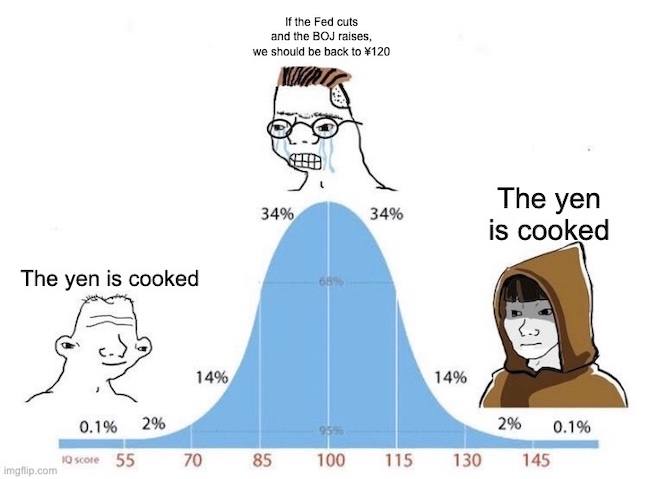
It doesn’t look good for the yen

In January 2023, I wrote a post charmingly titled How screwed is the yen? It actually holds up pretty well for a two-year-old post. The problems facing the currency have not changed very much and we are still hanging around at 155 yen to the dollar.

I have re-read this excellent post by Richard Katz several times: The BOJ, the Fed and The Future Of The Yen. He notes that although the gap between US and Japan overnight rates may close, the gap between the two countries’ long-term yields is unlikely to follow suit, meaning the yen probably won’t recover as strongly as some think it will. Here’s an excerpt from that piece:

Some of the issues people in Japan are facing when planning for their financial future are as follows:

  • Continuing yen weakness
  • Concern that the pension system will not meet their retirement needs
  • Rising interest rates, but not rising too far
  • Negative real rates (interest rates lower than the rate of inflation)
  • Rising wages but negative real wages relative to inflation

People are already feeling the pinch. If you bought rice recently, you know what I mean. Furthermore, prices of 1,656 food items are set to rise this month according to this Japan Times article.

So, what can we do?

If you are a regular reader, I am probably repeating myself, but here are some action items to consider:

Check your base currency – are you really going to spend all of your future money in Japan? Are there big expenses overseas that you are likely to be on the hook for in future? If so, you need to save and invest some or all of your money in that currency. More on that here: What is your base currency?

JPY cash is trash – even if your base currency is yen, you are going to lose against inflation over time if you keep all of your money in the bank. Sure, you need to keep a liquid emergency cash reserve, but everything else needs to go somewhere more productive. CPI was 3.6% in December. The BOJ’s target inflation rate is 2%. How much is your bank paying you in interest?

Fill up tax-free vehicles first – another no-brainer. If you are eligible for NISA and/or iDeCo, they are the first stop for investment money. NISA especially is an incredible deal as you can access the money freely if you really have to. Bad luck if you are a US citizen – you should explore options for investing back home. And remember, if your spouse is eligible, they should be maxing out tax-advantaged options, too.

Yen-cost average – if you are young, regular investment in a global stock index fund/ETF is a perfectly good strategy. You can worry about diversification later.

Learn to diversify – lump sum investments require more care. And the closer you get to spending your capital, the more you need to protect it. Diversification across asset classes (not geographical areas) is how you do this. Own some bonds, stocks (growth, value, dividend), property (physical or REIT), commodities and alternatives. Use a core/satellite allocation to dial up/down risk.

Explore dividend stocks – Japanese dividend stocks offer a great way to keep pace with inflation in yen terms. More here: How to beat inflation with Japanese dividend stocks

Lever up – if you are here for the long run, owning property is still better than renting. Even if you are risk averse, I am still seeing 35-year fixed-rate mortgages at under 2%. Floating rates are still well below 1% and, in some cases lower than 0.5%. It is still very cheap to borrow money for a home in Japan.

Stack gold and bitcoin – the two kings of hard assets and possibly the only satellite holdings you need. Average in over time and hold. More here: Facing inflation – the four assets you should own

A fistful of dollars – if you are the entrepreneurial type, I recommend brainstorming ways to earn money in USD. As the global reserve currency, it will be the last one standing in the Fiat race to the bottom. Read up on the dollar milkshake theory. If you can get paid in bitcoin, even better!

To summarise: have a view, make a plan and adjust it as you go. If you need help, don’t be shy about getting some. You will get better at this with practice.

Top image by tawatchai07 on Freepik

Disclaimer: This should go without saying, but the information contained in this blog is not investment advice, or an incentive to invest, and should not be considered as such. This is for information only.
Pump my bags!

I know I shouldn’t be posting about the guy everyone is sick of hearing about this week, but he’s proving hard to ignore.

I always argue that political changes have far less impact on asset markets than people expect, and I still believe that is true, but you have to hand it to the new Prez – he is pumping everything!

I write this following a highly enjoyable meet-up in Tokyo last night. We finished at a very responsible hour but I can’t say I am firing on all cylinders today – that’s the price of getting old. So, I will try to make this update as quick and painless as possible.

We all know about the flood of executive orders issued in the past few days. Trump sure loves a good fanfare. However, it was his online address to the World Economic Forum that caught my bleary eye this morning:

Trump said he would ask OPEC to lower the oil price and “with oil prices going down, I’ll demand that interest rates drop immediately,” adding that “likewise they should be dropping all over the world.”

Fed chair Jerome Powell will have something to say about that, of course, but it’s clear that Trump’s intention is for the US to lead global interest rates on a downward path. The S&P 500 reacted by notching its first all-time high close of 2025, rising +0.53% to $6,118.71.

Powell is not the type to be bullied and the Fed is actually signaling a slowdown in rate cuts this year as it awaits further economic data. However, the central bank is going to come under a lot of pressure to pave the way for higher asset prices.

Trump wants a booming stock market to brag about.

He wants higher crypto prices, too.

Last night he signed an executive order establishing the Presidential Working Group on Digital Asset Markets. Here are the main points:

  • Secure America’s position as the world’s leader in the digital asset economy
  • Create a federal regulatory framework for digital assets
  • Prohibit the creation of a central bank digital currency
  • Evaluate the potential of a strategic national digital asset stockpile

Hot on the heels of the executive order, the SEC rescinded the controversial SAB 121 accounting guidance, opening the door for banks to custody crypto assets. This one is bigger than many people realise, although it brings new risks as tradfi will surely make the same mistakes crypto lenders made last cycle – you shouldn’t dabble in under-collateralised fractional reserve lending on an asset you can’t print. But no doubt they will try!

The Bitcoin price whipsawed overnight, rising initially and then dumping in disappointment that the order did not explicitly mention Bitcoin or plans to acquire more Bitcoin. The most likely outcome seems to be that the government will hold onto existing crypto assets seized in legal proceedings.

My two cents: traders and Bitcoin maxis have become too fixated on the idea of the Strategic Bitcoin Reserve and are probably going to end up disappointed. However, the new administration’s appetite for clear regulation and openness is a huge positive for the industry. It is probably also going to provide a healthy level of support for the ongoing bull market. Too much good news all at once could easily have led to a Q1 blow-off top.

Let’s hope the shenanigans I wrote about earlier this week in Are you tired of winning yet? were a blip and the new admin will focus on the long-term health of the industry rather than pumping dumb stuff. I can’t say I’m convinced on that one…

Meanwhile in Japan

It’s BOJ day! Japan didn’t get the memo about cutting rates. No shocks this time as the Nikkei Shinbun was ahead of the decision to raise rates to 0.5%, the highest in 17 years. The BOJ expects wages to rise this year with inflation at around 2.5%. Real interest rates are expected to remain negative and policy is still largely accommodative.

The Japanese stock market is calm this afternoon but let’s give it a day or so before we judge the reaction. Part of me hopes for chaos next week and a chance to allocate the rest of my NISA with blood in the streets but I think I would prefer peace and quiet.

All roads lead to inflation?

In the US, the Fed is cutting rates without first scoring a decisive victory over inflation. Trump’s tariffs, if enacted, are likely to be inflationary. The resurgence of inflation appears to pose the biggest risk to markets this year.

With debt to GDP at 263% and little chance of growing out of the hole, Japan seems destined for higher inflation. It’s going to be tough for the BOJ to raise rates high enough to prevent this outcome and the weak yen will only accelerate price rises. JPY cash remains a bad place to hang around for too long.

I covered the four assets to own to face inflation back in late October and I don’t see any change there. Bitcoin, commodities, gold and tech stocks remain the best plays. If you don’t own Bitcoin already, I would caution jumping in at this point in the bull market. I don’t know what innings we are in but it’s certainly not early. If you own it and are planning to exit this year, we are approaching the time to begin averaging out. I sold around a third of my Metaplanet holding just before the inauguration as expectations of something special from Trump drove it close to ¥5,000. Euphoria and hopium should be sold more and more aggressively in my opinion.

The last word on Trump: he loves to brag about stock market performance as proof he’s doing a great job and has even started taking credit for the Bitcoin price. I wouldn’t bet against US stocks and BTC this year while he is in the driver’s seat.

Disclaimer: This should go without saying, but the information contained in this blog is not investment advice, or an incentive to invest, and should not be considered as such. This is for information only.
2025 – Snakes and elephants

Happy New Year, everyone! Welcome to the year of the snake. Just as we get back in the swing of things, a three-day holiday lies ahead. I watched the news last night and was reliably informed for 20 continuous minutes that it is snowing in the places where it always snows at this time of year. It’s nice when things go to plan, huh?

If you enjoy winter sports, it looks like a great season for it!

It would be nice if the investment climate was equally predictable, but alas, it’s complicated. In many ways, 2024 was smoother than expected. Global stocks gained around 19%, led by the Magnificent Seven and the hype around the AI trade. Japanese stocks kept pace well, although gains were concentrated in the first half of the year and things got a little scary for a minute there in August!

I had a look back and over the year I wrote 26 posts, covering the usual financial planning and asset allocation stuff along with macro views, currency, stocks to watch, crypto, AI, quantum computing and more. I hope it kept you entertained and maybe provided some actionable ideas. I plan more of the same in 2025, with the focus remaining on action. There’s already far too much information out there and the key for me is uncovering what we can actually do with it.

January is prime NISA allocation season and I’m sure many of you are already getting your accounts organised. If you are a ‘keep it simple’ type and have already completed this task, I salute you! Just like the gym, most of the battle is simply showing up and getting stuff done.

If you haven’t started yet, here are some things to consider:

Consensus views

So what is the forecast for 2025? The Bloomberg Outlook is always an interesting read. In short, the ‘experts’ are calling for more of the same: a strong US economy, a continued AI-led boom, albeit with a slightly tempered outlook on stocks.

Smart consensus sees US interest rates continuing lower, a weaker dollar, gold higher, and oil lower, with a mild stock market correction likely, but no bear market. Simple enough!

The potential spanner in the works is inflation reigniting as you know who takes office in the US. For what it’s worth, I think a lot of Trump’s tariff talk is bluffing/negotiating but we will know more in a few weeks. All bets are off if he invades Greenland lol! The inflation risk is a more pressing concern. You may have noticed how slightly stronger PMI data sent rate-cut expectations plummeting earlier this week. The market is near all-time highs, yet ultra-sensitive to the rates higher-for-longer narrative.

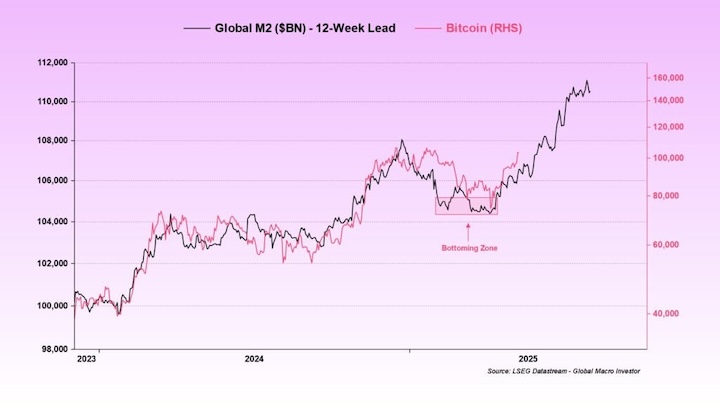
Liquidity drives markets. How high will risk assets go? Well, that probably depends on the money supply more than anything else.

Bubble watch

Getting away from the consensus views, this morning I found legendary investor Howard Marks writing about bubbles – his memo here is worth a read.

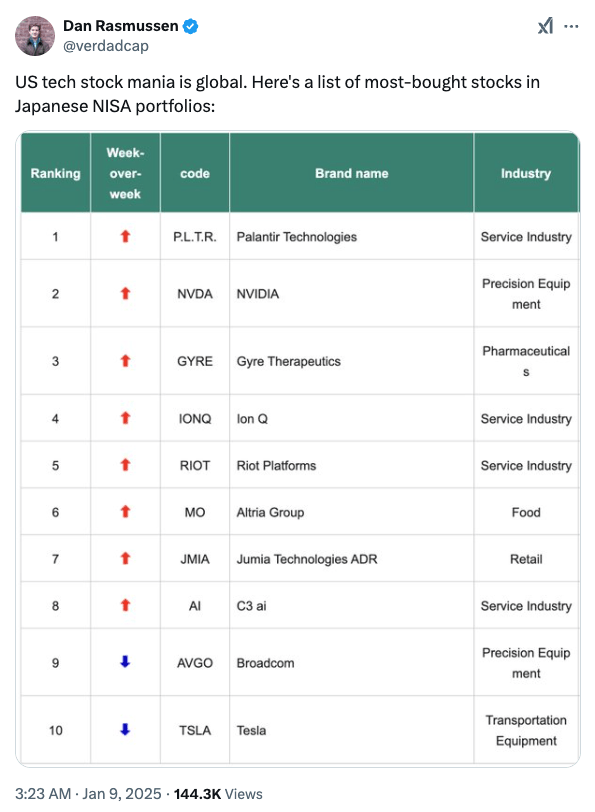
If you want to skip to the Tldr and know where the potential bubble could be, get a load of this:

So much for Mr & Mrs Watanabe being conservative. In my experience, the average ‘balanced’ Japanese investor has half of their money in the bank and the other half in whatever went up the most last year. And they are buying this with a weak yen???

So, how about Japanese stocks?

Global asset allocators that I pay attention to are still overweight Japan. And why not with USD/JPY at ¥158! There are many positives here in the land of snow in winter, with companies expected to post record profits for the 5th year straight. On average, wages increased +5.1% in 2024 and are expected to rise again this year, which is good news for consumer spending. The question is whether the hikes will keep pace with inflation. Remember, real wages have been down only over the last three years…

Still, there are several good reasons to own Japanese stocks: the TSE has successfully pushed companies to enhance returns for investors, resulting in a marked increase in dividends and buybacks. Companies also continue to unwind cross shareholdings.

Of course, the elephant in the room is the Bank of Japan. Having skipped a December rate hike, the BOJ is poised to continue its efforts to ‘normalise’ in 2025. In true Galapagos fashion, Japan boasts the only developed-world central bank trying to tighten policy this year. If you’re looking for a potential wrecking ball, look no further. A sharp upward move in the yen would severely curtail exporters’ profit. Not to mention the whole carry trade unwind thing. (oh, another elephant!)

On the other hand, banks will benefit from rising interest rates due to improved margins on their loan business. Homeowners won’t enjoy that one so much.

With demand for electric vehicles and smartphones flattening, the semiconductor sector will rely heavily on AI growth. A lot is riding on the rise of the machines.

All in all, though, the outlook is constructive for Japanese equities.

Time for some action!

Ok, I promised some action points. Obviously, I can’t give broad advice here, but this is how I am organising NISA this year:

  • Tsumitate is set and forget. I’m at 40% JPX 400, 30% All Country, 30% NASDAQ
  • Growth – I allocated about a third this week and plan to allocate the rest in the next week or two
  • I am leaning toward a much broader ETF allocation this year rather than trying to pick stocks. The last two years have been too easy – you could just throw darts and the stocks you hit would go up. I’m not convinced it will be so simple this year
  • At ¥158 to the dollar, I will keep a sizeable allocation to Japanese stocks. 1489 High Dividend is a favourite of mine and I also like the 1624 Machinery ETF

Can we forget about Bitcoin now?

Bitcoin has crashed to $93,000. These are desperate times!

If you are new to crypto, allow me to remind you that -30% dips are normal in a bull market. We had a -50% dump right in the middle of 2021. You get used to it, kind of…

If anything, the drawdowns have been mild so far. Unless you own Alts – those dips sting!

If you own crypto, I can’t stress this enough: the best thing you can do is go to sleep for about 3 months. Block out the noise.

I think we are all aware that 90% of what the orange man says is hot air, so if you are relying on the President-elect to send your bags higher, you may be disappointed. However, make no mistake, the new administration in the US is massively crypto-friendly compared to that of the outgoing dinosaur dude. It will be a factor.

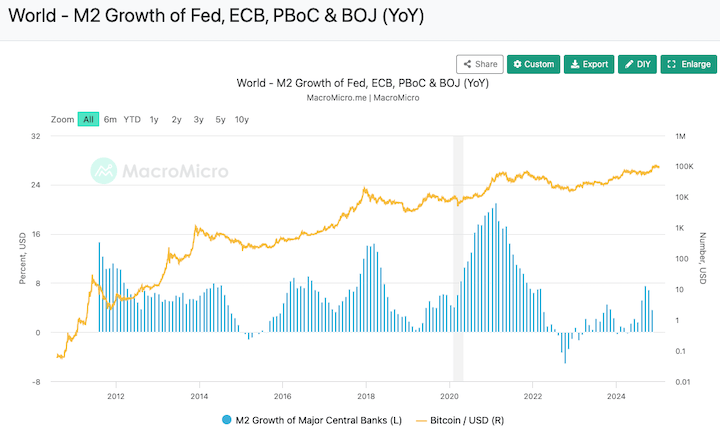
The best indicator is right here – keep an eye on it: (chart from MacroMicro)

Money supply has just taken a dip of its own, hence the market reaction. However, it won’t stay down for long. Unless inflation really runs wild, conditions will loosen.

You may think I am nuts. A year ago I wrote The Investment Case for Bitcoin with the price at just under $40,000. Some guy on Facebook called me a scammer and proceeded to spout a bunch of talking points I recognised from mainstream media circa 2017. These people are everywhere and they are brimming with confidence. I wonder if he has any other assets he thinks we should avoid?

Currently, sentiment is remarkably bad for $93k. ‘Crypto influencers’ are stressing over every dip. When we reach the top, these same people will tell you that dips are mathematically impossible and we are going up forever. Welcome to magic internet money musical chairs!

Long term, it’s going way higher than you think against Fiat. Don’t sweat it if you fail to execute a perfect dismount from the bull. Just don’t FOMO in money you can’t afford to sit on for a few more years.

If you haven’t subscribed, feel free to do so to get my posts by email. If you need help, please check out the coaching link, and follow me on X for jokes and details of Tokyo meetups.

I wish you all the best for the year ahead. Let’s make it a sensational one!

Top image by Freepik

Disclaimer: This should go without saying, but the information contained in this blog is not investment advice, or an incentive to invest, and should not be considered as such. This is for information only.

Ad-hoc update and market observations

Once more, I find myself short of time to post here. However, it is not due to a lack of things going on in markets these days. So, here I am on a Friday afternoon with a little time to spare to share some observations. Let’s do it quick and dirty!

Macro

We seem to be at the mercy of central banks these days. The number of Fed watchers and Fed experts is growing exponentially, especially among those with high exposure to risk assets who are gasping for a rate cut! Inflation is coming down, but not as fast as Mr. Powell would like. (remember falling inflation still means prices are going up, just not as quickly as they were) You may notice how the US stock market pumps whenever Fed officials say anything vaguely dovish. It also jumps on any weak economic data. Bad news is good news – ie. if the economy is slowing, the Fed is more likely to cut rates and pump our stocks. Weak jobs report = market up. GDP lower than expected = market up. Whatever you think of the Fed’s performance, they have been abundantly clear that they are data dependent. If inflation comes down and/or the economy weakens significantly, cuts are more likely. My guess is not until late this year, maybe next year.

Despite all this, the US market is near all-time highs. Stocks sure do like to climb a wall of worry!

Of course, there is an election coming. Biden has rather brashly said on camera that he thinks rates will come down. Yes, the Fed is independent and not susceptible to political pressure, right? The last time Trump won, the market went up. And you can bet the orange one will be applying heavy pressure for rate cuts if he wins again.

Of course, worsening economic data puts recession firmly on the table. Stocks do not like the R-word. However, recession also means rate cuts and the mere whiff of them may be enough to reignite irrational exuberance across risk assets. It’s going to be interesting…

Japan

The Nikkei is trading over ¥38,000 with bond yields pushing 1% and the yen at ¥157 to the dollar. If you had predicted this a few years ago, nobody would have believed you! I keep seeing articles about ‘the sun rising on a new Japanese bull market’. I don’t know where these writers have been for the last 2 years… I keep getting tempted to take some profits but doing nothing has worked nicely so far. Still, you might want to make sure your seatbelt is securely fastened. Turbulence is no fun, as we learned in recent news about a UK to Singapore flight.

In theory, rate cuts in the US will reduce the interest rate differential between the US/Japan and the yen should strengthen. Again, I don’t think it will be until later this year at the earliest, and maybe well into next year, but there may be some relief for the yen in the near term. Long term looks dark though, ladies and gents. If you got stuck in yen but it’s not your base currency, I would take any chance you get to reverse that. The market doesn’t owe you anything.

Time to get long on electricity generators?

Remember when Bitcoin was boiling the oceans and drinking swimming pools full of water like tequila shots? Crypto is forgiven. There’s a new bad guy in town and ChatGPT is hungry for electricity and in dire need of a drink! I’m pressed for time so you can google yourself, but data centres for AI are consuming mucho power and they get hot while they do it – I literally saw an article this morning about some crazy number of swimming pools needed to cool everything down. If you think demand for power is going anywhere but up, I don’t know what to say to you.

While on the topic of AI, chip giant Nvidia nailed earnings yet again. And raised their guidance to suggest more next quarter. Absolute monster company. Semiconductors, AI, data centres: all going bonkers.

The stock is up +594% over the last 3 years. Expect volatility, sure, but it’s not slowing down yet…

Crypto bull market progress

The Bitcoin halving is behind us. We got a pretty good pullback to $56k from $70k and now we are back at $67k. We didn’t even get to the good part yet. I still think people are underestimating how crazy this cycle will get. Another thing to strap in for!

The Biden admin, spearheaded by Senator Karen (sorry, Warren) has been openly hostile towards the industry ever since Sam Bankman-Fried torched them. These guys could rival the EU in crushing innovation. But then a funny thing happened: Trump came out and said ‘If you like crypto, you better vote for me’. Then he started accepting donations in crypto. Suddenly the crypto vote is leaning heavily towards orange man. And what do you know? We got an Ethereum ETF. Believe me when I say, there was ZERO chance of an ETH ETF getting approved a few weeks ago.

ETH has underperformed this whole cycle. And judging by today’s weak ETF reaction, the PTSD is real. The Bitcoin ETFs blew away expectations in terms of inflows. Watch for ETH doing the same.

There are many ways to play the crypto bull. Metaplanet Inc, a Japanese company no one had ever heard of, (they do hotel development and some web3 stuff) announced on 8 April that they were adopting Bitcoin as their core treasury asset, a la Microstrategy. The stock went from ¥19 to ¥36 on the news. Now it’s at ¥57, having touched ¥120 on 23 May. They’ve got Mark Yusko on the board and Dylan LeClair as Director of Bitcoin strategy.

I’m not saying you should buy this stock. (Disclaimer below!) I’m saying you should put it on your watchlist and forget about it until Bitcoin breaks out past the previous cycle all-time high, goes parabolic and then you can kick yourself for not owning such an obvious play on the bull market. (insert wink emoji here)

Supply and demand

Being dumb but with a high appetite for risk if you can explain something to me in simple terms, I own a copper ETF. (1693) I was hearing for some time that the demand for copper is going to far outstrip supply, so I got some exposure. So far, so good. A lot of clever people are saying the move is overdone and we are going lower, but these are low-time frame traders and from what I can tell, the long-term supply/demand dynamics are unchanged. But what do I know? Regardless, we’re gonna need some popcorn over here, please.

A note here: we are talking about satellite holdings and my long term diversified portfolio is completely unchanged, moisturised, happy in its lane etc etc.

I’m out of time here but lastly, somebody helpfully reminded me that Ben at Retire Japan is offering a 50% discount if you pre-order his 2024 Guide to NISA. I don’t see how you can afford to miss that. Click here!

Until next time!

Disclaimer: This should go without saying, but the information contained in this blog is not investment advice, or an incentive to invest, and should not be considered as such. This is for information only.

Q4 Market Outlook – Where’s my ¥40,000?

How’s everybody doing? This is a follow-up to my Nikkei ¥40,000? Thinking outside the box piece, which I just happened to post exactly 2 months ago. It’s interesting to see how things have developed since then and then look forward to the last quarter of the year. Yes, I know, it’s almost October. Where did those nine months go???

Remember Monex guy? Two months ago he said the Nikkei 225 was likely to trade in a range of ¥31,000 to ¥33,000 for a while. Gotta give my man credit there, it’s done exactly that. His expectation was that if we can break above that range, we’re heading for ¥40,000. What do you think about that?

If there’s one thing I’ve noticed recently, there’s been a subtle narrative change around the Japan stock market rally. In the first half of the year, it was exactly that – Japanese stocks were broadly rising and outperforming most other developed markets. What has changed, is that the narrative in the news now is more focussed on a Japanese value/dividend stock rally.

So what happened? Well, first, the Bank of Japan has allowed long-term yields to rise up to 0.70% and beyond and then, on 9 September, BOJ Governor Kazuo Ueda said that the lifting of the central bank’s negative interest rate policy will become an option if wages and prices rise. He even said they might have enough data to make a call on that by the end of the year. Despite the talk of interest rates rising, with inflation at over 3%, Japanese investors are realising that sitting in cash is a losing trade. With bonds still offering negative real rates, the money has been pouring into dividend-generating stocks. There’s also a possibility that the revamping of NISA for 2024 has got investors more excited about getting involved in the stock market.

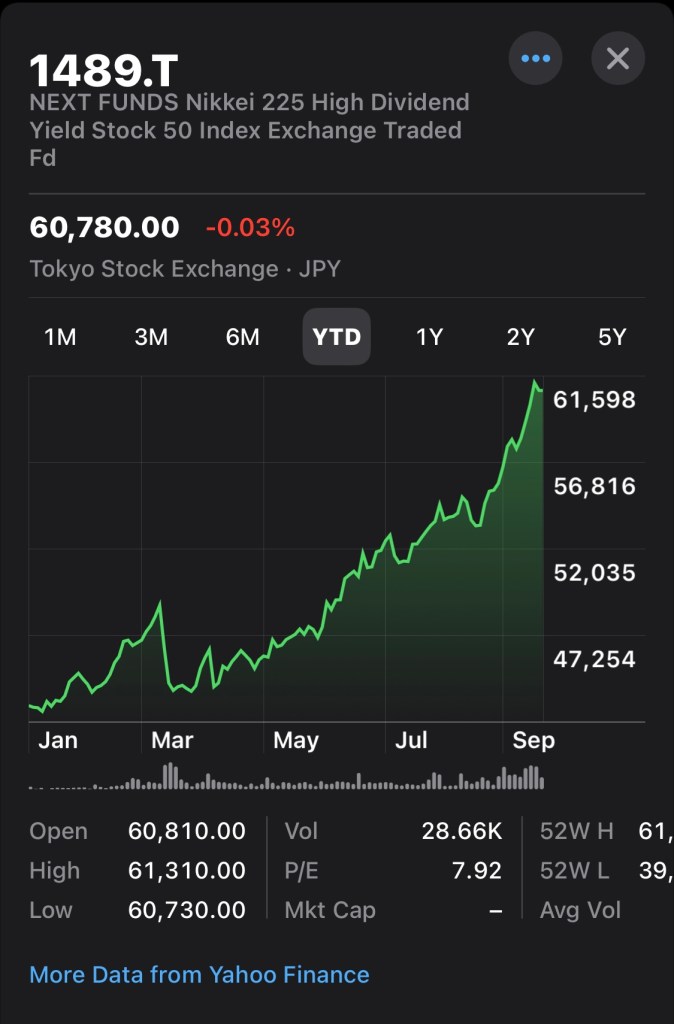
I know it lacks class to say I told you so, but sometimes you need to toot your own horn. This is stuff I figured out some time ago. On 14 September, Nikkei News Plus 9 did a feature on the Nikkei 225 High Dividend Yield Stock 50 Index. There is an ETF that tracks this index and I have owned it since spring 2022 and I covered it in posts in March and October. Here’s what it looks like year to date:

Not bad at all. Ok, enough self-congratulation, there is still a lot to think about here. The big question is, how is this going to play out over the remainder of the year? The fact that financial news programs are starting to fixate on the value/dividend stock narrative is good news if you hold these stocks. Just since the feature on the Nikkei program last week there has been a notable bump in the dividend ETF along with bank stocks, shipping companies, trading companies and steelmakers, which News Plus 9 showcased as examples. So this is now a hot trade which could run for a while, particularly as the talk of exiting negative interest rates heats up. Pick a banking stock and take a look at its performance year-to-date and particularly over the last few weeks!

When a sector gets hot and retail crowds in, it’s often a sign that we are nearing a top. The mania phase can last longer than you expect, but it can also blow off in a hurry. If I didn’t own these stocks already, I don’t think I would be jumping in now. As I mentioned in the July post, these are tactical positions for me, so I am keen to lock in some profit, while also remaining invested to catch any further upside. I have sold incrementally over the past 2 months and reduced my holdings by about 30%. Of course, with hindsight, I feel pretty silly selling anything. I could have just waited and sold higher. But that’s the way it goes – you have to make decisions based on the information you have in real time. So I took some profit, but left two thirds still invested. So far, so good.

So is the Nikkei going to ¥40,000 this cycle? I would be happy to be wrong on this one, but my bet is no. Higher rates, or at least the talk of higher rates, are bad for growth stocks but can be good for value as we are seeing. You would need both to be going up to hit the ¥40,000 mark.

I am still of the view that any attempt at normalising rates in Japan will lead to chaos and a hasty reversal. However, as we are seeing now, even talk of an increase is enough to change market dynamics. And if last night’s Nikkei News Plus 9 program is anything to go by, there is a lot of talk going on! They were feverishly covering how some net banks are raising their rates for fixed deposits to a hefty 0.70%!

From the BOJ’s perspective, a lot of this talk on rates is just that. There’s even a term for central bankers talking up a strategy in order to get the reaction they want from markets – jawboning. It doesn’t change the corner they have painted themselves into. It’s not looking good for the yen folks…

Of course, a lot also depends on the US. Last night’s Fed decision to leave rates unchanged and the plan to hike once more this year was as expected. As they always do in this situation, the Fed is talking up a soft landing. History is not on their side on that one. As the effects of this hiking cycle gradually feed through to the underlying economy, the smart money is still betting on recession. Markets are too interconnected for Japan to keep sailing on if that’s where we are headed.

So no ¥40,000 in the near future, but there could be some more upside for value/dividend stocks. Early next year may get interesting if the BOJ tries to translate some of this talk into action. I plan to have a ready supply of dry powder to allocate if we do take a dive. That’s my view, which I will look extremely foolish for putting in writing if we see ¥40k by Christmas! But if you’re going to invest tactically, you’ve got to have an opinion. Perhaps I should buy a Monex hat to eat if I am wrong…

Disclaimer: This should go without saying, but the information contained in this blog is not investment advice, or an incentive to invest, and should not be considered as such. This is for information only.

Nikkei ¥‎40,000? Thinking outside the box

After all the doom and gloom of 2022, 2023 has been a pleasant surprise for some brave investors. It looks like stocks actually did bottom in October last year and if you own US big tech and Japanese stocks you’re enjoying a bumper year!

And now comes the big question? When do I sell?

In case you forgot, the idea of investing is to buy low, sell high and beat inflation in your base currency. Sounds simple doesn’t it? Personally, I’m pretty good at the first part. Fear is easy to spot. Granted, it takes some guts to run towards the carnage when everyone else is running away, but I have successfully conditioned myself to embrace the pain in markets and buy stuff when it’s on sale.

In my experience, the selling part is harder than you think it will be. Because it’s generally time to sell when people are euphoric and euphoria is kind of addictive. It’s even harder to sell when things are simply good – they could always get better right? And you don’t want to leave money on the table.

I was watching the Nikkei News Plus 9 program on BS TV last night and a very serious-looking guy from Monex Securities was talking about Japanese stocks. I think he is the chief strategist at Monex and he identified what looks a lot like a double top in the Nikkei 225 chart. Ok, I had noticed that too. He explained that he thinks that means the index will likely trade in a range of approximately ¥‎31,000 to ¥‎33,000 for a while. I wish I had a video of it – he described the range as a box, and at one point he handed the presenter an actual cardboard box with Nikkei 225 written on it and asked him to look inside. The presenter rummaged around and came out holding four crisp ¥‎10,000 notes. Yes, the Monex guy explained, once the Nikkei breaks out of the box, it’s going to ¥‎40,000! Wahey!

Forgive my cynicism, but I immediately began wondering if it might not be time to get the hell out of Japanese stocks! There wasn’t a lot of explanation going on about how the index goes from the box to ¥‎40,000. I’m no technical analyst, but it sounded a lot like hopium to me. Still, the guy is the chief strategist at Monex so I assume some research went into this.

The US market is looking interesting too. The S&P 500 is up +18% so far this year. Fantastic! However, dig around a little and you find that it’s actually only seven stocks that have driven those returns. Those stocks are, of course, big tech and the narrative that’s driving them, in case you’ve been living under a rock, is AI. Feeling euphoric yet?

So it’s possible that things are a little overdone. All bets are on the Fed hiking rates again at month-end and leaving them there for at least the rest of the year. History does not bode well for a soft landing from an extended period of irresponsibly loose monetary policy followed by a burst of inflation and a breathtakingly fast tightening cycle. This generally does not end well. There is a lot of talk of the stock rally broadening out but it’s early days and if the tech companies sell off, the last one out the door can probably turn the lights off for a while.

So is it time to sell? If so, how much and how do you do it?

First of all, let’s take a breath and remember that we need to consider core and satellite holdings separately. The core being the 70-80% of a portfolio that is broadly diversified, and satellite being the 20-30% we may have in something a little sexier. We’re not talking about simply dumping all of our investments because the market might go down.

I have already written about how to buy low and sell high in your core allocation here. In short, you establish a strategic asset allocation that meets your risk profile and then rebalance it once per year. The rebalance, in effect, sells part of holdings that have gone up in value and reallocates to the holdings that have gone down. That’s it, no further action required!

Satellite holdings are generally invested in assets that add a little more spice to your overall portfolio. They sometimes have a higher risk/return profile and may change over time depending on market conditions and what is hot.

So let’s say, for example, you’re living in Japan and you have a core portfolio invested in an internationally diversified range of assets that is matched to your risk profile and base currency. However, over the last year or so the weak yen has prevented you from investing more outside Japan. Meanwhile, the rise in inflation meant that sitting in JPY cash was a dumb idea and so you’ve been allocating to a range of dividend-paying Japanese stocks to make sure you preserve your spending power. And low and behold, somebody lit a fire beneath the Japanese equity market and your boring Japanese boomer stocks are mostly up between 20% and 50%!

The man at Monex says the Nikkei is going to ¥‎40,000 and, much as you are intrigued by that idea, you are not sure you share his confidence!

What do you do?

Quite the dilemma, albeit a nice one to have. So what do the options look like?

  1. Sell the lot – the gains are way more than the dividends you are going to earn over the next 12 months, so take a break and come back when things are cheaper again.
  2. Sell part of your holdings – you’ll be happy you took some profit, but if the Monex guy is right, ka-ching!
  3. Roll the dice and keep it all – there’s ¥‎40,000 in that box!

Of course, there is no correct answer and it depends on your personal situation, risk profile blah blah blah. For the record, I’m in the option 2 camp. I’ve been selling incrementally and I try to sell on green days. If nothing crazy happens I’m looking to gradually cut my holdings in about half. That said, in the process of accumulating Japanese stocks I have found some that I think are keep-forever-type companies.

I still think the Bank of Japan is going nowhere fast on adjusting rates and if inflation comes down, there will be less pressure on them to take action. But if that pressure builds and it looks like they might blink, I go option 1 in a hurry.

US big tech I’m not so concerned about. Everyone should own some of that for the long term, and if you are buying index funds you probably own more than you realise!

So prepare for a hard landing while hoping for a soft one. And learn from the experience as you go.

Today marks 26 years since I landed in Japan. There’s a lot to be thankful for!

And if the Nikkei hits ¥40k I will get a box and take a photo with it.

Disclaimer: This should go without saying, but the information contained in this blog is not investment advice, or an incentive to invest, and should not be considered as such. This is for information only.
I’m not your financial adviser but…

How are people getting their financial advice these days? After 3 years pretty much at home during covid I’m wondering how it all works now. You used to have some bloke at the pub giving you stock tips, now it’s all on Twitter? When I first started in the business I used to call up guys at investment banks who knew way more about finance than me and try to blag them into meeting me. Are people still doing that? Maybe you just dance on TikTok these days?

I don’t have as much time to write this blog as I used to, so I apologise for the big gap between posts. (I wasn’t exactly prolific before, I know) However, if you only have time to write once in a while it does sharpen you up somewhat. So let’s get to the point.

I’m not your financial adviser, but you really need to get things organised. I sound like your dad, don’t I? What are you going to do with your life??? Let’s try and boil it down to the basics. Where are we and what should you be doing?

As WBC’s go, I enjoyed the World Baseball Classic much more than I’m enjoying the World Banking Crisis, but at least we are learning some stuff. The US treasury backstopped the banks. That means everyone else is going to have to backstop their banks or all the money is going to flow to the US as the least risky jurisdiction. Liquidity bottomed in October. If you don’t know what that means, listen to this podcast. The stock market bottomed around then too. Inflation is unlikely to just go away, but the Fed has raised rates about as high as they can go. Maybe another 25 bps in May but that’s about it. That doesn’t mean they will start cutting. We could sit around the 5.25% mark for the rest of the year.

Whichever way you slice it, it doesn’t look good for the yen. I discussed that here. If you are holding yen and not planning to spend yen in the future then you need to seriously consider your options. Drop your phone number in the comments and I will happily call up and shout at you like your dad.

So what should you do? Well, I may have mentioned this before, but you need to figure out your base currency and have a diversified portfolio. Diversified means cash, bonds, equities, property, commodities and alternatives, allocated according to your risk profile. If you are smart, you will want to spice it up a little by taking a core/satellite approach. 70-80% goes into the diversified portfolio, that’s the core. The other 20-30% goes into satellites. The satellites you want to own in this environment are gold and bitcoin. If you think bitcoin is silly then just buy gold. Gold mining stocks are a leveraged play on gold – maybe toss some of those in too. Ideally, your diversified portfolio should be rebalanced once a year so it doesn’t grow three heads and deviate from your risk profile. Clear?

You can either:

  1. Do this yourself
  2. Get someone to help you to do it
  3. Pay an asset manager to do it for you (except maybe the bitcoin part)

Any combination of the above is fine. There’s no shame in wanting to spend your time doing other things and paying someone competent to take care of this for you. Just be aware that for number 3, you will probably need to work with a financial adviser to find the right product and not all financial advisers are the same. Some may not have your best interests at heart.

And that’s it – what was that, like a 3-minute read? I hope the weather forecast is wrong and it doesn’t rain all through cherry blossom season so you can get out and enjoy it. I’m not really going to call you up, but ask me anything, any time. Until next time!

Disclaimer: This should go without saying, but the information contained in this blog is not investment advice, or an incentive to invest, and should not be considered as such. This is for information only.

How to Choose Investments for Your NISA

If there is one thing I have learned in all of my years of financial planning, it is this: people are way more focused on product than on what to invest in within the product. People will spend hours comparing investment accounts to find the one with the best tax advantages, lowest fees, and most comfortable user interface. Then once they decide, they just chuck all their money into the first global stock fund they find on the list. Somebody once said, “people will spend more time deciding on a pair of jeans than on what to invest their retirement fund in.” What follows is far from the definitive guide to investing in NISA, but it should provide some angles to consider it from.

Before that, I have a simple security tip for you. A friend of mine realised recently that someone was trying to change the email address on one of his financial accounts. They knew his email, and had figured out that he had an account with this particular institution, and were trying to get the institution to change his email address so they could get access. Scary, huh! Luckily my friend caught it in time, and rather than responding to emails/chat messages, he set an appointment to talk to a representative. (don’t get phished!) That representative gave him a great security tip: make an email address that no one (except maybe your immediate family) knows about, and only use it for your financial accounts. I thought that was pretty good advice and am implementing it myself. It may be a bit of a pain, but not as painful as having one of your accounts drained – this particularly goes for crypto accounts!

Ok, back to NISA. Obviously, I can’t give blanket advice that works for everyone. The investments you choose will depend on your base currency, attitude to risk and timeframe. Another big factor to consider is that NISA itself is changing from next year, which perhaps affects your strategy for this year. Given the above, I will try to provide a general guide with some helpful ideas:

Base currency

Yes, this again…Currency may seem irrelevant in a Japan-based account such as NISA, but I would argue that you have to at least think a little about when and where you will spend the money. If you are living and working in Japan, I would assume you at least have some need for yen as a base currency. However, if you plan to move or return home in five or ten years’ time, should you really be building assets in yen? I can’t speak to all of the NISA products out there, but my SBI account allows me to buy US-listed stocks and ETFs through their international site, and you can buy these for your NISA account too. Now, given that NISA is not a good fit for US citizens, why would you buy USD assets? Well take a look at my previous article on the yen and think if you really want to build all of your assets in yen. Yes, when you cash out you will have to cash out to your Japan yen account once, but you can then quickly convert to the currency of your choice. You can also buy yen-denominated funds / ETFs that invest in global assets, so even if the investment is priced in yen your underlying exposure is to other currencies. 

So, if you are going to spend the money in Japan, should you only buy Japan-based assets? That would depend on your overall asset allocation and whether you have some exposure to overseas assets through other investments. Compared to the rest of the world combined, Japan is not such a big market and it would seem like a risk in itself to only have Japan exposure, but I would still aim to keep a reasonable amount in yen, just in case it’s 80 yen to the dollar when you want to sell the assets and spend the money. Personally, I already have global exposure, so am mostly buying JPY assets in my NISA account.

Managing risk

Knowing your own tolerance for risk is important. No one wants to be lying awake at night worrying about their investments. The only thing I go on about more than base currency is diversification. The problem with Japan-based accounts is it is hard to diversify well if you are investing in yen. Japanese government bonds? No yield and more risk than anyone at the BOJ wants to admit, hmmm. I think REITs offer an opportunity for diversification and a quasi-bond type profile. Also, diversification across styles can help: don’t just buy a Nikkei 225 tracker – look at high dividend stock ETFs, look at value ETFs and growth ETFs. You can also buy individual stocks if there are companies you know well, or that fit your risk profile. Warren Buffet is buying Japanese trading companies. Maybe he knows a thing or two?  Also, perhaps put 5-10% in a gold ETF.

What about the new NISA?

You may have heard that NISA is changing in 2024. From next year you will be able to allocate up to ¥3.6 mill per year. You have to put ¥1.2 mill in mutual funds, but you are free to allocate the remainder as you wish. The maximum total contribution limit is ¥18 mill, but you can leave this invested tax-free for life! 

This has led me to decide that for this year’s contributions, I am going to focus more on dividend-paying stocks for my NISA and I will re-evaluate when the rules change next year.

Tax-free growth or tax-free dividends?

Here’s an interesting way to look at things. If you only have a limited allocation that is free from tax on capital gains or dividends, which do you try to maximise? Do you go for all-out growth and try to increase the value of your investments as much as possible over time, and take those gains tax-free? Or do you focus on more stable, dividend-generating stocks and REITs, whereby you get a more predictable annual yield with no tax on the dividends?

This again depends on your attitude to risk and how your other investments are allocated. Already have a broadly diversified portfolio elsewhere and NISA is a relatively small part of your overall allocation? Why not go for growth and try to shoot the lights out? On the other hand, if NISA is an important part of your long-term plan, perhaps you should take a more balanced, diversified approach and try to maximise dividends?

Regular or lump-sum investing

How do you actually go about allocating the money in your NISA? Do you dump it all in during January? Or do you allocate a little every month? If you are investing monthly you are taking a lot of the timing risk out of the allocation process, so you can lean more heavily into higher-growth stocks. This works great for Tsumitate NISA. If they go down, you buy more next month. If you are allocating in one go, you might try to diversify a little more.

Do your own research

I was considering putting a list of interesting funds, ETFs, and stocks at the end of this post for people to do some reading/research on, but I don’t want to be seen as recommending particular investments over others. Plus, that’s what my paid coaching sessions are for! The fact is, it doesn’t matter so much which global stock fund you choose. It’s more important that your overall allocation fits your personal situation, time frame and medium to longer-term goals. Putting in the work will lead to a better understanding over time. Don’t be afraid of making mistakes, but do spend a little more time deciding your investments than you would over buying a pair of jeans!

Disclaimer: This should go without saying, but the information contained in this blog is not investment advice, or an incentive to invest, and should not be considered as such. This is for information only.

How Screwed is the Yen?

First of all, Happy New Year! I hope you all had a fantastic holiday season. Keeping with the spirit of the last three years, we have not been anywhere! Ok, we did have a couple of mini-holidays here in Japan and a peaceful family Christmas and New Year at home, so no complaints!

2023 is shaping up to be interesting in many ways. I have taken on a freelance financial writer project that has diverted some time away from writing here. I will link to that at some point, once I am settled into the routine. It’s an interesting project and I am really enjoying the new challenge. However, if there’s one thing that writing to order and to deadlines has taught me, it is to be grateful for the freedom I have to write whatever I want here, hence the somewhat irreverent title of my first post of the year!

So how screwed is the yen??? 

Well, before we jump into that, let’s take a quick look back over 2022. As per my previous post, the lesson for us all is that liquidity drives markets, and in 2022 Jerome Powell was the first central banker to start draining liquidity. Throughout the year he continued to raise interest rates in order to fight inflation and, in doing so, pretty much killed the bull market in risk assets. Literally adding fuel to the fire, Vladimir Putin invaded Ukraine and fanned the flames of inflation, particularly in the energy sector. The S&P 500 index ended the year -19.4%, the NASDAQ -33.1%. European stocks were down around -13%. And not only equities suffered: US bonds, the so-called safe haven asset, were down around -13%. Even well-diversified portfolios were down somewhere between 15-20% on the year. The only big gains were in energy stocks, with that index up over 60%.

So how about Japan? Well, the Nikkei 225 index was down -9.4% on the year, but I can tell you from personal experience that if you picked the right stocks you actually made money last year. So not bad right? The danger, however, lurked in the fixed-income and currency markets. The strong US dollar crushed everything in its path, with the yen coming off perhaps the worst of the developed market currencies, although the pound and the euro suffered too. 

I just listened to a great interview with Brent Johnson, of Dollar Milkshake Theory fame. It gets interesting around the 16-minute mark. Here’s a quick summary if you want to save bandwidth: 

During 2022, after years of zero to negative yields, inflationary pressure caused Japanese Government Bond (JGB) yields to rise by 0.25%. That may not sound like much, but it had a huge effect on the price of JGBs. Remember, as yields rise, bond prices fall. As a result, the Bank of Japan had to repeatedly come out and reaffirm their commitment to Yield Curve Control. (YCC) In short, they had to do more quantitative easing, which meant printing more money and buying more bonds, which also translates to more yen going into the market and a weaker currency.

Keeping it simple – they had to devalue the yen to save the bond market. Why? Because the owners of those bonds are Japanese banks, pensions and insurance companies. Not the kind of institutions you want falling over. Things got so bad that, by the end of September, the BOJ had to come out and artificially support the yen. 

Here’s where it becomes a problem: The programs you would have to enact to save the yen are the exact opposite of the programs you would have to do to save the bonds. To save the currency you have to raise rates. To save the bond market you need lower rates.

Then, at the end of the year, the BOJ made the surprise move of widening the band for their Japanese Government Bond Yield Curve Control from 0.25% to 0.5%. When they did that, the yen started to strengthen. However, if you allow interest rates to rise, what happens to bond prices? Down they go! 

And herein lies the crux of the matter: you can save both the currency and the bond market for a short period of time, but ultimately, over a longer period of time, you have to choose one. Now, governments always say that they won’t sacrifice the currency, and then they always do. The reason is simple: the currency benefits the citizens the most, to the detriment of the government, and the bond market benefits the government the most, to the detriment of the citizens. Which do you think the government will choose to save?

Also if you save the currency, you will effectively collapse the banking system, which isn’t going to be pretty. And more importantly, as the government, if you sacrifice the bond market, you can’t raise money anymore. You essentially cut off your income. What government is going to do that?

So how screwed is the yen??? 

I try to avoid being sensationalist about this kind of stuff. People have been predicting the collapse of the Japanese economy for decades now and it still kept muddling through. The thing that has changed is that it was muddling through in a low inflation environment, which allowed the BOJ to keep rates low. If you are hoping that the value of your yen will hold up, you better hope that inflation calms down pretty soon! The thing that shocked me about the interview with Brent was not the fact that he thinks the yen is screwed – I always thought it would be at some point down the line – it’s that he thinks it is already screwed now and it gets really ugly from here. The ECB and the Bank of England are in a similar position, but Japan is so much further down the road. In terms of monetary policy, Japan is not just the canary in the coal mine. It’s the whole damn coal mine!

I wrote a post back in April 2022 called The Weak Yen Dilemma, where I basically noted that over time things tend to revert back to the mean, and that is what would eventually happen for the yen. In the realm of ‘nobody knows’, that is still a possibility but I am starting to think that from a financial planning/investing perspective we need to consider the big question: What if it doesn’t?

What if the yen is screwed?

I am not an intellectual and have no interest in a debate about the fate of the yen. As a financial planner and investor, I deal in probabilities. So I think it’s important to consider what we can do in case the yen is actually in trouble.

If you have been reading this blog for a while, you will know that I am the guy who never shuts up about base currency. I’m sure it’s annoying but here’s the thing: you can have the perfect tax-advantaged, low-fee account with the best asset allocation, but if you are in the wrong currency you are shooting yourself in the foot and by the time you realise it, it may be too late. If you found yourself last year saying “I want to do x but the yen is too weak” then you know what I mean. Base currency is not the currency you are earning in, it’s the currency you plan to spend the money in. So let’s take a look at what people living in Japan with different base currencies can actually do to prepare:

JPY Base Currency

If you live in Japan, earn yen and plan to spend it here until you die, you have the least to think about. The main thing you need to concern yourself with is beating inflation in yen terms. However, are you really 100% yen base currency? Might your kids want to study abroad? Do you plan to travel overseas regularly to visit family or for other reasons? If you think that Brent might be right, do you want to maybe allocate a portion of your investments to USD so you can take advantage of the eventual collapse of JPY?

USD Base Currency

If your BC is the global reserve currency and you have all your money languishing in yen, it’s time to start putting in some serious thought. You probably experienced severe pain last year watching the yen slide to ¥150. You’re probably waiting for it to get back to something reasonable, like say ¥110, before you convert your yen to dollars. Right? But what if it doesn’t get there? Maybe ¥130 is the best deal you’re going to get? I’m not saying you should panic and convert everything today, but you need to consider the probabilities. Maybe you should start converting a little every month, or every quarter? Again, I’m really not the alarmist type, and maybe things will gradually get back to normal. But what if they don’t?

GBP/Euro Base Currency

The good news for you guys is that the UK and Europe are just as screwed as Japan! Japan might go down first, but you are the next dominoes in line. So you may find that there is less of a differential between GBP/JPY and EUR/JPY than there is with dollar vs. yen. All the same, if you are not planning to spend the money in Japan, you should be saving and investing in your base currency. And maybe, given the situation we are describing here, you should consider owning some dollars too in case there is something to this milkshake theory?

Other Base Currency

Please forgive me for lumping everyone else together but there is only so much time that can be spent on one post. If you are from a country considered an emerging market, you are probably already well-experienced with currency fluctuations. Saving in your base currency is a great idea, but you should perhaps consider USD as an option too as it offers more stability. If you are going to retire somewhere like Australia or New Zealand then again, the local currency plus maybe a dash of USD seems like the way to go.

Outlook for Japan Investments in 2023

I will likely get into this in more detail in future posts. I’m thinking, given it is January, of writing a post on strategies for investing in NISA. But for the time being, here are some things to consider: Bonds are a no-go in my opinion. Stay away from them. Equities are likely to struggle just due to the general economic climate and the spectre of recession, but there are some stocks paying nice dividends out there that are probably a better option than cash. However, if the BOJ really does enter a tightening cycle, which has been unthinkable for longer than I care to remember, I would be pretty concerned about Japanese stocks. Remember that liquidity drives markets! Inflation, troublesome as it is, may provide a tailwind for property values.

I hope that provides some food for thought. Wishing you all the best for 2023 and let’s hope that the yen isn’t actually screwed!

Disclaimer: This should go without saying, but the information contained in this blog is not investment advice, or an incentive to invest, and should not be considered as such. This is for information only.