Q4 Market Outlook – Where’s my ¥40,000?

How’s everybody doing? This is a follow-up to my Nikkei ¥40,000? Thinking outside the box piece, which I just happened to post exactly 2 months ago. It’s interesting to see how things have developed since then and then look forward to the last quarter of the year. Yes, I know, it’s almost October. Where did those nine months go???

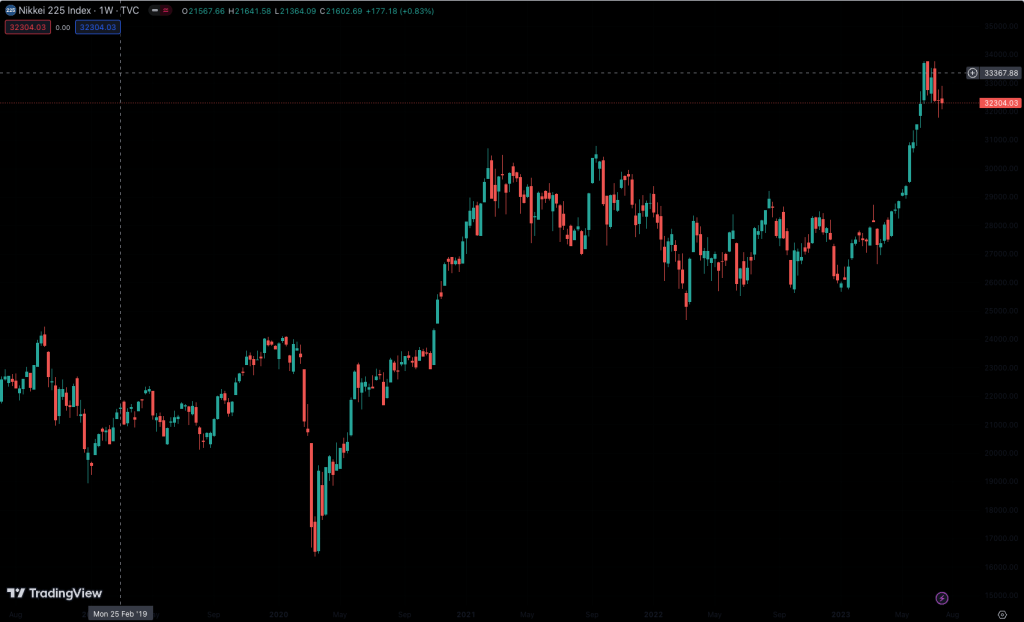
Remember Monex guy? Two months ago he said the Nikkei 225 was likely to trade in a range of ¥31,000 to ¥33,000 for a while. Gotta give my man credit there, it’s done exactly that. His expectation was that if we can break above that range, we’re heading for ¥40,000. What do you think about that?

If there’s one thing I’ve noticed recently, there’s been a subtle narrative change around the Japan stock market rally. In the first half of the year, it was exactly that – Japanese stocks were broadly rising and outperforming most other developed markets. What has changed, is that the narrative in the news now is more focussed on a Japanese value/dividend stock rally.

So what happened? Well, first, the Bank of Japan has allowed long-term yields to rise up to 0.70% and beyond and then, on 9 September, BOJ Governor Kazuo Ueda said that the lifting of the central bank’s negative interest rate policy will become an option if wages and prices rise. He even said they might have enough data to make a call on that by the end of the year. Despite the talk of interest rates rising, with inflation at over 3%, Japanese investors are realising that sitting in cash is a losing trade. With bonds still offering negative real rates, the money has been pouring into dividend-generating stocks. There’s also a possibility that the revamping of NISA for 2024 has got investors more excited about getting involved in the stock market.

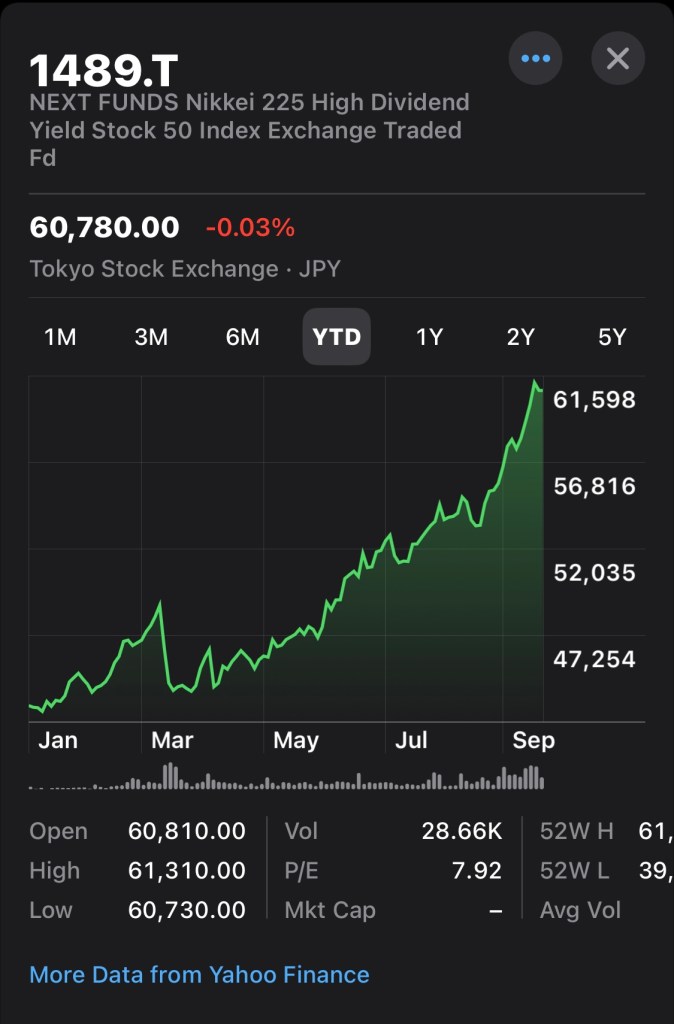
I know it lacks class to say I told you so, but sometimes you need to toot your own horn. This is stuff I figured out some time ago. On 14 September, Nikkei News Plus 9 did a feature on the Nikkei 225 High Dividend Yield Stock 50 Index. There is an ETF that tracks this index and I have owned it since spring 2022 and I covered it in posts in March and October. Here’s what it looks like year to date:

Not bad at all. Ok, enough self-congratulation, there is still a lot to think about here. The big question is, how is this going to play out over the remainder of the year? The fact that financial news programs are starting to fixate on the value/dividend stock narrative is good news if you hold these stocks. Just since the feature on the Nikkei program last week there has been a notable bump in the dividend ETF along with bank stocks, shipping companies, trading companies and steelmakers, which News Plus 9 showcased as examples. So this is now a hot trade which could run for a while, particularly as the talk of exiting negative interest rates heats up. Pick a banking stock and take a look at its performance year-to-date and particularly over the last few weeks!

When a sector gets hot and retail crowds in, it’s often a sign that we are nearing a top. The mania phase can last longer than you expect, but it can also blow off in a hurry. If I didn’t own these stocks already, I don’t think I would be jumping in now. As I mentioned in the July post, these are tactical positions for me, so I am keen to lock in some profit, while also remaining invested to catch any further upside. I have sold incrementally over the past 2 months and reduced my holdings by about 30%. Of course, with hindsight, I feel pretty silly selling anything. I could have just waited and sold higher. But that’s the way it goes – you have to make decisions based on the information you have in real time. So I took some profit, but left two thirds still invested. So far, so good.

So is the Nikkei going to ¥40,000 this cycle? I would be happy to be wrong on this one, but my bet is no. Higher rates, or at least the talk of higher rates, are bad for growth stocks but can be good for value as we are seeing. You would need both to be going up to hit the ¥40,000 mark.

I am still of the view that any attempt at normalising rates in Japan will lead to chaos and a hasty reversal. However, as we are seeing now, even talk of an increase is enough to change market dynamics. And if last night’s Nikkei News Plus 9 program is anything to go by, there is a lot of talk going on! They were feverishly covering how some net banks are raising their rates for fixed deposits to a hefty 0.70%!

From the BOJ’s perspective, a lot of this talk on rates is just that. There’s even a term for central bankers talking up a strategy in order to get the reaction they want from markets – jawboning. It doesn’t change the corner they have painted themselves into. It’s not looking good for the yen folks…

Of course, a lot also depends on the US. Last night’s Fed decision to leave rates unchanged and the plan to hike once more this year was as expected. As they always do in this situation, the Fed is talking up a soft landing. History is not on their side on that one. As the effects of this hiking cycle gradually feed through to the underlying economy, the smart money is still betting on recession. Markets are too interconnected for Japan to keep sailing on if that’s where we are headed.

So no ¥40,000 in the near future, but there could be some more upside for value/dividend stocks. Early next year may get interesting if the BOJ tries to translate some of this talk into action. I plan to have a ready supply of dry powder to allocate if we do take a dive. That’s my view, which I will look extremely foolish for putting in writing if we see ¥40k by Christmas! But if you’re going to invest tactically, you’ve got to have an opinion. Perhaps I should buy a Monex hat to eat if I am wrong…

Disclaimer: This should go without saying, but the information contained in this blog is not investment advice, or an incentive to invest, and should not be considered as such. This is for information only.

The 2024 NISA – NISA Forever!

I have been meaning to write this update for a while. In particular, because people keep finding an article I wrote about the ‘New NISA – Coming in 2024’ and telling me it is out of date, which it most certainly is! You see, that was the old new NISA plan and since then there is a new new NISA plan, which is even bigger and better. Clear? Apologies for the confusion and for my tardiness in updating – the old article will be consigned to the fires of internet hell just as soon as I get this one written and posted.

If you’ve read this blog before, you may be aware that I care very little about product. By that I mean, if you are buying a box to hold things, I don’t care if you get the blue box, the pink box or the rainbow box. It’s just a box, after all! There are a number of NISA products out there offered by online brokerages and banks. I hear even the Japan Post Bank is getting in on the act. My preference would be for the online brokerage accounts, but that’s mainly because I am terminally online and want to minimise time spent ever talking to staff at the bank! If the post office works for you, have at it!

What does get me excited is what you put in the box. That’s where things get interesting. I already wrote a post on How to choose investments for your NISA, so please check that out as a compliment to this post.

So, down to the nitty-gritty. How does the new NISA work? My NISA is with SBI, and they wrote a little guide with some ‘helpful’ graphics – see here. Google translate works ok on the main body of text but the graphics remain in Japanese. I’m really linking to this so you don’t rely entirely on this post to remain correct. Keep an eye on official sources in case something changes before launch.

In short:

You can invest up to ¥3.6 million per year – ¥1.2 million has to be invested in mutual funds, and the remaining ¥2.4 million can be invested freely. That means ETFs and direct stocks are on the menu.

The investment term is unlimited – so ¥3.6 million a year for 5 years = ¥18 million. This is the fastest you can fill it up, but you can actually take as long as you want to reach the ¥18 million limit.

The holding term is forever – there is no limit on how long you can hold the assets in the NISA. As long as you don’t sell, dividends will be paid tax-free and there will be no capital gains tax when you do eventually sell.

All in all, it’s a pretty good deal! I plan to be maxing out my allocation for each of the five years before making any investments into taxable accounts.

If you have an existing NISA, you will not be able to make any new contributions to it after the end of 2023, but you can choose to keep the money invested until the end of the term. For example, if you started a regular NISA this year and invested ¥1.2 million, you can leave that money invested, tax-free, for another four years. Any new contributions will go into the new NISA. If you have a Tsumitate NISA with 15 years remaining, you can choose to leave the money contributed up until the end of 2023 in there for 15 years. Again, from 2024 any new contributions will go to the new NISA.

Investment Strategy

I encourage you to give some thought as to how to allocate the investments in the new NISA. Again, the post I mentioned earlier may help.

There is one trade-off I am particularly focussed on here: growth vs. income. Your forever NISA investment will benefit from not being charged the 20% tax on capital gains or dividends. So which should you try to maximise? The short answer here is probably a combination of both, but let’s do some thinking about it:

For the ¥1.2 million per year that has to be invested in mutual funds, I don’t think it will be possible to generate income. Mutual funds generally re-invest dividends, so they are part of the investment return, but unless they have a distribution share class, they don’t pay dividends out. If anyone finds a mutual fund, available for NISA, that actually pays out dividends, please do chime in – I would be very interested to hear about it. For now, I’m going to assume that such funds are not available. In that case, for the ¥6 million (¥1.2 mill x 5 years) that you invest in mutual funds, it would make sense to go for growth. I will be looking for high-growth-focused funds for this part of the allocation. (note that growth stocks generally pay no/low dividends as any earnings the company makes are reinvested to spur further growth)

For the remaining ¥2.4 million a year, that’s ¥12 million, I am tempted to strongly focus on dividend-paying stocks and/or dividend stock ETFs. If you can generate a 4% dividend return on ¥12 mill, that gives you a tax-free ¥480,000 per year in income alone. And, of course, these stocks will probably also grow in value over time if you are patient. Now, nobody is retiring on ¥480,000 a year but over 25 years, for example, that’s ¥12 mill in your pocket. Not bad, huh?

Of course, there’s a pretty good argument for investing the ¥12 mill into a fund that reinvests the dividends so you get the compounding effect over the term of the NISA. I have no objection to that. I just like the idea of collecting my ¥480k tax-free every year and either spending it or reinvesting it myself.

Also, after a discussion with Ben at Retire Japan, I discovered that under the new NISA rules, you can sell assets and then re-use the tax-exempt amount to invest in a different asset, which is a huge improvement on the current system. Thanks, Ben for pointing that out! See this FAQ on the FSA website.

So those are my thoughts. I would love to hear from anyone who looks at the NISA opportunity differently. Drop me a line or come and tell me I’m wrong on X. (yes, we have to call it that now…)

Disclaimer: This should go without saying, but the information contained in this blog is not investment advice, or an incentive to invest, and should not be considered as such. This is for information only.

Nikkei ¥‎40,000? Thinking outside the box

After all the doom and gloom of 2022, 2023 has been a pleasant surprise for some brave investors. It looks like stocks actually did bottom in October last year and if you own US big tech and Japanese stocks you’re enjoying a bumper year!

And now comes the big question? When do I sell?

In case you forgot, the idea of investing is to buy low, sell high and beat inflation in your base currency. Sounds simple doesn’t it? Personally, I’m pretty good at the first part. Fear is easy to spot. Granted, it takes some guts to run towards the carnage when everyone else is running away, but I have successfully conditioned myself to embrace the pain in markets and buy stuff when it’s on sale.

In my experience, the selling part is harder than you think it will be. Because it’s generally time to sell when people are euphoric and euphoria is kind of addictive. It’s even harder to sell when things are simply good – they could always get better right? And you don’t want to leave money on the table.

I was watching the Nikkei News Plus 9 program on BS TV last night and a very serious-looking guy from Monex Securities was talking about Japanese stocks. I think he is the chief strategist at Monex and he identified what looks a lot like a double top in the Nikkei 225 chart. Ok, I had noticed that too. He explained that he thinks that means the index will likely trade in a range of approximately ¥‎31,000 to ¥‎33,000 for a while. I wish I had a video of it – he described the range as a box, and at one point he handed the presenter an actual cardboard box with Nikkei 225 written on it and asked him to look inside. The presenter rummaged around and came out holding four crisp ¥‎10,000 notes. Yes, the Monex guy explained, once the Nikkei breaks out of the box, it’s going to ¥‎40,000! Wahey!

Forgive my cynicism, but I immediately began wondering if it might not be time to get the hell out of Japanese stocks! There wasn’t a lot of explanation going on about how the index goes from the box to ¥‎40,000. I’m no technical analyst, but it sounded a lot like hopium to me. Still, the guy is the chief strategist at Monex so I assume some research went into this.

The US market is looking interesting too. The S&P 500 is up +18% so far this year. Fantastic! However, dig around a little and you find that it’s actually only seven stocks that have driven those returns. Those stocks are, of course, big tech and the narrative that’s driving them, in case you’ve been living under a rock, is AI. Feeling euphoric yet?

So it’s possible that things are a little overdone. All bets are on the Fed hiking rates again at month-end and leaving them there for at least the rest of the year. History does not bode well for a soft landing from an extended period of irresponsibly loose monetary policy followed by a burst of inflation and a breathtakingly fast tightening cycle. This generally does not end well. There is a lot of talk of the stock rally broadening out but it’s early days and if the tech companies sell off, the last one out the door can probably turn the lights off for a while.

So is it time to sell? If so, how much and how do you do it?

First of all, let’s take a breath and remember that we need to consider core and satellite holdings separately. The core being the 70-80% of a portfolio that is broadly diversified, and satellite being the 20-30% we may have in something a little sexier. We’re not talking about simply dumping all of our investments because the market might go down.

I have already written about how to buy low and sell high in your core allocation here. In short, you establish a strategic asset allocation that meets your risk profile and then rebalance it once per year. The rebalance, in effect, sells part of holdings that have gone up in value and reallocates to the holdings that have gone down. That’s it, no further action required!

Satellite holdings are generally invested in assets that add a little more spice to your overall portfolio. They sometimes have a higher risk/return profile and may change over time depending on market conditions and what is hot.

So let’s say, for example, you’re living in Japan and you have a core portfolio invested in an internationally diversified range of assets that is matched to your risk profile and base currency. However, over the last year or so the weak yen has prevented you from investing more outside Japan. Meanwhile, the rise in inflation meant that sitting in JPY cash was a dumb idea and so you’ve been allocating to a range of dividend-paying Japanese stocks to make sure you preserve your spending power. And low and behold, somebody lit a fire beneath the Japanese equity market and your boring Japanese boomer stocks are mostly up between 20% and 50%!

The man at Monex says the Nikkei is going to ¥‎40,000 and, much as you are intrigued by that idea, you are not sure you share his confidence!

What do you do?

Quite the dilemma, albeit a nice one to have. So what do the options look like?

  1. Sell the lot – the gains are way more than the dividends you are going to earn over the next 12 months, so take a break and come back when things are cheaper again.
  2. Sell part of your holdings – you’ll be happy you took some profit, but if the Monex guy is right, ka-ching!
  3. Roll the dice and keep it all – there’s ¥‎40,000 in that box!

Of course, there is no correct answer and it depends on your personal situation, risk profile blah blah blah. For the record, I’m in the option 2 camp. I’ve been selling incrementally and I try to sell on green days. If nothing crazy happens I’m looking to gradually cut my holdings in about half. That said, in the process of accumulating Japanese stocks I have found some that I think are keep-forever-type companies.

I still think the Bank of Japan is going nowhere fast on adjusting rates and if inflation comes down, there will be less pressure on them to take action. But if that pressure builds and it looks like they might blink, I go option 1 in a hurry.

US big tech I’m not so concerned about. Everyone should own some of that for the long term, and if you are buying index funds you probably own more than you realise!

So prepare for a hard landing while hoping for a soft one. And learn from the experience as you go.

Today marks 26 years since I landed in Japan. There’s a lot to be thankful for!

And if the Nikkei hits ¥40k I will get a box and take a photo with it.

Disclaimer: This should go without saying, but the information contained in this blog is not investment advice, or an incentive to invest, and should not be considered as such. This is for information only.
Nikkei 225 ¥30,000+, is it too late to buy Japanese stocks?

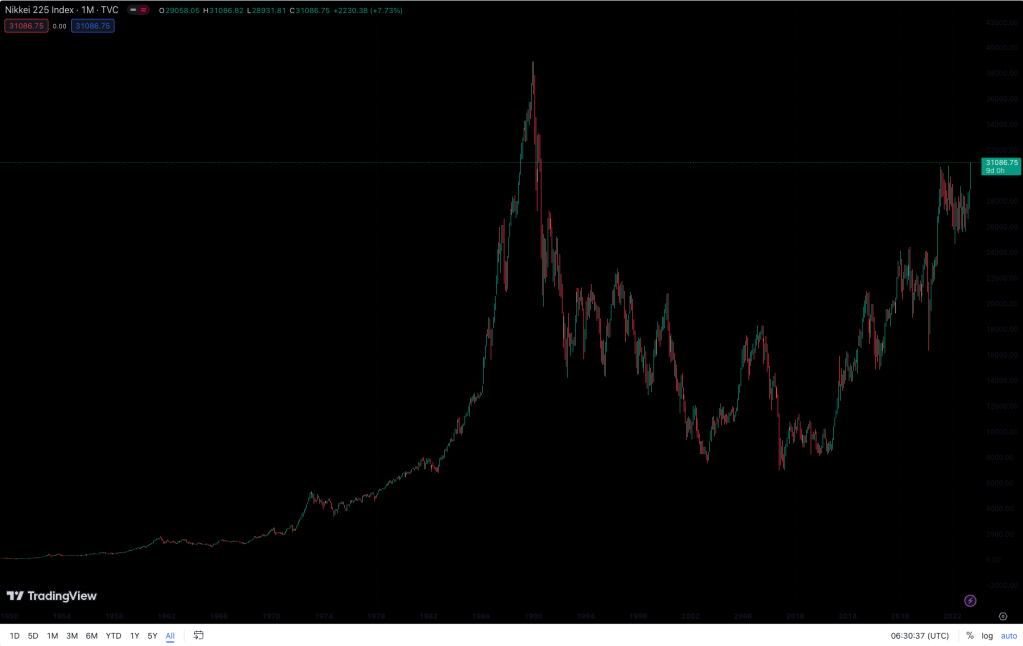
Japanese stocks have broken out, with both the TOPIX and the Nikkei 225 at levels not seen since August 1990. The inbound tourism revival is in full swing and foreign investors, including the great Warren Buffett, are pouring in. So is it too late to get involved?

After a volatile year for stocks in 2022 and a big drop in the yen, it feels like there is a lot of money sitting on the sidelines. And while ‘scared money don’t make money’, Japanese stocks have been quietly putting together a world-beating two quarters. Here is a selection of year-to-date performance numbers:

Nikkei 225 +19.1%, Toyota +7.5%, Honda +30.6%, Fast Retailing +26.7%, ANA Holdings +12.8%, Keisei Electric Railway +44.6%, Kyoto Hotel Ltd +9.25%, Panasonic +32.8%, JFE Holdings +17%, Marubeni Corp +31.4%, Hub Co Ltd +28% (yeah boiiii!), Japan Tobacco +16.6%, Takeda Pharmaceutical +10.8%, Yaskawa Electric +38.2%.

You get the picture. Japanese stocks are on a tear and not many people saw it coming. Not so the eternal Japan Optimist, Jesper Koll. I had to smile at the title of his recent post ‘We’re all bullish Japan now…’ I’ve seen countless bullish articles on Japanese stocks this last week – suddenly everyone is jumping on the train.

Jesper has of course been riding this train for some time and does a great job in his post of identifying the reasons for the surge in Japanese risk assets. If there’s one lesson that we all should learn from the past few years, it’s that liquidity drives markets. And as developed markets go, Japan is the last remaining source of cheap money. As the US and European central banks raise rates to fight off inflation, the Bank of Japan has, predictably, kept things very easy. There was a slight blip as a new governor took over at the BOJ and a host of people, who should know better, speculated that he would be forced into tightening monetary policy and blowing up the bond market just to fit their narrative. Ueda-san quickly put such rumours to rest and confirmed that policy will remain easy for the foreseeable future.

Jesper rightly points out other factors in the rise of risk assets in Japan: inflationary fiscal policy, a refreshing wave of pro-shareholder regulation, the expansion of NISA, increased business investment and a rising corporate metabolism. To that, we can add a few sector-specific catalysts: the weak yen providing a tailwind for exporters, Chinas’s economic reopening boosting commodities and shipping-related business, and the inbound tourism revival pushing up travel-related stocks.

However, none of this means much without that steady stream of delicious liquidity; mmmm zero interest rates and yield curve control are still on the menu!

A lot has been made of Berkshire Hathaway’s investments in Japan’s big five trading companies. And without wanting to diminish the fact that one of the world’s greatest living investors is buying in Japan, a lot of the coverage ignores the blindingly obvious: Warren pigged out at the last cheap money buffet in the world! He issued debt in yen at around 1% to buy quality companies that pay 4% income. It’s an exquisite arbitrage, but hardly a ringing endorsement of corporate Japan. If interest rates remain high in the US and low in Japan, you can bet he will be back. That man can’t turn a good deal down!

So, the big question is, if you don’t have much exposure to Japanese stocks already, is it too late? Once more it’s fascinating, and somewhat alarming, to see almost total consensus from commentators: the market is going to keep going up! I’m not one to fight the trend, but when everyone thinks one thing is going to happen it’s usually time to open your eyes to the exact opposite scenario…

Quoting Jesper himself here: ‘after more than thirty years, a positive break-out above the historic “Bubble Peak” of 40,000 on the NIKKEI stock index is finally becoming a realistic prospect over the next 15-18 months.’

So let’s be cautiously optimistic here, while keeping in mind the second part of Jesper’s post, what could go wrong? If you’re serious about owning Japanese stocks, I urge you to read the post yourself, but clearly, the number one thing that could derail this rally is inflation refusing to die down as expected, forcing the BOJ to take action on yield curve control and interest rates. My personal take on this is that any attempt to ‘normalise’ rates will be met with chaos and a hasty U-turn, but the damage will get done very quickly amongst the chaos. There’s obviously an argument here for long-term investors to ride out the storm and wait for the rebound, but I would prefer not to ride into that storm with too much JP stock exposure myself.

So if you own JP stocks already, enjoy the ride, but keep an eye on those inflation numbers and an ear to any rumblings from the BOJ. If you are planning on getting in now, then you are probably not too late but you don’t have a lot of cushion on the downside, so act accordingly.

Disclaimer: This should go without saying, but the information contained in this blog is not investment advice, or an incentive to invest, and should not be considered as such. This is for information only.
How to Choose Investments for Your NISA

If there is one thing I have learned in all of my years of financial planning, it is this: people are way more focused on product than on what to invest in within the product. People will spend hours comparing investment accounts to find the one with the best tax advantages, lowest fees, and most comfortable user interface. Then once they decide, they just chuck all their money into the first global stock fund they find on the list. Somebody once said, “people will spend more time deciding on a pair of jeans than on what to invest their retirement fund in.” What follows is far from the definitive guide to investing in NISA, but it should provide some angles to consider it from.

Before that, I have a simple security tip for you. A friend of mine realised recently that someone was trying to change the email address on one of his financial accounts. They knew his email, and had figured out that he had an account with this particular institution, and were trying to get the institution to change his email address so they could get access. Scary, huh! Luckily my friend caught it in time, and rather than responding to emails/chat messages, he set an appointment to talk to a representative. (don’t get phished!) That representative gave him a great security tip: make an email address that no one (except maybe your immediate family) knows about, and only use it for your financial accounts. I thought that was pretty good advice and am implementing it myself. It may be a bit of a pain, but not as painful as having one of your accounts drained – this particularly goes for crypto accounts!

Ok, back to NISA. Obviously, I can’t give blanket advice that works for everyone. The investments you choose will depend on your base currency, attitude to risk and timeframe. Another big factor to consider is that NISA itself is changing from next year, which perhaps affects your strategy for this year. Given the above, I will try to provide a general guide with some helpful ideas:

Base currency

Yes, this again…Currency may seem irrelevant in a Japan-based account such as NISA, but I would argue that you have to at least think a little about when and where you will spend the money. If you are living and working in Japan, I would assume you at least have some need for yen as a base currency. However, if you plan to move or return home in five or ten years’ time, should you really be building assets in yen? I can’t speak to all of the NISA products out there, but my SBI account allows me to buy US-listed stocks and ETFs through their international site, and you can buy these for your NISA account too. Now, given that NISA is not a good fit for US citizens, why would you buy USD assets? Well take a look at my previous article on the yen and think if you really want to build all of your assets in yen. Yes, when you cash out you will have to cash out to your Japan yen account once, but you can then quickly convert to the currency of your choice. You can also buy yen-denominated funds / ETFs that invest in global assets, so even if the investment is priced in yen your underlying exposure is to other currencies. 

So, if you are going to spend the money in Japan, should you only buy Japan-based assets? That would depend on your overall asset allocation and whether you have some exposure to overseas assets through other investments. Compared to the rest of the world combined, Japan is not such a big market and it would seem like a risk in itself to only have Japan exposure, but I would still aim to keep a reasonable amount in yen, just in case it’s 80 yen to the dollar when you want to sell the assets and spend the money. Personally, I already have global exposure, so am mostly buying JPY assets in my NISA account.

Managing risk

Knowing your own tolerance for risk is important. No one wants to be lying awake at night worrying about their investments. The only thing I go on about more than base currency is diversification. The problem with Japan-based accounts is it is hard to diversify well if you are investing in yen. Japanese government bonds? No yield and more risk than anyone at the BOJ wants to admit, hmmm. I think REITs offer an opportunity for diversification and a quasi-bond type profile. Also, diversification across styles can help: don’t just buy a Nikkei 225 tracker – look at high dividend stock ETFs, look at value ETFs and growth ETFs. You can also buy individual stocks if there are companies you know well, or that fit your risk profile. Warren Buffet is buying Japanese trading companies. Maybe he knows a thing or two?  Also, perhaps put 5-10% in a gold ETF.

What about the new NISA?

You may have heard that NISA is changing in 2024. From next year you will be able to allocate up to ¥3.6 mill per year. You have to put ¥1.2 mill in mutual funds, but you are free to allocate the remainder as you wish. The maximum total contribution limit is ¥18 mill, but you can leave this invested tax-free for life! 

This has led me to decide that for this year’s contributions, I am going to focus more on dividend-paying stocks for my NISA and I will re-evaluate when the rules change next year.

Tax-free growth or tax-free dividends?

Here’s an interesting way to look at things. If you only have a limited allocation that is free from tax on capital gains or dividends, which do you try to maximise? Do you go for all-out growth and try to increase the value of your investments as much as possible over time, and take those gains tax-free? Or do you focus on more stable, dividend-generating stocks and REITs, whereby you get a more predictable annual yield with no tax on the dividends?

This again depends on your attitude to risk and how your other investments are allocated. Already have a broadly diversified portfolio elsewhere and NISA is a relatively small part of your overall allocation? Why not go for growth and try to shoot the lights out? On the other hand, if NISA is an important part of your long-term plan, perhaps you should take a more balanced, diversified approach and try to maximise dividends?

Regular or lump-sum investing

How do you actually go about allocating the money in your NISA? Do you dump it all in during January? Or do you allocate a little every month? If you are investing monthly you are taking a lot of the timing risk out of the allocation process, so you can lean more heavily into higher-growth stocks. This works great for Tsumitate NISA. If they go down, you buy more next month. If you are allocating in one go, you might try to diversify a little more.

Do your own research

I was considering putting a list of interesting funds, ETFs, and stocks at the end of this post for people to do some reading/research on, but I don’t want to be seen as recommending particular investments over others. Plus, that’s what my paid coaching sessions are for! The fact is, it doesn’t matter so much which global stock fund you choose. It’s more important that your overall allocation fits your personal situation, time frame and medium to longer-term goals. Putting in the work will lead to a better understanding over time. Don’t be afraid of making mistakes, but do spend a little more time deciding your investments than you would over buying a pair of jeans!

Disclaimer: This should go without saying, but the information contained in this blog is not investment advice, or an incentive to invest, and should not be considered as such. This is for information only.

How Screwed is the Yen?

First of all, Happy New Year! I hope you all had a fantastic holiday season. Keeping with the spirit of the last three years, we have not been anywhere! Ok, we did have a couple of mini-holidays here in Japan and a peaceful family Christmas and New Year at home, so no complaints!

2023 is shaping up to be interesting in many ways. I have taken on a freelance financial writer project that has diverted some time away from writing here. I will link to that at some point, once I am settled into the routine. It’s an interesting project and I am really enjoying the new challenge. However, if there’s one thing that writing to order and to deadlines has taught me, it is to be grateful for the freedom I have to write whatever I want here, hence the somewhat irreverent title of my first post of the year!

So how screwed is the yen??? 

Well, before we jump into that, let’s take a quick look back over 2022. As per my previous post, the lesson for us all is that liquidity drives markets, and in 2022 Jerome Powell was the first central banker to start draining liquidity. Throughout the year he continued to raise interest rates in order to fight inflation and, in doing so, pretty much killed the bull market in risk assets. Literally adding fuel to the fire, Vladimir Putin invaded Ukraine and fanned the flames of inflation, particularly in the energy sector. The S&P 500 index ended the year -19.4%, the NASDAQ -33.1%. European stocks were down around -13%. And not only equities suffered: US bonds, the so-called safe haven asset, were down around -13%. Even well-diversified portfolios were down somewhere between 15-20% on the year. The only big gains were in energy stocks, with that index up over 60%.

So how about Japan? Well, the Nikkei 225 index was down -9.4% on the year, but I can tell you from personal experience that if you picked the right stocks you actually made money last year. So not bad right? The danger, however, lurked in the fixed-income and currency markets. The strong US dollar crushed everything in its path, with the yen coming off perhaps the worst of the developed market currencies, although the pound and the euro suffered too. 

I just listened to a great interview with Brent Johnson, of Dollar Milkshake Theory fame. It gets interesting around the 16-minute mark. Here’s a quick summary if you want to save bandwidth: 

During 2022, after years of zero to negative yields, inflationary pressure caused Japanese Government Bond (JGB) yields to rise by 0.25%. That may not sound like much, but it had a huge effect on the price of JGBs. Remember, as yields rise, bond prices fall. As a result, the Bank of Japan had to repeatedly come out and reaffirm their commitment to Yield Curve Control. (YCC) In short, they had to do more quantitative easing, which meant printing more money and buying more bonds, which also translates to more yen going into the market and a weaker currency.

Keeping it simple – they had to devalue the yen to save the bond market. Why? Because the owners of those bonds are Japanese banks, pensions and insurance companies. Not the kind of institutions you want falling over. Things got so bad that, by the end of September, the BOJ had to come out and artificially support the yen. 

Here’s where it becomes a problem: The programs you would have to enact to save the yen are the exact opposite of the programs you would have to do to save the bonds. To save the currency you have to raise rates. To save the bond market you need lower rates.

Then, at the end of the year, the BOJ made the surprise move of widening the band for their Japanese Government Bond Yield Curve Control from 0.25% to 0.5%. When they did that, the yen started to strengthen. However, if you allow interest rates to rise, what happens to bond prices? Down they go! 

And herein lies the crux of the matter: you can save both the currency and the bond market for a short period of time, but ultimately, over a longer period of time, you have to choose one. Now, governments always say that they won’t sacrifice the currency, and then they always do. The reason is simple: the currency benefits the citizens the most, to the detriment of the government, and the bond market benefits the government the most, to the detriment of the citizens. Which do you think the government will choose to save?

Also if you save the currency, you will effectively collapse the banking system, which isn’t going to be pretty. And more importantly, as the government, if you sacrifice the bond market, you can’t raise money anymore. You essentially cut off your income. What government is going to do that?

So how screwed is the yen??? 

I try to avoid being sensationalist about this kind of stuff. People have been predicting the collapse of the Japanese economy for decades now and it still kept muddling through. The thing that has changed is that it was muddling through in a low inflation environment, which allowed the BOJ to keep rates low. If you are hoping that the value of your yen will hold up, you better hope that inflation calms down pretty soon! The thing that shocked me about the interview with Brent was not the fact that he thinks the yen is screwed – I always thought it would be at some point down the line – it’s that he thinks it is already screwed now and it gets really ugly from here. The ECB and the Bank of England are in a similar position, but Japan is so much further down the road. In terms of monetary policy, Japan is not just the canary in the coal mine. It’s the whole damn coal mine!

I wrote a post back in April 2022 called The Weak Yen Dilemma, where I basically noted that over time things tend to revert back to the mean, and that is what would eventually happen for the yen. In the realm of ‘nobody knows’, that is still a possibility but I am starting to think that from a financial planning/investing perspective we need to consider the big question: What if it doesn’t?

What if the yen is screwed?

I am not an intellectual and have no interest in a debate about the fate of the yen. As a financial planner and investor, I deal in probabilities. So I think it’s important to consider what we can do in case the yen is actually in trouble.

If you have been reading this blog for a while, you will know that I am the guy who never shuts up about base currency. I’m sure it’s annoying but here’s the thing: you can have the perfect tax-advantaged, low-fee account with the best asset allocation, but if you are in the wrong currency you are shooting yourself in the foot and by the time you realise it, it may be too late. If you found yourself last year saying “I want to do x but the yen is too weak” then you know what I mean. Base currency is not the currency you are earning in, it’s the currency you plan to spend the money in. So let’s take a look at what people living in Japan with different base currencies can actually do to prepare:

JPY Base Currency

If you live in Japan, earn yen and plan to spend it here until you die, you have the least to think about. The main thing you need to concern yourself with is beating inflation in yen terms. However, are you really 100% yen base currency? Might your kids want to study abroad? Do you plan to travel overseas regularly to visit family or for other reasons? If you think that Brent might be right, do you want to maybe allocate a portion of your investments to USD so you can take advantage of the eventual collapse of JPY?

USD Base Currency

If your BC is the global reserve currency and you have all your money languishing in yen, it’s time to start putting in some serious thought. You probably experienced severe pain last year watching the yen slide to ¥150. You’re probably waiting for it to get back to something reasonable, like say ¥110, before you convert your yen to dollars. Right? But what if it doesn’t get there? Maybe ¥130 is the best deal you’re going to get? I’m not saying you should panic and convert everything today, but you need to consider the probabilities. Maybe you should start converting a little every month, or every quarter? Again, I’m really not the alarmist type, and maybe things will gradually get back to normal. But what if they don’t?

GBP/Euro Base Currency

The good news for you guys is that the UK and Europe are just as screwed as Japan! Japan might go down first, but you are the next dominoes in line. So you may find that there is less of a differential between GBP/JPY and EUR/JPY than there is with dollar vs. yen. All the same, if you are not planning to spend the money in Japan, you should be saving and investing in your base currency. And maybe, given the situation we are describing here, you should consider owning some dollars too in case there is something to this milkshake theory?

Other Base Currency

Please forgive me for lumping everyone else together but there is only so much time that can be spent on one post. If you are from a country considered an emerging market, you are probably already well-experienced with currency fluctuations. Saving in your base currency is a great idea, but you should perhaps consider USD as an option too as it offers more stability. If you are going to retire somewhere like Australia or New Zealand then again, the local currency plus maybe a dash of USD seems like the way to go.

Outlook for Japan Investments in 2023

I will likely get into this in more detail in future posts. I’m thinking, given it is January, of writing a post on strategies for investing in NISA. But for the time being, here are some things to consider: Bonds are a no-go in my opinion. Stay away from them. Equities are likely to struggle just due to the general economic climate and the spectre of recession, but there are some stocks paying nice dividends out there that are probably a better option than cash. However, if the BOJ really does enter a tightening cycle, which has been unthinkable for longer than I care to remember, I would be pretty concerned about Japanese stocks. Remember that liquidity drives markets! Inflation, troublesome as it is, may provide a tailwind for property values.

I hope that provides some food for thought. Wishing you all the best for 2023 and let’s hope that the yen isn’t actually screwed!

Disclaimer: This should go without saying, but the information contained in this blog is not investment advice, or an incentive to invest, and should not be considered as such. This is for information only.

Investment Update: Recession Fears, Japan Stocks, Crypto Crash

It’s been a year…

November 2021 was when we heard the first whispers of the Federal Reserve reversing course and hiking interest rates. The very smart few realised right then that risk assets were heading for trouble and made their way to the exit. For the rest of us, things weren’t looking so bad. Tech stocks were hitting home runs, Bitcoin was over $56,000. Christmas was coming!

It always looks so clear in hindsight. Risk assets were, of course, swimming in a giant pool of liquidity. Low interest rates, massive covid stimulus, glorious liquidity! And the spectre of inflation, caused by that very excess, was about to prompt the Fed to drain the pool. The onset of war in Ukraine certainly did not help the cause, but those who blame Putin for the economic state we are in are (sometimes deliberately) missing the big picture. If there’s a lesson we can all learn from this year, it’s that liquidity drives markets. When central banks are cutting and keeping rates low, risk assets make money. When they start increasing rates, and draining that liquidity, look out below.

Risk-off assets have not behaved well either thus far. Your typical 60/40 stocks/bonds portfolio is down almost 20% year to date. Even well-diversified investors haven’t really escaped the pain, but that’s how it can go when liquidity is sucked out of the market. One of the few bright spots this year has been energy, and that one does have more to do with President Putin than underlying economic conditions.

When’s the recession?

‘A recession is a significant, widespread, and prolonged downturn in economic activity. A common rule of thumb is that two consecutive quarters of negative gross domestic product (GDP) growth mean recession, although more complex formulas are also used.’Investopedia

Talk of recession has been swirling for some time, with governments even accused of changing the definition above to prevent the mood from getting too dark. The consensus view is that much of the world will be in recession for some part of 2023. It’s more of a when than an if thing, although the severity of the coming downturn is yet unknown. Unsurprisingly, stocks do not fare well during recessions – when income and employment decline, companies struggle to stay profitable.

Recessions are, however, usually accompanied by the cutting of rates and at some point, a trough is formed and both the economy and stock prices begin to recover. There’s that liquidity we’ve been thirsty for!

For those who can afford it, recession offers an opportunity for careful accumulation of growth assets. There is no need to try to catch the absolute bottom, just keep adding to your long-term positions.

What about Japan?

As discussed in previous posts, Japan has avoided the worst of the inflation that has caused so much trouble this year. This, coupled with the Bank of Japan’s commitment to continue providing massive liquidity, has also sheltered the stock market from a lot of damage, albeit at the cost of the yen. I have been buying Japan dividend stocks on dips throughout the year and am pleased to find myself in positive performance territory, with some nice dividend payments to boot. The capital gains can, of course, disappear quite quickly, but the dividends will still be paid.

Warren Buffet clearly sees something in Japan, as Berkshire Hathaway has just raised its stakes in the 5 major trading houses to more than 6%. This is a serious long-term investor who says he may not be done buying yet. (see Reuters article) Who would have thought that Japan would look so attractive in a year like this?

For a foreign resident, trapped in yen due to currency weakness, there are some pretty good options here to outperform inflation over the next few years. See my previous post for ideas.

Crypto really is dead this time, huh?

My thoughts on crypto winter were laid out pretty clearly in my Bitcoin is Dead post. It was always going to be ugly but wow…just wow! I’m not going to dig into the details of the crimes and insolvencies because if you’re interested you already know, and if you’re not you don’t care. Suffice it to say that human greed and leverage will always be a bad mix when liquidity dries up.

So is it all over this time? Of course, it is not. The Bitcoin protocol is no more affected by all the drama than it is by the outcome of the World Cup. Companies have blown up, and people have lost money, but Bitcoin didn’t do it to them. The protocol keeps churning out blocks, the next halving is around April 2024, and things will get interesting again after that.

If you know what you are doing, now is the time to average into BTC. It’s another accumulation game. If you want to study up during the winter, check out Jameson Lopp’s treasure trove of information and resources.

Also, take a look at this incredible chart from CryptoShadow:

And this one from Fidelity:

Lessons in crypto frequently have to be learned through painful experience, but if you are not learning them, you shouldn’t be involved. Here are my main takeaways from recent events:

  • Do not leave your coins on the exchange unless you are actively trading, no matter how high-profile the exchange may be. Learn to self-custody or research multisig solutions. Find what works best for you and use it.
  • Stay away from services offering interest on your crypto – they will make a comeback at some point and they are a massive house of cards. Locking up your coins with a centralised institution for a yield means you cannot move them when the rumours start and you go down with the ship.

Also a word on the other project you should be following. Since its merge and transition to proof of stake, the issuance of Ethereum has dropped significantly. The network that is likely to power the majority of NFTs and DeFi being deflationary, in a market as weak as this, is actually quite remarkable. We all need some hope during crypto winter and if I was going to pin it anywhere it would be on Bitcoin and Ethereum.

Disclaimer: This should go without saying, but the information contained in this blog is not investment advice, or an incentive to invest, and should not be considered as such. This is for information only.

The Weak Yen – Where to Invest in Japan Today

Source: xe.com

The chart says it all. The Yen is toast, brown bread even, if you know your cockney rhyming slang. Talking to people about money, as I do, I keep hearing the same refrain: “With markets down it seems like a good time to invest, but I don’t want to convert yen at this rate.” I feel your pain, I really do. I feel it so strongly that I needed to sit down and bash out some ideas to help us all get through this. Where do you invest if you are holding JPY at a time like this?

First of all, if you are wondering how we got here, please take a peek at my article on The Weak Yen Dilemma from April. In short, America is raising interest rates to fight inflation, Japan does not want to raise rates, so money seeking a “low risk” return goes from JPY to USD and hey presto, 145 yen to the dollar! Secondly, we are really talking about USD strength here rather than Yen weakness. If your base currency is GBP, for example, nothing much has changed for you as the pound has taken, well, for want of a better word, a pounding against the mighty dollar too.

If you are a dollar investor though, there is little doubt: If you hold yen you are pretty much stuck with it until inflation eases and Jay Powell backs off on rate increases. It most likely will take a recession, or at least a short-term panic in markets, before we see this though so there is still a way to go. So what are you going to do with your yen? Leave it sitting in the bank earning nothing with Japan inflation at 3%, and other developed market inflation at 8-10%? Below are a few ideas to get you thinking. For the most part, you will need a Japan brokerage account to access these opportunities. Als0 kindly note, below I am going to name actual investments, stocks, ETFs etc. that I feel are worth investigating in this environment. I have positions in some of these already, and will likely buy others soon. This is not an invitation to jump in blindly, get burned, and blame me for it! If central bankers ditch this jetliner in the ocean, we’re all going to get wet! Do your own research and know your own tolerance for risk. With that said, let’s brainstorm a little.

The Tourists are Coming Back Baby!

Unless you have been living under a rock, you will be aware that Japan finally re-opens to tourists on October 11th. This time it’s for real – no tour group requirement, no daily limit. Put on your mask and get ready for it! So what kind of businesses are going to be happy to see the return of the horde?

Airlines are an obvious one. JAL (9201) and ANA (9202)stock have already pumped in anticipation so I think we’re a little late here. Plus the cost of fuel is a bit of a concern. No reason they won’t continue to do well, but I’m not feeling the airlines.

Hotels are also obvious, but I like them a little more. In case you didn’t know, it’s really easy to get exposure to hotels in a Japan brokerage account. Check out Japan Hotel REIT Investment Corporation (8985), Invincible Investment Corporation (8963), and the Ichigo Hotel REIT Investment Corporation (3463). As business comes back these REITs should start paying a better income, and there’s room for a little growth too.

The winter ski season is shaping up to be a big one, with revenge tourists from Australia and elsewhere itching to get back to Japan’s ski fields. It may not sound like the most exciting company, but Nippon Parking Development Co. Ltd (2353) operates ski resorts and theme parks and is worthy of research.

Holiday-makers in Japan need to get around, and they love to shop, so the likes of Tobu Railway Co. Ltd (9001) and Hankyu Hanshin Holdings Inc (9042) do a great job of covering both. These companies also operate numerous hotels and leisure facilities, so will be looking forward to the reopening. Isetan Mitsukoshi Holdings (3099) is another big department store operator.

Whether Chinese tourists will be able to travel freely due to Covid restrictions is still a question, but once they come back you know how much they love tax-free shopping in Japan. They particularly like to stock up on electronics and are also renowned for shopping heavily at drug stores. Bic Camera Inc. (3048) and Laox Co Ltd (8202) cover the former, with Sundrug Co. Ltd (9989) and Tsuruha Holdings (3391) leading the drug store operators. Another big favourite with tourists are the colourful Don Quijote stores, operated by Pan Pacific International Holdings Corp (7532)

Japan boasts some of the best food and drink in the world, but you know the tourists love The Hub! Hub Co. Ltd (3030) has had a torrid time the past two years and will be looking to recover strongly, especially with the opportunity to screen the Football World Cup coming up in November. I have owned Hub stock for much longer than I probably should, and it’s just hovering around my average buy price now, so let’s all hope I’m right about this one!

Mmmmm Dividends

John D. Rockefeller sure did love his dividends, and so should you. If you are stuck in Yen and trying to keep up with inflation, Japanese Government Bonds are not going to do it for you. Get yourself some dividend stocks and hold on to them. If you are looking for the easy way to do this, just find yourself a Japan dividend stock ETF and buy that. Then maybe check out their top ten holdings and see if there is anything there you want to own directly. This is exactly what I did with the Next Funds Nikkei 225 High Dividend Yield stock 50 ETF (1489)

Who Else Benefits?

Put on your thinking cap and consider what other businesses benefit from a weak yen. Exporters are an obvious beneficiary, which in Japan generally means, but is not limited to, automakers. A few months back a friend of mine tipped me off that he was interested in a high-end Tokyo residential property REIT, given that foreign buyers are going to love Tokyo property at 145 yen to the dollar. That made sense to me, especially as it pays over 4% income. Sekisui House REIT Inc. (3309) is the one if you want to take a look, but remember, my friend won’t take responsibility for your decisions any more than I will!

Get Me Out of Fiat!

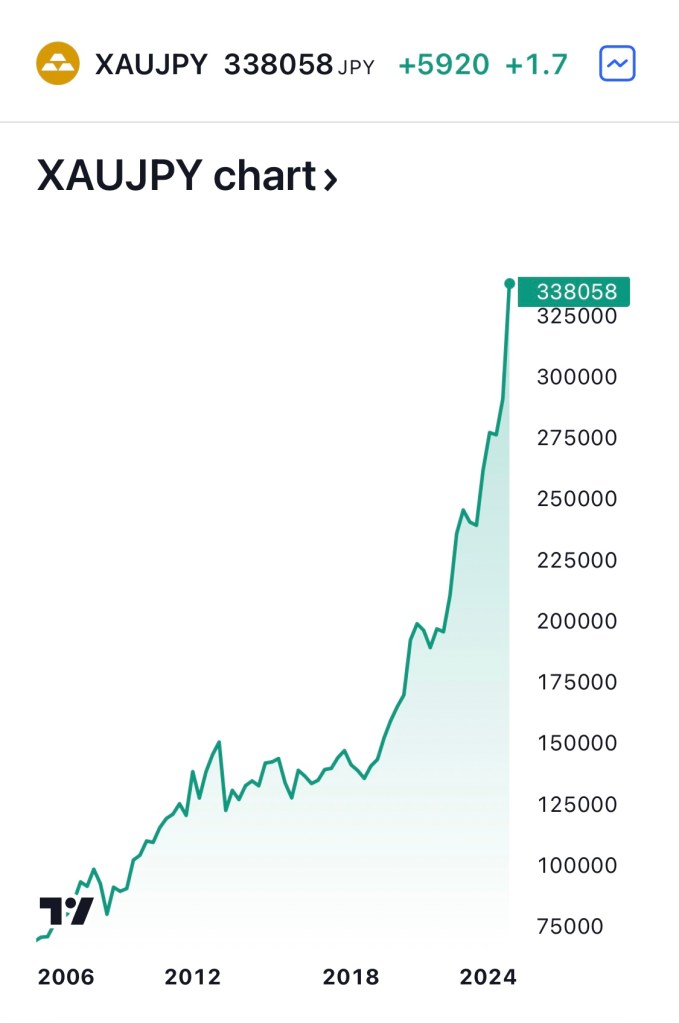
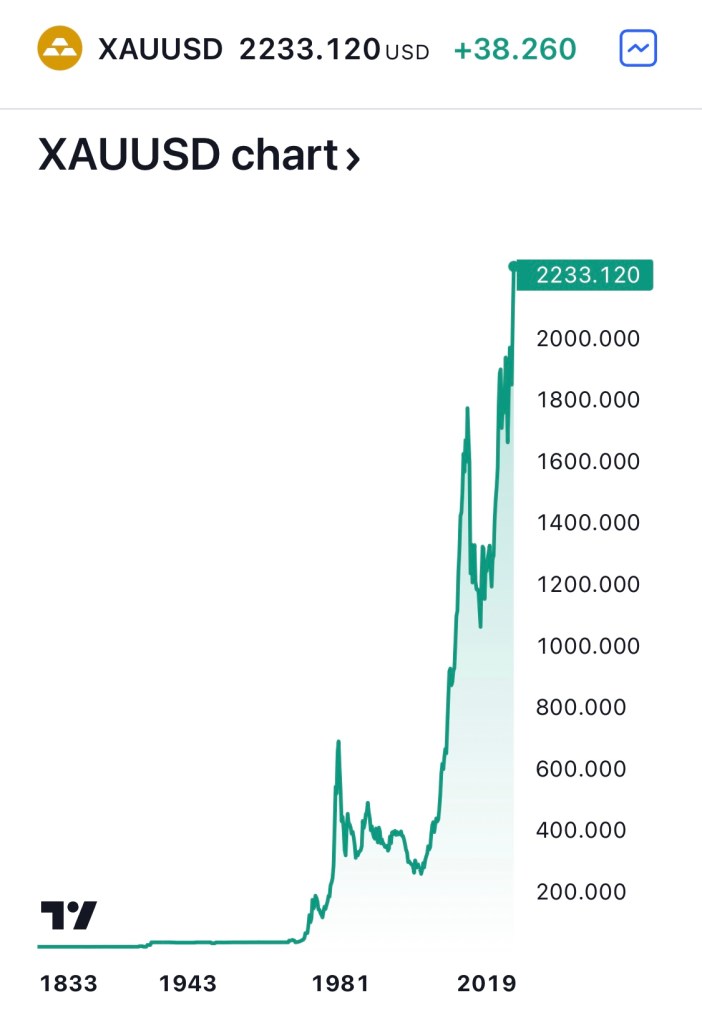
If you are paying attention to what is going on, you will realise that as the Yen, Pound and Euro are beaten down, eventually the US Dollar will suffer the same fate. This is not likely to end well for Fiat Currency. So buy yourself some insurance. Get an allocation to gold, and if you have the risk tolerance, Bitcoin too.

That’s all I’ve got for now. Hope it provokes some thought. Do your own research, make your own decisions, further disclaimer below blah blah blah!

Disclaimer: This should go without saying, but the information contained in this blog is not investment advice, or an incentive to invest, and should not be considered as such. This is for information only.

Japan – Is a Cost of Living Crisis Looming?

Inflation, inflation, inflation. If you have been reading the financial news, or even just the regular news, you will have heard a lot about the rise in the cost of goods and services this year. From the US to Europe, politicians have been desperately trying to shift the blame for the crisis away from their own central bank’s unprecedented money printing to the President of Russia. Whether they get away with such misdirection is yet to be seen, but President Putin himself is having none of it, as you can tell from this excerpt from one of his speeches.

Putin, while clearly not deserving of support, is absolutely right that Europe and the US have created this mess for themselves, and there is no doubt that he is now exploiting this weakness by regulating the flow of gas into Europe, making for a very uncomfortable winter ahead for Germany in particular, and the rest of Europe and the UK also. I didn’t realise until I read this BBC article that “A younger Vladimir Putin did his PhD thesis on the importance of Russian energy exports.” The Germans should have seen this coming a long way out. Having pumped up the money supply, and also made themselves dependent on cheap Russian energy, the EU and UK leadership have some gall to refer to the current situation as a “cost of living” crisis…

However, the goal of this post is not to discuss geopolitics. As a resident of Japan, I am interested in knowing if the inflation monster is lurking in Tokyo Bay, ready to go Godzilla on the Japanese consumer? As fellow Japan residents are well aware, Japan has not seen inflation in decades, and, as noted in Japan Mortgages – Fixed or Floating?, Bank of Japan boss Kuroda-san threw everything but the kitchen sink at the problem in order to reach the magic 2% mark. Now, with inflation at 2.5%, the yen at 25-year lows against the dollar, and the rest of the world facing a food and energy crisis, you can’t help wondering if prices aren’t going much much higher.

Of course, when it comes to the big questions of economics, the only correct answer is that no one knows. Financial journalists and macro gurus generally have a bleak outlook for Japan. With the US Federal Reserve still intent on raising rates to fight inflation there, the yen looks anything but safe at the 140 level, and a weaker yen could mean higher imported inflation. Another spike in energy prices due to the Russia / Ukraine situation and things could get expensive quickly.

Interestingly though, there is an optimist in our midst. Jesper Koll, according to his profile, is an economist, strategist, angel investor, patron, producer, and yes, a Japan optimist. A resident of Japan since 1986, and with experience at two major US investment banks, he has a new substack titled, of course, Japan Optimist. And it was there I found his July post titled: Who’s afraid of inflation? Not Japan

I encourage you to read the post yourself, but here’s a short summary:

There are two reasons that Japan is less impacted by inflation than other developed countries, for example, the United States:

  1. The government here is not afraid to intervene in markets to preserve the purchasing power of the people. About one-quarter of goods and services are subject to government regulation, which effectively means price controls. This goes for health care, education, transport, and staple foods. This year surging gasoline prices have been kept under control by government intervention
  2. At the same time, Japan’s domestic industrial structure is much more cut-throat competitive. In the US, the big players control twice as large a share of the manufacturing and service industries. Japan is more fragmented and competitive, and that competition keeps prices low.

Jesper notes that the Japanese government not only considers it important to protect citizens from economic shocks, but it also has the necessary parliamentary majority to act far more quickly than the US government is able to. So unlike in the US, where the Federal Reserve is having to fight inflation on its own, the Bank of Japan gets plenty of backing from the government.

Japan’s government and economic system comes in for so much bashing in the media that it’s almost shocking to hear from someone as positive as Jesper. And once more I’ll remind you that no one really knows how the global inflation issue will play out, here or abroad. However, the lack of polarization over every issue certainly puts Japan in a better position to take action than much of the western world.

From a financial planning perspective, inflation is something you should always be concerned about. I would argue that the whole point of investing is to at least keep pace with, and preferably outperform, the rise in the cost of goods and services over time. To put it another way, it’s all about preserving and increasing spending power. Remember, it’s not the cost of things that is going up, it’s the value of money that is going down. At the risk of sounding like a broken record, beating inflation in your base currency is the name of the game. Whether inflation in Japan gets worse or not, if you are going to spend the money in Australia, saving and investing in JPY does not really help you.

If you are planning to stay in Japan long term and JPY is your base currency, here are a few things you can do to protect yourself against inflation:

  1. Keep an emergency cash reserve – make sure you have a buffer in case prices increase more than expected.
  2. Invest – anything surplus to your cash reserve can be invested for the medium to long term, whether it’s NISA, iDeCo, a brokerage account, ETFs, dividend stocks, REITS, gold. You are not going to preserve your spending power sitting in JPY cash.
  3. Expect volatility – you need to be mentally prepared that your investments are unlikely to just go up in a straight line in this environment. Remember you are trying to beat inflation over time, not in the next 6 months.

Finally, if you enjoyed a bit of optimism for a change I recommend checking out Human Progress. Their Twitter account is here. With all the doom-scrolling it’s sometimes nice to be reminded how much progress we have made as a species!

Disclaimer: This should go without saying, but the information contained in this blog is not investment advice, or an incentive to invest, and should not be considered as such. This is for information only.

Japan Mortgages – Fixed or Floating?

I know….

Things are heating up in Japan in more ways than one. Scrolling through Twitter I have recently seen a lot of chatter about what is happening to the yen and the Japanese economy, so I tried a little sentiment check and ran a Twitter poll as follows:

I was genuinely surprised to see fixed win this one so easily. Of course there is no wrong answer, and your choice depends a lot on your attitude to risk and overall financial confidence. However, there is also an element of prediction involved. Will mortgage rates increase in the years to come? If so, by how much? If rates pop up over 1.5%, you’re suddenly going to wish you had taken that fixed rate deal. A variable rate mortgage in the US is around 5.2% now and rising. Imagine that in Japan! Seven years ago, when we bought our house, my wife and I bit the bank’s hand off for a floating rate loan. No way were rates going up in our lifetime! I’m fairly sure we would still make the same choice now, but we would certainly think about it a little more…

So why the hesitation? Everyone knows that interest rates in Japan have been near zero for a quarter of a century, and raising them, even a little, would lead to financial chaos. Well, as the US and Europe are raising rates in order to fight inflation, suddenly all eyes are on the one country that hasn’t blinked yet. And right there in the spotlight is Haruhiko Kuroda, Governor of the Bank of Japan. Since his nomination in 2013, Kuroda has spearheaded the BOJ’s loose monetary policy and, despite accusations from the west of deliberately weakening the yen to favor Japanese exporters, he has always maintained that his policy goal is the break out of deflation by targeting the magic 2% inflation level. In pursuit of this target the Bank of Japan has employed both quantitive and qualitative easing, meaning it has not only purchased vast quantities of government bonds, but also stocks and REITs. 2016 saw the start of yield curve control and negative interest rates. Yes everything but the kitchen sink has been thrown at the deflation problem and guess what? It finally worked!

You would think that reaching the holy grail of 2% inflation (actually it stands at 2.5% right now) would be greeted with celebrations, however over the past 25 years the Japanese populace has gotten rather used to things staying much the same price. Wages have also remained stagnant, making people rather sensitive to price hikes, as Kuroda himself found recently after remarking that households were “becoming more accepting of price rises”. The rebuke from the public was swift and clear: times are tough in the households of Japan.

And so the global media has begun to speculate over what comes next. The rise in rates in the US in particular has made the yen less attractive and it has quickly slid as far as 136 yen to the dollar, a 24 year low. What’s more, Japanese bond yields have been surging, with the Bank of Japan deploying vast amounts of money to defend its 0.25% yield curve control target. It appears that Kuroda-san can save the bond market or the yen, but not both. Given the massive JGB holdings held in pensions alone, you can bet it will be the bond market.

Now it’s being reported that a $127 billion hedge fund called BlueBay is attempting to pull a Soros by attacking the BOJ’s yield curve control position in an effort to force it to adjust its monetary policy.

It all sounds a little scary, doesn’t it?

It is not, however, the BOJ’s first rodeo. Betting against the central bank has long been known as the widowmaker trade. And many widows have been made in the last 20 years. It turns out that bringing a knife to a bazooka fight is not a smart move.

Japan’s debt to GDP is estimated to be around 248%, the highest in the world. Proponents of Modern Monetary Theory (MMT) will argue that as long as the fiscal deficit spending leads to an increase in the share of GDP retained by households, the funding of the debt is not an issue. However, who trusts the government to make sure the money ends up in the right places? After all, this is the country that just spent 1.42 trillion yen on the Olympics. How many households felt the benefit of that I wonder? And what is the the next sector up for a big spending spree in Japan? Defense…

So can you really just keep printing more money to pay back the debt? It looks like we are going to find out at some point, but we may be surprised how long this seemingly unsustainable status-quo can be maintained. Fresh after making a killing betting on the European debt crisis a decade or so ago, Kyle Bass turned his attention to the widowmaker trade, memorably declaring investing in Japanese stocks as “picking up dimes in front of a bulldozer”. However the bulldozer still hasn’t rumbled into town and Kyle has moved on to other trades. Inflation at 2.5% hardly calls for drastic action when the US is at 8.5%, but that can change.

So if you have a floating rate mortgage can you relax for now? Most likely yes, you have nothing to worry about in the near future. The BOJ is clearly ready to do whatever it takes to keep rates where they are. At some point further down the line though, that could lead to a continued weakening of the yen, which in turn would bring a rise in “imported inflation” as the cost of foreign goods would continue to grow in yen terms. If that gets bad enough then something drastic will have to be done…

In the short term, a drop in inflation later this year would certainly take the pressure off Kuroda-san somewhat, and Jerome Powell too for that matter!

Let’s all hope “This is fine”…

My Twitter poll, of course, only offered two options and, as people rightly pointed out in the comments, you can mix fixed and floating rate mortgages. 10 years fixed and floating after that is quite typical in Japan. If you do have a floating rate, it is always a good idea to save up money separately so you have the option to pay the loan off quicker if rates were to rise. For fixed rate mortgages you can also check if you are eligible for Flat 35.

Disclaimer: This should go without saying, but the information contained in this blog is not investment advice, or an incentive to invest, and should not be considered as such. This is for information only.