I haven’t had much to say on markets for a while. We clearly entered the dumbest timeline, and no amount of TACO is likely to pull us back out of it.
Speaking of tacos, and to keep this post light, my friend recently introduced me to Taco Fanatico. We went to the Shibuya branch – there’s another in Naka-Meguro and even one in Nagoya. Cold beer and tacos definitely beat trying to trade this market…
If I’m not mistaken, said market is almost entirely driven by Trump’s social media posts rather than actual events. And, once more, I could be wrong, but the great dealmaker appears to be negotiating with himself. The Iranians have probably read the Chris Voss book. Trump doesn’t strike me as much of a reader…
You have probably had enough armchair geopolitics, so I won’t add to the discourse. Here’s BlackRock Chairman Larry Fink with two extreme scenarios:
“GLOBAL RECESSION”
The man who manages $11 trillion just warned the world what’s going to happen if Trump doesn’t make a DEAL, now.
A total wipeout.
Larry Fink, CEO of BlackRock, the largest asset manager in human history explains to the BBC how that occurs 👇🏼 pic.twitter.com/HqYrOhwj8x
In short, either the war ends, and things go “back to normal”, and markets revert to being insane in a good way. Or we get $150 oil for an extended period and a global recession.
Hope for the best and plan for the worst. Short-term investors would want to be defensively positioned. Long-term investors can, and probably will have to, endure some pain. A globally diversified portfolio, perhaps with satellite holdings in hard assets, is not going to be a cake walk, but you don’t have to look at it every day.
I think I summed up my views on how to plan effectively in noisy markets in my Back to basics post.
Asian economies in particular are in a precarious position. Japan is better prepared than some other countries, although the prospect of higher inflation, low growth and a floundering yen is not exactly mouthwatering.
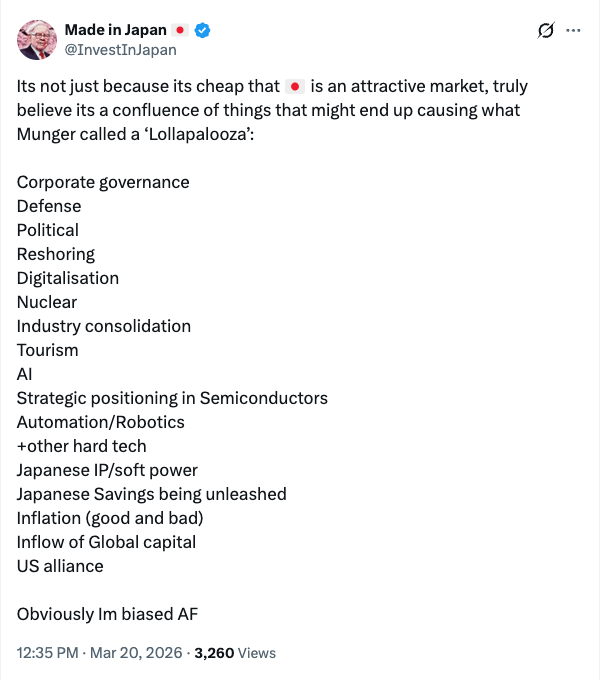
That said, the Japanese stock market still has a lot going for it, and the opportunity is nicely summed up here:
I may also be biased, but with many people trapped in yen, the investment options are not too shabby.
I’ve been buying some stocks on the heavy red days, but am exercising caution. I even bought a little Bitcoin, despite the nagging feeling that lower prices await.
Be careful out there. It’s a great time to touch grass, admire the sakura and eat tacos.
Disclaimer: This should go without saying, but the information contained in this blog is not investment advice, or an incentive to invest, and should not be considered as such. This is for information only.
AI has been the relentless driver of markets for several years now. Over the last few weeks, however, the tone has changed, and investors are dumping stocks in companies that may be at risk from AI tools. “Shoot first and ask questions later” is how analysts describe the action.
What is happening?
The AI scare trade is the rapid repricing of companies based on the perceived risk that generative AI will destroy their business model.
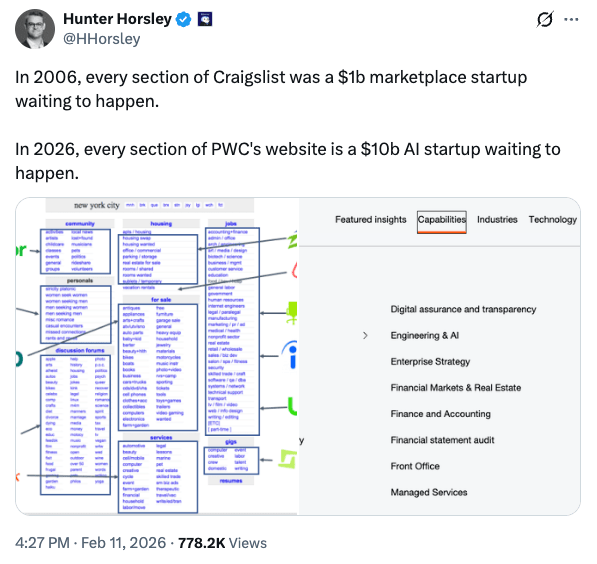
The narrative has shifted noticeably from AI as a productivity driver to AI as ruthless disruptor of whole swathes of the corporate landscape. First, it was software companies, then payments. Now, consulting and even cybersecurity are apparently on the brink of obsolescence.
Much of this is clearly overdone. And some of it probably isn’t. The job now seems to be to identify which services are genuinely under threat and which are merely suffering collateral damage. IBM shares plunged -13% on 24 February after Anthropic said its Claude Code tool could modernise Cobol, an old programming language running on IBM machines. So, is IBM done now?
IGV (the iShares software ETF) is down almost -20% in the last month. In Japan, Sansan Inc (4443) is down -36% over the same period. Are these stocks falling because earnings will collapse? Or because multiples are contracting due to uncertainty?
I think it’s important to read this stuff because, whether it’s big or not, something is definitely happening.
The Citrini article in particular struck a nerve. It was deliberately positioned as a possible scenario, rather than a prediction. The people writing it off as doomerism are probably more afraid than they will admit. What makes the AI scare trade different from past sector rotations is that many investors feel personally exposed. When the technology threatens your own profession, the fear feels more real.
And the market hates the uncertainty.
How to position
So how should we, as investors, navigate these uncharted waters? Shooting first and asking questions later is probably not a smart approach. I don’t necessarily have the answers, but here are a few thoughts:
If you are in the accumulation phase and mostly averaging into index funds and passive ETFs, there is no need to make any big changes. The indices themselves do a good job of allocating more cash to the winners than the losers. A few software companies may drop out of the S&P 500 over time, but they will be replaced by growing companies.
For more active investors, particularly those who like to pick stocks, it’s a good idea to separate out the genuine risks and opportunities:
Direct displacement risk – code generation, content creation (ouch!), basic legal/admin work
Margin compression risk – services that become cheaper, but not obsolete
AI beneficiaries – infrastructure, energy, chips, data centres, automation
It’s productive to focus on number 3, I think. If AI makes software 10x cheaper, demand for compute, electricity and physical infrastructure likely rises rather than falls.
In the chaos of the last few weeks, I heard about logistics stocks selling off. These are exactly the kind of companies that are likely to incorporate AI and deploy it to streamline processes and boost efficiency.
I saw a client last week whose company does commissioning for data centres. They are the guys who go in and check that everything works before the operation begins. They are jammed with work and can barely keep up.
Where is the power going to come from to run these places? What infrastructure needs to be built? Who makes the wiring, and where do the raw materials come from?
What stocks have been oversold, but clearly are not going away? Meta, Microsoft and Amazon have all weakened on concerns about their massive AI capex. Is the concern justified, or is this just another buy-the-dip opportunity? It’s not the first time these companies’ heavy investment has been called into question, but look at their long-term performance.
That’s the Crowdstrike CEO, by the way. He might be sweating the stock price a bit, but surely we’re a long way off from vibe-coding cybersecurity platforms.
As always, diversification is the name of the game for large sums of money.
In many ways, the AI scare trade reminds me of last year’s Sell America trade. It was a thing for a while, but then the panic died down.
Stay curious, keep reading, and don’t get too bearish.
It’s one thing to outline extreme scenarios. It’s quite another to position your entire portfolio around them.
Disclaimer: This should go without saying, but the information contained in this blog is not investment advice, or an incentive to invest, and should not be considered as such. This is for information only.
We’re only halfway through January, and it already feels like we have lived through a year’s worth of crazy news. Maduro has been ousted, Iran is in turmoil, Mexico and Colombia are on alert, the Europeans are mobilising to protect Greenland, and the chair of the Federal Reserve released a video accusing Trump of bringing criminal charges against him because he refused to bend to his will and lower interest rates quickly enough.
And, despite all of this, many markets are near all-time highs. There really has never been a world leader capable of instigating so much chaos, whilst simultaneously making markets stand up and dance for him.
If you are not convinced by now that Trump is going to pump liquidity and juice the stock market as hard as he can this year, I don’t know what to say.
Likewise, Prime Minister Takaichi. With such a strong approval rating, calling a snap election seems like a calculated risk. The market reaction tells you everything you need to know about her economic policies. Yen down, stocks up. She is going for growth, and that means yen debasement and more inflation coming.
Metals are sounding the alarm on all of this. Bitcoin is also finally starting to respond. The debasement trade is far from dead.
Here are a few thoughts on where this could be going:
Stocks
Mag 7 appears to be cooling somewhat, allowing the S&P 493 to catch up a bit. I’m even hearing American commentators discuss emerging markets. This is probably healthy, although the AI trade is by no means over and data centre spending is not slowing down.
Taiwan Semiconductor reported Q4 earnings this week that beat analyst expectations. Trump just announced a trade deal with Taiwan that will boost investment in the US semiconductor industry, and the deal sees the “reciprocal” tariff rate on Taiwanese goods drop from 20% to 15%.
The biggest short-term threat to stocks is the U.S. Supreme Court’s expected ruling on the legality of the Trump tariffs. If the court rules against these duties, expect all kinds of confusion.
Longer term, it’s hard to be bearish with Trump preparing to install the next Fed chair to do his bidding and midterms looming.
I guess the thing that could derail the Japan bull market would be the LDP performing poorly in the upcoming election and Takaichi being forced out as a result. Conversely, expect another yen down/stocks up surge if she wins a clear mandate.
Metals
The metals trade may not be done, but it’s surely in the late innings. People are starting to ask about copper and palladium. A while back, I put some of my old savings plan into a gold mining fund, and when I checked yesterday, the thing has more than tripled. Half of that went right into bonds for the time being.
If you’ve been in metals, well done! I have no idea if it’s over, but it’s not a bad time to trim some exposure.
There was a report on the 10pm news two nights ago about precious metals: Gold and silver jewellery are selling well in Japan. Dentists are losing money on 銀歯 (silver fillings), which are actually made from a mix of silver, palladium and gold. One dentist interviewed said that some people are even trying to sell their fillings! People are walking around with a hedge against yen debasement in their mouths…
If you are thinking of getting into silver right now, that’s FOMO.
The metals people on X are starting to sound like the crypto bros in a bull market. There are definite signs of euphoria, which means the reversal will likely be brutal when it comes.
Bitcoin
I’m talking Bitcoin, not crypto, as I can only think of a handful of coins that might do well IF Bitcoin gets back over $100k.
There’s an ongoing debate about whether the four-year cycle is dead. I’m not convinced it is, but at the same time, the liquidity backdrop for Bitcoin looks ridiculously good.
Here’s my best effort at a cheat sheet:
If you own Bitcoin, I’m assuming you are long-term bullish. If not, what the hell are you doing in it? I remain bullish on long time frames.
If you believe the 4-year cycle is alive and well, and 2026 will see the usual brutal bear market, prepare some dry powder. The chance to accumulate cheaply is coming.
If you think we bottomed already, you want to accumulate as much as you can under $100k.
If you’re not sure, DCA is the way. Just buy a little at regular intervals and pay as little attention as possible to short-term price fluctuations.
I don’t see a lot of fiscal responsibility coming out of America and Japan in the near future. Long live the debasement trade!
Disclaimer: This should go without saying, but the information contained in this blog is not investment advice, or an incentive to invest, and should not be considered as such. This is for information only.
Happy New Year, everyone! Welcome to the year of the horse. Markets are off to a strong start and have not shied away from early geopolitical shenanigans. The going appears to be good to firm as we come out of the gate in January, and runners and riders are expecting a fast race.
Ok, enough horsing around. January means many of us have NISA investments to allocate. It’s time to make some decisions.
I just scanned through my 2025 New Year post, Snakes and Elephants, and what do you know? This time last year, USD/JPY was around ¥158. Japanese retail investors were largely ignoring the bull market in local stocks and piling into US companies. And Bitcoin was trading at around $93,000.
Great Scott!
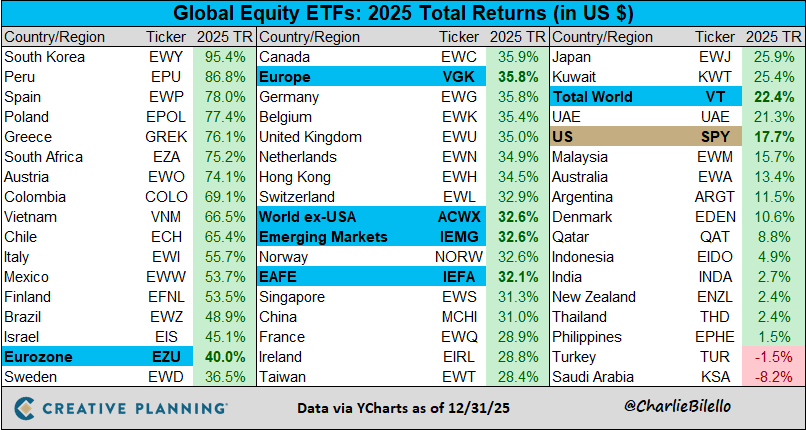
At least stocks are a good bit higher than they were this time last year. You would never guess the whole “Liberation Day” debacle happened unless you were there. If your 2025 NISA allocations are not in profit, something went very wrong…
From @CharlieBilello
The difference with Bitcoin is that last year, it was at $93k on the way up. Now, it’s around the same price on the way back down. At least that’s what I think, although many will disagree. But let’s leave the magic internet money for another post.
What is the outlook for equities in 2026?
The Bloomberg Outlook always provides a nice window into what Wall Street expects in the year ahead. In short, pretty much everyone is optimistic, and the AI boom continues to be the main story. The Fed is expected to continue to loosen monetary policy, and Trump and Bessent are also standing by to man the liquidity pump.
The leaders of Japan’s securities firms are also primed for another big year in domestic stocks, as per this NHK article. However, the Japan Times reports here that Japanese retail investors are still more interested in US stocks. It looks like Japanese stocks remain under-owned.
If, like me, you enjoy a little crypto and spice with your macro commentary, Arthur Hayes’ latest post is a fun read. He sees the Trump admin running the economy hot in 2026, whilst simultaneously trying to contain inflation by holding gas prices down. That Venezuelan oil may have a purpose, huh?
Suffice to say that everyone is sufficiently bulled up that we should be at least a little worried. Risk lurks in the AI bubble, excessive government debt, BOJ policy and the yen carry trade, rising bond yields, geopolitical crises, and who knows where else!
We all love a challenge, don’t we?
My themes for 2026, which I outlined in my previous post, are mostly unchanged
For Japan:
Japan’s base interest rate is 0.75%, and inflation is around 3%, so we have a real rate of negative 2.25%
The BOJ can maybe squeeze in one more hike to 1%, so real rates could go to negative 2%
This is still very accommodative monetary policy and will support asset prices
The weak yen will persist
Rice isn’t getting any cheaper, and people’s spending power will continue to decline
By the way, I feel like that last point is going to be critical for the Takaichi administration. People are feeling the pinch, and if prices continue to rise, I expect that beautiful approval rate to take a beating. Complaining about bad foreigners will only distract the public for so long…
Some more general themes:
Trump’s new Fed pick will likely force lower rates
Trump will want to pump the stock market ahead of the midterms
However, the AI trade will continue to come under scrutiny
The debasement trade is very much still in play – own hard assets
Bitcoin bear market – an opportunity to accumulate
I’ll come back to some of these in future posts.
So, what to do with ¥3.6 million?
Of course, I can’t give broad advice here, but I can tell you my own personal plan for NISA this year. Bear in mind that what works for me may not work for you, and we may have different goals and risk profiles. If you need help figuring out what is best for you, remember that I offer a coaching service.
I view NISA as a long-term investment. I want to mess with it as little as possible. If I make a bad pick, sure, I will drop it and reallocate later, but I prefer it to be set and forget.
Therefore, I will stick with last year’s plan of allocating most of Growth NISA to ETFs. I will continue to pick stocks in my taxable account, mainly because I like doing so, not because I really believe I can outperform. (it’s fun to try, and it works sometimes)
While I will allocate some money to global indices, I want to keep a decent chunk in yen. Converting to dollar assets at these exchange rates is painful!
Here are some ETFs I like:
1489 NEXT FUNDS Nikkei 225 High Dividend Yield Stock 50 Index – The S&P 500’s Dividend Yield ended 2025 at 1.15%, its lowest level since 2000.Japan is a dividend paradise, andI love this ETF as a simple way to earn steady dividends without worrying about how a certain company performs over the next decade. For a dividend fund, it has delivered impressive growth these last few years, too.
2644 Global X Japan Semiconductor – this will be volatile, but long-term chip demand is only going up
1624 NEXT FUNDS TOPIX-17 MACHINERY – this is 25% allocated to Mitsubishi Heavy Industries, so a bit concentrated
1627 NEXT FUNDS TOPIX-17 ELECTRIC POWER & GAS – this is a new one for me, and I’m substituting it in for an energy ETF. I’m bullish on power companies.
2559 MAXIS World Equity – good old All Country!
1545 NEXT FUNDS NASDAQ-100 (Unhedged)
The difficult part is timing. Markets are ripping early in the year, and I would love to catch a dip. But who knows when that will come? I will aim to have Growth fully allocated by the 30 March ex-dividend date for Japanese stocks. Maybe Trump can then crash everything in April again for a bit more déjà vu…
Tsumitate, I will keep the same at 40% JPX 400, 30% All Country, 30% NASDAQ. Average in and chill.
How about you? Do you have a plan in place, or are you still mulling the options? I would love to hear what other people are doing.
Wishing everyone all the best for 2026. Let’s make it a great year!
Disclaimer: This should go without saying, but the information contained in this blog is not investment advice, or an incentive to invest, and should not be considered as such. This is for information only.
I came back from the gym this morning and found my wife at her desk.
“Wow, my stocks are up again!”
This is good news.
“But why are they going up so much? News on the economy doesn’t seem so great.”
I begin an explanation of how low interest rates have finally reignited inflation in Japan and fueled a boom in stocks. And despite the recent rate hike by the Bank of Japan, real rates remain negative, which means the price of things, including assets, will continue to rise.
Her eyes quickly glaze over, and she goes back to work. I put some coffee on. Then I begin writing this, in case someone is actually interested!
USD/JPY is at ¥157. GBP/JPY is ¥210!!!
Last week’s BOJ rate hike was viewed mainly as an effort to prop up the currency. But it seems unlikely to halt the slide back to ¥160. Could we go further than that next year?
Here’s a quick reminder about the bind the central bank finds itself in, from my January 2023 post How screwed is the yen?:
The BOJ is caught in a spiral of rising bond yields and a falling yen. And between the bond market and the yen, it can only save one. The programs you would have to enact to save the yen are the exact opposite of the programs you would have to enact to save the bonds. To save the currency, you have to raise rates. To save the bond market, you need to keep rates low.
Last week’s rate hike was a band-aid. Many were hoping for at least a short-term bounce in the yen, but it didn’t come. The BOJ can’t manage an aggressive hiking cycle without destroying the bond market and taking down the banks, pension funds and insurance companies that own the bonds.
This is all very depressing, I know. However, I imagine many of us will be looking to allocate money to NISA, etc, next year and need to begin thinking what to do with it. I haven’t made any decisions myself yet, but I’m beginning to put together a list of themes that will influence these decisions:
Themes for 2026
Japan’s base interest rate is 0.75%, inflation is around 3%, so we have a real rate of negative 2.25%
The BOJ can maybe squeeze in one more hike to 1%, so real rates could go to negative 2%
This is still very accommodative monetary policy and will support asset prices
The weak yen will persist and perhaps go beyond 160
Rice isn’t getting any cheaper, and people’s spending power will continue to decline
To be clear, I’m not in the doomer “Japan has reached the end of the road” camp. Japan is the world heavyweight champion of muddling through with extraordinary monetary policy. There’s still a lot of road to kick this can down. However, those who do not own financial assets will struggle. It’s not going to be pretty.
Outside Japan, things could get pretty spicy, too.
Better have a plan to not get knocked out!
A few additional themes:
Trump’s new Fed pick will likely force lower rates
Trump will want to pump the stock market ahead of the midterms
However, the AI trade will continue to come under scrutiny
The debasement trade is very much still in play – own hard assets
Bitcoin bear market – an opportunity to accumulate
I will think on this some more and come back with a plan for 2026 in the next few weeks. Let’s see if the yen breaches the ¥160 mark before the year’s end.
Thanks for reading. Wishing you all a wonderful Christmas!
Disclaimer: This should go without saying, but the information contained in this blog is not investment advice, or an incentive to invest, and should not be considered as such. This is for information only.
One down, one to go. With the FOMC resulting in a dovish cut, we now await the BOJ meeting next week. So, how are things shaping up for the end of the year and 2026?
The Fed delivered the expected 0.25% rate cut. It was accompanied by cautious commentary on next year, without really turning hawkish. Pretty much a goldilocks result for markets. Stocks rallied into the close, while Bitcoin pumped to $94k before quickly retracing. The Fed’s dot plot and 2026 outlook seem wildly irrelevant given where things are going after Powell’s term ends.
BREAKING: President Trump is asked if the new Fed Chair will be expected to "lower interest rates immediately."
Does anybody need that stated more clearly? The next Fed chair will be appointed by Trump and will do his bidding. Their primary function will be to cut interest rates. End of story.
Leaping into the future, it will be fascinating to see if a post-Trump Democrat administration will work to reinstate the Fed’s “independence”. I bet you they won’t…
Anyway, I digress. The US is moving toward financial repression in 2026. Inflation allowed to run hot, and interest rates forced lower = Negative real rates. Negative real rates are a stealth tax on savers. It’s how the government reduces the debt burden.
It’s not good. But it’s what is going to happen.
Americans who own assets will be fine. Those who don’t will struggle.
Lots of liquidity, equities up, hard assets up, and a weaker dollar.
So, Bitcoin to the moon, right?
Hmmm, given what I wrote above, we are looking at the perfect environment for Bitcoin. The macro gurus, who are relatively new to Bitcoin, are declaring the 4-year cycle dead and preparing for new all-time highs in 2026. Except that’s not what usually happens. October marked a picture-perfect 4-year cycle top. It doesn’t get any clearer. The bottom should be around Oct/Nov next year.
I’m long BTC and happy to be proven wrong, but I think there is pain to come. I think we will see $40-50k, and buying Bitcoin when stocks are pumping will seem like the dumbest thing a person could ever do with their money. Sentiment needs to be broken before we run again.
And yes, I will buy at those levels. Until then, there isn’t much point in thinking too hard about it.
As for stocks…
The midterm general election is in November. Sometimes the most obvious outcome is the correct one.
Is the BOJ going to spoil the party?
The BOJ is signalling a hike. It’s been reported in the Nikkei. It’s pretty much baked in and would be more of a surprise if it didn’t happen. I don’t think it’s going to shock markets. It might strengthen the yen a little, but it probably won’t be earth-shattering. See my post on the Yen Carry Trade from last week.
Japan, of course, is already at negative real rates. That should support the Japan equity bull market. It only sucks if you don’t own stocks…
I have the flu. That’s as much brain power as I have this morning. Time for a lie down.
Disclaimer: This should go without saying, but the information contained in this blog is not investment advice, or an incentive to invest, and should not be considered as such. This is for information only.
It looks like the Bank of Japan (BOJ) is finally ready to raise rates again this month. So, right on cue, out come the doomers to ring the alarm on how the unwinding of the yen carry trade is going to blow up global financial markets.
Should we be worried? How could a potential unwind of this trade affect investors in Japan?
What is the yen carry trade?
The core idea behind this trade is to borrow money in a low-interest currency (JPY) and invest it in higher-yielding assets elsewhere.
For example, a fund could borrow yen at less than 1% interest, invest in US Treasuries earning 3.5%, and pocket the difference. This works perfectly until exchange rates make a big move. Then things can get interesting.
A conservative estimate puts the size of the carry trade at around $1 trillion, based on Japanese banks’ foreign lending. Some estimates use the notional value of FX swaps and forwards using the yen to reach a figure closer to $14 trillion.
Of course, hedge funds are not necessarily just buying conservative US government bonds on this trade. A mountain of cheap yen is converted to dollars and other currencies and flows into all kinds of assets. A deep dive would likely reveal that a large portion of this trade has gone right into the red-hot Magnificent 7 stocks.
Why Japan?
The carry trade can take place using any currency with a low interest rate. Japan has been the primary go-to market due to its unique characteristics:
The lost decades following the bursting of the bubble in the early 90s
Deflation and slow growth
The BOJ’s long-term low/negative interest rate policy
Hence, the yen became the world’s cheapest funding currency
How the carry trade makes (and loses) money
This trade works based on the interest rate differential – the carry. With a stable or weakening yen, it will remain profitable. In this type of environment, it’s hard to miss.
Problems occur if the yen strengthens. If an institution borrowed yen at ¥150 to the dollar but later the yen strengthens to ¥130, it suddenly requires more dollars to repay the same yen loan.
The unwind then happens as follows:
Sell the dollar asset (treasuries/stocks, etc.)
Convert to yen
Repay the yen loan
This unwind puts downward pressure on the asset being sold, which could be US treasuries or global stocks. And the flood of capital back into JPY accelerates the yen’s strengthening. A relatively small move in exchange rates can snowball into something much larger.
Famous unwind events include the 1998 Asian financial crisis and the 2008 global financial crisis. In 2024, we saw a mini unwind as the BOJ shifted policy.
Why does it matter to everyday investors, especially in Japan?
With the US central bank cutting rates and the BOJ looking to raise rates, there is a real possibility that the yen will strengthen in the short term. Most Japan residents will be relieved as foreign goods and overseas trips will become more affordable.
However, the unwind can suck out global liquidity and do some real short-term damage to our investments. Not many risk assets fare well in this kind of event, so be prepared for international stocks, Japanese stocks, high-yield bonds and crypto to take a beating. Japanese exporters, such as Toyota, are particularly sensitive as a stronger yen erodes their overseas profits.
So, are the doomers right this time?
Beware of people claiming that the yen will suddenly surge and stocks will crash overnight. The reality is:
Yen carry trade unwinds tend to happen in bursts, and not always in a straight line
Central banks will often intervene, verbally or via policy tools.
Markets tend to pre-position before the worst moves happen
You can already see this pre-positioning happening. The yen has strengthened over the last few days after the BOJ hinted at action at its next meeting. Note how BOJ governor Ueda is trying to communicate his thoughts in advance and avoid a “shock rate hike” a la August 2024.
People writing epic threads on X tend to overstate the timeline risks. Sharp moves can indeed happen. However, it doesn’t necessarily guarantee an imminent crash.
Should we be worried?
Concern about the carry trade unwind is most rational if you have:
Investments heavily exposed to foreign currencies
A portfolio dominated by global stocks
Income linked to export-driven Japanese companies
There is less to worry about if you have:
Mostly yen-denominated assets
A long time horizon
No plans to move money internationally soon
Concerns about a carry trade unwind are certainly not irrational. However, the real risk lies less in timing the event and more in understanding how currency moves can affect your portfolio and positioning accordingly.
So it really comes down to portfolio structure. Trying to predict macro events is insanely hard…
Ok, then how do I hedge against this?
Of course, some assets will benefit from a carry trade unwind:
The yen, of course, is the obvious winner – that trip abroad could get a lot cheaper next year!
Gold is historically a beneficiary of unwinds as investors deleverage and seek out safe havens. If the yen is rising, the dollar is usually falling, which is generally good for gold.
Long-duration government bonds generally do well as the world goes risk-off and money flows into the safest assets. Bond prices go up as yields go down.
In conclusion, don’t let the doomers scare you out of long-term investments, but be prepared for some volatility. Keep an eye on central bank rate decisions, the corresponding US-Japan interest rate gap, USD/JPY exchange rate and global risk sentiment.
Personally, I am long-term bearish on the yen, but in the short term, anything can happen.
It’s always good to keep some dry powder to pick up risk assets while investors run scared.
And make sure your passport is still valid for that overseas trip you’ve been planning!
Disclaimer: This should go without saying, but the information contained in this blog is not investment advice, or an incentive to invest, and should not be considered as such. This is for information only.
Markets are not looking so hot right now. I really hate to be bearish, but it’s becoming unavoidable.
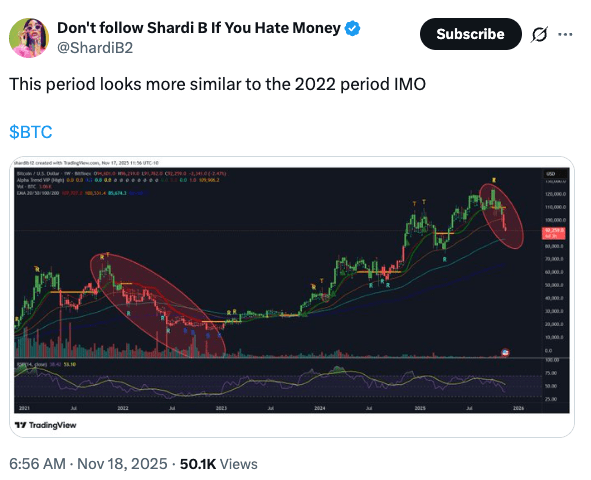
Last week, Bitcoin made its first daily close below $100,000 in 188 days. Then yesterday it closed below the 50-day moving average on the weekly chart. This is always bad news for bulls. Some of the people who were telling us the 4-year cycle is over are still holding out for a reversal, but they are probably grasping at straws.
We are so done. Thank you for playing.
I know it’s unlike me to be so negative, but when a situation changes, it’s important to confront reality quickly. Crypto is heading into a bear market, and it’s right on schedule.
Initially, Bitcoin is acting as the pressure release valve as investors lose faith in an overheated risk environment. You will note how, over the last week or so, Bitcoin is lower when you wake up. Asia propped up the price in the daytime, and then America sold hard while we slept. Now Asia is selling, too.
Worse still, BTC tends to lead equities, and in my humble opinion, BTC is heading lower.
Stocks are already wobbling. In particular, the AI trade is coming under increased scrutiny. Nvidia earnings are due on Wednesday. I don’t think there are numbers big enough to satisfy the masses this time, although the numbers will likely be impressive regardless.
Burry put on his Nvidia/Palantir short and then closed his fund. Now he doesn’t have to worry about investors trying to pull their money when the market moves against him. People are debating whether he is actually any good at calling this stuff, which is a valid question. It’s such an obvious trade that you wonder if it can really be that simple, especially with Trump there to pump the markets every time they stumble.
But it doesn’t look great to me. In the short term, at least, I’m siding with the bears.
Time preference is key
It’s ok to be bearish, but the big question is: over what timeframe?
BTC is a good starting point for this discussion, as it is highly sensitive to both global liquidity and overall risk sentiment.
When Bitcoin topped in November 2021, it was just as the Federal Reserve pivoted to begin a brutal tightening regime. Interestingly enough, in November 2025, the Fed is going in the opposite direction. In fact, the market was pricing in a further rate cut in December until the US government shutdown delayed the data and muddied the waters. Uncertainty around rates is a huge factor in sparking the sudden loss of appetite for risk.
The liquidity picture for 2026 actually looks pretty rosy. Trump is effectively going to gain control over the Fed, and he has the midterm elections to pump the market for. On the flip side of that lies a slowing US economy.
Bitcoin’s level of institutional adoption was meagre in 2021/2022. In fact, it turned out the industry was on the brink of collapse. And collapse it did: Terra/Luna, Celsius, Blockfi, 3AC, and, of course, FTX all fell during the bear market.
The picture is very different now. US Bitcoin ETFs have almost $120 billion in assets under management. $72 billion of that is in BlackRock’s IBIT alone. What’s more, the Trump administration is pro-crypto. This is not an industry on the brink of collapse any more. It’s just going to need to take a breather for a while.
Plan for the worst
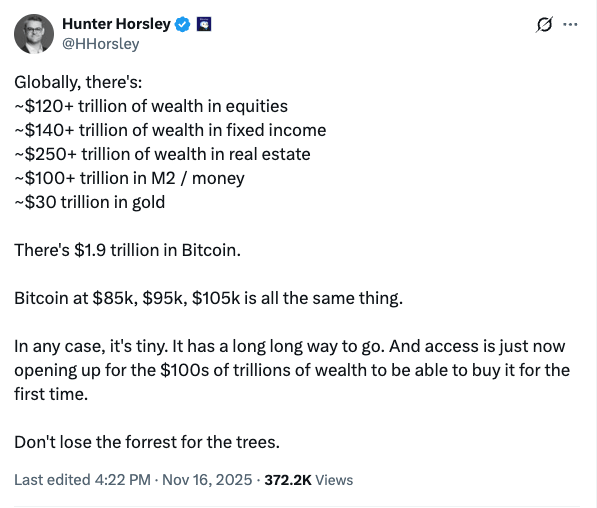
The typical bear market drawdown from the peak for Bitcoin is 80%. So, worst case, we are going back to $25,000. Ouch! Not pleasant at all, but I would not bet against this outcome.
If ETFs and institutional adoption, plus a favourable liquidity cycle count for anything, which I think they do, we may not go that low. Personally, I’m not really interested in bidding $90k. I’ll get interested at lower levels. $50k seems a bit more like it. (this is my finger in the air, best guess if you are wondering how I got this number)
Here’s a little perspective:
What about stocks?
Nvidia’s P/E ratio is around 53. Investors are willing to pay that amount for each dollar of the company’s earnings. I probably don’t need to tell you that future earnings expectations are a little on the high side. The Magnificent 7’s average P/E ratio is around 28 to 35. Those expectations may well be due for a sharp adjustment.
The other 493 stocks in the S&P 500 are not looking so bad, although they could get dragged down somewhat in a Mag 7 correction.
Global stocks, Japan included, are unlikely to emerge unscathed, but we could well be looking at an interesting buying opportunity.
Personally, I kind of like the idea of reducing US exposure (particularly Mag 7) and increasing Japan. The only problem is then you get trapped in yen. Finance Minister Katayama is making the usual concerned noises about exchange rates, while taking absolutely no action to counter the yen’s decline. Real interest rates in Japan remain negative, and as long as they persist, the currency will continue to struggle.
Negative real rates are a boon for stocks, though. If rates somehow ever turn positive, it’s time to rethink.
All in all, it comes down to where you are in the financial planning process. I covered this in the Burry post, but here it is again in simpler form.
I see three key stages in the personal finance journey:
Accumulation – spend less than you earn and invest the difference into stocks and other high-growth assets. If asset prices decline, don’t panic and keep buying. In fact, buy more if you can.
Diversification – a mix of protecting capital, whilst continuing to accumulate. The key to knowing when to diversify comes down to three factors:
a) The data tells you – you hit your number and simply don’t need as much risk any more
b) You become conscious of the amount of money you have at risk and start thinking about what to do
c) Asset prices are considerably higher than the average price you paid when accumulating. Despite the wobbles, we are still in this zone for anyone who has been accumulating for a while. It may not last much longer, however…
3. Distribution – you begin living off the income generated from your accumulated assets, or simply spending the money
If you are in stage 1 or 3 and are properly allocated, a stock market correction should not bother you too much. If you are at stage 2 but have not diversified yet, the current window of opportunity may be about to close for a while. Don’t panic, but perhaps give it some thought.
Personally, I have been selling stocks that have done well over the short term, particularly tech/semi/AI-related stuff. A few Japanese tech stocks I owned got a big boost when PM Takaichi was elected and are probably due for a reality check.
In other business
My next casual meetup, billed as the Nikkei ¥50,000 party, is on 26 November from 7pm at Hobgoblin Roppongi. Everyone is welcome. You don’t have to talk about investing, and you don’t have to drink unless you want to. Some of us may need to!
Before you ask, yes, the event will go ahead even if the Nikkei is below ¥50,000. That is an achievement unlocked, and I’m sure we’ll be back above that level in due course.
Don’t get too bearish!
Disclaimer: This should go without saying, but the information contained in this blog is not investment advice, or an incentive to invest, and should not be considered as such. This is for information only.
It’s been another interesting week. ‘Big Short’ legend Michael Burry returned to X to call out the AI bubble, posting charts that question whether the ongoing mega AI capex boom really matches demand. Burry pops up every now and then to predict disaster, and his hit rate post-2008 is not all that spectacular. However, he followed up by filing his investment firm’s 13F 11 days early, showing that he is short 1 million Nvidia shares and 5 million Palantir shares.
Money where his mouth is.
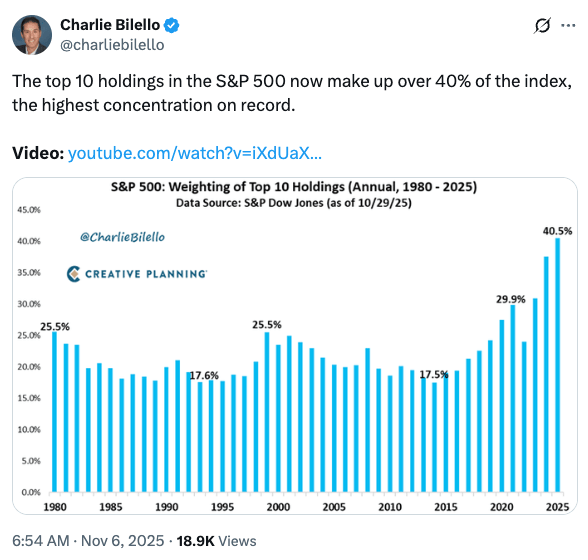
The market took notice and US tech stocks tumbled on 4 November. Japanese stocks followed suit, with Softbank Group dumping almost -17% over 2 days. This comes at a time when the US government shutdown is blocking the liquidity faucet and tightening things up considerably.
Crypto didn’t like it either, but hey…
Predictably, President Trump issued some positive comments about stocks and Bitcoin overnight, and the situation calmed down. Every time I think this market is ready to begin its descent into hell, I’m reminded that the guy in charge of America has a vested interest in keeping it above ground…
Clearly, Burry is hitting a nerve with AI bubble enjoyers. Here’s a great thread from Marko Bjegovic covering why he is probably correct.
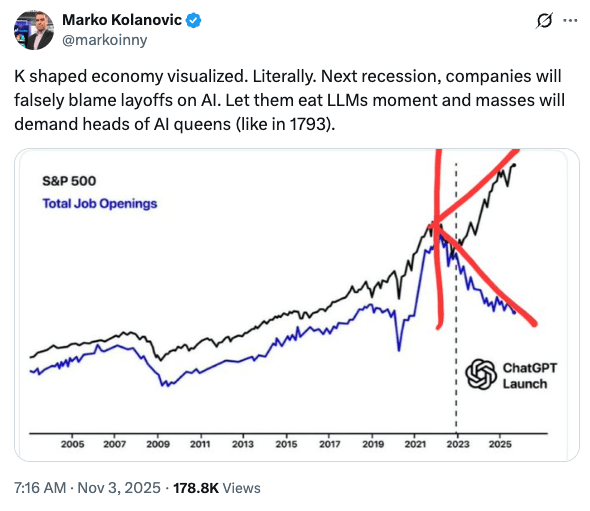
The ‘K-shaped’ economy
You are probably hearing this term lately. The K-shape represents the latest expression of wealth inequality. Essentially, high earners and large corporations are getting richer as asset prices rise, while low-income households and small businesses, the lower leg of the K, are struggling to get by.
High-end products are selling, while companies like Chipotle are finding their customers poorer and less inclined to visit.
Here’s another way of looking at the K-shape, from a different Marko:
Speaking of liquidity and the AI bubble, Ray Dalio just posted about how the Fed is stimulating at an odd time. I’m not sure the Fed is really beginning QE, as he says, but it is certainly ending QT, cutting rates and taking an expansionary stance. This is something it would generally do when the economy is in trouble. Instead, the backdrop for the Fed’s easing is high asset valuations, a relatively strong economy, inflation above target and abundant credit. Not to mention a bubble in AI-related stocks – the elephant in the room, so to speak.
The Trump administration is taking a bold and probably reckless bet on growth, and particularly AI growth. What could go wrong???
Time to take profit?
We’ve been talking about a melt-up before a melt-down, but that’s by no means guaranteed, and we’ve already melted up a lot.
Stock investors, belonging to the top leg of the K, have done very well, but are now faced with a choice: remain invested and ride through the bubble or protect capital. As Michael Burry experienced in 2008, bubbles can keep inflating and punishing shorts for a long time before they finally pop. Younger investors can probably handle the drawdown, provided they are disciplined enough not to sell the bust. We all know the drill when panic hits: as the last desperate few capitulate, central banks will cut rates, stimulate, and markets will surge back over the next 12-18 months.
People who are getting closer to spending their investment money should probably think more carefully. There may not be a better opportunity to take risk off the table and diversify for some time. Nobody ever went broke taking profit, especially around all-time highs.
For people in between, US treasuries are holding up as a safe haven as well as anything else at this time. Spreading some of the risk also serves an often overlooked purpose: offering the opportunity to rebalance and buy the bottom in stocks if we do suffer a crash. I stand by my belief that anyone with a meaningful amount of money should be well diversified at a time like this.
The stock market is not the economy
Here in Japan, we are enjoying the Nikkei holding above the ¥50,000 mark. That doesn’t mean we escaped the K-shaped economy. In a rare quiet moment the other evening, I was thinking about Japan’s economy and why interest rates don’t seem to go up much. Aside from the rich asset holders, many people are struggling. Wages still lag inflation. 5kg of rice is almost ¥5,000. The lower/middle classes do not have a lot of money to spend.
Fewer people spending money is bad for the economy. The general expectation seems to be that interest rates will rise gradually. They certainly won’t rise quickly. Higher rates would mean higher interest payments on government debt. PM Takaichi is focused on growth, not inflation.
Should we really expect a meaningful rise in interest rates? I simply can’t see it.
If rates can’t rise, then the yen remains weak, prices increase, stocks and Tokyo property appreciate, and low-income families continue to struggle.
If all this is true, then what’s the trade?
Own dollars, own financial assets, own hard assets, and be kind…
Disclaimer: This should go without saying, but the information contained in this blog is not investment advice, or an incentive to invest, and should not be considered as such. This is for information only.
Our family just came back from a weekend break, which was my treat in celebration of our stellar investment returns. Note: don’t tell your significant other how well your portfolio is doing unless you are prepared to spread some of the winning around! We had barely been back home for 5 minutes when the doorbell rang and a new pair of boots was delivered. She bought those herself, so no complaints from me, but you can see how this goes.
Even the stock market is enjoying a little retail therapy.
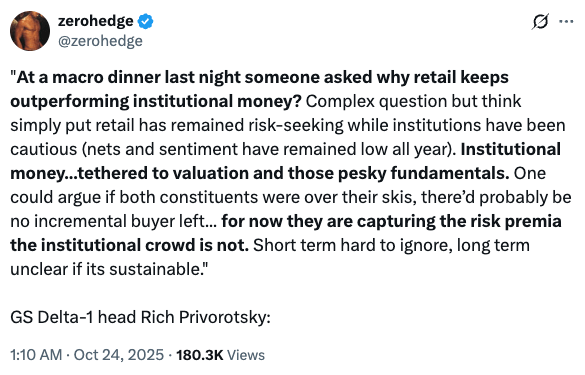
In case you’re not familiar with the term, retail in this case means individual investors: regular people, you and me. One theory is that covid is behind this surge in retail-driven performance. Stuck at home with their stimmy checks, regular investors learned to buy the dip, and it’s been working for them ever since. Stocks, crypto, gold – whatever retail jumps on goes up. Institutional investors look on in bewilderment, stuck with their risk models flashing warnings as the market leaves them in the dust.
It may not be healthy, but these are the cards we’ve been dealt. And with the Fed expected to cut a couple more times this year while simultaneously ending its balance sheet runoff, it’s hard to find a compelling reason to ease off the gas. Trump has even been talking about handing out money from tariff proceeds to the public. Can you imagine?
It would be rude not to do this! I’m looking at late November, maybe 26th, 27th or 28th. I’m open to suggestions on the venue, but my basic rule is that it must be a cash bar, so we don’t have to worry about whether everyone turns up to cover costs or fiddle around sorting out the bill. What do you say? If you don’t live in Tokyo and have been thinking of taking a trip, well…
Send me a message, email, DM or whatever if you want to come along. Will mostly plan this on X, so keep an eye on this thread.
We’ve been talking about an end-of-year melt-up for a few weeks now. So far, so good. I noticed the Nikkei Asia already started talking down the likelihood of a BOJ rate hike later this week. You can pretty much take that to the bank, right?
Is the Bitcoin 4-year cycle over?
After the most vicious deleveraging event ever just a couple of weeks ago, the crypto market has recovered. Yes, retail bought the dip once more!
There has been a wave of speculation over whether the 4-year cycle is still intact. It’s fascinating, actually, as crypto-natives have been hyper-trained on this narrative. It’s probably the reason Bitcoin is not significantly higher right now. Long-term holders have been unloading, while retail ETF buyers continue to accumulate. Many of the new investors have no idea what the 4-year cycle is and just have a monthly allocation set up for their account.
Felix is awesome, and I love his Forward Guidance Podcast, but time will tell. 2013, 2017 and 2021 were all followed by a nasty bear market. Yes, Bitcoin wasn’t a macro asset like it is now. Yes, you can make a great case that liquidity is rising, and the boomer ETF buyers will keep buying. I really want to believe, you know! But let’s just say I’m ready for anything. Warren Buffett hates crypto, but his quote about finding out who’s been swimming naked when the tide goes out could have been written for the industry. All we need is one good leverage flush to start the dominoes falling, and we all get a chance to buy at $50k again. Don’t think it can’t happen.
At least it will give these guys something to chirp about.
These guys are great! They’ve done zero work, but they will gladly tell you how Bitcoin is too volatile to be investable.
Well, BTC has closed above $100,000 for 172 consecutive days now. If you wanted to sell, you have had plenty of time to do so. If 2026 is a bear market, make sure you ignore these nitwits on their victory lap and back up the truck.
Melt-up before the melt-down, though, right? I’m yet to see real euphoria in crypto this year. Remember the images of people lined up on the street to buy gold a week or so ago? That’s what we’re looking for. We’re not there yet.
It’s a busy week with the Fed meeting, BOJ and Trump on the loose in Asia. I don’t know when the next dip will come, but you can bet that retail will be ready to buy it!
Disclaimer: This should go without saying, but the information contained in this blog is not investment advice, or an incentive to invest, and should not be considered as such. This is for information only.





















 Smart Money Asia