
What’s your Japan plan?

I started this site in 2017 and ran out of things to say about the basics of financial planning some time ago. If you are just getting started, I put together a thread of simple financial planning tips from my early posts, which you can view on X here.

The basics don’t change, but the environment can change drastically. If you plan to live in Japan for the long term, you are probably now figuring out how to adjust from living in a country where deflation was the norm to one where prices are rising. Looking into the future, one of the big questions is whether this inflationary environment will stick, or will Japan be back at zero interest rates and falling prices in a few years? How can we plan when we don’t know the variables we will likely deal with?

Prediction is very difficult, especially if it’s about the future. – Niels Bohr

I have a client who was an economist at a financial institution for many years. He told me he always felt it was his job to have a view. For some reason that has stuck with me and I think it is important in my job too. It’s also important not to be wrong, though! I wish I could tell you I have always held the correct view and never been wrong, but I doubt you would believe me. I have, however, gained some experience over the years, which has helped me develop some skills in dealing with the uncertain future we face.

Strong views, loosely held.

Having a view is helpful but you don’t have to marry it. If something changes or evidence comes to light that proves you wrong, you can simply change your view. Don’t get caught up in the social media battle to be right about everything. In just the last few years, people have pivoted from being epidemiologists to vaccine experts to geopolitical analysts to macroeconomists to AI gurus and now, tariff experts.

It’s exhausting.

So, I thought today I would take a look at some basic data about the Japanese economy and share my view on what a person living here should focus on in terms of financial planning and investment.

Debt is a problem

Japan still has a strong, productive economy but it is not expected to grow fast. The predicted real GDP change for 2025 is 1.1%. (IMF) Government debt to GDP is currently 255%. (Trading Economics)

December 2024 CPI (inflation) was 3.6% and, in response, the Bank of Japan recently increased the overnight interest rate to 0.5%. The 10-year yield on government bonds currently stands at around 1.2%.

Japan is clearly not going to grow out of its debt problem. Demographics do not support the level of growth required to meaningfully reduce the size of the mountain. When governments can’t outgrow their debt, they usually end up inflating their way out. I struggle to see how the BOJ leadership can raise rates high enough to head off this outcome but they will of course delay it as long as possible.

It doesn’t look good for the yen

In January 2023, I wrote a post charmingly titled How screwed is the yen? It actually holds up pretty well for a two-year-old post. The problems facing the currency have not changed very much and we are still hanging around at 155 yen to the dollar.

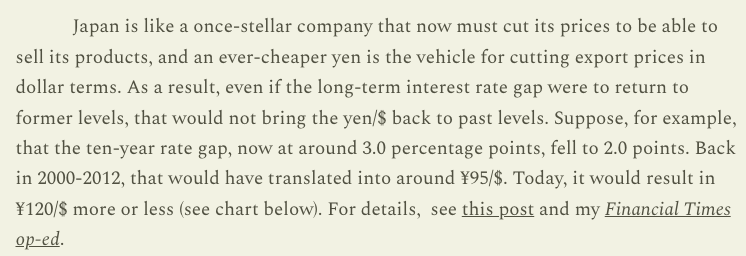
I have re-read this excellent post by Richard Katz several times: The BOJ, the Fed and The Future Of The Yen. He notes that although the gap between US and Japan overnight rates may close, the gap between the two countries’ long-term yields is unlikely to follow suit, meaning the yen probably won’t recover as strongly as some think it will. Here’s an excerpt from that piece:

Some of the issues people in Japan are facing when planning for their financial future are as follows:

  • Continuing yen weakness
  • Concern that the pension system will not meet their retirement needs
  • Rising interest rates, but not rising too far
  • Negative real rates (interest rates lower than the rate of inflation)
  • Rising wages but negative real wages relative to inflation

People are already feeling the pinch. If you bought rice recently, you know what I mean. Furthermore, prices of 1,656 food items are set to rise this month according to this Japan Times article.

So, what can we do?

If you are a regular reader, I am probably repeating myself, but here are some action items to consider:

Check your base currency – are you really going to spend all of your future money in Japan? Are there big expenses overseas that you are likely to be on the hook for in future? If so, you need to save and invest some or all of your money in that currency. More on that here: What is your base currency?

JPY cash is trash – even if your base currency is yen, you are going to lose against inflation over time if you keep all of your money in the bank. Sure, you need to keep a liquid emergency cash reserve, but everything else needs to go somewhere more productive. CPI was 3.6% in December. The BOJ’s target inflation rate is 2%. How much is your bank paying you in interest?

Fill up tax-free vehicles first – another no-brainer. If you are eligible for NISA and/or iDeCo, they are the first stop for investment money. NISA especially is an incredible deal as you can access the money freely if you really have to. Bad luck if you are a US citizen – you should explore options for investing back home. And remember, if your spouse is eligible, they should be maxing out tax-advantaged options, too.

Yen-cost average – if you are young, regular investment in a global stock index fund/ETF is a perfectly good strategy. You can worry about diversification later.

Learn to diversify – lump sum investments require more care. And the closer you get to spending your capital, the more you need to protect it. Diversification across asset classes (not geographical areas) is how you do this. Own some bonds, stocks (growth, value, dividend), property (physical or REIT), commodities and alternatives. Use a core/satellite allocation to dial up/down risk.

Explore dividend stocks – Japanese dividend stocks offer a great way to keep pace with inflation in yen terms. More here: How to beat inflation with Japanese dividend stocks

Lever up – if you are here for the long run, owning property is still better than renting. Even if you are risk averse, I am still seeing 35-year fixed-rate mortgages at under 2%. Floating rates are still well below 1% and, in some cases lower than 0.5%. It is still very cheap to borrow money for a home in Japan.

Stack gold and bitcoin – the two kings of hard assets and possibly the only satellite holdings you need. Average in over time and hold. More here: Facing inflation – the four assets you should own

A fistful of dollars – if you are the entrepreneurial type, I recommend brainstorming ways to earn money in USD. As the global reserve currency, it will be the last one standing in the Fiat race to the bottom. Read up on the dollar milkshake theory. If you can get paid in bitcoin, even better!

To summarise: have a view, make a plan and adjust it as you go. If you need help, don’t be shy about getting some. You will get better at this with practice.

Top image by tawatchai07 on Freepik

Disclaimer: This should go without saying, but the information contained in this blog is not investment advice, or an incentive to invest, and should not be considered as such. This is for information only.

Number go up

Being a financial planner by trade, I try to organise our financial future as efficiently as possible without going overboard. My wife and I both work and we have a reasonable income. We have a plan, we know what our numbers are for later in life and the big events in between. Most of all, we are flexible in that plan – our core investments are set and forget, but they can be adjusted easily. The tactical stuff is fun for me and I see it as a bit of a challenge.

Of course, things can go wrong: ill health, accidents, economic change and shifts in specific industries. You prepare for these as best you can and get on with living. Eat well, exercise, look both ways crossing the street, buy insurance etc. etc.

However, there are a few bigger things that bother me. I don’t think about them all the time, but they lurk in the back of my mind. For example, I don’t think AI is going to take over my job, but it could change the world considerably – gotta keep up with developments there. I could classify these things as outliers and conspiracies. Some may or may not have a meaningful impact and others feel a little ‘out there’. The best conspiracy theories have an element of truth, though, don’t they?

So, here are a few things I think about and how they relate to money, investing and how big your number should be:

Climate

I must confess, I don’t allow myself to dwell on what we are doing to the planet. We are clearly having an adverse impact and most of the damage is being done by big business interests who will not stop. The paper straws are cute, but they are hardly going to offset the widespread burning of fossil fuels and other environmental destruction. It’s not that I don’t think it’s important – it’s crucial to our survival as a species. I just know there isn’t much I can do about it. I separate our garbage, cut down on plastic and try not to waste resources, but I’m not losing sleep. Half the people in the developed world don’t even believe climate change exists so good luck to us coming together and taking action as a species. Do you remember the Covid mask and vaccine debates?

It is certainly getting hotter though! And it’s hotter for longer than it was before. After 27 years in Japan, it’s noticeable how spring and autumn are shrinking while summer gets longer year by year. What’s that going to be like in 10 years? How about 20?

I hardly think Yokohama will become unlivable in our lifetime but it could become pretty unpleasant. Imagine Japanese summer from April to October! Would that change your planning? Could it mean your ‘number’ needs to be bigger? The ability to escape Kanto, and maybe even Japan, for several months a year could become a key lifestyle choice. Maybe some people will want to escape for good. Wouldn’t that mean that the cooler, more livable climates in the world are going to see an influx of people who can afford to move? Parts of India are already hitting 50°C as a matter of course. That kind of temperature is more manageable in the developed world with aircon but doesn’t higher demand for a cool place mean higher prices?

As we move from climate change to climate crisis, how are governments going to address it? Again, remember Covid? It was all the people’s fault that it was spreading. They had to be stopped from travelling and confined to their homes in some countries.

Climate lockdowns anyone? Do you think they won’t do it?

It’s a dark thought, but people with flexibility financially will fare better than those who are struggling for money. Does that change your number?

Japan’s economic decline

Honestly, this one would bother me more if I was younger. I’m not sure Japan is a place I would be trying to build a life, career or business given the demographics and the economic outlook if I was in my twenties. But I’m not that young any more and I’m happy where I am. I would, however, want my kids to have the opportunity to live and work overseas if they choose.

The yen is a major concern though. My view is that short term it should recover somewhat when America begins cutting rates. I can see it getting to ¥130 or even ¥120 in the next year or so. However, longer term I expect the yen to steadily lose ground, particularly against the dollar. I talked about it in my ‘How screwed is the yen?’ post a year and a half ago. Staying alert for opportunities to earn in other currencies, investing in a combination of domestic and overseas assets and accumulating Bitcoin remain priorities for me.

Financial shenanigans

Grab your tinfoil hats for this one! In simple terms, the money has been funny since the 2008 global financial crisis. A lot of institutions that should have died were propped up at the expense of taxpayers and we’ve been getting screwed ever since. Economies and big business have become addicted to liquidity: cheap money, low rates. Low interest rates foster inflation, which is a tax on us all, but especially a tax on people who do not own financial assets.

Countries have too much debt and are not producing enough to pay it back. Japan is perhaps the worst offender, at least in the developed world. The debt spiral is probably terminal. That’s why the yen is doomed, and after that so are the pound, the euro and the dollar. I covered currency debasement in ‘Harden up your assets.’ There are tools to fight it that need to be deployed. Otherwise, your money buys less and less.

This is why governments are getting interested in the idea of Central Bank Digital Currencies. (CBDCs) At some point, they are going to need to perform a reset and substitute the current failing money with an alternative. And the powers that be never want to waste an opportunity to seize more control.

In essence, CBDCs are just another form of fiat money. But they come with a whole new opportunity for manipulation. Here’s an interesting video of Rishi Sunak being asked how he would enforce national service in the UK:

Controlling ‘access to finance’ is a government wet dream and CBDCs will make it easy. If you think that the possibility of losing permanent residence due to unpaid taxes is bad, wait until they freeze your bank account or apply a negative interest rate to your money until you pay up.

The public is sleepwalking into this one. You can already imagine how half the population won’t have any issue with it at all. ‘If you don’t have anything to hide, why would you need to keep your money private?’ will be the refrain. People who are well off have no concept of how less fortunate people can run into money trouble and fall behind on bills and taxes. The rich just don’t want to pay for a bunch of ‘layabouts and immigrants’.

The Bank of Japan already has a page on its website about Central Bank Digital Currency by the way. Cute, huh? No plans to implement it at present, but they are looking into it…

CBDC is one thing I think is really worth fighting against, but it will most likely be a losing battle. Sooner or later some crisis will come along and CBDC will have to be implemented ‘for our protection’. You can already see it happening with the AML/CFT mission creep.

Call me crazy, but I think that accumulating Bitcoin and other crypto is the best we can do to prepare for what is coming. Any money sitting in the fiat system will be caught in the net. In many countries, people who want to withdraw a few thousand dollars in cash already have to explain to the bank what they are planning to do with it.

Assuming the number will go up

So there it is. Like you didn’t have enough to worry about! From a financial planning perspective, my take on this is that whatever your number is, you will probably need more.

That’s to say, whatever amount of money you think will be enough to secure your future, maybe add another 10-20% for safety.

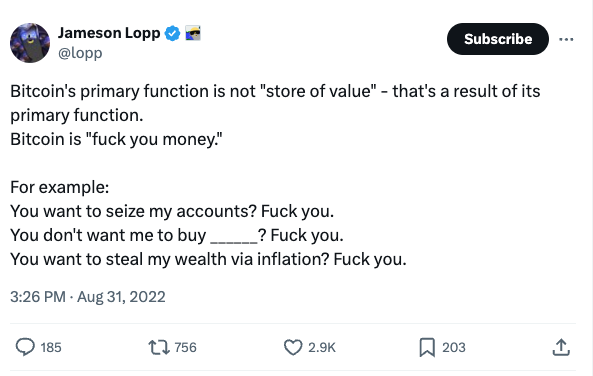
This is why I recommend dividing investments into core/strategic and satellite/tactical. The long-term strategic investments are focused on hitting the number. The tactical assets are aiming for a little extra. The crypto holdings are a shot at f**k you money.

Number go up. Act accordingly.

Disclaimer: This should go without saying, but the information contained in this blog is not investment advice, or an incentive to invest, and should not be considered as such. This is for information only.

Goal Setting Part 4 – Financial Independence

woman-591576_640

Today we have the fourth part of our series on setting financial goals, based on Tony Robbins “Wealth Mastery”, and this is a pretty major milestone: financial independence.

I have heard many definitions of financial independence, but I think this is the clearest: You have achieved financial independence when you have accumulated a critical mass of capital that, invested at an 8% rate of return, provides you with enough cash to live the exact same quality of life you have today, without ever having to work again for the rest of your life.

What we are talking about here is becoming independent from work. It doesn’t necessarily mean retiring, or stopping work. In fact, most people who achieve financial independence continue to work in some form or other, often on something that is meaningful to them.

Wealth mastery actually has two more stages after financial independence:

Financial freedom involves accumulating enough capital to provide you with sufficient income to live the lifestyle you desire, without having to work again. And absolute financial freedom is when you feel certain that you can do virtually anything you want, whenever you want, wherever you want, with whomever you want, as much as you want.

What you are probably realising as you read this is that the goal here is income without having to work. It’s not about having enough money to just buy everything you want. A new car purchase can be broken down into monthly payments, as can a new home. Kids school fees are paid on a quarterly / annual basis. It’s much easier to break your ideal lifestyle down into monthly payments, rather than a list of what you want and what it costs. The income to cover your lifestyle of choice could come from investments, property, royalties, a pension, or any combination of these things.

The key is to work out what is the monthly income you would require, and from there calculate the critical mass amount you need to accumulate to cover this. Once you get there, you need to know how to generate that 8% return without taking too much risk.

What is the total amount of capital you would need to be independent from work?

Goal Setting Part 3 – Financial Vitality

inspiration-1514296_640

Moving on to the third installment on setting financial goals, based on Tony Robbins “Wealth Mastery”, today we will look at Financial Vitality.

You have achieved financial vitality when you have accumulated a mass of capital that, invested at an 8% rate of return, provides you with enough cash to meet the six goals of financial security, plus the following three additional financial goals, without having to work again unless you want to.

  1. The ability to provide for your children’s education.
  2. Providing for basic entertainment needs.
  3. The purchase of new clothing, or one or two reasonable luxury items.

Obviously the big one here is children’s education, and it will require some research in order to understand the numbers on this goal. Here’s a little date that may help:

For school, Santa Fe Relocation Services website has a great overview of the cost of international school in Japan here. As a minimum we are looking at JPY 2,000,000 per year.

Higher Education costs will of course vary from country to country. There are some useful numbers in this article. Education costs are rising every year so you will need to keep updating your research but currently, including tuition, room and board, you could be spending somewhere between $20,000 and $40,000 per year.

What is the total amount of capital you would need to accumulate to achieve financial vitality?

Goal Setting Part 2 – Financial Security

cash-1169650_640

Continuing our series on setting financial goals, based on  Tony Robbins “Wealth Mastery”, today we will look at the second milestone, known as Financial Security. People have varying definitions of what it means to be financially secure, which is fine. However, if you are not sure how to define financial security, perhaps the following will help:

Financial security is not just a matter of job security or income. In order to be truly financially secure you need to accumulate a critical mass of capital that, invested at an 8% rate of return, provides you with enough cash to meet the following needs forever, without having to work again unless you choose to:

  1. Monthly mortgage payment on your home until it’s paid off (or otherwise your monthly rent)
  2. You and your family’s food needs each month
  3. All utilities
  4. Transportation needs
  5. Insurance
  6. Taxes

We are using an 8% return here based on a diversified, growth-oriented asset allocation. Feel free to change the annual return to fit your expectations.

Go ahead and calculate how much you need for each of the six categories above. If you don’t know the amount for each of these monthly expenses, then that is the first job. You can’t have a target for financial security without understanding these basic numbers.

Here’s a simple example:

  1. Mortgage: $1,200
  2. Food: $330
  3. Utilities: $360
  4. Transportation: $280
  5. Insurance: $320
  6. Taxes: $460

In this case the monthly total is $2,950, so annual is $35,400. That would require capital of $442,500 @ 8% return.

Now calculate how much capital you would need to be financially secure.


Goal Setting – Financial Protection

umbrella-2904775_640

We’ll spend the next few posts looking at various milestones in the financial planning process, and start to understand exactly what you need to have in place for each stage. I am going to borrow heavily from Tony Robbins “Wealth Mastery” here as he has done an incredible job of helping people get clarity on their financial goals.

Today we’ll start with Financial Protection. This is the basic minimum goal for everyone. The idea here is to be absolutely certain that you and your family are protected, no matter what life may throw at you. You want to financially bulletproof yourself and your family against sickness, unemployment, an economic downturn or whatever else may lie in wait.

You have adequate financial protection when:

  1. You have accumulated an emergency cash reserve large enough to cover your basic living expenses for a minimum of 3 months and up to 24 months, depending on your needs. If you lose your job tomorrow, you need to be able to cover these basic expenses for as long as it takes to find new employment. If you have a very secure job or highly marketable skills, you may be comfortable with less. If you are self employed, or have a fluctuating income, you may need a bit more cash to feel comfortable. Write down the actual amount of money you need for your emergency cash reserve.
  2. You have obtained income protection insurance to protect yourself and your family against long-term sickness or disability. The amount of insurance you need is directly related to the amount you already have saved. Income protection insurance is designed to pay you a portion of your current income if you are sick and unable to work for the long term. It will often cover you up to age 65 for a relatively small monthly cost. Write down how much income you would require per year if you you were disabled and unable to work ever again from tomorrow.
  3. You have at least obtained basic life insurance to provide for your family if you were to pass away. Even if the amount of cover is small, try to at least meet your family’s basic income needs. If your family needs a minimum of $25,000 per year to pay the bills, then look at $500,000 in cover. The $500,000 invested at a 5% return = $25,000 per year. Go for a simple term life policy and set the term so it expires when your youngest child will become financially independent. Write down the amount of life insurance required to cover the basics for your family if you were no longer around.

Loss of income due to job challenges or long term illness are the main causes of economic trouble for families. If your choice is to make the first contribution to a retirement plan, or pay the first premium on an income protection plan, the latter is going to be far more valuable if you have an accident or illness.