
Dry powder

Greetings, fellow bulls!

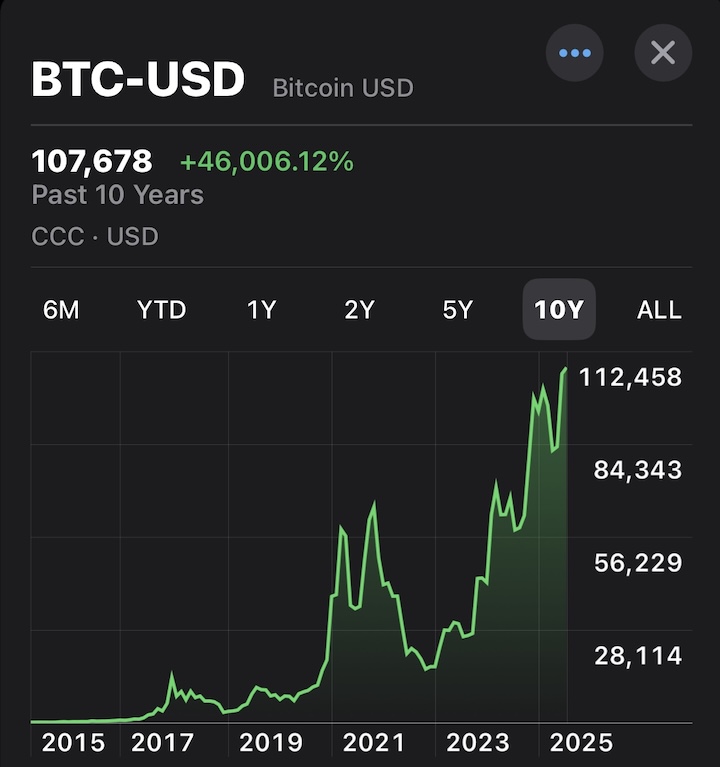
BlackRock’s IBIT Bitcoin ETF recently hit $70 billion in assets under management. Do you know how long it took to get there? 341 days. That’s 5 times faster than it took their gold ETF (GLD) to reach that milestone. Bitcoin moves at a different speed.

Remember when the Bitcoin ETF launch was supposed to be a sell-the-news event? The midcurvers did it again.

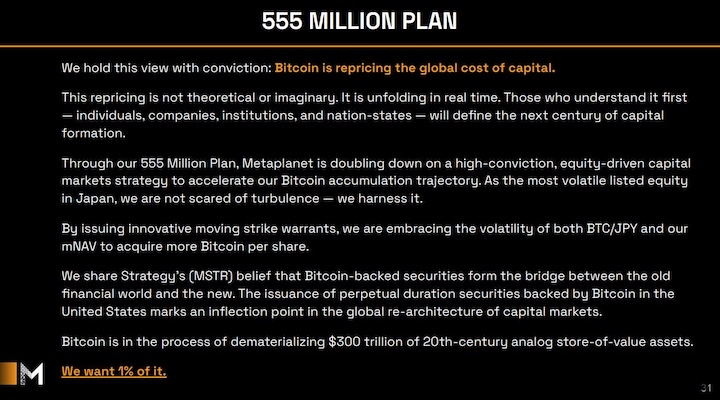
On 6 June, Metaplanet announced an accelerated 2025-2027 Bitcoin acquisition plan, targeting 210,000 BTC by 2027. The company started this new phase with a 555 million share issue, with expected proceeds of $55.4 billion, to buy more Bitcoin. You can find the whole plan outlined here. You have to hand it to these guys for having mega conviction. Go, go, go!

If the ETFs were the catalyst for the 2024/25 bull market, Bitcoin treasury companies have been the other major force driving ongoing demand. Michael Saylor’s Strategy (formerly Microstrategy) hoovered up another 1,045 BTC on 9 June and now holds 582,000 Bitcoin acquired at an average price of just over $70k. Strategy has a nice overview of the company metrics here.

All this makes you wonder how the BTC price isn’t higher…

Not that $108k BTC is cheap, but institutional demand for the orange coin is surging, with copycat treasury companies springing up almost daily.

So why isn’t BTC at $150k? Probably the number one reason is that retail fever has yet to show up in this cycle. Maybe people got too badly burned by FOMO in previous bull markets. Or maybe Bitcoin at $100k+ just feels too expensive.

There’s also a lot of selling going on. OG whales, who accumulated coins at far lower prices, are cashing out. It turns out that $100k really is a magic number in that respect.

At some point, those guys will be satisfied and look to hold the rest of their stack for even higher prices. It feels like we might be getting close. Whether retail shows up or not remains to be seen. Part of me hopes they don’t – this is the herd that buys at the highs and ends up getting burned. Part of me is resigned to the fact that there is always a level of buzz where they can’t resist jumping in. It is what it is.

Where do we go from here?

If you managed to ignore the haters and the naysayers and accumulate the best-performing asset in the world and then sit on it this cycle, congratulations. That’s no mean feat!

Now don’t screw it up!

What do you think this is going to look like in another 4 years? How about 8 years? Hey, maybe governments will rein in their rampant spending and start behaving responsibly. Perhaps they’ll pay down some of that debt instead of creating more.

If you haven’t already, I suggest you check my previous post: It’s going up forever, Laura.

I’ve been writing about this stuff since 2017, imploring people to educate themselves on Bitcoin. I’m still shocked how few people have made the effort.

“I only invest in things I understand.”

Oh really? Explain to me how that bond fund you own works. What’s the sector breakdown in that stock index ETF you’ve got there?

Hey, if you’ve actually spent the time on Bitcoin and decided it’s not for you, that’s cool.

Or maybe your hobby is hunting Japanese deep value stocks, and you’re not interested in doing anything else – this one I can respect. If you’re happy and you don’t care, it’s all good.

But most people are just a combination of lazy and slaves to their own biases.

If this is you, you have until about the end of 2026 to change it or get left behind.

Times are changing

This summary thread on GMI’s ‘Everything Code” is worth 5 minutes of your time. That’s the reading time. It might take a little longer to digest.

The Tldr: Human productivity is heading down, to be replaced by robots and AI. More debt is coming. Debt to GDP is going up only. Spending power gets vaporised. Tech stocks and Bitcoin are the two things that can still outperform the debasement, and one is way more efficient than the other.

Things are going to get weird and very difficult for a while. It’s not a good scenario to sleepwalk into.

Death and taxes

“But, what about the tax on crypto?” This concern is understandable. Japan’s taxation on crypto is indeed heinous. Personally, I think it will change and be taxed like stocks sooner or later. But I might be wrong.

What is occurring is the financialization of Bitcoin. It’s crossed over to tradfi already. Don’t miss this. Pretty soon, you won’t have to sell your Bitcoin. You’ll be able to borrow against it.

No capital gains if you don’t sell. It’s how the rich spend their money.

It’s already here with various institutions, including Xapo Bank – I wrote about it in Banking your Bitcoin. This stuff is only going to get easier and more accessible. Just sit tight a little while.

What’s the game plan?

Bitcoin still has room to run this year, but next year is likely to be brutal. It will be ok to laugh at it again. You will feel smart for not owning it.

Metaplanet and other copycat BTC treasury companies might even turn out to be the FTX/Luna of this cycle. One or more of them could blow up spectacularly. This is not the time for FOMO. If you missed it, you missed it. Metaplanet is currently trading at a massive premium to its Bitcoin holdings. In the bear market, I would expect it to trade at a big discount.

However it works out, my thanks go out to this company for providing me with a larger-than-anticipated pile of dry powder to allocate this summer.

If you still have zero bitcoin exposure, 2026 is your best opportunity. You have until then to get your head around it and set aside some cash. Put the work in. Jameson Lopp has an excellent list of reputable Bitcoin news sites and newsletters here.

I talked to a young guy the other day, and every time I said Bitcoin, he came back with ‘crypto’. If you think these two are the same thing, you have some catching up to do. I cover this in The investment case for Bitcoin.

This cycle has been a real eye-opener in this respect. Every time Bitcoin pulls back 5%, crypto (meaning alts) gets destroyed. The bleed has been insane. You will go broke very quickly trying to outperform BTC – and why do you need to anyway?

Screenshot

The name of the game is to accumulate as much Bitcoin as you can, without putting yourself in the position where you could become a forced seller. You don’t have to go crazy, just average in when nobody wants it. ETFs are fine – you don’t have to go crypto native.

If you want to get excited about crypto, stablecoins are where it’s at. USDC founder Circle Internet Group’s (CRCL) IPO just blew away expectations. This could be the start of a gold rush in crypto IPOs. (I would be keeping an eye on Tether here) Societe Generale just announced that it will launch a USD-pegged stablecoin on Ethereum and Solana. I don’t think the average person on the street has any idea how easy it is to transact in stablecoins. Money is going to start moving so much faster.

The 2024/25 bull cycle may well accelerate from here. Things could get crazy. Maybe we’ll even get the alt season traders have been waiting for. Do what you have to to accumulate more BTC, and don’t be scared to set aside some dry powder for next year.

Good luck!

Disclaimer: This should go without saying, but the information contained in this blog is not investment advice, or an incentive to invest, and should not be considered as such. This is for information only.

Bitcoin – when do I sell?

As I sit here on a calm November afternoon, Bitcoin is trading right around the $90,000 mark. In yen, we are getting close to ¥14 million per BTC. Quite a number, huh? The Bitcoin market cap just overtook silver. Yes, silver. And the total crypto market cap briefly touched an all-time high of $3.01 trillion today.

The mainstream media have picked up on the feverish price action since the US election. Being mainstream media, they are making the mistake of reporting on it as a ‘Trump trade’. I have seen this on the BBC, the evening Nikkei news and elsewhere.

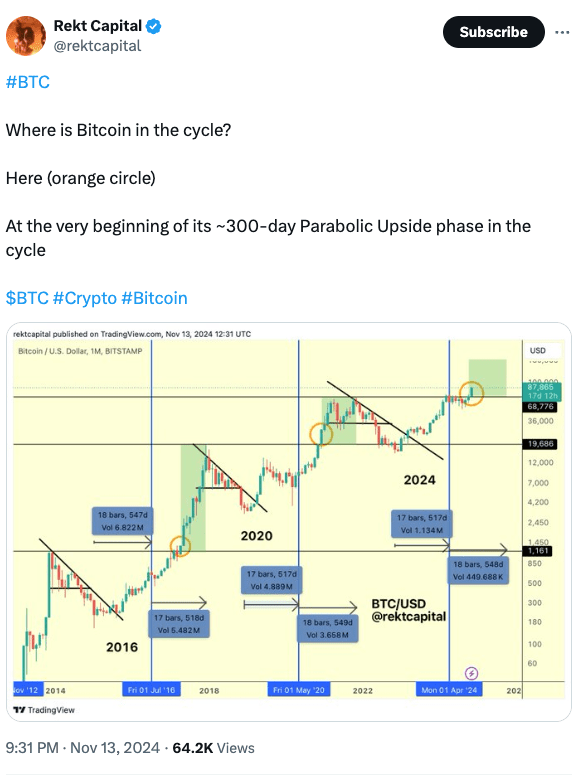
Here’s the first thing to note: the bull market was already in motion and primed to enter the parabolic phase. Trump was just a catalyst. It was going to happen anyway. Something else would have kicked it off if it hadn’t been Trump’s victory. If you think this is about Trump, you have missed the point.

That said, the incoming US administration is going to be far more crypto-friendly than the current one, which is something I covered in my previous post, Full Send.

I discussed bull market catalysts back in my October 2023 post: Bitcoin, Pump up the Volume! I was wrong about the US entering recession (so far), but that wouldn’t have stopped the bull market either.

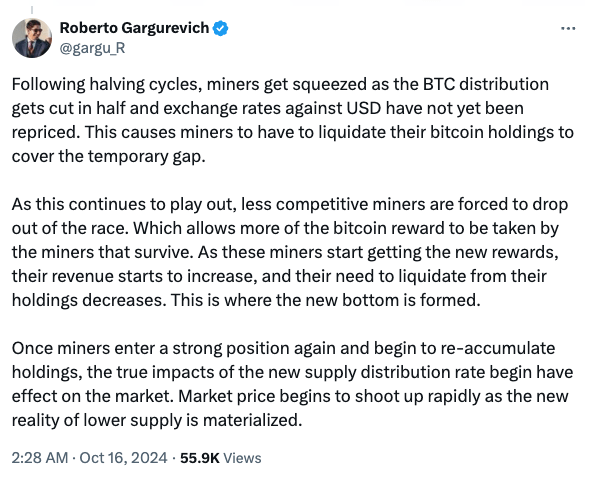
Here is an excellent explanation of how the halving, which took place in April this year, squeezes miners and eventually leads to a surge in price:

The key takeaway: the bull market mania phase was going to happen regardless. Trump was a catalyst. Central banks entering a rate-cutting cycle was a catalyst. They lit the fuse, and now we get to watch the fireworks.

So, when do I sell?

Take it easy now. The decisive break of the 2021 cycle top was only a week ago!

We need to be careful who we listen to when things go parabolic. One week in and crypto ‘analysts’ are already calling the top.

It’s been interesting to note that over the past week, during Asia daytime, price has tended to dip. People are taking profit at these levels. Some of these people probably bought the 2021 top, of course. Then overnight, when Blackrock and the other ETFs start buying, price moves up again. ETF inflows for the first 3 days of this week totalled $2.4 billion. Retail FOMO is only just getting started.

Some have lamented how people are now going to pile in and end up buying high and getting stuck holding the bag. Yes, that’s what is going to happen. It happens everywhere when the price of an asset shoots up. It’s not limited to crypto. Your job is not to join the legions of people who make this mistake.

Study this tweet. Ponder it. There’s a whole chapter of George Soros’ best-selling book in those 6 words. (look up reflexivity from ‘The Alchemy of Finance’)

An asset may start to rise due to fundamentals, an economic or political event, a drag on supply, or whatever. Once it starts going up, people notice and react to the price, pushing it higher. This can get extreme during bull markets and bubbles.

Things are about to get silly. Focus.

Professional traders and investors are generally very good at buying low. Research shows that they are mostly pretty average when it comes to selling high. It’s actually really difficult. Sell too early and you regret leaving money on the table. Wait too long and you get fixated on the all-time high and start willing it back up there when you should be hitting the exit.

It’s hard. Don’t let anyone tell you otherwise.

You are not going to sell the top

Accept this. It’s not going to happen.

So, what to do?

Have a plan

Are you even going to sell? Bitcoin is going way higher over the next 10 years. It’s perfectly acceptable to hodl and ignore all the noise. You don’t have to complicate matters. If that’s your plan, it’s a good one. Please enjoy doing something else!

Many intend to sell during the bull run so they can accumulate more in the inevitable bear market that follows. That requires a plan of action. I can’t tell you exactly what that plan should look like. It’s an individual thing. But have a plan.

Some people need to build a spreadsheet. Some just need a few calendar reminders. Here are some general pointers:

Avoid round numbers – everyone wants to sell $100k. Yep, they did in 2021 too. The market does not owe you a particular number. Your favourite analyst says we are going to $125k – giddyup!!! This is how people screw up. Waiting for a number that never comes. Your favourite influencer says the bull market will run until February 2026 – red flag!!! Don’t get sucked into this kind of thinking. Nobody knows anything.

I would be much more willing to bet that BTC reaches $1 million sometime in the future than I would to bet on it reaching any particular number in the next 10 months.

Average out – the chances are you didn’t buy all of your Bitcoin at the stone-cold bottom of $16k. More likely, you bought little by little during the bear market and the early bull market. Dollar-cost averaging is a great way to buy a volatile asset. It’s also a great way to sell a volatile asset. Exiting a little at a time over the coming months means you will get out at an average price, which is a lot better than round-tripping the whole bag back to the bottom. You might even sell the top on one of those orders!

Alts go first – I stressed this in my previous post: Bitcoin and crypto are not the same thing. Any non-Bitcoin crypto asset needs to be aggressively sold when things get crazy. That means ETH, SOL, SUI, dogs, cats, squirrels. Whatever crazy coin you got yourself into that is destined for the moon. It’s going to crash 90%. And then it’s going to get cut in half again. Most meme coins are going to zero. (don’t worry, Doge will survive!)

Sell catalysts

The 2021 bull market peaked at $69k in November of that year. At that time, crypto influencers were loudly calling for a push to $100k by around February 2022. Euphoria reigned. Meanwhile, Jerome Powell and his pals at the Fed were just getting to grips with the fact that inflation was not going to be transitory like they thought. Bitcoin rolled over as it became apparent we were about to enter a rate hike cycle. Maybe we would have got $100k without it, maybe we wouldn’t. I wish I could say I correctly identified this glaring top signal, but I didn’t. I know one or two traders who did, but we are talking about a very small minority.

Just like there are catalysts that ignite a bull market, there are events and conditions that usher in the bear. Whilst averaging out, look for the signs. Averaging out may well require selling on both sides of the cycle top.

The number one thing to look out for is euphoria. When everyone thinks we are going up forever, take cover.

Don’t forget the tax man – assuming you did a great job and averaged out, you should end up with some handsome profits. But don’t rush out and buy the lambo just yet. Remember, you are going to have to declare your winnings and pay the man. Many a successful trader has fallen into this trap and ended up in debt.

Reinvest – make sure you reinvest profits for the future. You don’t have to lump it all back into crypto. Splitting part of the gains into a well-diversified portfolio is a smart move. Past bear markets have seen Bitcoin drop by around 80% from its peak. Start getting greedy again when we get to those levels.

Enjoy the ride – bull markets are fun! Laugh at the memes, smile at the gains, take profits and just beware of euphoria.

Or simply never sell.

Top Image by starline on Freepik

Disclaimer: This should go without saying, but the information contained in this blog is not investment advice, or an incentive to invest, and should not be considered as such. This is for information only.

The 2024 NISA – NISA Forever!

I have been meaning to write this update for a while. In particular, because people keep finding an article I wrote about the ‘New NISA – Coming in 2024’ and telling me it is out of date, which it most certainly is! You see, that was the old new NISA plan and since then there is a new new NISA plan, which is even bigger and better. Clear? Apologies for the confusion and for my tardiness in updating – the old article will be consigned to the fires of internet hell just as soon as I get this one written and posted.

If you’ve read this blog before, you may be aware that I care very little about product. By that I mean, if you are buying a box to hold things, I don’t care if you get the blue box, the pink box or the rainbow box. It’s just a box, after all! There are a number of NISA products out there offered by online brokerages and banks. I hear even the Japan Post Bank is getting in on the act. My preference would be for the online brokerage accounts, but that’s mainly because I am terminally online and want to minimise time spent ever talking to staff at the bank! If the post office works for you, have at it!

What does get me excited is what you put in the box. That’s where things get interesting. I already wrote a post on How to choose investments for your NISA, so please check that out as a compliment to this post.

So, down to the nitty-gritty. How does the new NISA work? My NISA is with SBI, and they wrote a little guide with some ‘helpful’ graphics – see here. Google translate works ok on the main body of text but the graphics remain in Japanese. I’m really linking to this so you don’t rely entirely on this post to remain correct. Keep an eye on official sources in case something changes before launch.

In short:

You can invest up to ¥3.6 million per year – ¥1.2 million has to be invested in mutual funds, and the remaining ¥2.4 million can be invested freely. That means ETFs and direct stocks are on the menu.

The investment term is unlimited – so ¥3.6 million a year for 5 years = ¥18 million. This is the fastest you can fill it up, but you can actually take as long as you want to reach the ¥18 million limit.

The holding term is forever – there is no limit on how long you can hold the assets in the NISA. As long as you don’t sell, dividends will be paid tax-free and there will be no capital gains tax when you do eventually sell.

All in all, it’s a pretty good deal! I plan to be maxing out my allocation for each of the five years before making any investments into taxable accounts.

If you have an existing NISA, you will not be able to make any new contributions to it after the end of 2023, but you can choose to keep the money invested until the end of the term. For example, if you started a regular NISA this year and invested ¥1.2 million, you can leave that money invested, tax-free, for another four years. Any new contributions will go into the new NISA. If you have a Tsumitate NISA with 15 years remaining, you can choose to leave the money contributed up until the end of 2023 in there for 15 years. Again, from 2024 any new contributions will go to the new NISA.

Investment Strategy

I encourage you to give some thought as to how to allocate the investments in the new NISA. Again, the post I mentioned earlier may help.

There is one trade-off I am particularly focussed on here: growth vs. income. Your forever NISA investment will benefit from not being charged the 20% tax on capital gains or dividends. So which should you try to maximise? The short answer here is probably a combination of both, but let’s do some thinking about it:

For the ¥1.2 million per year that has to be invested in mutual funds, I don’t think it will be possible to generate income. Mutual funds generally re-invest dividends, so they are part of the investment return, but unless they have a distribution share class, they don’t pay dividends out. If anyone finds a mutual fund, available for NISA, that actually pays out dividends, please do chime in – I would be very interested to hear about it. For now, I’m going to assume that such funds are not available. In that case, for the ¥6 million (¥1.2 mill x 5 years) that you invest in mutual funds, it would make sense to go for growth. I will be looking for high-growth-focused funds for this part of the allocation. (note that growth stocks generally pay no/low dividends as any earnings the company makes are reinvested to spur further growth)

For the remaining ¥2.4 million a year, that’s ¥12 million, I am tempted to strongly focus on dividend-paying stocks and/or dividend stock ETFs. If you can generate a 4% dividend return on ¥12 mill, that gives you a tax-free ¥480,000 per year in income alone. And, of course, these stocks will probably also grow in value over time if you are patient. Now, nobody is retiring on ¥480,000 a year but over 25 years, for example, that’s ¥12 mill in your pocket. Not bad, huh?

Of course, there’s a pretty good argument for investing the ¥12 mill into a fund that reinvests the dividends so you get the compounding effect over the term of the NISA. I have no objection to that. I just like the idea of collecting my ¥480k tax-free every year and either spending it or reinvesting it myself.

Also, after a discussion with Ben at Retire Japan, I discovered that under the new NISA rules, you can sell assets and then re-use the tax-exempt amount to invest in a different asset, which is a huge improvement on the current system. Thanks, Ben for pointing that out! See this FAQ on the FSA website.

So those are my thoughts. I would love to hear from anyone who looks at the NISA opportunity differently. Drop me a line or come and tell me I’m wrong on X. (yes, we have to call it that now…)

Disclaimer: This should go without saying, but the information contained in this blog is not investment advice, or an incentive to invest, and should not be considered as such. This is for information only.

Death and Taxes in Japan

sakura-1911208_640

Benjamin Franklin said that there are two things certain in life: death and taxes. Following a change in Japan inheritance tax law in April 2017, those two things may have come into sharper focus for some foreign residents. You may have come across this Bloomberg article on the “bizarre” death tax that deters expats. It certainly seems that Japan does not make it easy for people to come and live and work here long term.

So what do expats need to know about the recent changes to inheritance tax law Japan?

Short term residents: Foreigners staying temporarily in Japan have been excluded from gift and inheritance tax on overseas assets. Staying temporarily is defined as residing in Japan for not more than 10 of the last 15 years and holding a “table 1 visa”, such as a work visa. If you are in this category and you receive an inheritance from a family member overseas, for example, it is not subject to inheritance tax in Japan. This also applies if the transfer of overseas assets is between you and another “temporary resident”. However, if you die and transfer your overseas assets to a Japanese national there is no exclusion. The transfer of Japanese assets will be subject to Japan gift or inheritance tax.

To keep it simple, if a relative dies and leaves you a house overseas – no tax in Japan. If you die and leave another temporary resident heir a house overseas – no tax in Japan. If you die and leave another temporary resident heir a house in Japan – taxed in Japan. If you leave a house overseas or in Japan to a Japanese heir – taxed in Japan.

Long term residents: If you hold a “table 2 visa”, which is a spouse visa or permanent residence, and/or have lived in Japan for more than 10 of the last 15 years, you are a long term resident. You are therefore considered an unlimited taxpayer. This means that any transfer of assets, in Japan and worldwide, will be subject to Japan gift and inheritance tax. This also comes with the controversial “look back” rule, whereby even after leaving Japan, the tax on worldwide asset transfers continues for 10 years. So a situation could arise, for example, where a long term resident leaves Japan, dies within 10 years, and an heir who has never lived in Japan will be subject to Japanese inheritance tax on the donor’s worldwide assets.

So what can you do?

If Japan inheritance tax is a concern, and you are currently a short term resident, then the number one thing you can do is leave Japan before you reach the 10 year mark. (this is quite sad when you consider Japan’s long term demographic problems – you would think that encouraging productive foreign residents to stay and contribute to the economy would be a good idea, but there you go…)

If you are a short term resident with a table 2 visa, such as a spouse visa, you might consider changing to a table 1 visa if possible.

If you are a long term resident, you have some thinking to do, particularly if you have significant worldwide assets. Retiring in Japan may not be so attractive when it comes with up to a 55% tax bill on handing down everything you own. If you are going to leave, you will want to do it while you are still healthy and confident of surviving the 10 year lookback.

The April 2017 reform was essentially implemented to counter wealthy Japanese from moving abroad and passing on assets to heirs who were not born in Japan, or had given up Japanese nationality, but unfortunately the new rules will deter long term foreign residents from living out their life here.

Regardless of tax considerations, writing a will is something everyone should consider, particularly those with assets spread around the world. Most people would prefer to make clear “who gets what” after they are gone rather than it being dictated by local laws.

Further reading: this PWC report on the April 2017 reform is both clear and comprehensive.


Tax – Who Has Access To Your Financial Information?

hand-1248053_640

By now I’m sure one of the banks or other financial institutions you use have asked you for confirmation of where you are tax resident, and for your tax ID number. In fact, you may have been asked for this information multiple times. So what is it all about and who knows what you have got, so to speak?

You may want to read up on the Common Reporting Standard (CRS). Developed by the OECD in 2014 to combat tax evasion, CRS involves the automatic exchange of tax and financial information globally. 83 countries have already signed up for the agreement and first reporting begins this month, September 2017.

What this means, in practical terms, is that every financial institution in these jurisdictions is required to collect information on their customers country or countries of tax residence, including their Tax ID number(s). Hence the requests you have probably already received from some or all of the institutions you have accounts with. This information will be provided to the local tax authority in the institution’s jurisdiction, who will then share the information with the country you are tax resident in.

The information exchanged will include:

  1. Name, address, DOB and Tax Identification number of reportable person
  2. Account number
  3. Name and ID number of financial institution
  4. Account balance of value at end of calendar year

So, for example, if you are from the UK and currently live and work in Japan, your country of tax residence will most likely be Japan. If you have a bank account in the UK, then the details and balance of that account will be shared with the Japan tax office. The same applies to accounts in any other participating countries. In case you are wondering, your tax ID number in Japan is the recently introduced My Number.

CRS was initially based on the USA Foreign Account Tax Compliance Act (FATCA) and therefore it’s interesting to note that the US, which is already receiving information about foreign accounts held by its citizens through FATCA, has not signed the CRS treaty.

So what does this mean for you? Well mostly it means more and more disclosure related to international financial transactions. You are already required to provide certified ID and proof of residential address in order to open accounts and move money, and now you will also need to provide your tax ID. If you have transferred money overseas recently, you may have noticed that the amount of information you have to provide is increasing, especially for larger amounts. What it also means is that, in order to catch people who are hiding money and evading taxes, people who are doing nothing wrong are steadily losing the ability to keep their financial data private. Like it or not, that is the world we are living in so plan accordingly.

Here is a useful list of participating countries, and to what degree they are implementing CRS.