
Facing inflation – the four assets you should own

Happy Friday! I thought I would provide a quick round-up of what is going on in markets. In case you missed it, here’s the most important five minutes of financial commentary I saw this week:

If you don’t know who PTJ is, here is his Wikipedia page. The Tldr is legendary trader and billionaire hedge fund manager.

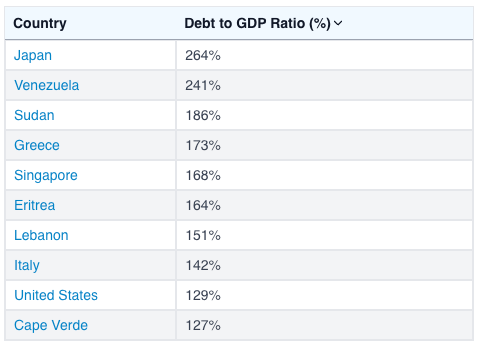
The message here couldn’t be clearer: ‘All roads lead to inflation.’ Note the mention of Japan around the 4-minute mark. The playbook for how nations get themselves out of debt trouble is to inflate their way out. This is happening. Think what that means for your spending power. Think what it means for the yen…

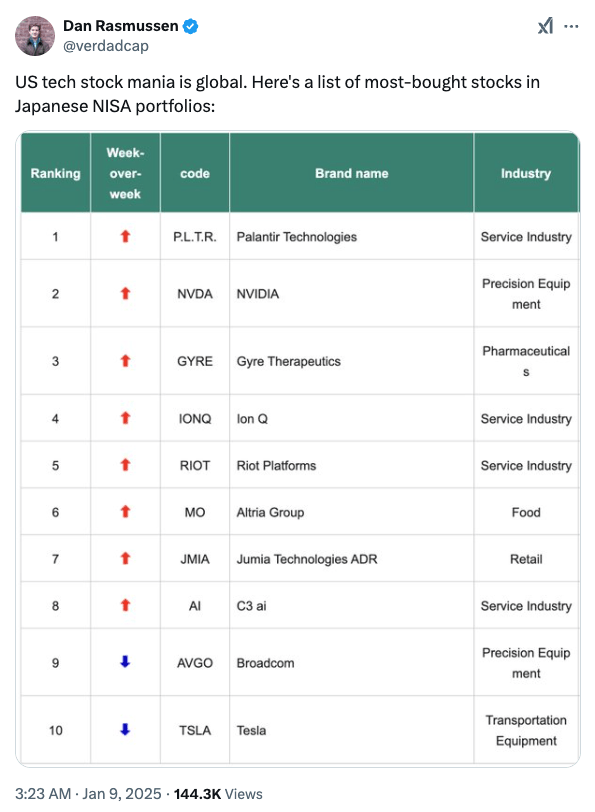
So what assets does a guy like this own to face down the inflation threat? Bitcoin, gold, commodities and tech stocks. Hard assets and tech stocks. Simple.

I have had numerous conversations this past few weeks along the lines of ‘I want to own gold, but I feel like I’m too late.’ Yes, this is why I preach having the core of your assets in a diversified portfolio instead of just lumping it all into a global stock ETF. If you owned a diversified portfolio, you would have 3-5% in gold, and that part of your portfolio would be up +30% this year already. You wouldn’t have to scramble to buy some now.

This is an excerpt from a post I wrote in March 2023:

‘But global stocks have outperformed a diversified allocation over the last 12 months.’ – yes, there will be times when they will do that and there will be times when they won’t…

Here’s the simplest way I can put it: if you are young and in the process of accumulating wealth, then maybe a 100% stock allocation is ok. If you have already built up a nice nest egg, you need to think seriously about how to keep it. Spread the risk and sleep well at night.

When it comes to the satellite holdings, it’s pretty clear what needs to be beefed up right now: bitcoin, gold, commodities and tech stocks. You might already have commodities in your diversified portfolio, but with inflation looming, it’s time to get some more. Note that PTJ mentions how commodities are still under-owned.

Bitcoin is coiled

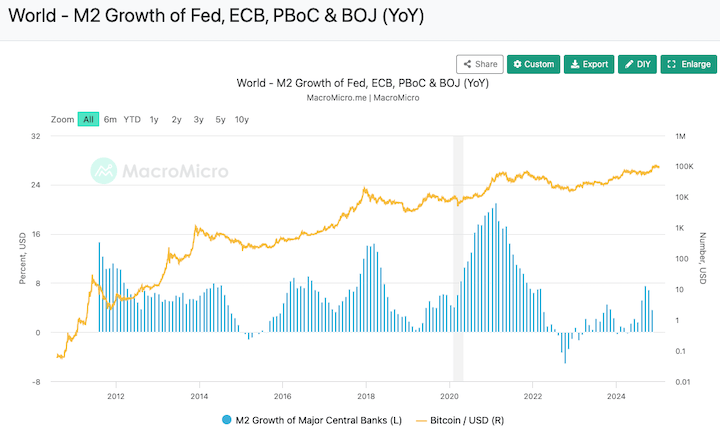
The Bitcoin four-year cycle is playing out exactly as expected and we are about to enter the fun phase.

The BTC ETFs are buying more BTC than is being mined every day. By a long way. Supply shock incoming. I don’t know how to explain it any more clearly.

If you are waiting around for a Japan Bitcoin ETF, I wouldn’t hold your breath – see this Financial Times article.

Meanwhile, Microsoft placed an ‘assessment on investing in Bitcoin’ on the voting ballot for its 10 December annual shareholder meeting. The Microsoft board recommends voting against the proposal, deeming it ‘unnecessary’ as the firm’s management ‘already carefully considers this topic’. This is a conversation that will take place in boardrooms of more and more major companies. Note here that Tesla still owns 9,720 BTC.

Gold breakout is happening now – are you really late?

Tesla leads big tech earnings

Tesla was the first Magnificent 7 company to report earnings this season and it got things off to a good start. The EV manufacturer’s stock just had its best day in the market in over a decade after reporting better-than-expected results. I understand why some people don’t like the CEO, but betting against his companies is a risky business. A +22% gain in a day is going to hurt some short sellers. More on upcoming Mag 7 earnings here.

That’s all I have for today. Wishing everyone a great weekend!

In summary, all roads lead to inflation. A core diversified portfolio and satellite holdings in bitcoin, gold, commodities and tech stocks is the best way to face down the threat to your purchasing power.

Top image by wirestock on Freepik

Disclaimer: This should go without saying, but the information contained in this blog is not investment advice, or an incentive to invest, and should not be considered as such. This is for information only.

Turning point

So, here we are. Overnight, the Federal Reserve announced a rate cut of 50bps, the first cut in four years. Projections imply a further 50bps later this year and another 100 bps in 2025. Welcome to the rate cut cycle.

US markets reacted cautiously, with stocks rising ahead of the announcement only to give back those gains and close down slightly. 50bps is considered a big initial cut, so it will be interesting to see how markets behave over the next few days as they digest the news.

Surprisingly, the yen fell against the dollar to the upper ¥143 range and Japanese stocks were up strongly this morning. Again, time will tell if the initial reaction is the correct one.

The macro gurus will no doubt be fighting it out as to whether the US economy is coming in for the much-vaunted soft landing or heading for recession. Jerome Powell sounded upbeat on America’s economic prospects and made clear that he views the larger cut as a move to prevent the Fed from falling behind.

We will find out in due course.

Sometimes the most obvious take is the correct one: rate cuts are generally bullish for risk assets over time, although we may need to ride out some volatility in the short term. The doomers will keep dooming but optimists make more money in the long run:

“Bulls make more than bears, so if anything being an optimist about life and about things in general is a great attribute as an investor. You just can’t be starry-eyed and naive.” — Stanley Druckenmiller

Deja vu

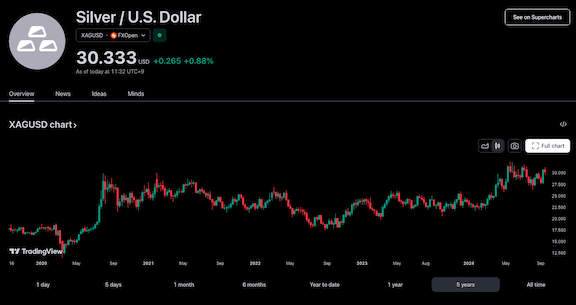
Three assets that are a hot topic in this new environment are gold, silver and bitcoin. It’s funny because I remember these three getting a lot of attention four years ago. Granted, the post-Covid crash environment in 2020 was very different from today – for a start, the Fed funds rate was already at zero in September 2020. However, it’s interesting how things move in cycles. Gold is around all-time highs now and silver enthusiasts are clamouring for a breakout. It has a strong 2020 feel to me, so I thought I would take a look back and see what happened four years ago.

Observe the five-year charts:

As you can see, both gold and silver reacted quickly to the stimulus injection that followed the March 2020 Covid shock. Liquidity is generally good for hard assets. Bitcoin took longer to catch alight but when it did, the fireworks were spectacular as it took out the previous all-time high of $20k and then marched right on to $60k and then $69k in 2021. That move started at $6k at the end of March 2020 and BTC was still only $11k on 19 September 2020.

I like all three of these assets in the current environment, but I like one much more than the others.

Game time soon, anon.

Disclaimer: This should go without saying, but the information contained in this blog is not investment advice, or an incentive to invest, and should not be considered as such. This is for information only.
Lock in

I hope you are enjoying Obon and the summer holiday. After a market crash and a Nankai Trough earthquake warning, things feel a little calmer this week. Hopefully, there won’t be any more ‘big events’ in August other than the local matsuri.

However, September is approaching and it feels like that will be the time to get locked in and focused. So here are a few thoughts as we speed into the last four months of the year!

US markets

There is a slew of economic data coming out of America this week, with the Producer Price Index (PPI) coming in a little softer than expected last night. CPI is tonight and another soft print will heighten expectations of a Fed rate cut in September. Toys will be thrown if Chair Powell does not deliver, but I’m also becoming a little more cautious about the outlook for stocks if he does go ahead and cut. History favours a recession scenario at the end of a hiking cycle. A lot of effort has gone into the soft landing narrative, so we should be on our guard. No reason to make adjustments to long-term investments but things rarely go as smoothly as the crowd expects.

That said, the completion of the US election will remove a lot of uncertainty, regardless of who wins.

Yen / Japan stocks

After starting August with a bang, the Bank of Japan has swiftly backed down from any plan to raise rates again this year. They got as far as 0.25% and the stock market melted down. They didn’t even get to the bond market jitters part of the project. I would love to hear from anyone who can explain how the BOJ will go about a meaningful tightening from here. Imagine what rates at 0.5% would look like. How about 1%?

I just saw a Bloomberg headline that said that PM Kishida is stepping down in favour of a leader who is supportive of the central bank’s efforts to normalise policy. Best of luck to whoever picks up that poison chalice!

Let’s just call BS, shall we? You can’t normalise a ponzi.

Nonetheless, if the Fed does begin to cut, the yen should strengthen. I don’t know how far it will get. 130? 120? 100? It doesn’t matter, because once that cycle is over it is only going the other way. You can save the bond market or the currency and no one is sacrificing the bond market.

I have said it before but I’m nothing if not a broken record: if you are going to spend your future money outside of Japan, you should forget about those alluringly cheap Japanese value stocks and get your money out of yen and into your base currency while you have the opportunity.

If you are here for the long haul, by all means, have at it. In the shorter term, Japanese stocks should do ok and I would even be tempted to look for names that will benefit from a stronger yen. Exporters that did well under the weak yen don’t seem such a great idea going forward.

Getting hard

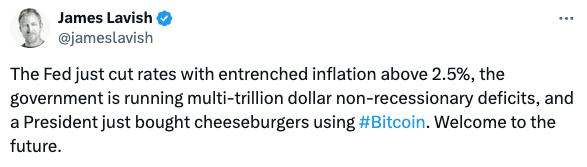
With the US election looming, the cynical among us would be watching out for a liquidity boost to pump up the US stock market. Rather than the Fed, we should probably be looking at the treasury to provide the liquid refreshment. This ‘Bad Gurl Yellen’ piece by Arthur Hayes goes deep into the fountain of liquidity that is about to spring forth. In short, the treasury needs to lower the debt-to-GDP ratio, and it will do so by issuing yet more debt.

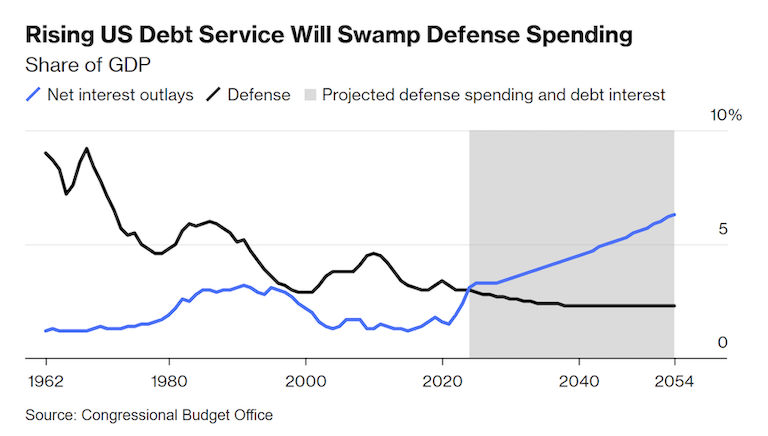
The Congressional Budget Office projects that interest payments on America’s debt will total $892 billion in fiscal 2024 and rise significantly in the next decade.

If you are wondering what that looks like, get a load of this chart:

Tell me you’re gonna print more money without saying you’re gonna print more money…

I wrote about currency debasement and and how to protect yourself in Harden up your assets! If you are looking at stocks to plough your hard-earned money into right now, that’s one way to do it but maybe there is a better option.

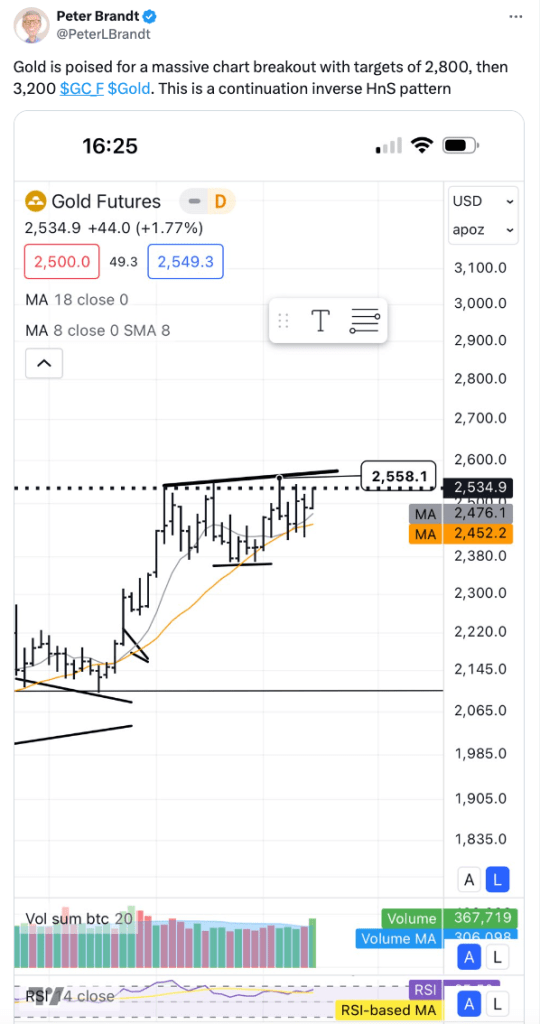
As you can see, some technical traders are getting excited about gold. JP Morgan agrees, arguing that the structural bull market remains intact and forecasting an average price of $2,500 in Q4 and $2,600 in 2025. Geopolitical tensions, rate cut expectations, central bank buying and ETF flows all point to elevated gold prices – report here.

Of course, those are short-term targets and the real point of owning gold is to protect against currency debasement over time. Remember, this is what you’re up against:

Digital gold

Ever the broken record, allow me to point out once more that the boring phase of the Bitcoin bull market is drawing to a close. We probably bounce around for a few more weeks, maybe even a couple of months. The timing is difficult to predict but I expect significantly higher prices by the end of the year. And more to come in 2025. If you are thinking of getting on the train, you don’t have long left…

Despite a reshuffle of the Democratic nominee, pretty much everything I wrote in the Bitcoin bull market update still stands. All aboard!

If you are still trying to get your head around the hardest asset on the planet, the presentations from Michael Saylor’s keynotes are a great resource.

Don’t say I didn’t warn you!

Disclaimer: This should go without saying, but the information contained in this blog is not investment advice, or an incentive to invest, and should not be considered as such. This is for information only.

Buckle up!

It’s the 1st of August. The two big central bank decisions are behind us and summer is in full swing. So what comes next? Where will markets be at the end of this year? Nobody knows the answer to that question but I can almost guarantee you one thing: there is turbulence ahead.

Just like Japanese summer, the volatility already got started in July. However, we seem to have entered a new phase and central banks are the main drivers of the momentum shift.

Having hiked rates to levels unseen in 15 years, there is little doubt that the BOJ has entered a tightening cycle. Governor Ueda did not rule out another hike this year and the yen responded quickly to his comments, rising to 150 against the dollar. Today it is trading at around 149. Weston Nakamura sees 152 as the most important price level in global macro right now and we are already well beyond it.

Japanese stocks reacted positively to yesterday’s decision, pumping across the board. However, the Nikkei 225 index slumped -2.5% today as exporters felt the pinch of a stronger yen.

US tech investors rotate into small caps

In the US, Fed chair Powell left rates unchanged while hinting that he is getting closer to a cut. The market fully expects this to happen in September and there will be visible disappointment in people’s brokerage accounts if it doesn’t. Volatility is already rearing its head. Tech stocks have sold off over the past month amid fears that the AI bubble might be bursting. Nvidia has been trending down from its 6 June high of $140.76 and a -7% dump on 29 July seemed ominous, but last night it pumped +12.7% after AMD’s better-than-expected earnings release. Go figure…

Hats off to strategist Tom Lee for calling the rotation into small caps. IWM has been the main beneficiary of the tech selloff.

The crypto coaster rolls on

Not to be outdone by chipmakers, crypto remains unpredictable over short time frames. At the Bitcoin conference in Nashville last week, none other than Donald Trump showed up to play to the crowd. His list of “promises” included: keeping the Bitcoin the US government has seized as a strategic reserve, (yes, wow!) firing Gary Gensler on day 1, ending the democrat’s war on crypto and making the US a leader in mining.

The air quotes around “promises” don’t need much explanation. Trump has zero interest in crypto and is plainly exploiting the dem’s antagonistic stance toward the industry for votes. But don’t let that distract you from the bigger picture: governments are examining Bitcoin as a strategic hedge against their own money-printing excess. The fact that this conversation is even happening is remarkable. Bitcoin game theory is going to get very interesting in the months and years ahead.

Bitcoin is back in the $64,000 range today, as it appears that the Biden/Harris camp may be selling off the reserve that Trump promised to keep. It’s never boring. See my Bitcoin bull market update for more.

Meanwhile, investors in Japan received a lesson in FOMO from Bitcoin proxy Metaplanet Inc. this week. Shares went on a tear after the company announced its Bitcoin treasury strategy in April and many people piled in late. Now the stock is coming back down to earth with a bang as the excitement wears off. Shares are down over -70% from their 24 July high and the move down doesn’t look done yet. Of course, every man and his dog wanted the stock when it was skyrocketing and nobody is interested now. There’s a clear lesson there. That said, I wouldn’t be surprised if Metaplanet makes another run if/when Bitcoin makes a decisive break above its previous all-time high and enters the parabolic phase of the cycle. Timing is everything in narrative-driven trades.

So, what to do?

I have noticed an uptick in clients trying to position and trade some of these macro moves, particularly the USD/JPY angle. The problem with access to unlimited information, content and opinion is the urge to react to it and do something. So here’s my two cents:

The summer, and perhaps the rest of the year, will see some turbulence. Volatility goes both up and down. Overall, the backdrop keeps me optimistic. Rate cuts in the US are coming – it’s just a question of when. As things currently stand, it would not be a panic cut, which is constructive for risk assets. US stocks, gold and crypto should react accordingly. Regardless of who wins, the US election will remove a lot of uncertainty. If you are broadly diversified, you could do a lot worse than fastening your seatbelt and taking a nap for a while.

If the BOJ is tightening and the Fed is loosening, the yen should continue to strengthen. This is going to put some strain on export-related Japanese stocks and the market as a whole looks more unpredictable than the US. Governor Ueda said he doesn’t think the rate hike will damage the Japanese economy. He’s probably right for now, but let’s see what kind of toll a series of hikes will take. The last time the BOJ tried to hike was 2007/2008 and that move was reversed in a hurry…

If you have been waiting for your chance to escape JPY and get into your base currency, that window is opening. Don’t miss it – long term it does not look good for the yen.

Stay hydrated folks!

Disclaimer: This should go without saying, but the information contained in this blog is not investment advice, or an incentive to invest, and should not be considered as such. This is for information only.

Gradually, then suddenly

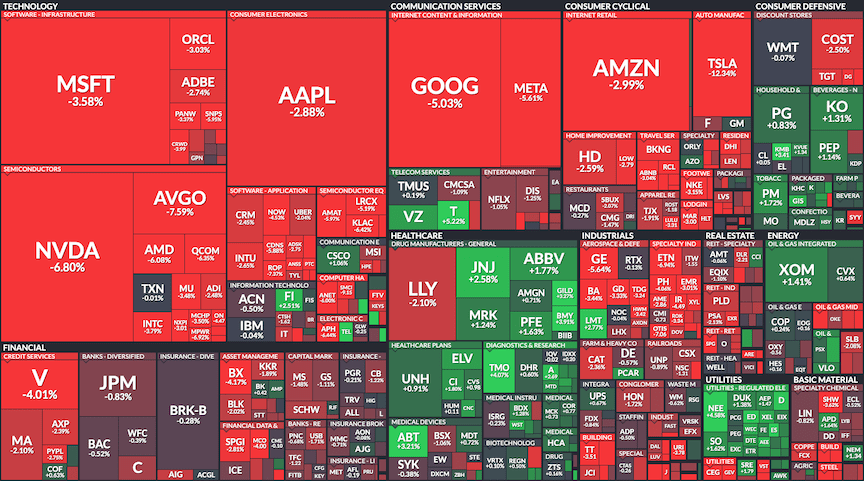
After showing signs of wobbling the last few weeks, US markets slumped on 24 July with big tech shares leading the move down. Tesla Inc (TSLA) fell -12.3% after a Q2 earnings miss while Alphabet Inc (GOOGL) dropped -5% despite beating earnings expectations. That was enough to trigger an avalanche and the NASDAQ ended -3.6% lower and the S&P 500 endured its worst day since 15 December 2022, falling -2.2%.

Correction territory

Japanese shares followed the US market down, with the Nikkei 225 index falling -3.3% today as exporters laboured under a strengthening yen. The benchmark index peaked on 11 July at ¥42,426 and has trended downwards since then. It turns out that I wasn’t imagining things when I asked Are we shaking? at the end of June.

Investors will now be wondering if this is simply a healthy correction after a big run-up or the start of a larger move downwards. It is too early to begin talking about a bear market but we are certainly in correction territory. A correction is defined as a fall of -10% from a recent high and the Nikkei closed today down -10.7% from the 11 July peak.

At 3pm today, USD/JPY was trading at ¥152.7. The current rebound in the yen is being driven by expectations that the Bank of Japan will raise rates at its policy meeting next week. In addition, the US Federal Reserve appears to be moving in the direction of rate cuts starting in September. A sustained sell-off in stocks may well need confirmation of rate cuts in order to stabilise.

Semiconductor stocks fall hard, Lawson delisted

Semiconductor-related stocks are bearing the brunt of the current selloff with Disco Corporation (6146) falling for seven straight days. Disco fell a further -4% today to close at ¥46,850, well off its peak of ¥68,850 set on 11 July.

In other news, convenience store operator Lawson Inc. was delisted from the TSE on 24 July following a successful tender offer from KDDI Corp. KDDI will partner with Lawson’s parent company, Mitsubishi Corp to take the company private.

A stock to watch

Crypto followed the trend in traditional markets with Bitcoin falling to around the $64,200 mark. Ethereum is down around -8% despite the successful launch of the Ethereum ETFs in the US on 23 July. 

Meanwhile, Japanese Bitcoin proxy Metaplanet Inc. (3350) has been on a wild ride. The stock has risen more than +1,100% since the company announced its Bitcoin treasury strategy in early April. However, the FOMO really kicked in this week with shares accelerating to ¥300 on 24 July. Metaplanet is back trading around ¥220 today but is still a stock to watch as investors try to front-run the potential decisive break of Bitcoin’s all-time high in the coming months. 

It seems likely that traders view Metaplanet as a tax-efficient way to gain exposure to Bitcoin price moves. Crypto in Japan is taxed as miscellaneous income, whereas stocks are taxed as capital gains.

Disclaimer: This should go without saying, but the information contained in this blog is not investment advice, or an incentive to invest, and should not be considered as such. This is for information only.

We’re so back!

The all-time highs keep coming. On Monday 9 July, the Nikkei 225 index made its highest ever close at ¥41,580.17. Semiconductor-related stocks led the way, while other notable movers included Hitachi Ltd (6501) and Fujikura Ltd (5803).

Not to be outdone, the S&P 500 and NASDAQ Composite also closed at record highs on 9 July. Gains were heavily weighted to big tech stocks as the AI narrative continues to drive market sentiment. Fed Chair Jerome Powell stuck to the script during his first day of testimony, reiterating that the Fed’s objective is to cool the economy and progress towards the 2% inflation target without cooling it too much. Market consensus continues to favour a soft landing scenario, with one or two rate cuts expected later this year. CPI data is due on Thursday and if that comes in line with expectations, the positive mood should continue.

Meanwhile, Tesla Inc (TSLA) continued its rebound, closing higher for the 10th consecutive day.

Japan’s real wages fall again, BOJ discussing cuts in bond purchases

Despite the good times in the stock market, much of Japan’s economy still looks relatively weak. Real wages fell by 1.4% in May, marking a record 26th month in decline. Wages are actually rising at the fastest pace in 31 years, but the increases are being offset by inflation, meaning households have less purchasing power.

USD/JPY is trading around ¥161.47 with no end to yen weakness in sight.

This week sees the Bank of Japan meeting with major market players to discuss the tapering of the central bank’s bond purchases. Some market participants are calling on the BOJ to cut bond purchases in half while others favour a more gradual reduction. The final plan is expected to be revealed at the BOJ’s end-of-July meeting.

Semiconductor shares remain strong, Hitachi and Fujikura impress

Chip stocks are once more powering ahead with Advantest Corp (6857) and Tokyo Electron Ltd (8035) gaining +4.1% and +3.8% respectively on 9 July. Chip materials maker Resonac Holdings Corp (4004) announced that it will form a consortium with nine other Japanese and US firms to collaborate on the development of semiconductor technologies for generative AI. Resonac shares surged +8.7% on the news.

Hitachi shares jumped +5.2% on reports that the company is increasingly focused on improving shareholder returns. On 2 July, the electronics giant provided an update on the progress of its buyback of up to 21 million shares at a cost of up to ¥200 billion. The company is targeting a total return ratio of around 50%, including dividends and buybacks – that would be on an expected net profit of 600 billion this fiscal year. Hitachi shares are up +89% year-to-date.

Another big mover was Fujikura Ltd, which jumped +11.4% on 9 July. Fujikura is an electrical equipment manufacturer that develops a range of telecommunication system products, including devices for optical fibres. It appears that Fujikura’s surge was spurred by a 12% move by Corning Inc (GLW) on 8 July after the company revised its sales forecast upward. Fujikura gained a little more today and is now up +228% in 2024.

Japanese stocks rose again today with the Nikkei 225 closing at another record high of ¥41,831.99. Financial stocks were up again on hopes that higher interest rates would bring improved profits. Mitsubishi UFJ Financial Group (8306) has gained over +8% in the past month and almost +50% year-to-date.

Bitcoin also bounced back from its current correction somewhat, moving from around $57,000 to $59,000 despite an increase in market supply from Mt Gox and the German government. Bitcoin ETF flows were positive again and traders eagerly await the SEC decision on Ethereum ETFs.

Disclaimer: This should go without saying, but the information contained in this blog is not investment advice, or an incentive to invest, and should not be considered as such. This is for information only.

Number go up

Being a financial planner by trade, I try to organise our financial future as efficiently as possible without going overboard. My wife and I both work and we have a reasonable income. We have a plan, we know what our numbers are for later in life and the big events in between. Most of all, we are flexible in that plan – our core investments are set and forget, but they can be adjusted easily. The tactical stuff is fun for me and I see it as a bit of a challenge.

Of course, things can go wrong: ill health, accidents, economic change and shifts in specific industries. You prepare for these as best you can and get on with living. Eat well, exercise, look both ways crossing the street, buy insurance etc. etc.

However, there are a few bigger things that bother me. I don’t think about them all the time, but they lurk in the back of my mind. For example, I don’t think AI is going to take over my job, but it could change the world considerably – gotta keep up with developments there. I could classify these things as outliers and conspiracies. Some may or may not have a meaningful impact and others feel a little ‘out there’. The best conspiracy theories have an element of truth, though, don’t they?

So, here are a few things I think about and how they relate to money, investing and how big your number should be:

Climate

I must confess, I don’t allow myself to dwell on what we are doing to the planet. We are clearly having an adverse impact and most of the damage is being done by big business interests who will not stop. The paper straws are cute, but they are hardly going to offset the widespread burning of fossil fuels and other environmental destruction. It’s not that I don’t think it’s important – it’s crucial to our survival as a species. I just know there isn’t much I can do about it. I separate our garbage, cut down on plastic and try not to waste resources, but I’m not losing sleep. Half the people in the developed world don’t even believe climate change exists so good luck to us coming together and taking action as a species. Do you remember the Covid mask and vaccine debates?

It is certainly getting hotter though! And it’s hotter for longer than it was before. After 27 years in Japan, it’s noticeable how spring and autumn are shrinking while summer gets longer year by year. What’s that going to be like in 10 years? How about 20?

I hardly think Yokohama will become unlivable in our lifetime but it could become pretty unpleasant. Imagine Japanese summer from April to October! Would that change your planning? Could it mean your ‘number’ needs to be bigger? The ability to escape Kanto, and maybe even Japan, for several months a year could become a key lifestyle choice. Maybe some people will want to escape for good. Wouldn’t that mean that the cooler, more livable climates in the world are going to see an influx of people who can afford to move? Parts of India are already hitting 50°C as a matter of course. That kind of temperature is more manageable in the developed world with aircon but doesn’t higher demand for a cool place mean higher prices?

As we move from climate change to climate crisis, how are governments going to address it? Again, remember Covid? It was all the people’s fault that it was spreading. They had to be stopped from travelling and confined to their homes in some countries.

Climate lockdowns anyone? Do you think they won’t do it?

It’s a dark thought, but people with flexibility financially will fare better than those who are struggling for money. Does that change your number?

Japan’s economic decline

Honestly, this one would bother me more if I was younger. I’m not sure Japan is a place I would be trying to build a life, career or business given the demographics and the economic outlook if I was in my twenties. But I’m not that young any more and I’m happy where I am. I would, however, want my kids to have the opportunity to live and work overseas if they choose.

The yen is a major concern though. My view is that short term it should recover somewhat when America begins cutting rates. I can see it getting to ¥130 or even ¥120 in the next year or so. However, longer term I expect the yen to steadily lose ground, particularly against the dollar. I talked about it in my ‘How screwed is the yen?’ post a year and a half ago. Staying alert for opportunities to earn in other currencies, investing in a combination of domestic and overseas assets and accumulating Bitcoin remain priorities for me.

Financial shenanigans

Grab your tinfoil hats for this one! In simple terms, the money has been funny since the 2008 global financial crisis. A lot of institutions that should have died were propped up at the expense of taxpayers and we’ve been getting screwed ever since. Economies and big business have become addicted to liquidity: cheap money, low rates. Low interest rates foster inflation, which is a tax on us all, but especially a tax on people who do not own financial assets.

Countries have too much debt and are not producing enough to pay it back. Japan is perhaps the worst offender, at least in the developed world. The debt spiral is probably terminal. That’s why the yen is doomed, and after that so are the pound, the euro and the dollar. I covered currency debasement in ‘Harden up your assets.’ There are tools to fight it that need to be deployed. Otherwise, your money buys less and less.

This is why governments are getting interested in the idea of Central Bank Digital Currencies. (CBDCs) At some point, they are going to need to perform a reset and substitute the current failing money with an alternative. And the powers that be never want to waste an opportunity to seize more control.

In essence, CBDCs are just another form of fiat money. But they come with a whole new opportunity for manipulation. Here’s an interesting video of Rishi Sunak being asked how he would enforce national service in the UK:

Controlling ‘access to finance’ is a government wet dream and CBDCs will make it easy. If you think that the possibility of losing permanent residence due to unpaid taxes is bad, wait until they freeze your bank account or apply a negative interest rate to your money until you pay up.

The public is sleepwalking into this one. You can already imagine how half the population won’t have any issue with it at all. ‘If you don’t have anything to hide, why would you need to keep your money private?’ will be the refrain. People who are well off have no concept of how less fortunate people can run into money trouble and fall behind on bills and taxes. The rich just don’t want to pay for a bunch of ‘layabouts and immigrants’.

The Bank of Japan already has a page on its website about Central Bank Digital Currency by the way. Cute, huh? No plans to implement it at present, but they are looking into it…

CBDC is one thing I think is really worth fighting against, but it will most likely be a losing battle. Sooner or later some crisis will come along and CBDC will have to be implemented ‘for our protection’. You can already see it happening with the AML/CFT mission creep.

Call me crazy, but I think that accumulating Bitcoin and other crypto is the best we can do to prepare for what is coming. Any money sitting in the fiat system will be caught in the net. In many countries, people who want to withdraw a few thousand dollars in cash already have to explain to the bank what they are planning to do with it.

Assuming the number will go up

So there it is. Like you didn’t have enough to worry about! From a financial planning perspective, my take on this is that whatever your number is, you will probably need more.

That’s to say, whatever amount of money you think will be enough to secure your future, maybe add another 10-20% for safety.

This is why I recommend dividing investments into core/strategic and satellite/tactical. The long-term strategic investments are focused on hitting the number. The tactical assets are aiming for a little extra. The crypto holdings are a shot at f**k you money.

Number go up. Act accordingly.

Disclaimer: This should go without saying, but the information contained in this blog is not investment advice, or an incentive to invest, and should not be considered as such. This is for information only.
Are we shaking?

Anyone who has lived in Japan for a while knows the feeling: a faint tremor, something moving in your peripherals, like the train next to yours slowly pulling away and you’re not sure which carriage is moving. You look up at your partner/friend/co-worker…

Are we shaking?

Earthquakes are not always so subtle of course. Sometimes that faint rumble becomes something bigger. And sometimes, it’s just a heavy truck passing by outside.

Did you feel that? Maybe it was just me? Of course, the market is not just one stock but, if you had to pick a name that has driven US markets to new highs this year, it would be Nvidia. Sure, your Apples and your Microsofts have been strong too, but nothing quite like this. And last week we finally saw a hint of weakness. It would hardly be the first dip this year – questions were asked in mid-February and again in mid-April. What we haven’t really seen is a broadening out of the stock rally into other industries. Charlie Bilello points out here that the top 5 holdings in the S&P 500 now make up 27% of the index, the highest concentration since 1980. He also notes here that the index’s P/E ratio moved above 25 last week, the highest level since Q1 2021.

So, the AI hype-driven tech boom (or is it a bubble?) is still the dominant narrative driving the US market. George Soros once said: ‘When I see a bubble forming, I rush to buy, adding fuel to the fire.’ This is precisely what less savvy investors do too. However, they are rarely as clever as Soros when it comes time to take profits and get out.

Pockets of recession

US economic data continues to come in better than expected. Certainly better than small businesses and low-income families are feeling at this point. To wildly misquote one of my favourite writers, William Gibson: ‘Recession is already here – it’s just not evenly distributed.’

This one-hour podcast with James Lavish is worth a listen if you want to get a better understanding of the impending US debt crisis. He talks about how pockets of recession are already forming, they just haven’t spread broadly across the economy yet.

Are Japanese stocks stalling?

Speaking of debt crises, how is Japan doing? USD/JPY is creeping ever closer to the ¥160 level. Rubbing salt into the wound, the US has just put Japan back on the currency manipulator watch list. This could all be solved by the Bank of Japan raising rates in a hurry but it’s the debt that makes that rather difficult. Bad demographics, sky-high debt to GDP and a doomed currency – good thing we choose to live here for the harmony and the mild weather, desho?

After a fantastic run, there are signs that Japanese stocks are stalling too. (are we shaking?) Foreign investors, who played a significant role in driving the market to post-bubble highs, have largely been unloading in the last couple of weeks in the face of lacklustre economic data and persistent yen weakness. The Bank of Japan can no longer be relied on to buy ETFs on down days either. Stocks take the stairs up but they’re known to take the elevator back down…

Meanwhile, the Norinchukin Bank has gotten itself into quite a pickle. The fishers, farmers and foresters cooperative was long US treasuries and, trying to be sensible, it was currency hedged. That meant it endured the two-year rout in US bonds without any of the benefit of the strong dollar when converting holdings back into yen. As a result, it is having to fire sale around $60 billion of its $310 billion in foreign assets and eat the loss. I have preached for some time that currency is the biggest risk most investors don’t know they are taking, but I never considered getting burned like this by being currency hedged – ouch!!!

To sell or not to sell?

This is beginning to sound like a terribly negative post, but it’s really just a reflection of my thoughts about taking some profit and de-risking for a while. Just to be clear here, I am talking about adjusting tactical or satellite holdings. I don’t see any reason to make any changes to my long-term core investments. I own US tech stocks and a range of Japanese stocks in my core portfolio and am happy to keep them. However, I also own some of these same assets tactically – that’s to say I bought them at an opportune time with a shorter time frame in mind. Those are the ones I am getting tempted to sell.

Everyone is a genius in a bull market. You will notice though, that no one wants to tell you when to sell. Except maybe the macro doomers, but they’ve been telling you to sell the whole time markets have been rising, so let’s leave them out of this. For sure, it is smart not to fight the trend, and in US tech and Japanese equities, the trend has been unmistakably upward. There is also the fear of leaving money on the table and looking silly if markets pump after what turned out to be a minor correction.

However, we are talking tactical and that means buy low, sell high. If you are yen base currency and you bought US tech stocks a couple of years ago, not only have you made nice gains in the stocks, but the weak yen has boosted your profits significantly. You could be forgiven for cashing out back to yen and taking the win. The same can be said if you got trapped in yen and instead bought Japanese stocks to counter inflation and the market then went off to the races. That’s a nice win too, but you have to sell before you take the victory lap.

The big question is, supposing you sell, what do you do with the money next? If you are going to spend it on a sports car or a nice holiday, good for you! But if you still have to worry about keeping pace with inflation and currency debasement, you are going to have to find a suitable home for it. Sitting in cash for a few months and then catching a big drop in markets would be ideal, but we are not playing on easy mode here.

These are the thoughts I have on a Monday afternoon with the Nikkei up +0.5% to ¥38,804 and US stock futures looking steady. Perhaps I’ll just sit on this one for a while. Doing nothing is frequently the smartest play, but did you feel that? Maybe we are shaking?

Disclaimer: This should go without saying, but the information contained in this blog is not investment advice, or an incentive to invest, and should not be considered as such. This is for information only.
Bond investing – a simple guide

Of the six main asset classes, the one that stands out as perhaps the least understood is bonds. Although most people have a general idea of what bonds are and how they fit in an investment portfolio, they are incredibly complex financial instruments and misconceptions abound. I frequently hear people wonder if there is even any need to own them. So, let’s take a look and see if we can get a clearer picture of how bonds work and why they are useful.

Why do bonds exist?

Bonds are used by governments and corporations to raise capital. If a government issues a bond, it is borrowing money from the public to finance itself. Companies issue bonds so that they can expand operations or fund new business ventures. So if you buy a bond, you are loaning a government or a corporation money.

The key components of bonds

  1. Issuer: bonds can be issued by governments or corporations. Each issuer carries a different level of credit risk, with bonds issued by developed world governments considered the safest. Bonds from issuers with a lower credit rating carry more risk of default and pay a higher yield to compensate for that risk.
  2. Coupon rate: this is the annual interest rate paid to bondholders, expressed as a percentage of the bond’s face value. (often referred to as par value) So a bond with a $1,000 face value and a 5% coupon rate pays $50 a year in interest.
  3. Maturity date: bonds have a specified maturity date when the issuer repays the bond’s face value to the bondholder. Maturities can range from a few months to several decades, influencing the bond’s risk and potential return. A 30-year bond is regarded as more risky than a 5-year bond as more factors can affect the issuer’s ability to repay the debt over longer periods.
  4. Market price: the price of a bond in the secondary market can fluctuate based on changes in interest rates, credit quality and market demand. If the bond’s market value is higher than its face value, it is trading at a premium. If it is lower than face value, it is trading at a discount.

Understanding bond prices

Bonds can be bought and sold on the secondary market after they are issued. A bond’s value in this market is determined by its price and yield. The key thing to understand is that a bond’s price moves inversely to its yield. A bond’s price reflects the value of the income it can provide. So, if interest rates are falling, the value of older bonds that were sold in a higher interest rate environment increases and their price goes up. In a rising interest rate environment, older bonds become less valuable as investors would rather buy newer bonds paying higher yields.

You can see this clearly in the performance of the above iShares TLT long-term treasury ETF. After the 2008 financial crisis, interest rates were kept low to stimulate economic recovery. Just as rates began to drift upwards, Covid happened and rates were slashed again. Bond prices increased significantly in this low interest rate environment and so the price of the ETF rose. When the Federal Reserve began raising interest rates in late 2021, bond prices fell heavily and continued to fall throughout the Fed’s tightening cycle, which is now nearing its end.

You could make a pretty strong argument that now is a good time to be buying a long-term treasury ETF like TLT. When the Fed begins cutting rates, bond prices will recover and investors will be able to capture capital gains along with income. 

Conversely, having held interest rates low for longer than most other developed countries, Japan is now in a rising interest rate environment as the Bank of Japan attempts to slow down inflation. This means the price of Japanese Government Bonds is likely to fall.

Why own bonds?

Investors may choose to own bonds for a range of reasons. Those reasons include:

  • Steady income – particularly applicable to retirees and investors who require income for other reasons
  • Capital preservation – if held to maturity, bonds issued by institutions with strong credit ratings come with a low risk of loss of capital
  • Portfolio diversification – bonds offer a good counterbalance to equity market volatility
  • Capital appreciation – as above, bond prices can appreciate when central banks are cutting interest rates
  • A hedge against economic downturn – in the US and Europe, inflation is cooling and economies are slowing. This means the income from bonds will be able to buy more goods and services, making bonds more attractive

How to buy bonds

For a typical retail investor, there is no need to buy individual bonds. Just like equities, investors can choose from a range of active or passive strategies offered by bond funds or bond ETFs. Generally, a passive ETF provides perfectly adequate exposure to bonds without any stress or hassle. For example, Blackrock’s iShares ETF series offers 135 different bond ETFs – more than enough to build a diversified bond allocation. The fixed income part of a well-diversified portfolio will generally contain a blend of shorter/medium/longer-term government bonds along with an allocation to more risky corporate and emerging market bonds.

Be sure to pay attention to your base currency when you build such a portfolio. If you are planning to spend the money in the UK eventually, you should be looking at UK Gilts as the core of your bond holdings rather than US treasuries. Don’t be afraid to engage professional help if you are not comfortable organising this yourself.

As to whether owning bonds is really necessary or not, that’s obviously an individual call to make. I would comment that if you are young and just getting started with investing a little money every month, averaging 100% into equity ETFs is a perfectly acceptable strategy for the first few years.

However, after you have been investing for some time and have built up a larger pool of capital, it is probably time to start thinking about diversifying into other asset classes to protect against sharp drawdowns in equity markets. Bonds become a useful tool as you shift from an aggressive capital accumulation strategy to a more balanced portfolio that offers growth and income with a degree of capital preservation.

Hopefully, this post goes some way to explaining what bonds are, how they work and the benefits of investing in them. Feel free to comment or send questions any time!

Disclaimer: This should go without saying, but the information contained in this blog is not investment advice, or an incentive to invest, and should not be considered as such. This is for information only.
All-time highs!

I spent the last year and a half writing financial content for a broker. I enjoyed the experience immensely and learned a lot in the process. Unfortunately, the contract ended, but I now have 10-12 hours a week that have been returned to me. So, readers of this blog may notice some extra market commentary/analysis being posted here. I hope it is useful.

It’s central bank week, with both the Federal Reserve (Fed) and the Bank of Japan (BOJ) conducting their policy meetings. As expected, the Fed held rates steady at 5.25-5.5% while CPI came in marginally cooler than expected. The Fed was surprisingly hawkish, forecasting just one rate cut in 2024.

Some think the BOJ may actually tighten at their meeting. If they do, it will likely be a minor adjustment. There will certainly be discussion about reducing the purchase of government bonds.

USD/JPY is currently trading close to the ¥157 level. With no major change in the US/Japan interest rate differential, we can expect the yen to remain weak for some time.

US markets hit all-time highs

In the US, the S&P 500 and the NASDAQ hit fresh all-time highs overnight. Apple Inc (AAPL) rose again after jumping +7.3% on 11 June when it unveiled a range of AI-enabled features and software for its devices. Apple overtook Microsoft Corporation (MSFT) to once more become the world’s most valuable company. Apple’s market cap now stands at a staggering $3.27 trillion.

Oracle Corporation (ORCL) surged +13.3% after the cloud technology company announced two new partnerships with OpenAI and Google Cloud while also forecasting strong revenue growth in fiscal 2025. Broadcom Inc (AVGO) jumped +14.6% after hours on strong earnings and a big stock split.

TDK and Hitachi set new highs since listing

Japanese stocks are largely in wait-and-see mode as the BOJ meeting kicks off today. TDK Corp (6762) has set another new high since listing as electronic parts stocks related to Apple are bought up. TDK announced in December that it will manufacture lithium-ion battery cells for iPhones in India.

Hitachi Ltd (6501) also hit a new high since listing of ¥17,340 on 11 June. On 7 June, its subsidiary, Hitachi Energy announced that it will invest $4.5 billion to increase production of power transmission and distribution equipment by 2027. Hitachi shares have cooled a little in the last couple of days, despite the announcement of plans to invest ¥300 billion in generative AI in fiscal 2025.

At lunchtime on 13 June the Nikkei 225 index is up slightly to ¥38,831.

Crypto stocks rise

Bitcoin, being the quickest asset to react to economic data and central bank policy, fell the day before the CPI data release and immediately bounced when the numbers came in soft. At the time of writing BTC is trading at around the $68,000 mark. Crypto stocks fared well with both Microstrategy Inc (MSTR) and Marathon Digital Holdings Inc (MARA) up overnight. Meanwhile, in Japan, Metaplanet Inc (3350) announced the purchase of an additional 23.35 Bitcoin on 11 June. The company now holds 141.07 Bitcoins, acquired at an average price of ¥10,278,391 per coin. Shares are up +494% since Metaplanet announced the adoption of Bitcoin as its core treasury asset on 8 April.

Disclaimer: This should go without saying, but the information contained in this blog is not investment advice, or an incentive to invest, and should not be considered as such. This is for information only.