
Is offshore investing still relevant?

As you may know, I have worked as an independent financial adviser for many years. I first got involved in this business in 2002, and the world has changed drastically since then. Some of the financial products that were popular at that time are almost obsolete now. So, is offshore investing over? Or is it still something worth considering for the right person?

A note here: I have never used this blog to promote offshore products, and that is not my intent here. However, I’m probably as qualified as anyone to discuss this topic, so here we go!

Much has changed

In 2002, if you were an expat in Japan, earning good money and looking for a way to invest, your options were fairly limited. Opening an investment account in Japan was not something many people considered. Along with the obvious language barrier when it came to reading product information, opening an account would involve meeting with a broker from a Japanese securities company and going through their sales process. If you think offshore advisers had a bad reputation, local securities company salesmen were not much better – they were well known for heartily recommending whatever was booming at the time and throwing their clients in at the chuffing top of the market.

Therefore, speaking to a British guy in a suit and cufflinks and investing in the Isle of Man was usually a more palatable option. Of course, these guys operated on commission, and some of them did not have your best interests at heart. Buyer beware! Many people got duped into long-term savings plans they didn’t understand.

To be fair, some of these people partly deserved what they got. All these offshore products had terms and conditions readily available in English. You just had to get a copy and read them! Plenty of people managed to ask questions, read the documents and invest in a product that they actually understood.

These days, investing in Japan could not be simpler. Go online, choose a brokerage, fill in the initial online form (with your name in half-width katakana hahahahahaha!) and then post off copies of your residence card/My Number card. You can have a brokerage account and a tax-free NISA set up in a couple of weeks.

So, is offshore investing dead?

Other advisers may have different mileage, but from my perspective, the demand for offshore products is certainly down significantly. I attribute this to two factors: getting a low-cost brokerage account is very easy, and nobody wants to pay for anything these days.

Not that avoiding high fees on investments is a bad thing. It’s one of the simplest things you can do to improve your returns. However, when offshore advisory is done well, you are not necessarily paying a lot for the product. Lump sum investment products in particular have very flexible fee structures, and a good adviser will be reducing their initial commission and taking an annual management fee for servicing you and providing ongoing advice.

Of course, much depends on your country of origin, how long you plan to spend in Japan and where you will go next. Offshore isn’t a great fit for everyone. (Americans in particular, take note. NISA isn’t necessarily a great fit for you either, and you are likely better off getting US-specific advice and investing in US-based accounts.)

Here’s a simplified view of how I see the steps to allocate money:

  • Make sure you have an emergency cash reserve
  • Fill up anything tax advantaged first – in Japan, that would be NISA, iDeCo
  • Any money over and above that is up for consideration – it could be invested in a taxable Japan brokerage account, an international brokerage account like Interactive Brokers, or offshore.

Again, a lot depends on nationality and personal situation, so no advice here, but some of the benefits of offshore get overlooked in the relentless pursuit of low fees.

I will leave the offshore regular savings plans out of this, as they are somewhat outdated. But many people, including myself, still have plans set up years ago, and that’s fine.

The offshore portfolio bond is for larger lump sum investments. It’s essentially an insurance structure; the individual owns the policy, and the policy owns the assets. It is open architecture so policyholders can access ETFs, mutual funds and individual stocks. For Japan residents, you are not required to report capital gains and dividends within these policies as they occur. You report when you exit the policy and pay a one-time tax payment (一時所得) of around 20% of gains. E.g. You invest $100k and the policy grows to $200k – you cash out the policy and owe approximately $20k.

So you effectively get gross roll-up inside the policy. You can switch investments and take profits as much as you like without triggering a taxable event. For some people, that alone is worth the fees.

If you leave Japan, you just take it with you, and when you cash out, you may end up owing nothing here. Of course, some people may have to factor in the exit tax and the lookback, etc. It depends on amounts and timeframes.

Use of trusts

The other thing you can do with offshore insurance products is put them in a trust. Trusts can be very effective for estate planning, particularly for, but not limited to, British nationals.

In the case of Isle of Man assets, probate will be required on the death of the last policyholder before proceeds can be paid out of the plan. Placing the policy in trust avoids this lengthy and often frustrating process, allowing money to be paid out quickly to the beneficiaries.

Trusts allow the donor to maintain a degree of control over the assets and, in some cases, to have limited access to the capital. A discretionary trust, for example, can instruct the trustees to hold the assets until the beneficiaries reach a certain age before distributing the proceeds to them.

For individuals who are treated as UK long-term residents, a trust is an effective way to shield assets from UK inheritance tax. Trusts are also worth considering for anyone who plans to become a UK long-term resident in the future.

A note here: trusts will not help you to mitigate Japanese inheritance tax. Japanese tax authorities do not recognise foreign trusts and generally look through them and tax the assets. If Japanese inheritance tax is a concern, you should first do your own reading and then discuss with a local tax professional before taking action. Reddit is an incredible resource, but you should not be taking personal tax advice from there.

If you have an offshore policy that you have been holding onto and perhaps do not know what to do with, it could be worth discussing with your adviser as to whether it would be better to put it into a trust. If you have lost contact with your advisor, you are welcome to contact me. I can also assist with general advice on whether it is better to keep the policy or cash it in and invest elsewhere.

In conclusion

Offshore investing is generally less relevant than it used to be. However, it is far from dead. In particular, high-net-worth individuals may find there are significant benefits to investing in a tax-free jurisdiction, and/or taking assets out of their own name.

For simple day-to-day investing for longer-term Japanese residents, NISA and iDeCo are incredibly hard to beat, and local brokerage accounts provide access to a wide range of assets. We are really spoiled these days. If you need help getting things organised, don’t forget that I offer fee-based personal finance coaching!

Top image by Clker-Free-Vector-Images from Pixabay

Disclaimer: This should go without saying, but the information contained in this blog is not investment advice, or an incentive to invest, and should not be considered as such. This is for information only.


Be uncorrelated

I keep seeing posts declaring the 60/40 portfolio dead. No sh*t, Sherlock! Markowitz’s Modern Portfolio Theory dates back to 1952. I learned that 60/40 was no longer relevant in 2005. Where the hell have you been?

In case you are not familiar with it, the 60/40 refers to the traditional portfolio strategy that allocates 60% to stocks and 40% to bonds. The stock part aims for long-term growth while the bonds smooth out the volatility in rough periods.

Markowitz advanced this idea by blending a range of assets to produce a more efficient portfolio, recognising that the typical investor wants reasonable returns without excessive risk. See my post on Asset Allocation for more on this.

Can’t I just long equities?

Yes, it’s perfectly acceptable to just average into one or two stock ETFs and hold them for the long term, especially if you’re young. In fact, you can do that and read no further – you don’t need any help!

However, if you believe in passive investing and market indexing, which many people do these days, you must understand that the market encompasses more than just stocks.

Also, if you are investing a significant amount of money, it’s unwise to be 100% invested in one asset class, unless you have specific knowledge and overwhelming conviction. (which, by definition, a passive investor does not)

What’s a lot of money then? Great question! It’s different for everyone, but let me put it this way: If you are a passive investor, 100% in stocks, and you are starting to get concerned about the damage a market crash could do to your net worth, you might be getting close!

The funny thing about the 60/40 idea is that young people these days are probably already allocated 60/40, but to tech stocks and crypto!

Yeah, crypto, so where does that fit in?

This question is doing the rounds. If crypto is a new asset class, then where does it fit in a diversified portfolio? How big should the allocation be?

I saw this article recently: Bigger bitcoin HODL: Time for 10% to 40% of portfolio in crypto, says financial advisor Ric Edelman

I was not familiar with Ric Edelman, but it turns out he is pretty much a superstar financial adviser – check out this clip:

We can argue all day about whether the allocation should be closer to 10% or 40%. It clearly depends on an individual’s situation, risk profile, level of conviction, etc. The notable thing about this article is how it mixes up the whole Bitcoin vs. crypto terminology.

It mentions Bitcoin to start, but then it refers to crypto. So you should be putting 10-40% of your portfolio in what exactly? Bitcoin ETFs? Cryptocurrencies? Which ones? It’s not very clear.

I mean, they’re all the same thing, right?

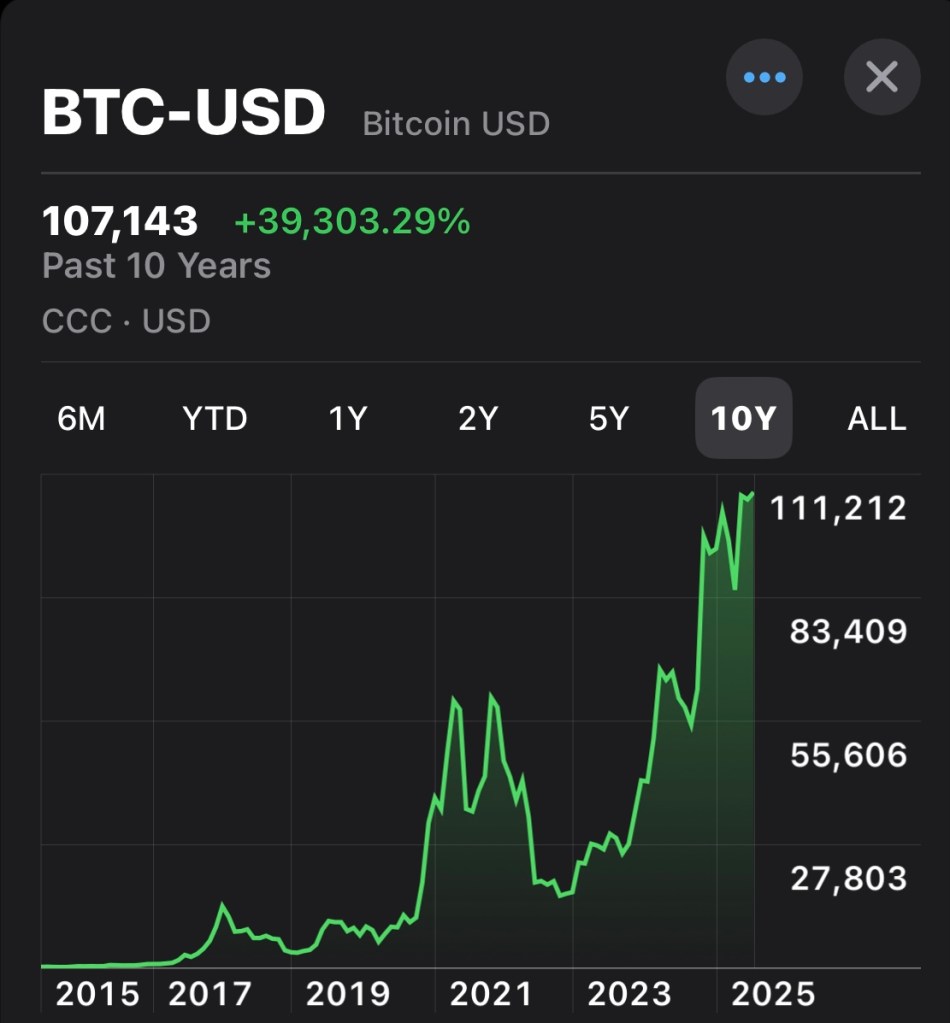
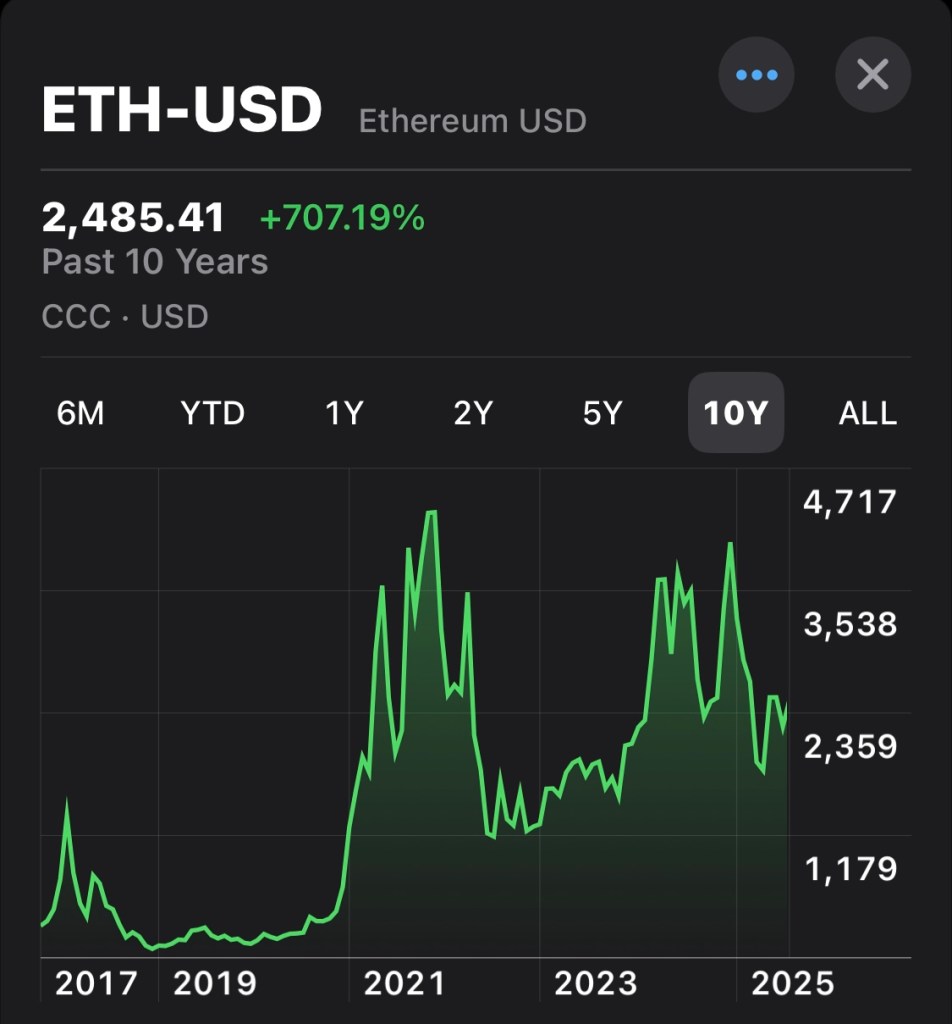
Not even close! And ETH is the second-largest digital asset. Think how many coins have gone to zero since 2017! In my opinion, if you’re going to allocate part of your portfolio to this asset class, you need to get smart about it.

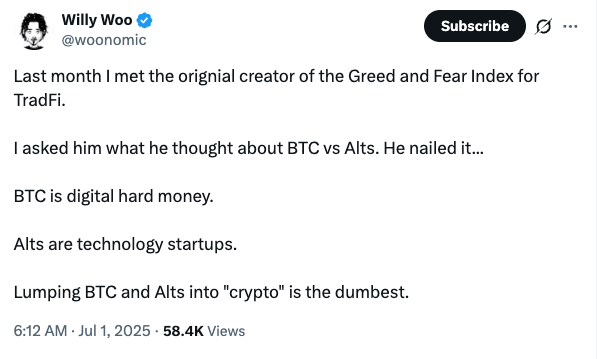
Here’s a pretty solid definition:

I’m not saying you can’t have mad conviction on a particular coin and hold it as an investment. If you have that level of certainty, then go for it. Hardcore XRP hodlers don’t care what I think, and they shouldn’t. They believe in the coin. But should the average investor put 10% of their net worth into it? Of course not!

The mainstream media are leading lambs to the slaughter if they can’t get their terminology straight.

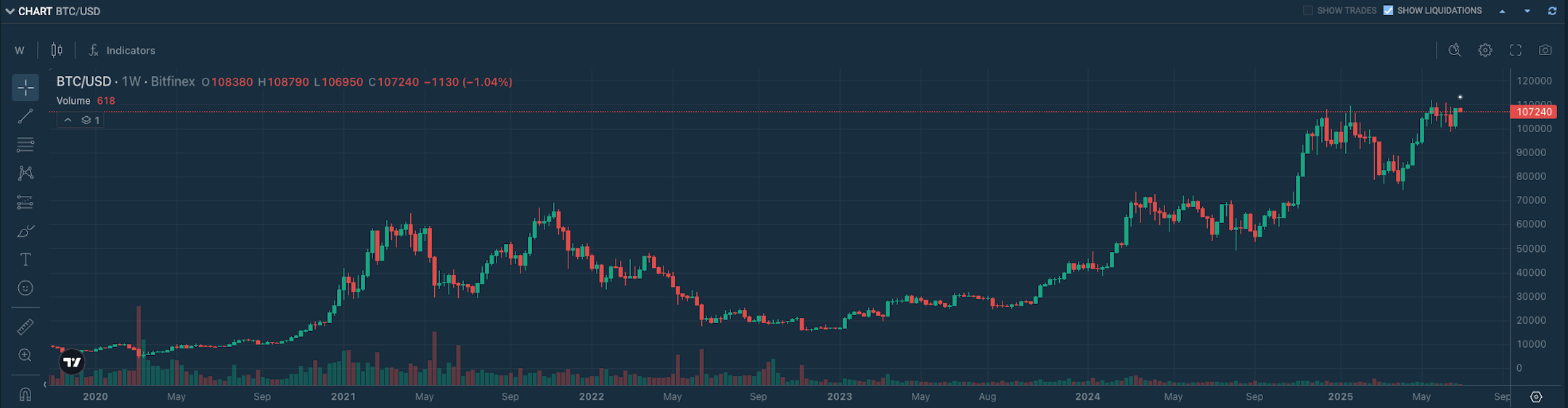
Here’s the only truly investable cryptoasset in my humble opinion. Doesn’t it look beautiful?

Uncorrelated assets for the win

The modern portfolio enhances 60/40 by adding assets that are uncorrelated or only lightly correlated to stocks and bonds. That’s how you achieve better risk-adjusted returns. (similar or better returns with less risk) Back in 2005, I never imagined a shiny new, uncorrelated asset would emerge. It really is a remarkable thing.

If you are interested in understanding how a modern diversified portfolio benefits from the addition of Bitcoin (and even other crypto), this report from 21shares is worth a read: Primer: Crypto assets included in a diversified portfolio – Q1 2025

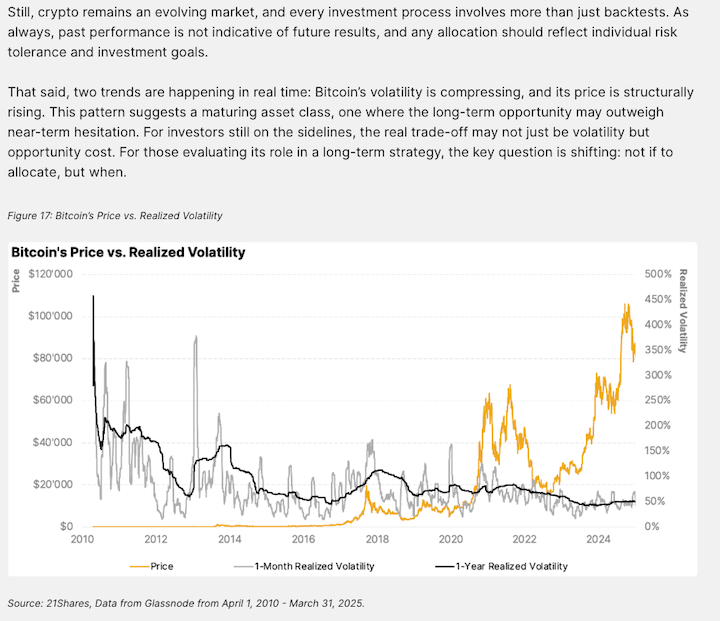
Here’s a quick summary: between April 2022 and March 2025, Bitcoin’s correlation to the rest of the asset universe was 36%. People like to compare Bitcoin to tech stocks, but its correlation to them was only 40%. These levels are significantly lower than traditional assets’ correlation to each other, which typically comes in at around 60-70%. This makes Bitcoin an ideal asset to add to a diversified portfolio in order to beef up returns without meaningfully increasing risk.

What makes Bitcoin especially interesting is how sometimes it behaves like a risk asset, like equities, and other times, it acts as a defensive asset, like gold. Over time, it is expected to become more of a gold-like store of value asset.

“This makes Bitcoin unlike any other asset in the market. It is structurally independent, behaviorally adaptive, and still offers significant asymmetric upside relative to legacy safe-haven assets. For portfolio construction, Bitcoin stands out as both a potential long-term hedge, and a high-impact diversifier at present.”

Adding a 1% allocation to Bitcoin to a modern portfolio over the 3 years resulted in stronger risk-adjusted returns. (It improved both cumulative returns and shape ratios)

Adding Bitcoin did not increase downside risk.

When scaling up to a 5% Bitcoin allocation, the risk-adjusted returns were even stronger, and the volatility remained manageable. Interestingly, they also tried a 3% allocation to the top 5 cryptoassets and achieved a similar uplift in performance without greatly increasing the risk.

So what’s the conclusion to be drawn here? You don’t have to go 40% into Bitcoin! Just a modest allocation increases portfolio efficiency without meaningfully increasing risk.

What are we trying to do again?

The whole point of investing is to beat inflation in your base currency. Doing it most efficiently with the least amount of risk is just being smart.

You can be overweight certain satellite holdings if you have a high level of conviction in them.

I still run a boring diversified portfolio, despite currently exceeding the recommended daily dosage of Bitcoin and Japanese stocks.

What’s my level of certainty?

Disclaimer: This should go without saying, but the information contained in this blog is not investment advice, or an incentive to invest, and should not be considered as such. This is for information only.

Facing inflation – the four assets you should own

Happy Friday! I thought I would provide a quick round-up of what is going on in markets. In case you missed it, here’s the most important five minutes of financial commentary I saw this week:

If you don’t know who PTJ is, here is his Wikipedia page. The Tldr is legendary trader and billionaire hedge fund manager.

The message here couldn’t be clearer: ‘All roads lead to inflation.’ Note the mention of Japan around the 4-minute mark. The playbook for how nations get themselves out of debt trouble is to inflate their way out. This is happening. Think what that means for your spending power. Think what it means for the yen…

So what assets does a guy like this own to face down the inflation threat? Bitcoin, gold, commodities and tech stocks. Hard assets and tech stocks. Simple.

I have had numerous conversations this past few weeks along the lines of ‘I want to own gold, but I feel like I’m too late.’ Yes, this is why I preach having the core of your assets in a diversified portfolio instead of just lumping it all into a global stock ETF. If you owned a diversified portfolio, you would have 3-5% in gold, and that part of your portfolio would be up +30% this year already. You wouldn’t have to scramble to buy some now.

This is an excerpt from a post I wrote in March 2023:

‘But global stocks have outperformed a diversified allocation over the last 12 months.’ – yes, there will be times when they will do that and there will be times when they won’t…

Here’s the simplest way I can put it: if you are young and in the process of accumulating wealth, then maybe a 100% stock allocation is ok. If you have already built up a nice nest egg, you need to think seriously about how to keep it. Spread the risk and sleep well at night.

When it comes to the satellite holdings, it’s pretty clear what needs to be beefed up right now: bitcoin, gold, commodities and tech stocks. You might already have commodities in your diversified portfolio, but with inflation looming, it’s time to get some more. Note that PTJ mentions how commodities are still under-owned.

Bitcoin is coiled

The Bitcoin four-year cycle is playing out exactly as expected and we are about to enter the fun phase.

The BTC ETFs are buying more BTC than is being mined every day. By a long way. Supply shock incoming. I don’t know how to explain it any more clearly.

If you are waiting around for a Japan Bitcoin ETF, I wouldn’t hold your breath – see this Financial Times article.

Meanwhile, Microsoft placed an ‘assessment on investing in Bitcoin’ on the voting ballot for its 10 December annual shareholder meeting. The Microsoft board recommends voting against the proposal, deeming it ‘unnecessary’ as the firm’s management ‘already carefully considers this topic’. This is a conversation that will take place in boardrooms of more and more major companies. Note here that Tesla still owns 9,720 BTC.

Gold breakout is happening now – are you really late?

Tesla leads big tech earnings

Tesla was the first Magnificent 7 company to report earnings this season and it got things off to a good start. The EV manufacturer’s stock just had its best day in the market in over a decade after reporting better-than-expected results. I understand why some people don’t like the CEO, but betting against his companies is a risky business. A +22% gain in a day is going to hurt some short sellers. More on upcoming Mag 7 earnings here.

That’s all I have for today. Wishing everyone a great weekend!

In summary, all roads lead to inflation. A core diversified portfolio and satellite holdings in bitcoin, gold, commodities and tech stocks is the best way to face down the threat to your purchasing power.

Top image by wirestock on Freepik

Disclaimer: This should go without saying, but the information contained in this blog is not investment advice, or an incentive to invest, and should not be considered as such. This is for information only.