
Japan ETFs for 2020


Screen Shot 2020-01-16 at 9.39.46 AM

Cheers everybody! I’ll have what they’re having!

Happy New Year! I wish you all health, wealth and happiness for 2020. Most of us are settled back into work now, and some of you may even be planning your investment strategy for the year to come. Perhaps you are considering how to allocate your NISA contributions, or just wondering how things will play out over the next 12 months? There is a lot of investment chatter around the Olympics of course, but it’s also interesting to note what Japan’s central bank is doing.

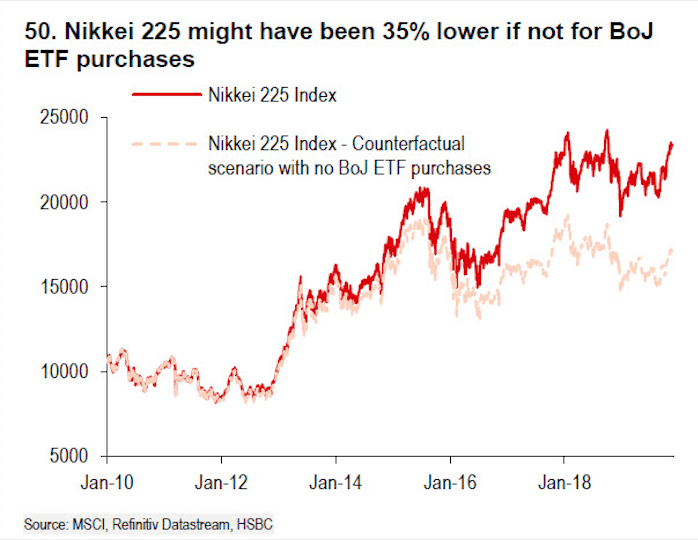
I saw the above chart on a tweet from Zerohedge towards year-end. It has been widely publicised that the Bank of Japan have been big buyers of Japan Exchange Traded Funds over the last three years, but what exactly are they buying? And if you were buying Japan stocks at this time, would that influence your choices?

It turns out that the BOJ don’t simply buy only the Nikkei or Topix indices. As part of their overall public policy, the BOJ send a message by focussing on stocks of companies that actively engage in capital and human resources investment. (see here) In order to encourage companies to invest in their people and long-term assets, the BOJ is willing to invest some 300 billion yen per year. (their actual purchases can be tracked here so you can keep an eye on whether they are still buying)

A big issue the BOJ face is that they are constrained to not purchase more than half of the market value of any one ETF. The rest should be held by private investors. There are only a handful of ETFs that fit the definition of capital / human resources investment ETFs and, as the Japanese public have been slow to wake up to the idea of investing in this area, it is hard for the BOJ to find anything big enough to allocate the whole 300 billion yen to.

What that means is, that if you invest in one of these ETF’s, you are effectively giving the central bank the ability to “match” your investment. Every ¥10,000 the public invest adds ¥10,000 to the capacity the Bank of Japan have to buy that same fund. That’s a pretty heavy hitter you’ll be investing alongside!

The following ETFs look like they would fit the investment criteria:

1479:JP Daiwa ETF MSCI Japan Human and Physical Investment Index

1484:JP One ETF JPX/S&P CAPEX & Human Capital Index

1480:JP Next Funds Nomura Enterprise Value Allocation Index

It’s also interesting to note what happens with the money that can’t be invested due to lack of capacity: It is allocated to a JPX-Nikkei 400 ETF. It turns out that companies in this index have been quick to wake up to the prospect of big investment from the BOJ and have been making an effort to increase capital and human resources investment, which then acts as a stimulus to the real economy.

So if you are a buyer of Japan stocks today, and I’m not saying you should or shouldn’t be, but if you were, wouldn’t you want to have some of what the BOJ are having?

Disclaimer: This should go without saying, but the information contained in this blog is not investment advice, or an incentive to invest, and should not be considered as such. This is for information only.

Which is the Best Performing Stock Market?

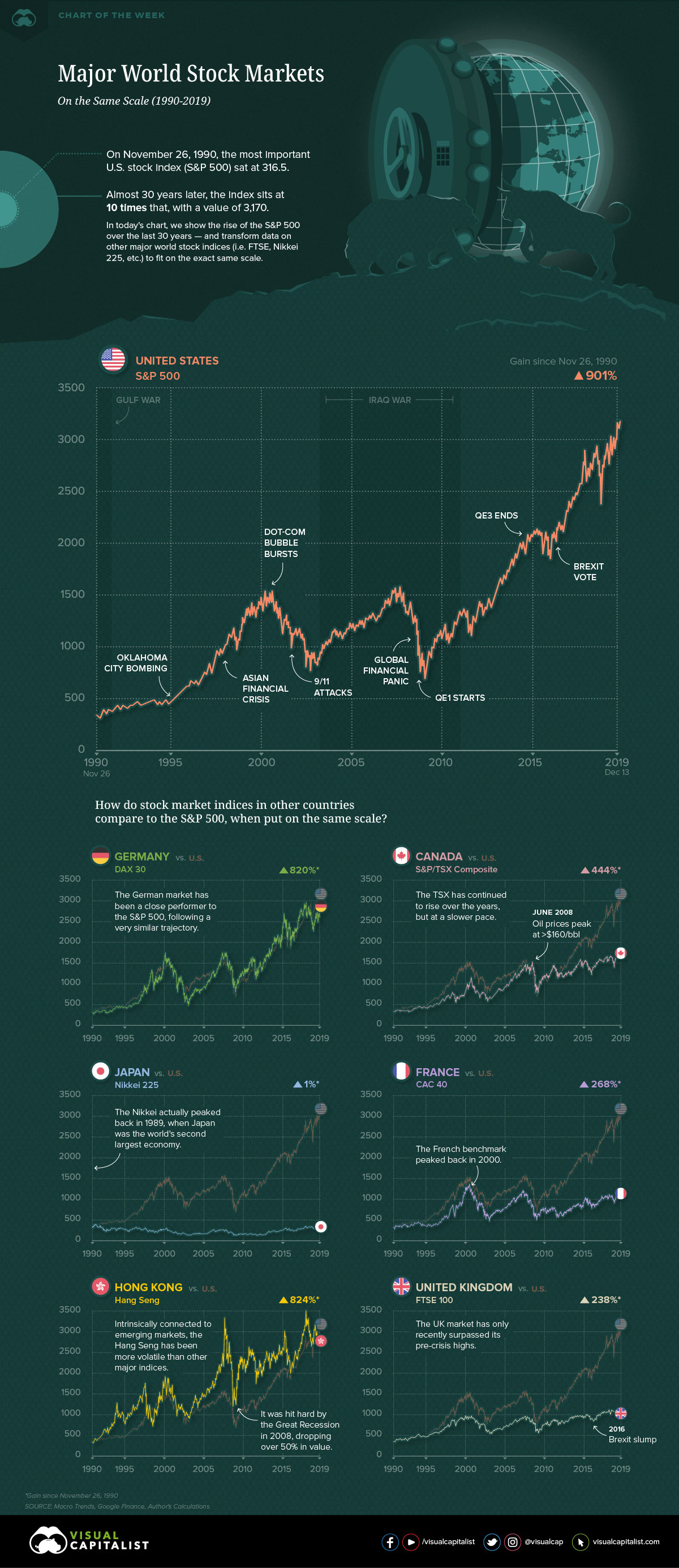
If you had allocated $100 to one of the major stock markets 30 years ago, what would it be worth today?

I first saw this chart today on Zerohedge, but the original article is by Jeff Desjardins on Visual Capitalist.

It’s quite fascinating to see seven major stock markets compared on the same scale in this way:

world-major-stock-markets-compared-sp500

And the final value of a $100 investment in each market after 30 years:

United States: $1,001

Hong Kong: $924

Germany: $920

Canada: $544

France: $368

United Kingdom: $338

Japan: $101

Despite the obvious takeaways that USA / HK / Germany were great markets to be invested in, while 1990 was a terrible time to only buy Japan, we should probably note the following when allocating to stocks:

  • Stay invested – despite some severe bumps in the road, stocks generally increase in value over time
  • Diversify – we don’t know which market will be best for the next 30 years so spread your money around
  • Be patient – achieving big numbers takes time

Disclaimer: This should go without saying, but the information contained in this blog is not investment advice, or an incentive to invest, and should not be considered as such. This is for information only.
What is the Bitcoin Halving?


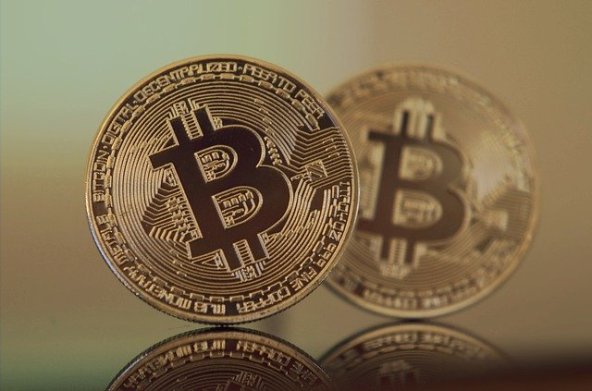
bitcoin-2868703_640

If you follow cryptocurrency, you may well have heard about the upcoming Bitcoin halving, or halvening. So, what on earth is a halvening and what could it mean for the price of BTC?

What is it? – The halving refers to the reward paid to miners being reduced in half. Miners add “blocks” to the blockchain by performing transactions. Currently they earn 12.5 Bitcoins for each block added, but that will reduce to 6.25 Bitcoins.

When will it happen? – One block is added to the Bitcoin blockchain roughly every 10 minutes. Halvings typically occur every four years or so and this will be the third halving to date. If nothing major changes it is due to take place in May 2020.

What effect will the halving have on the price of Bitcoin? – Well, nobody knows, but previous halvings have seen an increase in the price of Bitcoin. The simple theory goes that as supply is cut short, miners will charge a higher price for their Bitcoins. The number of Bitcoins to be mined is fixed at 21 million, so each cut in new supply makes Bitcoin more scarce, and therefore more valuable. However, past performance is no indicator of future results. Some commentators believe the halving is already priced in, while others are predicting a severe drop in price before the halving even takes place.

Here’s an interesting price chart showing the previous halving dates.

My view is that Bitcoin is worth accumulating whenever the price dips, as it will pay off in the long run. However, price volatility can be severe and cautious investors should, of course, be careful of overcommitting. Crypto investing is not for the faint hearted, but it will be interesting to watch what happens after May next year.

Disclaimer: This should go without saying, but the information contained in this blog is not investment advice, or an incentive to invest, and should not be considered as such. This is for information only.


International Health Insurance

doctor-1015624_640

If you live and work in Japan, you are probably quite satisfied with your health insurance coverage. The Japanese national health insurance system is super-efficient and covers 70% of medical costs. Unless you have a serious injury or illness, you are unlikely to get any nasty surprise medical bills.

This is how I’ve thought of my own health insurance until recently. I bought a little extra cover in case of an extended stay in hospital and figured I’m good.

Then a friend of mine got a critical illness. Without going into too much detail, the doctors in Japan told him to get his affairs in order, there’s nothing they can do. He then returned to his home country and found that actually there is an option to undergo immunotherapy. The cost, however, is around 2 million yen equivalent per month…

Thankfully, many years ago he took out some international health insurance with a UK insurance company. He faithfully paid his premiums for years and now, when he actually needs it, they have agreed to cover the full cost of his treatment.

I don’t think I need to spell this out much further. Google international health insurance, do a bit of research to find a policy that fits you, and sign up. If you are choosing from a well known provider the terms and costs are likely to be pretty similar. The one choice you will need to make is whether you want US cover or not.

You may pay your premiums for years and feel like you are wasting money. Hopefully you’ll never need the cover. However, like my friend, there may come a time when you will be glad you had it.

Pension Shortfall – Reality Sets In

senior-3336451_640.jpg

A recent report from the Financial Services agency is causing quite a stir in the Japanese media after it detailed a shortfall in pension provision for retirees. It’s estimated that a quarter of Japanese 60 year olds will live until 95 and will need an extra 20 million yen for a 30 year retirement. (article here)

Of course the Japanese are known for their world-leading life expectancy, but the issue highlights another Japanese trait: saving money in cash instead of investing. A news report I watched this morning estimates that the average Japanese family has over half of their assets in cash, which of course earns next to nothing in the bank and is eroded by creeping inflation. This unwillingness to take risk could come back to haunt them in later life as they age and run out of money.

The political leadership are adamantly defending the credibility of Japan’s public pension system, but the reality of a pension shortfall has been known for some time. It seems a little unfair to only now be telling an aging public that they need to invest more.

Certainly there is a lesson here for everyone: Improved lifestyle, technology and advances in healthcare mean many of us will live longer than we perhaps once thought. With a noticeable reduction in the number of defined benefit pensions these days, we all need to save and invest more for the future.

It’s particularly important for younger people to realise this now and not wait too long to get started saving for retirement. Here is a useful calculator to help you understand if you are looking at a retirement surplus or shortfall.

If you are looking at a potential shortfall, you may want to review this section on retirement planning.

Disclaimer: This should go without saying, but the information contained in this blog is not investment advice, or an incentive to invest, and should not be considered as such. This is for information only.

How to Get Rich (without getting lucky)

Naval

And now for something different… If you recognise the title of today’s post, you probably already follow Naval Ravikant. And if you don’t, I recommend checking out his work.

His tweetstorm on getting rich is pinned to his Twitter page, and has also been reproduced in pdf form here. There’s a lot of knowledge packed into a five minute read and I think I might be coming back to this again and again.

I’m not going to try to summarise Naval’s thoughts and work, because he is already incredibly concise. Check out his series of short podcasts on Youtube and you will see what I mean. You will also find more on his website here.

Enjoy!


Bitcoin – Are you Accumulating?

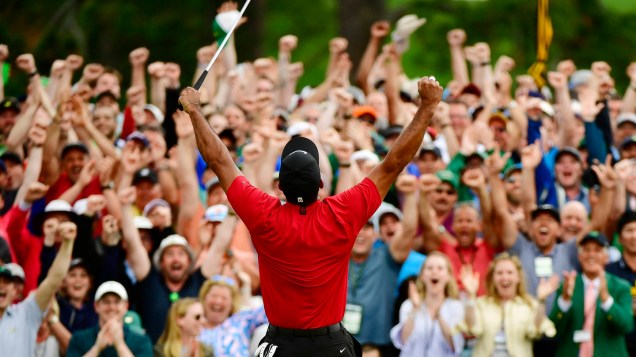
2019 Masters

After day two of the recent US Masters Golf, a friend of mine asked me who I thought he should bet on. My answer was somewhere along the lines of “My heart says Tiger, but my head says Molinari”. Shows where rational thinking can get you sometimes…

Luckily, when it comes to calls on a speculative asset like cryptocurrency, you don’t need my opinion to help decide if it’s worth a flutter. Tuur Demeester’s head and heart have been in Bitcoin for many years and he has been writing informative reports on the leading cryptocurrency since 2012. His latest report is here and I highly recommend you read it.

Although a little technical at times, the main points are quite clear:

  • Big investors (whales) are accumulating Bitcoin
  • We’ve seen this kind of bear market scenario before
  • Smart investors don’t try to buy the exact bottom, they accumulate when they know they are around it
  • Lower prices and shocks are still possible
  • Bitcoin expected to trade in a range of $3,000 – $6,500 before the next bull market breakout

Obviously I’m not saying you should be putting all of your savings into crypto, but given the potential for returns it’s worth considering a small allocation of money you can afford to take risk on.

Disclaimer: This should go without saying, but the information contained in this blog is not investment advice, or an incentive to invest, and should not be considered as such. This is for information only.

Financial News – Cut Out the Noise!

earmuffs-2755553_640

If you are a consumer of financial news, you will be used to seeing headlines like this: “The Dow added 141 points because recession fears are fading”. Well that sounds like great news doesn’t it? Onward and upward! Yet only two days ago it was “Dow plunges on recession fears”. So are we afraid of a recession or not? Is the market going up or down?

Of course, the market is going up and down. That’s what markets do. Most of what passes for financial news is just commentary on that particular day. It’s like listening to a report on how the weather was at the end of the day – not much use if you’re trying to figure out if it will be sunny for golf at the weekend…

But surely some of this stuff must be important? What should we be paying attention to and what is just noise? Well firstly, if you are a long term investor with a diversified portfolio that you rebalance at least annually, then almost all of this stuff is noise. It may be helpful if you are making tactical trades with a small portion of your assets, but talk of an inverted yield curve* should not be keeping you awake at night.

Of course I am not trying to discourage you from keeping an eye on what’s going on and trying to become a better investor. But if you want to keep your time spent on this stuff to a minimum, here are some simple tips:

  1. Understand the correlated assets and how they behave over time – here’s a basic guide to cash, bonds and equities.
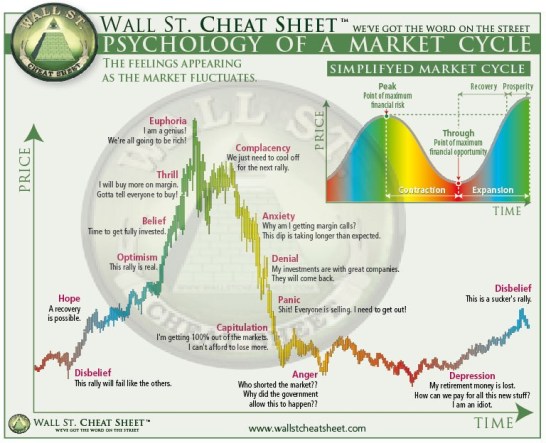
  2. Understand what stage of the stock market cycle we are in. Most people buy and sell at exactly the wrong time. If you don’t know where we are on the graph below, then how do you know when to be more aggressive or defensive?

Psychology-of-Market-Cycles

3. Know your benchmarks. In particular, know the rate of inflation in your base        currency. This is your key benchmark to compare investment performance to.

For most (non-finance) people, I think this is enough. If you understand how the main asset classes behave over time, what stage of the market cycle we are in, and how your investments are performing relative to the main indices, you probably have more valuable knowledge than you would gain from watching an hour of Bloomberg news a day.

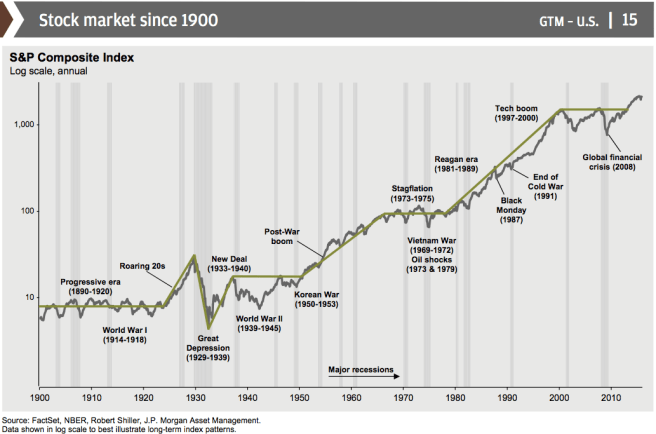
This isn’t to say you shouldn’t read or listen to investment podcasts to broaden your knowledge. Just don’t let yourself be swayed from your long term goals by sensational headlines. I know people who have been following doom and gloom commentators far too closely since the 2008 crisis, and have completely missed the 10 year bull run in equities. Keep in mind what the stock market looks like over the long term:

Stock Market Since 1900

Much like other types of news, focus on a few key things and shut off the rest of the noise for a less stressful life.

If you are looking to go a little deeper, this article provides a simple guide to 16 major leading and lagging economic indicators which are worth keeping tabs on.

*If you really want to know what an inverted yield curve is, there’s an explanation here.

Disclaimer: This should go without saying, but the information contained in this blog is not investment advice, or an incentive to invest, and should not be considered as such. This is for information only.

Investment Fees – Am I Paying Too Much?

flying-2891745_640

I came across an interesting article this week – see here. JP Morgan are launching a US Equity ETF with a fee of just 0.02%. That makes it the lowest fee ETF available at the moment, beating Vanguard, Schwab, and iShares on cost.

This is great news for long term investors, as long as they make money. Now why wouldn’t they make money with a fee of only 0.02% you ask? With the rise of ETFs, there’s a lot of talk these days about how much investors are paying. Fund managers and financial advisers are frequently criticised for charging too much.

But here’s the thing: it doesn’t matter how cheap your investment is if you buy it when the market is doing well and then sell it during a downturn. You are going to lose money!

Here are a couple of excerpts from Tony Robbins’ “Money Master the Game” book:

For the 20 year period from December 31,1993, to December 31 2013, the S&P returned 9.2% annually. However the average mutual fund investor averaged just over 2.5%, barely beating inflation. They would have been better off in US Treasuries.

Another fascinating example is that of the Fidelity Magellan mutual fund. The fund was managed by Peter Lynch, who delivered an astonishing 29% average annual return between 1977 and 1990. However Fidelity found that the average Magellan investor actually lost money over the same time period. How can that be? Well, quite simply, they bought and sold the fund at the wrong time!

So what can we learn from this? Simply that if you focus too hard on fees, be careful not to lose sight of the big picture. If you are prone to making emotional investment decisions when markets are swaying, maybe it’s worth paying for a good adviser who can help you make sound decisions?

If you are able to buy that JP Morgan ETF, hold it forever, and add to it when markets are bleeding, then good for you! You are going to be very happy with the result over the long run.

If watching your investment value go up and down makes you nervous, maybe you are better off paying for a diversified managed fund with a blend of asset classes that is adjusted tactically by the manager. Then you don’t have to worry about buying and selling at the wrong time.

I guess what I am saying is; if you are a disciplined investor you should absolutely be conscious of fees, and minimise them where possible for best results. If discipline is an issue for you, or you simply don’t have the time, it may be worth paying for some help.

Disclaimer: This should go without saying, but the information contained in this blog is not investment advice, or an incentive to invest, and should not be considered as such. This is for information only.
Japan Inflation Watch

yen-1995422_640

It’s been a long time coming… 27 years in the case of a well known soft drinks company. Japan’s top Coca-Cola distributor recently announced that they will be increasing prices by between 6% and 10% as soon as April this year. (article here) They are certainly not the only ones, as spring will see price increases in many of your favourite restaurants, as well as on specific foods such as instant ramen, canned mackerel and even ice cream! Coupled with the planned October increase in sales tax from 8-10% this means that your yen isn’t going to go as far as it has for the last three decades.

This will come as a shock to the Japanese public and long-time Japan residents. We’ve all got used to the size of food and drink portions getting incrementally smaller, so called “shrinkflation”, but it’s really quite a jolt to see the actual price of things going up. Even my barber is raising his prices from next month!

What is this going to mean for us all financially? Well, put simply, the massive debt bubble created by the Bank of Japan means we are unlikely to see a rise in interest rates any time soon. So, money languishing in our Japanese bank accounts is going to be losing spending power. I have talked about base currency over and over, but it still bears repeating: If you are planning to spend the money you make in Japan in the UK, then UK inflation is your minimum benchmark for investments. Holding cash in JPY at zero interest in this case means you are not only losing spending power in your base currency, but taking currency risk as well. Up until now, if you were planning to spend the money in Japan, then holding JPY cash was both safe, and good enough to at least preserve your spending power. Regardless of what government inflation statistics might say, this is clearly no longer the case.

So what action should Japan residents be taking here? Here are a few things you can do:

  1. Review your base currency / currencies – if you are saving to pay for your kids education overseas, or your retirement abroad, you should be saving and investing in the currency you are planning to spend the money in. JPY cash is not the place to be.
  2. That said, if you live and work in Japan, your emergency cash reserve should be in JPY. (unless losing your job would mean leaving Japan immediately)
  3. If you have a future need for JPY as a base currency, you are going to lose spending power in JPY cash / bonds – this means you will have to take some risk with some of your money.
  4. One way to do this would be to look for dividend paying stocks / ETFs. Here is an interesting list of dividend paying ETFs in Japan. Google translate does a pretty good job on this. Remember that you should be looking at the Japan stocks / REITS – anything that invests in overseas assets, like emerging market bonds, carry currency risk that could wipe out your actual return.
  5. You could also consider a diversified Japan fund manager. I invest part of my NISA in Rheos Hifumi Plus, which is one of the most popular NISA investment funds in Japan. (this is not a sales pitch – just what I do)

I hope this helps. Please do get in touch with any interesting price increases you notice here in Japan.

Disclaimer: This should go without saying, but the information contained in this blog is not investment advice, or an incentive to invest, and should not be considered as such. This is for information only.