Core vs Satellite

satellite-1030779_640.jpg

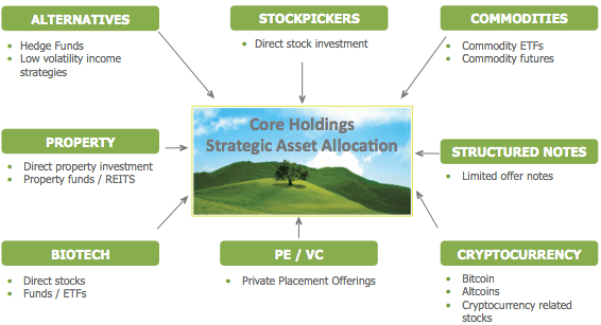
So, you have completed your financial profile, worked out your base currency and risk profile, and committed to a strategic asset allocation that fits. You should be feeling pretty good about your investments. However, isn’t this all a little bit…boring? You just read that gold mining stocks are about to go on a tear, or your friend showed you a cool biotech fund you want to get into, or how about cryptocurrency? There are always going to be some more exciting investments out there with potentially big returns, but where do they fit into your strategic asset allocation? The answer is, they don’t!

Firstly, you should be very careful investing in “the next big thing”. Often, by the time you hear about a cool new opportunity from your friend at the bar, the smart money has already been invested for some time and is looking for suckers coming in late to sell to. Having said that, at any given time there may be really exciting long term investment opportunities for people willing to tolerate some extra risk. They are just a little “niche”.

Screen Shot 2017-06-27 at 8.40.59 AM.png

This is where you need to understand the concept of a core/satellite approach. Simply put, the core of your assets, that is 80-90% of your investments, should be in your strategic asset allocation. This is serious money that you are planning to spend later on important things like your kid’s education and your retirement. If you really want to invest in platinum, or alternative energy, or bitcoin then this should be considered a “satellite” holding. It’s perfectly ok to allocate 5% of your investments to something more speculative, just don’t go all in! Over time we will look at some potential satellite holdings that you may want to consider.


Strategic Asset Allocations

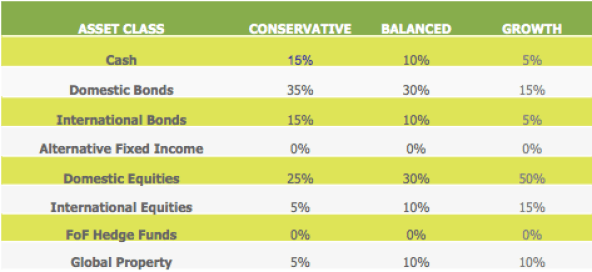
So what might an actual strategic asset allocation look like? This depends entirely on who you ask at any given time, but it’s good to have a general idea. Below are three examples for risk profiles Conservative, Balanced and Growth:

Screen Shot 2017-06-25 at 8.34.02 AM

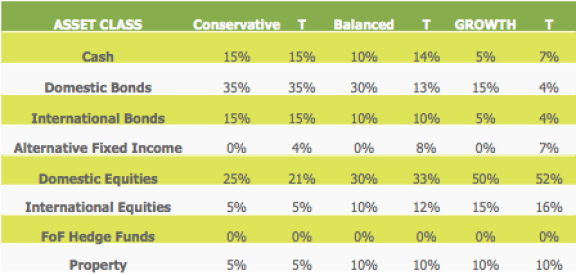
Note how a conservative investor has a heavier weighting to cash and bonds, whereas a growth investor has a heavier weighting to equities. These are by no means set in stone and may vary from year to year, but they are not going to vary from month to month – if you are changing the allocation that often then you are behaving tactically. Professional investors do this as a matter of course: Their strategic weighting to domestic bonds may be 15%, but if they are currently negative on bonds for a particular reason, they may adjust this tactically back to 10% for a period. However, when they rebalance at the end of the year they will rebalance back to the original strategic weighting of 15%.

Here’s what a strategic asset allocation may look like with a “tactical overlay” (T) – a temporary adjustment for tactical reasons:

Screen Shot 2017-06-25 at 8.59.41 AM

Please note that these are not investment recommendations, they are simply examples to show you what certain asset allocations may look like. If this level of detail is a little overwhelming, don’t worry. We will look at ways to simplify this in future posts.

Buy Low, Sell High!

dollar-790903_640

I’m sure you have heard the mantra “buy low, sell high”. That’s because it is the number one objective of investing. But how do you actually go about this in a fast changing world without constantly having to watch the markets? The answer is more straightforward than you might think:

Let’s keep this really simple – say you have a portfolio that is 60% in stocks and 40% in bonds. (of course your portfolio will be much better diversified than this but we’re going for simple here!) Over the course of a year the stock market soars and the bonds stay about the same. You’ve had a really good year in your stocks. In fact, they’ve done so well that the balance of your portfolio has changed to 70% stocks and 30% bonds. Now, you haven’t changed anything yourself. It’s just that one of your asset classes has increased in value and therefore in weight.

Then the next year, guess what? The stock market continues to do well! Your bonds stay about the same and the stocks have such a great year that the value of your investment goes up significantly. And you go out and celebrate! Your asset allocation is working perfectly!

What you haven’t noticed is that now your portfolio is 80% stocks and only 20% bonds. And what happens the next year? Yes, you guessed it – the stock market crashes, you are over-exposed to it, and all those gains are wiped out…you failed in your attempt to buy low and sell high.

So how can this be averted? Simply, by rebalancing. At the end of the first year you automatically sell some of your stocks (selling high what you bought low) and buy bonds, restoring your asset allocation to 60/40. At the end of year two you do the same.

Then year three comes and the stock market goes down, but the 40% you have in bonds is there to protect you. In fact, it’s quite likely that bonds do well that year. So in that case, at the end of the year, you will sell the some of the bonds (high) and invest back into stocks (low). That’s it!

So, once you have understood your risk profile, and diversified into a blend of assets weighted to match that profile, the last thing to do is make sure you rebalance on a regular basis so the weightings don’t get out of whack.

Rebalancing annually is how you automatically buy low and sell high, without stressing yourself about the direction of the market.


Regular vs Lump Sum investing

achievement-18134_640

When talking about asset allocation, I mentioned that your strategy will need to be different depending on whether you are investing a small amount on a regular basis, or a lump sum at one time.

I would consider these two different types of money. Regular comes from your surplus over expenditure every month. It doesn’t drain your bank account. In fact, the maximum you should contribute to long term regular investments every month should be 50% of your monthly surplus. That way you don’t suddenly find yourself with cash flow trouble when a big bill comes in. Lump sum is money over and above your emergency cash reserve that you have accumulated in the bank. When you look at your asset weighting and find that you are overweight in cash, you might decide to make a lump sum investment into medium term assets in order to correct the overall weighting.

Now if you are going to invest $50,000 tomorrow, you will probably want to be very careful about your asset allocation, particularly if you have a low appetite for risk. If you invest all this money into equities, then a sudden correction or prolonged bear market could have a major effect on your capital. You would want to make sure you were diversified across a broad range of asset classes to protect the downside.

However, if you are starting a long term savings scheme for your retirement and investing $500 a month, then equity market volatility can be your friend. I’m sure by now you have heard the term Dollar Cost Averaging? If not, then take a look at this Investopedia article, which has a great video explaining how it works. A regular investment plan like this can be broken down into three stages:

  1. Capital accumulation – here’s where you take advantage of the averaging effect of buying shares every month. At this stage you can allocate 100% to equities.
  2. Diversified – at some point, when you have build up a weight of capital in the investment, and when current stock prices are higher than the average price you paid for them, you should diversify into an allocation that fits your strategic risk profile. There’s no fixed time frame for doing this. You need to review annually yourself or with your adviser, and when you feel you have built up enough capital that it has become a lump sum in itself, diversify across other assets.
  3. Pre-retirement – this doesn’t have to be about retirement necessarily, but when you get close to using the money you will need to switch to a more tactical allocation to preserve capital. This is typically in the last 1-3 years. During the crash in 2008, many people’s retirement accounts were hit because they were still in a growth focussed asset allocation – no problem for a young person but a disaster for someone about to retire and start spending the money.

I sometimes hear the term “set and forget” for long term investments, however you should be careful about this. Even a small monthly savings plan needs to be reviewed at least once a year to check if it’s time to move into the next allocation phase. Lump sum investments also need to be rebalanced regularly, and we will cover rebalancing shortly.


What’s your risk profile?

risk-1945683_640

We know already that asset allocation is the most important investment decision you will make. So how to decide what percentage of your money should be allocated to which assets? One factor is your stage in life: Young people have time on their side and are looking to grow their money over that time. Someone nearing retirement may no longer be looking for capital growth – they are going to need income from their investments and a significant drop in value would be damaging.

Another thing to consider is your risk tolerance. This can vary wildly from one person to another, even within your family, and it’s important to understand what level of risk you are able to bear.

The first part is to determine your investor experience. This can be summed up fairly simply:

Inexperienced Investor: You have invested in a limited range of asset classes for a period of less than four years and/or your investment knowledge is low or poor. However, you do understand that prices of securities may go up as well as down.

Experienced Investor: You have invested in various asset classes for a period of more than four years and have experienced volatility. Your investment knowledge is good and you acknowledge investment risk.

Professional Investor: You frequently trade various asset classes and have done so for more than four years. As an individual you have in excess of US$1.1 million of ‘investible’ assets and have extensive investment knowledge.

So what really separates an experienced investor from an inexperienced investor? The key term here is that you have “experienced volatility”. Simply put, if you have invested in a variety of assets for four years or more then you will have lost money somewhere!

The next part is to determine your risk tolerance. If you search online you will find numerous risk profiling questionnaires. Try one or two and see what results you get. For reference, here is a typical one from HSBC, and here is a more fun one from Rutgers.

Typically risk profiles are divided into two major categories:

  • Strategic – for long term planning,
  • Tactical – either aggressive trading, or focussed on a specific life stage such as pre-retirement, post retirement, or income generating

We won’t get into the tactical profiles today, suffice to say that needs can change with major life events. If you are retired then long term capital growth is less of a concern and your focus is likely to be on capital preservation and generating income.

Strategic Profiles:

  • Conservative – investors primarily interested in income and modest growth potential. The allocation is relatively defensive but has a modest exposure to growth assets. Looking for income and capital growth from investments.
  • Balanced – investors with some time until retirement. The allocation invests in

    a much broader range of assets than a typical balanced fund, which will result in lower potential for capital loss whilst at the same time offering growth potential. Looking for income and growth from investments, but more focussed on growth.

  • Growth – investors who have a longer investment time horizon, primarily interested in capital growth, and are comfortable with modest short-term capital losses. The allocation is biased towards growth assets, but still invests in a broader range of assets than a typical growth fund.
  • Alpha – investors who wish to adopt an aggressive approach, with the sole aim of long-term capital growth. Medium-term losses should be expected. The allocation is almost entirely biased towards equities and other growth assets.

The names and definitions of the strategic profiles may differ depending on who you ask. Alpha may be called adventurous, for example. The important thing is to start to understand where you fit in on the risk scale so you can plan your asset allocation accordingly.

Asset Allocation – an introduction

financing-2379784_640

It’s quite likely that you have heard the term Asset Allocation. It may mean different things to different people, so I will try to give you an overview of where the term comes from and what I mean when I refer to it.

First some history: The pioneer of asset allocation was Harry Markowitz. As early as 1952 he was writing on diversification, efficient frontiers, and modern portfolio theory. Understanding Markowitz is about recognising that most investor’s requirements revolve around obtaining reasonable investment returns without excessive volatility (risk). In other words, it’s not about high returns, it’s about blending different asset classes to produce average to good results at lower risk.

Since Markowitz, further studies have concluded that asset allocation constitutes the most important step in portfolio construction, accounting for more than 90% of the variability in portfolio performance over time. (G.P. Brinson, B.D.Singer, G.L. Bebower, “Determinants of Portfolio Performance II: An Update”, Financial Analyst Journal, May-June 1991)

Another interesting person to read up on is the psychologist Daniel Kahneman, who won the 2002 Nobel Memorial Prize in Economic Sciences for his work on the psychology of judgement and decision making. Most importantly, Kahneman points out that individuals are more depressed with investment losses than they are satisfied with equivalent returns. In other words, people hate losing money more than they like making money. Which brings us back to Markowitz’s theory that, although people might think they want high returns, what they really want is reasonable returns with the minimum amount of risk possible.

If we were to put Markowitz’s work into a diagram, it would look something like this:

Screen Shot 2017-06-12 at 3.57.28 PM

We can refer to the return on cash as the “risk free rate”. This will, of course, vary depending on your base currency. If you take all of your money out of the bank and put it into private equity, there is a chance of very high returns, but the risk will quite literally go off the chart. However, if you diversify through cash, bonds, base currency stocks, overseas / emerging stocks, property and alternatives, you will find that the risk increases, but not by a huge amount. This means it is possible to put a little of your money into more racy investments without massively increasing your overall risk.

The actual weighting you should allocate to each asset class will depend on your attitude to risk, which we will consider in a later post. It will also differ for regular monthly investments vs lump sum investments. For now it’s enough to know that this “strategic asset allocation” is used to form the core of an investment portfolio, allowing you the peace of mind to get on with more important things!

Active vs Passive Investment

MW-EL069_buffet_20160425110104_mg

You may remember we talked a little about trade-offs already. Well another investment trade off is active vs passive strategy. This is a trade-off we are hearing more and more about these days. Fifteen years ago, almost nobody was talking about index funds and Exchange Traded Funds (ETFs). You would either buy stocks and bonds directly; or you would buy a mutual fund, run by a manager who was benchmarked against “the market”. Hedge funds were only just becoming accessible to regular investors, rather than being for sophisticated or high net worth investors only.

You may have heard about a bet that Warren Buffet made almost 10 years ago: He bet that a passive investment in the S&P 500 index would beat any given portfolio of hedge fund strategies over a 10 year period ending December 31st 2017. The only takers were an alternative investment specialist firm called Protege Partners LLC, and there is a million dollars riding on it to go to the winner’s charity of choice.

So how’s it going? Well, in truth it’s not even close. Despite starting the bet before the 2008 financial crisis the S&P 500 is sitting on a return of 85.4%. (7.41% p.a.) The hedge funds average is 22%. (2.2% p.a.)

So what can we learn from this? Well here are a few lessons:

  • It’s time in the market that matters, not timing the market.
  • Fees really matter – the hedge funds have performed ok, and with lower volatility. But an annual fixed fee and 20% performance fees are going to eat into investor returns.
  • You have to hang in there! Think back to 2008 – the housing crisis, Lehman Brothers goes down, the stock market plunges, it feels like the end of the world…and you just invested a chunk of your savings in the S&P 500! Be honest here, would you have sat on that bet and waited? It’s easy to say yes with hindsight, but an awful lot of people sold investments at the bottom of the market, when despair was at its highest, and then sat out in fear and missed the big rebound.

So does this bet settle the active vs passive investment debate? Well, not exactly. Hedge funds vs the S&P 500 is not really a good comparison. If, however,  it was US large-cap mutual fund managers vs the index, then we would be comparing apples with apples. According to this article, 66% of large-cap managers failed to beat the index in 2016, and if you lengthen the time period, the numbers just get worse. And out of the managers who do beat the index over a three year period, only about 5% go on to beat the index over the next three years. So we can conclude that it’s very hard to beat the market.

So does this mean we should just lump all of our money into an equity index fund?Although there are worse things you could do, it’s not a very balanced approach. Getting a diversified blend of different asset types, and rebalancing this blend over time, can help smooth out returns, lower risk, and make it easier to sleep at night when the stock market takes one of its downturns. We will look at this in more detail in future posts.


So what returns should I expect?


Ok, we have covered the different asset classes, and we have understood that the basic minimum benchmark is inflation in our base currency. So how are these assets likely to behave over time relative to that benchmark? Well three of the asset classes are correlated to inflation and to each other, so although we can’t predict exactly, we have a pretty good idea what they will do over time in a particular base currency:

CBE

Take a look at the diagram above. It shows a rise in the cost of goods and services (inflation) over time. The first thing to note is that in the short term we really have no idea which asset will perform the best. We do know that cash will at least hold it’s value. Stocks, on the other hand, could rise or fall significantly. So, if you have a pile of money and are planning to do something important with it in the next 12 months, like make a down-payment on a house, you would be ill-advised to invest this money in the stock market. It might go down 30%! Therefore money for short term needs should stay in the bank.

Over the longer term, you won’t make money in cash. As you can see, cash tracks inflation to preserve your spending power, but it won’t increase it. If inflation is 2%, you might earn 2.5% in the bank. In Japan, where inflation is near zero, interest on a cash deposit is also very near zero. So if you want to make money over the long term, you have to take some risk.

One way you could take some more risk is by lending money to the government. The price of bonds may fluctuate over time, but in order to attract investment, bonds will pay a better return than cash. Note here that all bonds are not the same. A Japanese government bond may pay low interest, but there is little chance of default. A Venezuelan government bond may pay outstanding interest (10.43% p.a. on a 10 year issue at the time of writing), but there is a greater risk you won’t get your money back at the end of the term. Likewise corporate bonds carry higher risk than bonds issued by solid governments.

If you are looking for still higher returns, then it’s time to invest in the stock market. Although stocks are unpredictable in the short term, historically they outperform over a long period of time. This is because over time the economy and population tend to grow, and workers become more productive. This economic ground swell makes businesses more profitable, which drives up stock prices.

Although the other asset classes are uncorrelated and less easy to chart here, they can add valuable diversification. In building your own investment strategy there are a few things you need to take into account here:

The first is your base currency. The second is your time frame, which may vary from one investment objective to another. And the third is how you feel about the ups and downs in each of these asset classes, otherwise know as your attitude to risk. The better you understand the behaviour of different investments over time, the more you may find you are comfortable taking risk on a certain portion of your capital.

Striking the right balance between the different asset classes and maintaining that balance over time is know as Asset Allocation, a subject we will cover in future posts.

Are my investments any good?

opposites-489521_640

How do you know if an investment you have made is doing well or not? How can you tell if it’s worth paying an investment manager rather than just buying an index fund? Is 8% per year a good return?


The simple answer to each of these questions is, it depends what you compare it to. You need to have something meaningful to measure an investment against in order to gauge how it is doing. This is known as benchmarking. Whether you realise it or not, you are probably already familiar with some benchmarks:

  • MSCI Global Index – covers global stocks
  • S&P 500 – covers US stocks
  • FTSE 100 – covers UK stocks
  • Nikkei 225 – covers Japan stocks
  • Citi World Government Bond Index – covers global bonds

So a mutual fund manager running a US Growth Stock fund might be benchmarked to the S&P 500 index. If he is underperforming the index, he is not worth paying fees to. If he is outperforming the index his fund will be popular. If he is getting a wildly different result to the index then he is doing something very strange and likely won’t keep his job for long!

So is 8% a good return? Well it partly depends on what your expectations are. The S&P 500 has returned, on average, 7.1% per year over the last 10 years, so 8% seems like a pretty good return. However, if your goal was to be aggressive and get a 20% return you might still be disappointed. In 2008 the S&P 500 fell by 37%. Even a 1% return that year would be nothing short of exceptional!

So how should the average investor benchmark their investments? I would say the basic minimum benchmark should be inflation in your base currency. Inflation is defined as the rise in the cost of goods and services over time, and is the reason we don’t just lock our money in a safe. Take a look at the table below showing the effect of inflation on $100:

Inflation erosion

We are currently living in a low-inflation environment, particularly if you live in Japan. However, if you look at the historical average, 3% is a good guide. So at 3% inflation, if you put your $100 under the mattress for 20 years you will still have $100, but it will only buy you $54.38 in goods and services. The spending power of your money has almost halved!

One thing I will stress here is that we are talking about inflation in your base currency. If you are living in Japan, but you are planning to retire in Australia, for example, don’t be fooled by the low inflation rate in Japan. Back home the current rate of inflation is 2.1% and rising. Keeping money in your Japanese bank account is not only a currency risk, but you are losing 2.1% per year in spending power!

Investment trade-offs

yin-and-yang-145874_640

There is no such thing as the perfect investment. They all come with advantages and disadvantages, or trade-offs.

One of the simplest explanations of these trade-offs I have heard goes as follows:

Any investment you make needs to balance three factors: low risk, high returns, and liquidity. You can have any two of these but not all three.

If you want high liquidity (easy access to the money) and low risk you are going to have to sacrifice high returns. Your money is going to be in something like a savings account.

If you want high liquidity and high returns you are going to have to take a lot of risk. This could mean an investment in stocks that could go down significantly in the short term.

If you want low risk and high returns, no-one is going to give you that unless they are able to keep your money for a long time. The best performing hedge funds and capital guaranteed products often have lock-ins, preventing investors from withdrawing their money for a fixed period.

Another trade off to consider is capital versus income. Some investments provide capital growth, but little or no income. Income generating investments may have lower prospects for capital growth. Before investing it’s important to understand which is best for you at your current stage in life.

One more trade-off to consider is absolute versus relative return. Absolute return is what an investment returned over a particular period. If a mutual fund returned 10% over the last 12 months is that a good return? Well, it depends on what the rest of the market returned. If the market returned 18%, then 10% is not particularly good. In fact in relative terms it’s a minus 8% return. Active fund managers are benchmarked in this way in order to gauge their performance. We will talk more about benchmarks starting tomorrow.