
Diversifying Through Crypto – How Digital Assets Could Change Your Retirement Plan

puzzle-1713181_640

Sticking with the theme of cryptocurrency this week, I came across this fascinating research paper  on the role that digital assets can play in asset allocation. While I recommend you read the report yourself, I appreciate that not everyone is enraptured by talk of efficient frontiers and Sharpe ratios, so I will attempt to summarise the main points of the paper into something more easily digestible.

First of all, here’s a post I wrote previously about asset allocation, which may be a good refresher. As noted there, modern portfolio theory is about diversification, specifically, blending various asset classes to produce good returns with the lowest possible risk. Over the long term it is possible to estimate the future behaviour of various asset classes and blend them to together to create an efficient frontier portfolio, whereby the return is optimized to the level of risk.
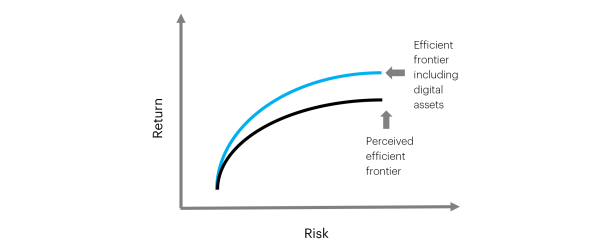
Efficient frontier
https://grayscale.co/a-new-frontier-research-paper/

What makes the development of a new digital asset class so interesting is the opportunity to add it into the mix and create an allocation that is more diversified than traditional portfolios. A well diversified portfolio contains a blend of assets which are not strongly correlated to each other. So the key to success is not necessarily finding better performing assets, but properly combining uncorrelated assets. In short, to widen the net and capture a better return without greatly increasing the risk.

The graphic below shows a simple simulation of how this could work. It takes a typical portfolio that is 60% global stocks and 40% global bonds, (Global 60/40) and shows how the performance and risk characteristics change by simply adding an allocation to bitcoin:
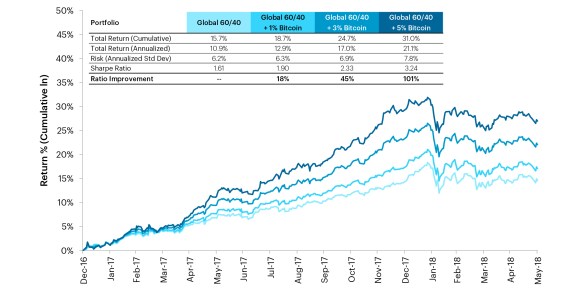
Figure 5
https://grayscale.co/a-new-frontier-research-paper/

As you can see, a 1% allocation to Bitcoin increases the return over the time period without greatly affecting the level of risk. A 5% allocation to bitcoin moves the risk needle a little more, but the cumulative return is almost double that of the Global 60/40.

This can then be taken a step further by adding a blend of digital assets rather than just bitcoin:
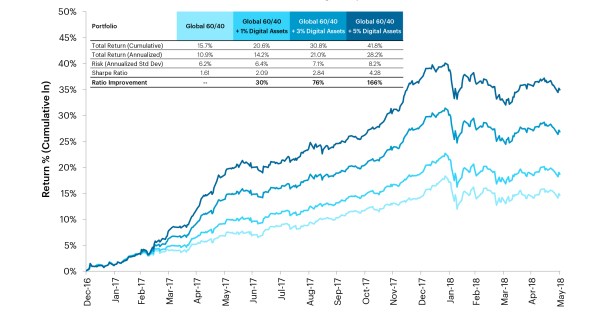
grayscale_fig8
https://grayscale.co/a-new-frontier-research-paper/

It seems that the extra diversification achieved through a range of digital assets has a significant positive impact on the risk/return profile of this portfolio. This can be attributed to the fact that although digital assets appear to go up and down together, they are not perfectly correlated.

I’m not going to get into Sharpe ratios in this post but you can get a definition here. From a financial planning perspective I do think it is worth a look at Figure 12 and Figure 13 in the paper, which give an interesting simulation of how someone saving for retirement could benefit from an allocation to digital assets over time:

grayscale_fig12
https://grayscale.co/a-new-frontier-research-paper/

Assuming $100,000 in starting capital and an annual contribution of $18,500, this gives us an idea of how adding a 5% allocation to a blend of digital assets to the Global 60/40 can affect risk/return results over time. Although the increase in annualised return is only 0.3% for a similar level of risk, the effect of compound interest over the years turns this into a meaningful dollar figure at the end:
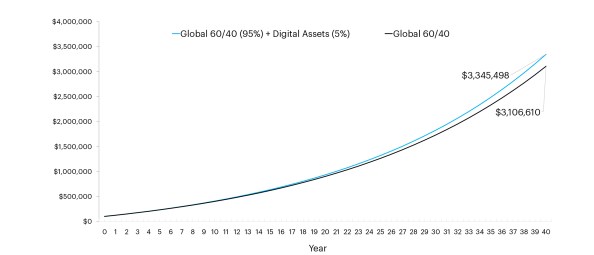
grayscale_fig13
https://grayscale.co/a-new-frontier-research-paper/

Now this is, of course, a simulation and there is no guarantee of achieving these returns over time, but it certainly makes for a compelling argument for allocating a small portion of long term investments to digital assets. Having said that, we are still some way from being able to click a button and add a 5% allocation to crypto to a retirement plan, which means investors currently have to figure out how to buy and store these assets safely themselves. However, there is already talk of bitcoin ETFs, and crypto funds that are accessible to retail investors are starting to appear. It looks like making an allocation to digital assets as part of your long term investment strategy is about to get easier.

Disclaimer: This should go without saying, but the information contained in this blog is not investment advice, or an incentive to invest, and should not be considered as such. This is for information only.

Don’t Panic!

Stocks Sink

It’s already been an eventful year for the markets, but waking up this morning I must say I did a double take at the stocks app on my phone. The S&P 500 Index was down 3.3% overnight, with the fall being led by the popular tech stocks. The NASDAQ was down 4.4%.

The stock app also offered up this article, which  is a quick but worthwhile read at a time like this. There’s some simple advice in here for individual investors:

  • Don’t panic.
  • Wait a few days for things to settle.
  • Make sure you know yourself and don’t be aggressive with money you are planning to spend in the near future.

Makes sense right? While this may not necessarily be the start of the grand reckoning that many are expecting, there are going to be more days like this, so it’s best to be prepared.

Here are a few things I would add:

  • Diversify – should you really be 100% in stocks? Are you prepared to ride out the storm for as long as it takes? A well diversified asset allocation will not capture all of the upside in the good times, but it also won’t absorb all of the downside when things go south.
  • Don’t try to time the market – the pros get this wrong, so what chance do we have? You are right to be buying after a significant drop in prices, but you don’t have to do it all at once. Add a little and then wait a few days.
  • Knowing yourself means knowing your base currency, your risk profile and your time horizon.
  • There is more to come -The Cboe Volatility Index rose past 20 for the first time since April. The US Federal Reserve is walking a tightrope trying to return rates to normal in order to avoid the economy overheating, whilst trying not to upset the stock market. The Bank of Japan can not even hint at “tapering” or reducing bond purchases without setting off an avalanche.

It’s likely to be a rough day for Asian stocks today. Be prepared, stick to your long term plan and don’t panic!

Update to this post, 12th October 2018: Ray Dalio says it better than me in this 5 minute interview, but the message is the same – stick to strategic asset allocation and don’t try to trade and time markets.

Disclaimer: This should go without saying, but the information contained in this blog is not investment advice, or an incentive to invest, and should not be considered as such. This is for information only.

50 Cent and the Art of Being Wrong


IMG_2934

I’m sure you noticed that last week saw a sudden return to volatility in markets. As discussed in our 2018 Investment Outlook, this kind of correction was long overdue. The one thing we didn’t know for sure was when it would happen.

Which leads us to a major lesson in investing, taught this week by 50 Cent. (well not that 50 Cent…)

Nomura apologizes to investors burned in bet against “fear index”

The mysterious trader nicknamed ’50 Cent’ made $200 million last week as the market blew up

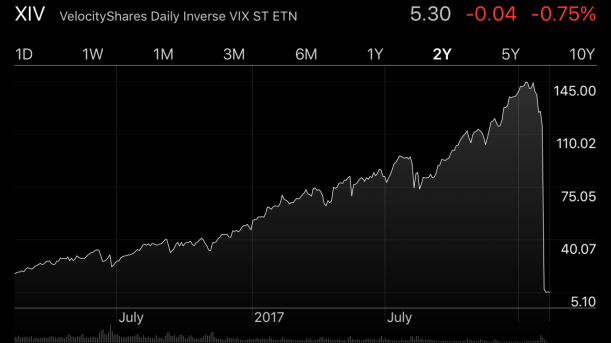
The articles above show two sides to the same trade. After a long period of almost no volatility in the stock market, Nomura managed to convince investors that the status-quo would continue. The chart above, plotting the inverse of the VIX volatility index, essentially shows what happened to those investors last week.

Meanwhile, the trader nicknamed “50 Cent” spent the last 12 months being expensively wrong on his bet on a (let’s face it, inevitable) return to volatility. Wrong that is, until he was right and made a profit of some $200 million.

The lesson here, of course, is that when things are good (stocks hitting all-time highs and volatility low), it’s easy to get caught up in the fervor and keep buying. It’s much harder to realise that things can’t go on this way forever, but not know exactly when they will come to an end. You will note that “50 Cent” did not make this bet a month ago. He started acquiring large amounts of call options over a year ago. He didn’t know when he would be right, he just knew he would be.

Now this is a financial planning blog not a trading blog, but the lesson is still valuable. Those Nomura clients aren’t professional traders, they are regular people. It’s likely that many of them did not realise how much risk they were taking. However, if stocks are at all time highs, you probably shouldn’t be betting the farm that they will keep going higher. If another asset class has underperformed for the last few years, that doesn’t mean you should write it off forever.

It takes a mixture of common sense and courage to go against the crowd, especially if it means you might be wrong for a while.

Disclaimer: This should go without saying, but the information contained in this blog is not investment advice, or an incentive to invest, and should not be considered as such. This is for information only.

How to Buy Gold

gold-163519_640

On August 10th Bridgewater Associates founder Ray Dalio wrote a LinkedIn blog post suggesting investors should have 5-10% of their portfolio in gold due to a rise in risk in global markets. He also put his money where his mouth is as his fund took a new position in two gold ETFs. This is not a new recommendation from Dalio, whose All-Weather strategy has included a 7.5% allocation to gold for some time. As I’m writing this, gold is up 16% year to date at $1340 per ounce.

So if you wanted to follow Mr. Dalio’s advice, how would you go about it? Here are a few simple ways you can allocate to gold:

  1. Buy physical gold – probably the most exciting way to own gold is to buy the stuff itself and take it home. Obviously it’s not advisable to have large amounts of gold sitting around in your spare room, but for smaller amounts a decent safe is probably enough security. If you live in Japan you can buy gold on the high street from Tanaka Kikinzoku. Their English page is not so detailed, but it does have up to date price information.
  2. If you are planning on buying larger amounts you may want to use a service like Goldmoney where you can both purchase and securely store your gold for a fee.
  3. Buy a gold ETF – if you have a brokerage or platform account that gives you access to ETFs, this is the simplest way to get exposure to gold. SPDR Gold Shares (GLD) and iShares Gold Trust (IAU) are two well known gold ETFs. There are also a number of gold funds out there that buy and store the physical metal – just make sure you are buying a gold bullion fund, rather than a gold (miners) stock fund, as they will not necessarily produce the same results.

If you are thinking of adding gold to your overall asset allocation I hope this helps. I would be happy to hear from anyone who has found other convenient ways of investing in gold or other precious metals.

Disclaimer: This should go without saying, but the information contained in this blog is not investment advice, or an incentive to invest, and should not be considered as such. This is for information only.


Asset Allocation for All Seasons

beach-84631_640

Welcome back – I hope you had a great summer! It’s hard to believe it’s already almost September. The last four months of the year can be a busy time for investors. Many people have committed to targets earlier in the year, maybe in their New Year’s resolutions, for how much money they will put away or invest during the year, and suddenly the last quarter is looming. We all know that December is pretty much a write-off as you get busy preparing for Christmas and end of year holidays, so there are only really three months left to take action.

It’s been a pretty eventful year, not to mention a volatile summer. At one point in August the VIX Index, otherwise known as the fear index, surged by 62% in three days. (Bloomberg) A person with money to invest right now is looking at a constant stream of rather off-putting news: North Korea, terrorist attacks, protests in the US, Brexit, oil prices slumping again, not to mention central banks mulling major monetary policy decisions. So how on earth do you choose investments at a time like this?

Once again we need to go back to basics and build a core portfolio that can withstand the risks a fast changing world can throw at it. A lot of people already get the concept of spreading their risk around, not having all their eggs in one basket, but are perhaps unsure of exactly how to achieve this. Today we will look at some advice from an expert.

Ray Dalio is the founder of Bridgewater Associates, the world’s largest hedge fund with some $150 billion in assets under management. Coincidentally, while I was drafting this post, I found this article in the Financial Times quoting the man himself on a rise in risk in the current climate. Needless to say, his opinion is highly sought after.

Tony Robbins interviewed Dalio for his book MONEY Master the Game: 7 Simple Steps to Financial Freedom and asked him how regular investors should organise their portfolios. His advice is both simple, and easily implemented:

According to Dalio there are four things that move the price of assets:

  1. Inflation
  2. Deflation
  3. Higher than expected economic growth
  4. Lower than expected economic growth

Also, there are only four economic environments, or seasons, that will affect asset prices:

  1. Higher than expected inflation (rising prices)
  2. Lower than expected inflation (deflation)
  3. Higher than expected economic growth
  4. Lower than expected economic growth

Unlike the four seasons we associate with nature, these seasons do not necessarily come in order, and it is difficult to predict how long a season will last. Each asset class will fair differently depending on the prevailing season. Therefore Dalio says we should have 25% of our risk in each of the categories. His strategy is known as All Weather, and ensures the portfolio is covered, regardless of what season comes next.

Dalio breaks down which assets will perform well in each of these seasons:

  1. Higher than expected inflation – commodities / gold, inflation linked bonds
  2. Lower than expected inflation – government bonds, stocks
  3. Higher than expected economic growth – stocks, corporate bonds, commodities / gold
  4. Lower than expected economic growth – government bonds, inflation linked bonds

Tony Robbins persuaded Dalio to simplify this into an asset allocation that individual investors can follow. It’s called the All Seasons strategy and it looks like this:

  • 30% stocks
  • 15% intermediate term bonds (7-10 year)
  • 40% long term bonds (20-25 year)
  • 7.5% gold
  • 7.5% commodities

This portfolio could easily be constructed with a low cost portfolio of ETFs, as suggested in this article. (a year old but see the ETFs listed in the middle of the article)

Many people are surprised by the high allocation to bonds, but Dalio points out that stocks are three times more volatile than bonds, therefore the damage they can do in the wrong environment needs to be controlled. Most investors have their asset allocation set up to do well in a good market, but very badly in a bad market.

He also points out the importance of rebalancing annually so you do not get out of balance when one segment does particularly well. I would also stress, for the international investor, the importance of establishing your base currency to control currency risk over time.

So, if you are looking to add to your investments over the coming months, make sure you are considering your asset allocation carefully and set yourself up to thrive in all four seasons.

Disclaimer: This should go without saying, but the information contained in this blog is not investment advice, or an incentive to invest, and should not be considered as such. This is for information only.

Core vs Satellite

satellite-1030779_640.jpg

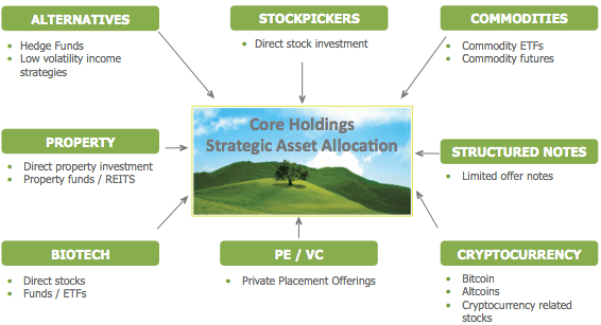
So, you have completed your financial profile, worked out your base currency and risk profile, and committed to a strategic asset allocation that fits. You should be feeling pretty good about your investments. However, isn’t this all a little bit…boring? You just read that gold mining stocks are about to go on a tear, or your friend showed you a cool biotech fund you want to get into, or how about cryptocurrency? There are always going to be some more exciting investments out there with potentially big returns, but where do they fit into your strategic asset allocation? The answer is, they don’t!

Firstly, you should be very careful investing in “the next big thing”. Often, by the time you hear about a cool new opportunity from your friend at the bar, the smart money has already been invested for some time and is looking for suckers coming in late to sell to. Having said that, at any given time there may be really exciting long term investment opportunities for people willing to tolerate some extra risk. They are just a little “niche”.

Screen Shot 2017-06-27 at 8.40.59 AM.png

This is where you need to understand the concept of a core/satellite approach. Simply put, the core of your assets, that is 80-90% of your investments, should be in your strategic asset allocation. This is serious money that you are planning to spend later on important things like your kid’s education and your retirement. If you really want to invest in platinum, or alternative energy, or bitcoin then this should be considered a “satellite” holding. It’s perfectly ok to allocate 5% of your investments to something more speculative, just don’t go all in! Over time we will look at some potential satellite holdings that you may want to consider.


Strategic Asset Allocations

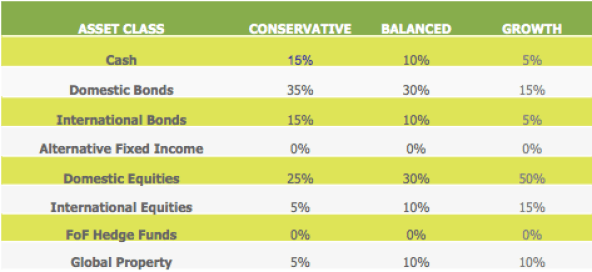
So what might an actual strategic asset allocation look like? This depends entirely on who you ask at any given time, but it’s good to have a general idea. Below are three examples for risk profiles Conservative, Balanced and Growth:

Screen Shot 2017-06-25 at 8.34.02 AM

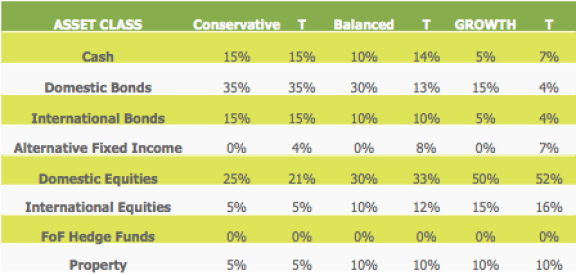
Note how a conservative investor has a heavier weighting to cash and bonds, whereas a growth investor has a heavier weighting to equities. These are by no means set in stone and may vary from year to year, but they are not going to vary from month to month – if you are changing the allocation that often then you are behaving tactically. Professional investors do this as a matter of course: Their strategic weighting to domestic bonds may be 15%, but if they are currently negative on bonds for a particular reason, they may adjust this tactically back to 10% for a period. However, when they rebalance at the end of the year they will rebalance back to the original strategic weighting of 15%.

Here’s what a strategic asset allocation may look like with a “tactical overlay” (T) – a temporary adjustment for tactical reasons:

Screen Shot 2017-06-25 at 8.59.41 AM

Please note that these are not investment recommendations, they are simply examples to show you what certain asset allocations may look like. If this level of detail is a little overwhelming, don’t worry. We will look at ways to simplify this in future posts.

Buy Low, Sell High!

dollar-790903_640

I’m sure you have heard the mantra “buy low, sell high”. That’s because it is the number one objective of investing. But how do you actually go about this in a fast changing world without constantly having to watch the markets? The answer is more straightforward than you might think:

Let’s keep this really simple – say you have a portfolio that is 60% in stocks and 40% in bonds. (of course your portfolio will be much better diversified than this but we’re going for simple here!) Over the course of a year the stock market soars and the bonds stay about the same. You’ve had a really good year in your stocks. In fact, they’ve done so well that the balance of your portfolio has changed to 70% stocks and 30% bonds. Now, you haven’t changed anything yourself. It’s just that one of your asset classes has increased in value and therefore in weight.

Then the next year, guess what? The stock market continues to do well! Your bonds stay about the same and the stocks have such a great year that the value of your investment goes up significantly. And you go out and celebrate! Your asset allocation is working perfectly!

What you haven’t noticed is that now your portfolio is 80% stocks and only 20% bonds. And what happens the next year? Yes, you guessed it – the stock market crashes, you are over-exposed to it, and all those gains are wiped out…you failed in your attempt to buy low and sell high.

So how can this be averted? Simply, by rebalancing. At the end of the first year you automatically sell some of your stocks (selling high what you bought low) and buy bonds, restoring your asset allocation to 60/40. At the end of year two you do the same.

Then year three comes and the stock market goes down, but the 40% you have in bonds is there to protect you. In fact, it’s quite likely that bonds do well that year. So in that case, at the end of the year, you will sell the some of the bonds (high) and invest back into stocks (low). That’s it!

So, once you have understood your risk profile, and diversified into a blend of assets weighted to match that profile, the last thing to do is make sure you rebalance on a regular basis so the weightings don’t get out of whack.

Rebalancing annually is how you automatically buy low and sell high, without stressing yourself about the direction of the market.


Asset Allocation – an introduction

financing-2379784_640

It’s quite likely that you have heard the term Asset Allocation. It may mean different things to different people, so I will try to give you an overview of where the term comes from and what I mean when I refer to it.

First some history: The pioneer of asset allocation was Harry Markowitz. As early as 1952 he was writing on diversification, efficient frontiers, and modern portfolio theory. Understanding Markowitz is about recognising that most investor’s requirements revolve around obtaining reasonable investment returns without excessive volatility (risk). In other words, it’s not about high returns, it’s about blending different asset classes to produce average to good results at lower risk.

Since Markowitz, further studies have concluded that asset allocation constitutes the most important step in portfolio construction, accounting for more than 90% of the variability in portfolio performance over time. (G.P. Brinson, B.D.Singer, G.L. Bebower, “Determinants of Portfolio Performance II: An Update”, Financial Analyst Journal, May-June 1991)

Another interesting person to read up on is the psychologist Daniel Kahneman, who won the 2002 Nobel Memorial Prize in Economic Sciences for his work on the psychology of judgement and decision making. Most importantly, Kahneman points out that individuals are more depressed with investment losses than they are satisfied with equivalent returns. In other words, people hate losing money more than they like making money. Which brings us back to Markowitz’s theory that, although people might think they want high returns, what they really want is reasonable returns with the minimum amount of risk possible.

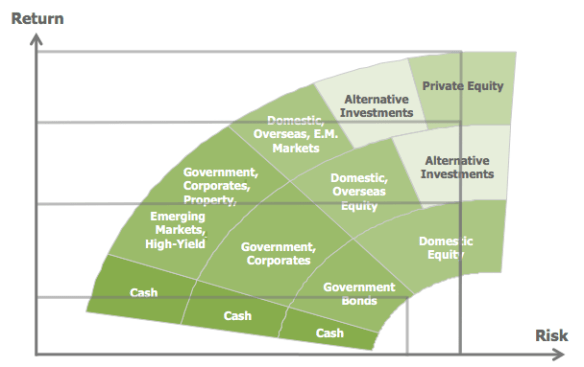
If we were to put Markowitz’s work into a diagram, it would look something like this:

Screen Shot 2017-06-12 at 3.57.28 PM

We can refer to the return on cash as the “risk free rate”. This will, of course, vary depending on your base currency. If you take all of your money out of the bank and put it into private equity, there is a chance of very high returns, but the risk will quite literally go off the chart. However, if you diversify through cash, bonds, base currency stocks, overseas / emerging stocks, property and alternatives, you will find that the risk increases, but not by a huge amount. This means it is possible to put a little of your money into more racy investments without massively increasing your overall risk.

The actual weighting you should allocate to each asset class will depend on your attitude to risk, which we will consider in a later post. It will also differ for regular monthly investments vs lump sum investments. For now it’s enough to know that this “strategic asset allocation” is used to form the core of an investment portfolio, allowing you the peace of mind to get on with more important things!